


Talitha
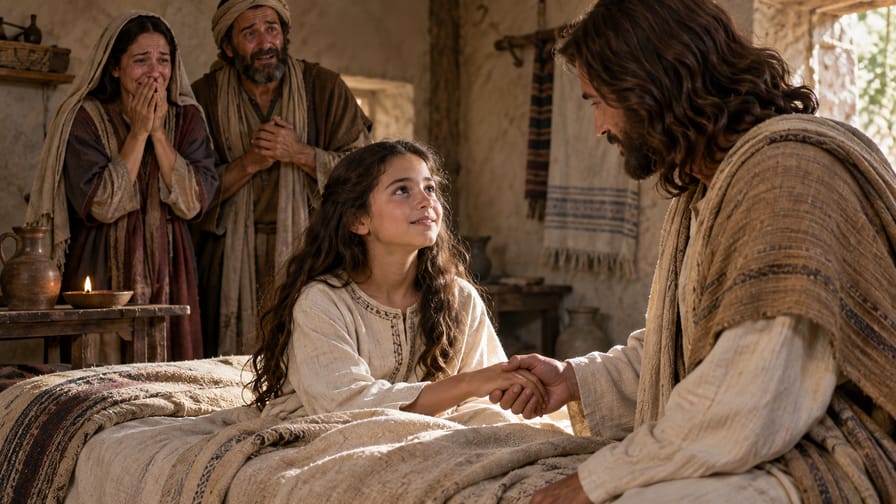
The figure of Talita, though briefly mentioned in the Synoptic Gospels, holds a place of profound theological significance in the biblical narrative. Her name, which has become synonymous with resurrection and new life, is inseparable from one of the most moving and instructive miracles performed by Jesus Christ. An analysis of her story and the context of her appearance reveals crucial truths about Christ's divine authority, the power of faith, and the hope of resurrection.
From an evangelical Protestant perspective, the narrative of Talita is a vivid testament to Jesus' sovereignty over death and a premonition of the eschatological victory over the last enemy. This entry will explore the onomastic meaning, historical context, role in the narrative, theological significance, and legacy of this girl who was brought back to life by the touch and word of the Messiah.
The depth of her meaning transcends the mere occurrence of a miracle. It points to the essence of the Gospel message: the restoration of life through divine intervention, offering a powerful illustration of spiritual and physical resurrection. The story of Talita serves as a cornerstone for understanding Christ's redemptive work and the promise of eternal life for those who believe.
1. Etymology and meaning of the name
The name Talita is not a proper name in the usual sense, but rather an affectionate Aramaic term, talitha (טַלְיְתָא), meaning "girl" or "young woman." The complete expression uttered by Jesus is Talitha cumi (טַלְיְתָא קוּמִי), which translates literally as "Little girl, get up!" This phrase is found in Mark 5:41, preserved in the Greek text of the New Testament, demonstrating the narrative's fidelity to the languages spoken in 1st-century Palestine.
The Greek transliteration from Aramaic for Talitha is ταλιθα (talitha), and for cumi is κουμ (koum). The etymological root of talitha is linked to the Aramaic noun ṭalyā (טַלְיָא), which means "young lamb" or "boy/girl." The feminine form with the suffix -tha is an affectionate diminutive, highlighting the tender age and innocence of the child.
The literal meaning of "girl" acquires a profound symbolism in the context of the miracle. Jesus' word is not merely a command, but an affirmation of life over death, directed at a child who still had her whole life ahead of her. The choice of this affectionate word underscores Jesus' tenderness and compassion towards the grieving family and the girl herself.
There are no other biblical characters explicitly named Talita, as mentioned, it is a form of address. However, the uniqueness of the expression and the event make her an iconic figure. The preservation of the Aramaic phrase in the Gospel of Mark is notable, suggesting its importance and authenticity to the early Christian community, which valued Jesus' exact words.
The theological significance of the name, or rather, the invocation, lies in the demonstration of the creative power of Christ's word. Just as God spoke and the world came into existence (Genesis 1:3), Jesus' word has the authority to reverse death. The command "get up" (cumi) is a divine imperative that transcends natural laws, manifesting Jesus' divinity and His dominion over life and death.
This word of resurrection prefigures the great resurrection of the last days and the spiritual resurrection that occurs in conversion. It is an illustration of the transforming power of God's voice, which calls into existence what does not exist and gives life to what is dead. The simplicity of the expression "Little girl, get up!" hides immense theological depth, revealing Jesus as the Lord of life.
2. Historical context and biblical narrative
The narrative of Talita is set during Jesus' ministry in Galilee, likely around 30-33 AD, during the height of His popularity and the beginning of growing opposition from religious authorities. The events are recorded in Mark 5:21-43, Matthew 9:18-26, and Luke 8:40-56. The setting is the region of Capernaum, an important city in Galilee and a center of Jesus' ministry.
The political context was one of Roman domination over Judea and Galilee, with Herod Antipas ruling as tetrarch of Galilee. Socially, Jewish society was stratified, with religious leaders like Talita's father, Jairus, a synagogue official, occupying positions of respect and influence. Jewish religion was central to the life of the people, and the synagogue was the heart of the community, both for worship and social life.
Talita's family is introduced through her father, Jairus, who is described as one of the synagogue leaders (Mark 5:22). His position indicates that he was a prominent and respected figure in his community. The girl was twelve years old (Mark 5:42), a significant age, as it marked the beginning of puberty and the transition to adulthood in Jewish culture, making the loss even more tragic.
The narrative chronology begins with Jairus approaching Jesus, pleading for his daughter who was on the verge of death. This act by a religious leader seeking help from Jesus, who was viewed with suspicion by many of his peers, demonstrates Jairus' despair and faith. Jesus agrees to go with him, and on the way, the miracle of healing the woman with a hemorrhage occurs, an interlude that highlights the faith and compassion of Jesus (Mark 5:25-34).
While Jesus was still speaking with the woman, messengers arrived from Jairus' house, informing him that the girl had died and there was no longer any need to trouble the Teacher (Mark 5:35). At this point, Jesus encourages Jairus with the words: “Do not fear, only believe” (Mark 5:36). This exhortation to faith is a crucial point in the narrative, underscoring the importance of trust in God even in the face of death.
Upon arriving at Jairus' house, Jesus finds a scene of intense mourning and weeping, with professional mourners (Mark 5:38). Jesus rebukes the commotion, stating: “The child is not dead but asleep” (Mark 5:39), which provokes the scorn of those present. This declaration does not deny the reality of physical death, but reinterprets it from a divine perspective, where death, to God, is a temporary sleep, awaiting awakening.
Jesus then enters the girl's room, taking with Him only Peter, James, and John, in addition to the child's parents (Mark 5:40). He takes the girl's hand and utters the words that would become famous: “Talitha cumi!” (Mark 5:41). Immediately, the girl gets up and begins to walk, to the astonishment and joy of all. Jesus, with His characteristic compassion, instructs that something be given to her to eat (Mark 5:43), a detail that confirms the fullness of her restoration to life.
3. Character and role in the biblical narrative
Talita's character, as a twelve-year-old child, is implicitly revealed through her state of innocence and vulnerability. She is the passive recipient of divine intervention, not acting on her own in the narrative, but being the focus of her father's faith and Jesus' power. Her youth and the fatal nature of her illness make the miracle even more impactful, highlighting the extreme need for Christ's grace and power.
No explicit virtues or spiritual qualities, nor sins or moral weaknesses, are attributed to Talita, as would be expected for a child in such a situation. Her role is symbolic and experiential. She represents humanity in its fragility before death and Jesus' ability to bring new life. Her story is less about her individual character and more about what she represents in the drama of salvation.
Talita's specific calling or function in the narrative is to be the living proof of Jesus' authority over death. She is not a prophetess, priest, king, or apostle she is a child who dies and is resurrected. Her case serves as a public and undeniable demonstration of Jesus' messianic power, confirming His divine claims and His mission to bring life and salvation.
Talita's significant actions are her death and her resurrection. Her death is the catalyst that moves Jairus to seek Jesus, and her resurrection is the climax that reveals Christ's glory. She is the object of the miracle, and her restoration to life is tangible evidence of Jesus' victory over the power of death.
The character development, though limited, is profound. She passes from a state of life to death, and from death to a restored and full life. This journey mirrors the spiritual journey of many who find new life in Christ, moving from spiritual death to abundant life. Jesus' instruction for her to eat reinforces the reality of her resurrection, indicating a complete return to normal vital functions.
In summary, Talita is a symbol of human fragility and divine omnipotence. Her role is to be the stage where Jesus' sovereignty over death is dramatically enacted, serving as a lasting testimony to God's power to restore, heal, and resurrect. Her story is a powerful illustration of the hope that the Gospel offers to a world marked by pain and loss.
4. Theological significance and typology
The miracle of Talita's resurrection holds a deep and multifaceted theological significance in redemptive history. It serves as a progressive revelation of Jesus Christ's identity and authority. It is one of three recorded instances in the Gospels where Jesus raises someone from physical death, alongside the son of the widow of Nain (Luke 7:11-17) and Lazarus (John 11:1-44).
This event is a powerful prefiguration or Christocentric typology of Jesus' own resurrection and the general resurrection of the dead. Jesus demonstrated that He had power over death, an attribute exclusive to God (Deuteronomy 32:39 1 Samuel 2:6). By resurrecting Talita, Jesus not only healed, but reversed the process of death, affirming His divinity and His role as the Lord of life (John 1:4 John 11:25).
The connection with central theological themes is evident. The miracle highlights the sovereignty of God's grace, manifested in Jesus' compassion for Jairus and his family. Jairus' faith is a crucial element, as Jesus encourages him to "only believe" (Mark 5:36), indicating that faith is the channel through which God's power operates. This is a fundamental principle of evangelical salvation, where faith is the human response to divine grace (Ephesians 2:8-9).
Talita's resurrection also serves as a powerful symbol of the spiritual resurrection that occurs in conversion. Those who are "dead in trespasses and sins" (Ephesians 2:1) are called to new life by the voice of Christ. Just as Talita heard Jesus' command and rose, sinners hear the voice of the Gospel and are quickened by the Holy Spirit, experiencing a spiritual resurrection to a new existence in Christ (John 5:24-25).
Jesus' teaching that the girl "is not dead but asleep" (Mark 5:39) is theologically significant. Although physically dead, from a divine point of view, death is a temporary sleep before the final awakening. This perspective offers comfort and hope to believers, for death is not the end, but a transition to God's presence or to the future resurrection (1 Thessalonians 4:13-14).
In a broader sense, Talita's story reinforces the New Testament promise that Jesus is the resurrection and the life (John 11:25-26). His power over death is the guarantee of believers' resurrection on the last day. Talita's resurrection is a prophetic fulfillment of the Messiah's work, who would come to undo the works of the devil, including the sting of death (1 Corinthians 15:26, 55 Hebrews 2:14).
5. Biblical-theological legacy and canonical references
The story of Talita, though present only in the Synoptic Gospels (Mark 5:21-43 Matthew 9:18-26 Luke 8:40-56), has a lasting biblical-theological legacy. There are no direct mentions of her in other biblical books outside these Gospel records, nor literary contributions attributed to her. However, the depth of the miracle involving her ensures her influence on Christian theology.
In Christian interpretive tradition, Talita's resurrection is often cited as one of the clearest demonstrations of Jesus' power over death, alongside the resurrection of Lazarus and the son of the widow of Nain. She has become a symbol of the hope of resurrection and the promise of eternal life offered by Christ. The phrase Talitha cumi is universally recognized among Christians as an icon of divine restoration.
In Reformed and evangelical theology, the narrative of Talita is fundamental for affirming Jesus' divinity and the literalness of biblical miracles. The girl's resurrection is understood as a real historical event, not a metaphor, which authenticates Jesus' messianic claims. It demonstrates that Jesus was not merely a prophet or teacher, but God incarnate Himself, with authority over the forces of nature and death (Philippians 2:6-11).
The evangelical emphasis on biblical authority and the inerrancy of Scripture means that this miracle is accepted as a literal fact, providing a basis for the doctrine of the bodily resurrection of believers. Talita's story is frequently used in sermons and studies to illustrate Jesus' ability to bring new life to situations of despair and death, both physical and spiritual.
Talita's importance for understanding the canon lies in how her story fits the general purpose of the Gospels: to present Jesus Christ as the Savior and Lord. Her miracle reaffirms Christ's sovereignty over death, a central theme in Pauline theology of the resurrection (1 Corinthians 15). Talita's resurrection is an echo of Christ's own resurrection, which is the cornerstone of Christian faith.
In summary, Talita, the resurrected "little girl," is an enduring testament to Jesus' life-giving power. Her story is a beacon of hope, illustrating Christ's ability to transcend human limitations and death itself. She continues to inspire millions, reminding us that with Jesus, even death does not have the final word, but is a prelude to eternal life.