


Elnan
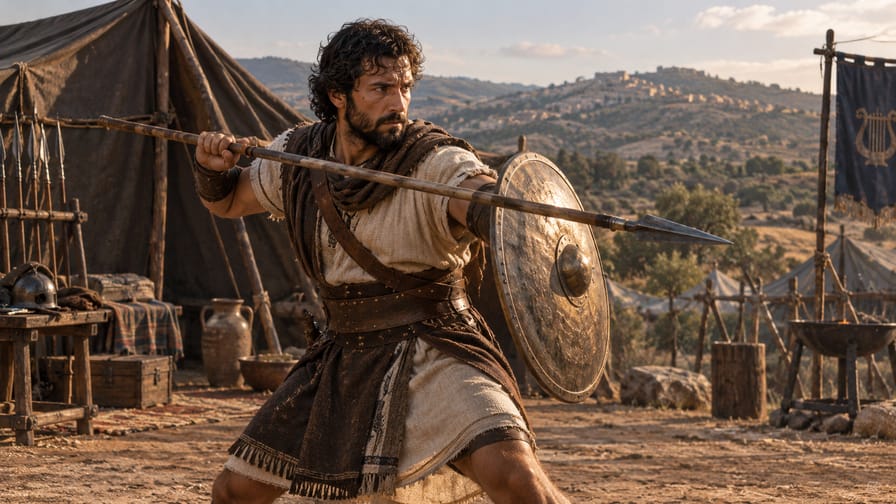
The figure of Elhanan is one of the biblical characters who, though mentioned in few passages, plays a significant role in the narrative of David's kingdom, especially in the context of battles against the Philistines. His story, though brief, raises important textual and theological questions, serving as a relevant point of discussion for the integrity and harmonization of Scripture, particularly within the conservative evangelical perspective.
The analysis of Elhanan requires a careful exploration of his name, the historical context of his actions, and the theological implications of his heroism. His mention in the books of Samuel and Chronicles offers an opportunity to deepen the understanding of divine providence, human courage, and God's faithfulness in protecting His people through His chosen instruments.
1. Etymology and meaning of the name
The name Elhanan, in its Hebrew form, is אֶלְחָנָן (’Elḥānān). This name is a theophory, composed of two distinct parts that reveal a profound theological meaning. The first part, ’El (אֶל), is an abbreviated and common form for "God" or "Almighty," referring to the God of Israel.
The second part, ḥānān (חָנַן), is a verb meaning "to show favor," "to have mercy," or "to be gracious." Thus, the literal and most accepted meaning of the name Elhanan is "God has been gracious" or "God has shown favor." This name reflects the belief that the person so named or their family experienced divine benevolence.
The meaning of the name Elhanan resonates with a central theme in biblical theology: God's unmerited grace and favor toward His creation and, especially, toward His people. The choice of this name for a warrior who plays a crucial role in the protection of Israel can be seen as an acknowledgment of God's providential hand in their victories.
It is important to note that there are two distinct individuals named Elhanan (or Elhanan) in Scripture, which has been a source of considerable exegetical debate. One is Elhanan, son of Jair, from Bethlehem, mentioned in 2 Samuel 21:19 and 1 Chronicles 20:5. The other is Elhanan, son of Dodo, also from Bethlehem, listed among David's mighty men in 2 Samuel 23:24.
Although both are from Bethlehem and contemporaries of David, the Scriptures distinguish them by their fathers. The name itself underscores dependence on God and belief in His favorable intervention, an essential mindset for the people of Israel, especially in times of war and adversity.
2. Historical context and biblical narrative
The figure of Elhanan is situated in the period of the United Kingdom of Israel, specifically during the reign of King David, which extended approximately from 1010 BC to 970 BC. This was a time of great political and military consolidation for Israel, marked by continuous wars against neighboring peoples, with the Philistines being one of the most persistent and dangerous adversaries.
The political context of the time was one of expansion and territorial defense. David was establishing his dominion over Israel and Judah while also seeking to subdue the surrounding nations that posed a constant threat. The battles against the Philistines were crucial for the security and sovereignty of Israel, and the biblical narrative frequently highlights the bravery of David's warriors.
The primary appearance of Elhanan occurs in two parallel passages that describe battles against the Philistines. The first is found in 2 Samuel 21:19, which relates: "And there was again war at Gob with the Philistines, where Elhanan the son of Jaare-oregim, the Bethlehemite, struck down Goliath the Gittite, the shaft of whose spear was like a weaver's beam."
The second mention, which is crucial for harmonization, is in 1 Chronicles 20:5: "And there was again war with the Philistines, and Elhanan the son of Jair struck down Lahmi the brother of Goliath the Gittite, the shaft of whose spear was like a weaver's beam." This passage from Chronicles adds the detail that Elhanan struck down Lahmi, the "brother of Goliath," and not Goliath of Gath, who was killed by David in 1 Samuel 17.
This apparent discrepancy has been the subject of intense discussion among biblical scholars. The conservative evangelical perspective generally upholds the inerrancy of Scripture, seeking to harmonize the texts. The most widely accepted explanation is that the text of 2 Samuel 21:19 may have undergone a minor textual alteration during transmission, or that "Goliath the Gittite" in Samuel is a generic reference to a giant from Gath, or more likely, that 1 Chronicles 20:5 provides the more precise detail, indicating that Elhanan killed Lahmi, Goliath's brother.
Commentators such as John Gill and Matthew Henry, following the Jewish tradition (like the Targum of Jonathan), suggest that the text of Chronicles clarifies that of Samuel, and that Elhanan indeed killed Goliath's brother. Other scholars, such as Gleason L. Archer Jr., point to possible scribal errors in the transmission of the Samuel text, where ’ēt (אֶת, "with") may have been mistakenly copied as ’eṭ (אֵת, "the brother of"), and laḥmi (לַחְמִי, "Lahmi") may have been omitted, leading to the reading "struck down Goliath" instead of "struck down Lahmi, the brother of Goliath."
The geography associated with Elhanan is Bethlehem, his hometown, and Gob (or Gezer, depending on the translation and harmonization of the texts), the location of the battle against the Philistines. Bethlehem is a city of great biblical significance, being the city of David and, later, the birthplace of Jesus Christ. Elhanan's connection to Bethlehem places him in the lineage of valiant men associated with this important locality.
In addition to the Elhanan who killed the giant, 2 Samuel 23:24 and 1 Chronicles 11:26 mention another Elhanan, son of Dodo, also from Bethlehem, as one of David's thirty mighty men. This Elhanan is distinct from the son of Jair. The inclusion of an Elhanan in David's list of "thirty" reinforces the importance of the name and the probable association with bravery and loyalty to the king.
3. Character and role in the biblical narrative
The character of Elhanan, as revealed by Scripture, is that of a courageous and skilled warrior. His main recorded action – the defeat of a Philistine giant – attests to his bravery and his ability to face overwhelming adversaries. He is presented as an instrument of God's victory over the enemies of Israel, a role that requires not only physical strength but also faith and determination.
The mention that he struck down Lahmi, the brother of Goliath, with a spear whose shaft was like a weaver's beam (1 Chronicles 20:5), highlights the magnitude of the challenge and Elhanan's prowess. Giants like Lahmi were feared figures, and their defeat brought great honor and security to Israel. Elhanan's courage echoes that of David in facing Goliath, showing that faith and dependence on God can empower individuals to overcome seemingly invincible enemies.
Although the Scriptures do not detail his spiritual virtues or moral failures, his inclusion in David's war narratives suggests loyalty to the king and to God's purpose for Israel. As one of the warriors who fought the battles of the LORD, Elhanan represented divine strength and protection manifested through human agents.
His specific role was that of a warrior. There is no indication that Elhanan had a prophetic, priestly, or royal calling. He was a soldier, a "man of war," whose function was to defend the kingdom of Israel and ensure its peace, under the leadership of David and, ultimately, of God. His action is an example of how individuals, in their respective callings, can serve the divine plan.
Elhanan's key decision was to face a giant, an act that required immense courage. This type of confrontation was not for the faint of heart, and Elhanan's victory not only removed an immediate threat but also boosted the morale of the Israelite troops and reiterated the supremacy of the LORD over the Philistine gods and their champions.
The narrative does not offer an extensive development of Elhanan's character, as he appears in the context of a battle report. However, his action is an enduring testimony to his bravery and his role in the history of Israel. He joins other mighty men of David who, by their faith and courage, contributed to the stability and success of the kingdom.
4. Theological significance and typology
The theological significance of Elhanan lies primarily in his role in the redemptive history of Israel, acting as an instrument of divine providence. His victory over a Philistine giant was not merely a military feat but a demonstration of God's power in favor of His people. He participated in the progressive revelation of God's plan to protect and establish the nation of Israel under the leadership of David, a king after God's own heart.
Although there is no direct and explicit Christocentric typology for Elhanan, his action can be interpreted as a minor type or an echo of Christ's greater victory. Elhanan's defeat of the giant prefigures, in a broader sense, Jesus Christ's definitive victory over the spiritual giants of sin, death, and Satan. Just as Elhanan liberated Israel from a physical threat, Christ liberated humanity from a much greater spiritual bondage.
Elhanan's name, "God has been gracious," also points to the theme of divine grace, which finds its culmination in the person and work of Jesus Christ. The grace of God, which empowered Elhanan for battle, is the same grace that is abundantly poured out on humanity through Christ's sacrifice on the cross (Ephesians 2:8-9).
The story of Elhanan connects indirectly with divine covenants and promises. The security of David's kingdom, to which Elhanan contributed, was fundamental for the fulfillment of the Davidic Covenant, which promised an eternal throne for David's offspring (2 Samuel 7:12-16). The stability of the kingdom was a prerequisite for the coming of the Messiah from that lineage.
There are no direct quotes or references to Elhanan in the New Testament. However, the theological principles of faith, courage, and dependence on God in the face of adversity are recurring themes throughout Scripture (Hebrews 11:32-34). Elhanan's story illustrates the truth that God uses individuals to accomplish His purposes, even if their actions may seem small in the grand scheme of salvation history.
The narrative of Elhanan also emphasizes the doctrine of God's sovereignty over history and human battles. Victory is not attributed merely to Elhanan's strength but is seen as a manifestation of God's favor. This aligns with the evangelical perspective that all victory and salvation come from the LORD (Psalm 3:8).
The discussion surrounding the harmonization of the Samuel and Chronicles texts, concerning the death of Goliath or his brother, also has a profound theological significance for evangelical theology. It reinforces the importance of biblical inerrancy and the belief that the Scriptures are divinely inspired and trustworthy in their entirety, encouraging careful exegesis and the search for solutions that honor the authority of the Word of God.
5. Biblical-theological legacy and canonical references
Elhanan's biblical-theological legacy, though not as prominent as that of figures like David or Moses, is significant on several fronts. His canonical mentions are found in 2 Samuel 21:19 and 1 Chronicles 20:5, describing his heroic feat, and in 2 Samuel 23:24 and 1 Chronicles 11:26, where another Elhanan is listed among David's mighty men.
Elhanan left no literary contributions, but his action is an integral part of the historical narrative of the books of Samuel and Chronicles, which are fundamental to understanding the establishment of the kingdom of Israel and the Davidic lineage. His story, even if brief, contributes to the tapestry of biblical theology by illustrating God's faithfulness and human courage in the face of evil.
Elhanan's influence on biblical theology lies primarily in how his story is used to discuss the harmony and inerrancy of Scripture. The apparent contradiction between 2 Samuel and 1 Chronicles regarding who killed Goliath (or his brother) has been a focal point for evangelical theologians and apologists throughout the centuries. The resolution of this issue, usually by accepting the Chronicles reading as clarifying, serves to strengthen confidence in the integrity of the Bible.
In Christian and Jewish interpretive tradition, the figure of Elhanan is often invoked in discussions about textual criticism and the reliability of biblical manuscripts. Ancient and modern commentators, such as Keil and Delitzsch, and more recently, Gleason L. Archer Jr. in his work "Encyclopedia of Bible Difficulties," dedicate attention to this passage, demonstrating the importance of rigorous exegesis.
In Reformed and evangelical theology, Elhanan's story is a practical example of applying the principles of biblical hermeneutics. It teaches us to approach the Scriptures with reverence, seeking to understand the context and the author's intention, and to harmonize seemingly conflicting passages in light of the canonical whole, maintaining the view that the Bible is the inspired and inerrant Word of God (2 Timothy 3:16-17).
Elhanan's importance for understanding the canon is not in a specific doctrine he taught, but in how his brief story underscores the providential nature of Israel's history and the way God raises individuals to fulfill His plans. He is a reminder that every character, however small their appearance, contributes to the great narrative of divine redemption.
Thus, the figure of Elhanan, though secondary in terms of textual space, is of great theological relevance. His name, his actions, and the exegetical debate surrounding his story contribute to a deeper understanding of God's grace, the courage of faith, and the inerrancy of the Word of God, central elements for the conservative evangelical Protestant perspective.