


Benaiah
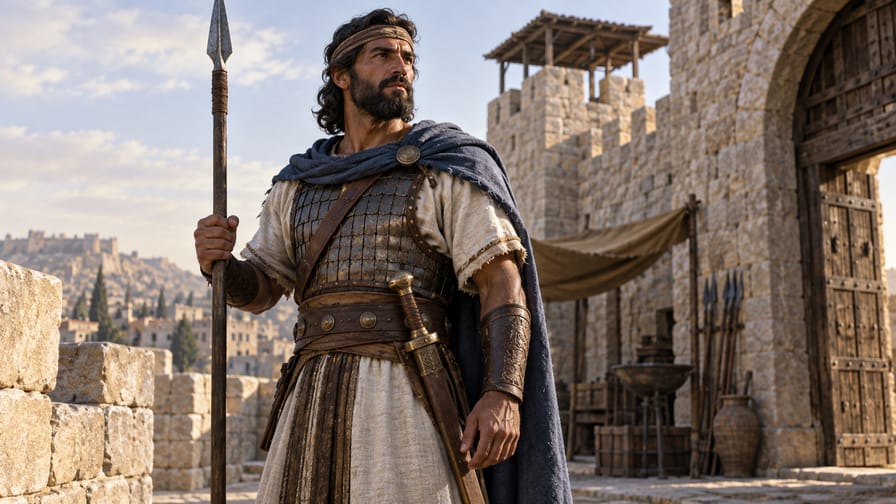
The figure of Benaiah, son of Jehoiada, emerges in the Hebrew Scriptures as one of the most prominent and faithful servants of King David and, subsequently, of his successor, Solomon. His story is intrinsically linked to the consolidation and stability of the Davidic monarchy, playing crucial roles both as a fearless warrior and as a loyal executor of royal commands. The analysis of his life and service offers valuable insights into leadership, loyalty, and divine providence in the formation of Israel's history.
From an evangelical Protestant perspective, Benaiah represents an archetype of the obedient and capable servant, whose strength and determination are put at the service of a greater purpose: the establishment of the earthly kingdom that prefigured the eternal kingdom of Christ. His trajectory is a testament to the importance of faithfulness and courage in executing the divine will, even in tasks that require firmness and discernment amidst political intrigues and military challenges.
1. Etymology and meaning of the name
The name Benaiah, in Hebrew, is transliterated as Bĕnāyāhû (בְּנָיָהוּ) or Bĕnāyāh (בְּנָיָה). It is a theophoric name, composed of two significant parts. The first part, bānāh (בנה), is the root of the verb "to build," "to edify," or "to establish." The second part is an abbreviated form of the tetragrammaton YHWH, the personal name of God, Yah (יה).
Therefore, the literal meaning of the name Benaiah is "Yahweh built," "Yahweh edified," or "Yahweh established." This meaning is deeply resonant with the role that Benaiah played in the history of Israel, especially in the building and stabilization of the kingdom of David and Solomon. His name reflects God's sovereignty in the building and maintenance of His people and His institutions.
The choice or attribution of such a name to an individual often carried an expectation or a declaration of faith on the part of the parents, or even a prophecy about the person's future. In **Benaiah's** case, the name seems to have been prophetic and descriptive of his vital function in the consolidation of the Davidic kingdom, a kingdom that God Himself was establishing according to His promises (2 Samuel 7:12-16).
Although there are other biblical figures named **Benaiah** (for example, a Levite in 1 Chronicles 15:18, a priest in 2 Chronicles 31:13, and a prince of the people in Ezekiel 11:1, 13), the most prominent and the one on whom this analysis focuses is **Benaiah**, son of Jehoiada. The theological significance of his name, "Yahweh built," echoes the truth that all the success and stability of the kingdom of Israel were, ultimately, the work of God.
This name serves as a constant reminder of divine providence, which not only chooses and empowers individuals but also uses them as instruments to build and fulfill His redemptive purposes in history. **Benaiah's** life demonstrates how God builds His kingdom through the loyalty and strength of His dedicated servants, even in contexts of conflict and transition of power.
2. Historical context and biblical narrative
2.1 Family origin and genealogy
Benaiah, son of Jehoiada, was descended from a priestly family, which is notable considering his prominent military and political career. His father, Jehoiada, is identified as "the chief" or "the high priest" (1 Chronicles 27:5, though some translations and commentators debate whether he himself was the high priest or merely a priestly leader). The mention of Kabzeel as his hometown (2 Samuel 23:20) places him in the southern region of Judah, an area known for its warriors.
This priestly origin confers an additional dimension to his trajectory, as he transcended the expectations of his lineage to become a prominent military and political figure. Although the priesthood was a distinct vocation, **Benaiah's** ability to serve the king and the kingdom demonstrates the diversity of gifts and flexibility of service within Israel's theocratic structure.
2.2 Period and main events
Benaiah's life unfolded during the crucial period of the United Monarchy of Israel, spanning the reigns of David (c. 1010-970 BC) and Solomon (c. 970-931 BC). This was a time of consolidation of royal power, territorial expansion, and the establishment of a centralized administration. The political landscape was often volatile, marked by external wars and internal intrigues.
His first significant mention places him among David's "thirty" warriors, an elite group known for their bravery and extraordinary feats (2 Samuel 23:8-39 1 Chronicles 11:10-47). The Scriptures detail his exploits, including the slaying of two notable Moabite warriors, described as "lions of God" or "lion-men" (2 Samuel 23:20 1 Chronicles 11:22). This description highlights his strength and ferocity in combat.
Other memorable feats of Benaiah include going down into a pit on a snowy day to kill a lion (2 Samuel 23:20 1 Chronicles 11:22), demonstrating courage and resilience in adverse conditions. He also confronted and killed an Egyptian of impressive stature, who wielded a spear like a weaver's beam, taking the spear from him and killing him with it (2 Samuel 23:21 1 Chronicles 11:23). Such acts established him as an elite warrior, comparable to David's "three" most powerful men.
In addition to his individual exploits, Benaiah was appointed commander of the Cherethites and Pelethites (2 Samuel 8:18 1 Samuel 15:18), who were David's personal guard, composed of foreign mercenaries or elite soldiers. This position of trust indicates his unwavering loyalty and his ability to lead a security force vital to the king, ensuring the personal protection of the monarch and the maintenance of order in Jerusalem.
His loyalty was tested during the succession crisis that marked David's final days. While figures like Joab and Abiathar supported Adonijah, Benaiah remained faithful to David and his anointed successor, Solomon. He was among those who did not join Adonijah (1 Kings 1:8), demonstrating discernment and commitment to the divine will revealed by David.
Benaiah played a decisive role in the anointing of Solomon as king, following the instructions of David and Nathan the prophet. He accompanied Solomon to the Gihon Spring, where the new king was anointed and acclaimed, ensuring the legitimacy of the transition of power (1 Kings 1:32-40). His presence and action were crucial for the affirmation of Solomon's authority.
After Solomon's ascent, Benaiah was entrusted with executing the new king's main opponents. He killed Adonijah (1 Kings 2:25), Joab (1 Kings 2:34), and Shimei (1 Kings 2:46), carrying out Solomon's orders and consolidating his reign. These executions, though severe, were seen as acts of royal justice to remove threats to the stability of the throne and the peace of the kingdom.
In recognition of his faithfulness and effectiveness, Solomon appointed Benaiah as commander of all Israel's army, succeeding Joab (1 Kings 2:35). This appointment elevated him to the highest military position in the kingdom, confirming his strategic importance and his trusted place in the royal court. The geography of his operations was centered in Jerusalem and in the military campaigns that followed the pacification of the kingdom.
3. Character and role in the biblical narrative
3.1 Evidenced virtues and qualities
Benaiah's character is delineated in the Scriptures by a series of notable virtues. The first and most prominent is his **unwavering loyalty**. He served David with exemplary faithfulness, not being swayed by the intrigues and rebellions that plagued the kingdom. His adherence to Solomon during the succession crisis (1 Kings 1:8) demonstrates that his loyalty was not merely personal to David, but to the principle of divinely ordained succession.
His **courage and physical strength** are evident in his exploits as a warrior, where he faced wild animals and giants in single combat (2 Samuel 23:20-21). These narratives not only highlight his bravery but also his ability to act decisively in situations of extreme danger, protecting the interests of the king and the kingdom. He was a man of action and results.
**Obedience** is another striking characteristic. Benaiah diligently carried out all the orders given to him, even those of a darker nature, such as the executions of Adonijah, Joab, and Shimei (1 Kings 2:25, 34, 46). His readiness to execute the king's will, without apparent questioning, underscores his commitment to established authority, an essential quality for a military and royal officer.
He also demonstrated **competence and effectiveness**. His promotion to command the Cherethites and Pelethites and, subsequently, all the army of Israel (1 Kings 2:35), attests to his capacity for leadership and military organization. He was reliable for carrying out the most difficult and crucial tasks for the security of the kingdom, showing that he was a first-rate strategist and executor.
3.2 Role played in the narrative
Benaiah's role in the biblical narrative is multifaceted and crucial for the stability of the Davidic monarchy. Initially, he served as an **elite warrior**, one of David's "mighty men," whose heroic exploits inspired respect and awe. This phase of his career established his reputation for strength and bravery, making him a trusted figure for King David.
Subsequently, he ascended to the position of **commander of David's personal guard**, the Cherethites and Pelethites (2 Samuel 8:18). In this role, Benaiah was primarily responsible for the safety of the king and his family, a position of immense responsibility that required constant vigilance and absolute loyalty. His presence guaranteed the protection of the monarch against internal and external threats.
His most decisive role, however, was as the **guarantor of Solomon's royal succession**. During the succession crisis, his unwavering loyalty to David and Solomon was fundamental for David's will to be carried out (1 Kings 1:32-40). He not only supported Solomon's anointing but also acted as the new king's executing arm, eliminating rivals and conspirators.
As an **executor of royal commands**, Benaiah was Solomon's instrument to consolidate power and establish justice in the kingdom. The executions of Adonijah, Joab, and Shimei, though severe, were presented as necessary measures to eliminate threats to the throne and ensure peace and order. They demonstrate the seriousness of sin and rebellion against divinely instituted authority.
Finally, his appointment as **commander of Israel's army** under Solomon (1 Kings 2:35) solidified his legacy. He transitioned from an individual warrior to the supreme military leader of the kingdom, tasked with defending its borders and maintaining internal order. His ascent reflects the full trust that Solomon placed in his capability and faithfulness, cementing his character development from a warrior to a general.
4. Theological significance and typology
4.1 Role in redemptive history and progressive revelation
The figure of Benaiah, although not a prophet or priest who directly reveals the divine will, plays a significant role in Israel's redemptive history by ensuring the stability of the Davidic line. This lineage is crucial for the messianic promise, through which the Savior would come into the world (2 Samuel 7:12-16). **Benaiah's** loyalty to David and Solomon contributed directly to the preservation of this line, which would culminate in Jesus Christ.
His name, "Yahweh built," resonates with the idea that God was actively building and establishing His kingdom through David and his successors. Benaiah was a human instrument in God's hand to build and protect the earthly kingdom that prefigured the eternal kingdom of Christ. His life demonstrates divine providence acting through empowered individuals to fulfill His sovereign plans.
4.2 Prefiguration and connection with theological themes
Although Benaiah is not an explicit typological figure in the New Testament, his life offers valuable insights into theological themes. His **unwavering loyalty** to King David and Solomon can be seen as a model for the faithfulness that believers should have to the King of kings, Jesus Christ. Just as Benaiah served an earthly king anointed by God, Christians are called to serve Christ with absolute devotion (Matthew 6:24).
His role as **executor of royal justice** under Solomon points to God's holiness and justice. The executions that **Benaiah** carried out, though by the order of a human king, reflect the seriousness of sin and rebellion against authority established by God. This prefigures the divine justice that will be fully manifest at the final judgment, where Christ, the righteous King, will judge the world (John 5:22 Revelation 19:11).
The transition of power from David to Solomon, secured in part by Benaiah, symbolizes the order and continuity of divine sovereignty. The guarantee of a successor on David's throne was vital for the promise of the Davidic covenant, which promised an eternal kingdom. This theme finds its definitive fulfillment in Christ, the Son of David who established a kingdom that will have no end (Luke 1:32-33).
Benaiah's **obedience** to commands, even the most difficult ones, illustrates the principle of submission to legitimate authority, a recurring theme in evangelical Protestant theology (Romans 13:1-7 1 Peter 2:13-17). His willingness to carry out the king's will, even if it involved drastic actions, serves as an example of how faith manifests itself in action and service, even in challenging circumstances.
Benaiah's name, "Yahweh built," serves as a theological reminder of God's **sovereignty** in history. It is God who builds kingdoms, establishes leaders, and fulfills His purposes through His servants. **Benaiah's** life is a testament that human strength and capacity are instruments in the Lord's hands for the accomplishment of His redemptive plans, which always aim at God's glory and the advancement of His kingdom.
5. Biblical-theological legacy and canonical references
5.1 Canonical mentions and influence on biblical theology
Mentions of Benaiah are concentrated in the historical books of the Old Testament, primarily in 2 Samuel, 1 Kings, and 1 Chronicles. He is consistently portrayed as a man of strength, courage, and loyalty. His story is an integral part of the narrative of the rise and consolidation of the united monarchy of Israel, a formative period for the national and religious identity of God's people.
Although Benaiah did not write any biblical book or have a direct influence on the formulation of theological doctrines like prophets or priests, his life and actions contributed to the development of biblical theology in various ways. He exemplifies the concept of a faithful servant who is rewarded with great responsibility and trust, a theme that resonates with the ethics of the Kingdom of God.
His actions in Solomon's succession underscore the importance of order and governmental stability for the fulfillment of divine promises. The guarantee of the Davidic line was fundamental for covenant theology, and **Benaiah** was a key agent in this preservation. His story, therefore, reinforces the doctrine of divine providence that uses human means to achieve His redemptive ends.
5.2 Presence in interpretive tradition and Reformed theology
In the Jewish and Christian interpretive tradition, Benaiah is often seen as a model of loyalty and dedicated service. Commentators and theologians, such as John Gill and Matthew Henry, highlight his unquestioning faithfulness to Kings David and Solomon as a virtue to be imitated. He represents the competent and reliable executor, essential for the functioning of any just government.
Within Reformed and evangelical theology, the figure of Benaiah is often used to illustrate principles of **obedience to God-instituted authority**, even when that authority demands difficult or unpopular actions. His readiness to carry out Solomon's orders, which aimed at the pacification and justice of the kingdom, is seen as an example of how faith and obedience translate into practical service to the divine plan.
He also serves to highlight the doctrine of God's **sovereignty over human history and governments**. **Benaiah's** name, "Yahweh built," functions as a reminder that God is behind historical events, using individuals to build and maintain the structures that serve His purposes. The stability of the kingdom of Israel, partly guaranteed by **Benaiah**, was a prerequisite for the coming of the Messiah.
Benaiah's life, therefore, contributes to the understanding of the biblical canon by demonstrating how God operates through ordinary people (though extraordinarily capable) in positions of power and influence. He was neither a prophet nor a chief priest, but a warrior and commander, whose dedication and competence were essential for the realization of divine plans for the nation of Israel and, by extension, for the history of salvation.
His story offers a perspective on the application of divine justice through human instruments and the importance of loyalty in service to the kingdom of God. Ultimately, **Benaiah** is a testament to the truth that all the success and stability of God's people are, ultimately, the work of Yahweh, He who builds and establishes His kingdom.