


Bartholomew
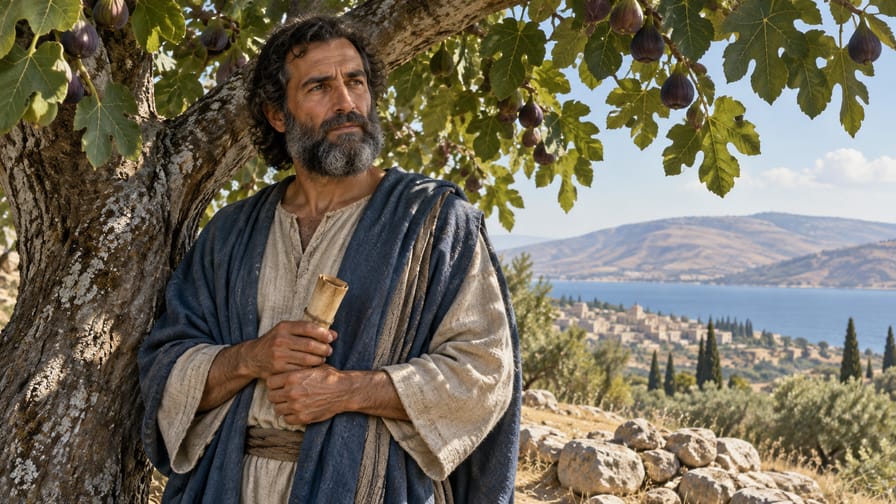
The figure of Bartholomew, one of the twelve apostles of Jesus Christ, presents a peculiar profile in the Scriptures, marked by the brevity of his direct mentions in the synoptic gospels and the book of Acts, but substantially enriched by his probable identification with Nathanael, according to the Gospel of John. This analysis aims to explore the depth of his biblical persona and his theological significance from an evangelical Protestant perspective, addressing his etymology, context, character, and legacy.
The scarcity of biographical details about Bartholomew in the synoptics and Acts contrasts with the richness of Nathanael's encounter with Jesus, an episode that reveals distinctive traits of faith and character. Christian tradition, since the first centuries, has consistently associated Bartholomew with Nathanael, allowing for a more complete understanding of his role in Christ's ministry and the founding of the Church. This association is crucial for unraveling the theological relevance of this apostle.
The conservative evangelical perspective values biblical authority and careful exegesis, seeking to extract precise teachings about the life and ministry of Bartholomew. His story, though fragmented, offers lessons on God's sovereignty in choosing His servants, the nature of genuine faith, and the transformation wrought by a personal encounter with the Messiah. The following analysis will delve into these aspects, using the Scriptures as the primary and inerrant source.
The identification of Bartholomew with Nathanael, although not explicit in any biblical passage, is widely accepted by evangelical commentators such as D. A. Carson and John MacArthur, based on contextual evidence and narrative patterns. This connection allows Nathanael's qualities in John 1:45-51 to be attributed to Bartholomew, providing the basis for a more robust analysis of his character and theological significance.
Therefore, throughout this study, the figure of Bartholomew will be examined through the lens of Nathanael's narrative, recognizing the probability of this identification as the key to understanding his contribution and his place in the history of redemption. This integrative approach seeks to honor the biblical record and extract the maximum spiritual and doctrinal meaning from his life.
1. Etymology and meaning of the name
The name Bartholomew derives from the Aramaic Bar-Talmai (בר-תלמי), which literally means "son of Talmai". The Greek transliteration we find in the synoptic gospels and in Acts is Bartholomaios (Βαρθολομαῖος). This onomastic structure, common in Semitic culture, indicates filiation, as in "Simon Bar-Jona" (Simon, son of Jonah) in Matthew 16:17.
The name Talmai (תַּלְמַי) has Hebrew and Aramaic roots, and its exact meaning is subject to some discussion. Some interpretations suggest "furrower" or "plowman," possibly relating it to agricultural activities, or "courageous." In the Old Testament, Talmai is the name of one of the sons of Anak, a giant whom the spies of Israel found in Hebron (Numbers 13:22 Joshua 15:14), and also of a king of Geshur, father of Maacah, one of David's wives (2 Samuel 3:3).
It is important to note that there is no biblical indication that the apostle Bartholomew had any genealogical connection with these Old Testament figures. The mention of "son of Talmai" is merely a form of personal identification. The name Bartholomew itself does not possess a direct symbolic meaning or an inherent theological weight that reveals aspects of his character or his prophetic destiny.
The main theological significance of the name Bartholomew lies in its connection with the figure of Nathanael. While the synoptic gospels (Matthew 10:3 Mark 3:18 Luke 6:14) and Acts (Acts 1:13) list Bartholomew among the twelve apostles, the Gospel of John, which does not list a "Bartholomew," presents Nathanael of Cana as one of the first disciples and includes him among the seven who meet with Jesus after the resurrection (John 21:2).
The absence of Nathanael in the synoptic lists and the absence of Bartholomew in John, combined with the fact that Philip, who calls Nathanael, is invariably listed alongside Bartholomew in the synoptics, strongly suggest that Nathanael was his personal name and Bartholomew his patronymic. Thus, the name "son of Talmai" acquires an indirect significance by directing us to the rich narrative of Nathanael in John.
2. Historical context and biblical narrative
The life of Bartholomew, or Nathanael, unfolded in the context of first-century AD Jewish Palestine, under the dominion of the Roman Empire. It was a period of intense messianic expectation among the Jews, of political and social tensions, and of religious fervor that manifested in various sects and movements. Judea was under Roman procurators, while Galilee, where Bartholomew likely resided, was governed by Herod Antipas.
The apostle Bartholomew was a native of Cana of Galilee, a small town in the northern region of Israel, as indicated for Nathanael in John 21:2. Galilee was a predominantly Jewish region, but with strong Gentile influence, which, in the eyes of southern Jews, made it a less "pure" area and from where, according to Nathanael's prejudice, "can anything good come?" (John 1:46).
The main references to Bartholomew in the biblical canon are the lists of the twelve apostles, found in Matthew 10:3, Mark 3:18, Luke 6:14, and Acts 1:13. In all these lists, Bartholomew is consistently mentioned after Philip, which strengthens the identification with Nathanael, for it was Philip who introduced him to Jesus in John 1:45. This sequence is not random, but reflects the interpersonal relationships within the apostolic group.
The most detailed narrative, and crucial for understanding Bartholomew, is the account of Nathanael's call in John 1:45-51. Philip finds Nathanael and announces to him: "We have found him of whom Moses in the Law and also the Prophets wrote, Jesus of Nazareth, the son of Joseph" (John 1:45). Nathanael's initial response reveals skepticism based on regional prejudice: "Can anything good come out of Nazareth?" (John 1:46).
However, Nathanael's skepticism is quickly overcome by Jesus' supernatural knowledge. Even before Nathanael approached, Jesus describes him as "an Israelite indeed, in whom there is no deceit" (John 1:47). Jesus' revelation that He saw him "under the fig tree" (John 1:48) before Philip called him, shocks Nathanael, who immediately confesses: "Rabbi, You are the Son of God You are the King of Israel!" (John 1:49).
After Jesus' ascension, Bartholomew was among the apostles who gathered in the upper room in Jerusalem to pray, awaiting the outpouring of the Holy Spirit (Acts 1:13-14). This is the last direct mention of him in the New Testament. He remained faithful to the apostolic group, witnessing the crucial events of the founding of the early Church.
3. Character and role in the biblical narrative
The analysis of Bartholomew's character, through the lens of Nathanael, reveals a man of profound integrity and sincerity. Jesus' own description, "an Israelite indeed, in whom there is no deceit" (John 1:47), is the most eloquent testimony to his nature. The Greek word dolos (δόλος) means "deceit," "cunning," or "fraud," indicating that Nathanael was honest, straightforward, and without ulterior motives.
This quality of sincerity is a remarkable spiritual virtue, especially in a context where religious hypocrisy was criticized by Jesus (Matthew 23:27-28). Nathanael's frankness in expressing his prejudice ("Can anything good come out of Nazareth?") was not seen by Jesus as a moral failing, but as a manifestation of his honesty. He did not disguise his doubts or opinions.
The role of Bartholomew in the biblical narrative is, first and foremost, that of an apostle, one of the twelve chosen by Jesus to be His companion, a witness to His resurrection, and a founder of the Church (Ephesians 2:20). His calling was to follow Christ, learn from Him, and, after the ascension, proclaim the Gospel. He was one of the pillars upon which the early Christian community was built.
Despite his initial skepticism, Bartholomew demonstrated a remarkable readiness to recognize the truth when confronted with the evidence of Jesus' supernatural knowledge. His immediate confession—"Rabbi, You are the Son of God You are the King of Israel!" (John 1:49)—is one of the highlights of his characterization, revealing a mind open to truth and a heart receptive to divine revelation.
This rapid transition from skepticism to faith demonstrates the integrity of his character. He did not stubbornly cling to his preconceptions but allowed the evidence to transform his view. This ability to change one's mind in the face of truth is a mark of wisdom and humility, essential qualities for a disciple of Christ.
As an apostle, Bartholomew played a fundamental role in witnessing Jesus' teachings, miracles, death, and resurrection. He was present at crucial moments, such as the meal with Jesus after the resurrection on the shores of the Sea of Tiberias (John 21:2) and the waiting for the Holy Spirit in Jerusalem (Acts 1:13). Although the Bible does not record his actions after Pentecost, his inclusion in the apostolic roll ensures his significance in the history of the Church.
4. Theological significance and typology
The theological significance of Bartholomew (Nathanael) in redemptive history is multifaceted. He represents the integrity and sincerity that God seeks in human hearts, a quality that Jesus honored and affirmed. His story demonstrates that genuine faith can arise even from a point of skepticism, provided there is a heart without "deceit," open to truth and divine revelation.
Jesus' description of Nathanael as "an Israelite indeed" (John 1:47) is profoundly significant. In contrast to the hypocrisy of some religious leaders of the time, Nathanael embodied the ideal of God's people: a heart of integrity, seeking truth and responding with faith to divine revelation. He prefigures the "Israel of God" (Galatians 6:16), composed of those who believe in Christ and are truly children of Abraham by faith (Galatians 3:7).
Nathanael's experience under the fig tree (John 1:48) is a moment of profound Christocentric revelation. The fig tree, in Jewish tradition, can symbolize Torah study, meditation, or intimacy with God. The fact that Jesus knew him there, even before meeting him, reveals Christ's omniscience. This episode points to Jesus as the Messiah who "knew what was in man" (John 2:25) and who sees beyond outward appearances.
His confession, "Rabbi, You are the Son of God You are the King of Israel!" (John 1:49), is one of the earliest and most explicit declarations of Jesus' divinity and messianic kingship in the Gospel of John. This confession is a pillar of Christian faith, affirming Christ's identity as the promised Messiah, the Son of God, who came to establish His Kingdom.
Jesus' promise to Nathanael: "You will see greater things than these. Truly, truly, I say to you, you will see heaven opened, and the angels of God ascending and descending on the Son of Man" (John 1:50-51), is a clear allusion to Jacob and his ladder (Genesis 28:12). Here, Jesus presents Himself as the ladder itself, the bridge between heaven and earth, the only mediator between God and men (1 Timothy 2:5). He is the fulfillment of God's promise to be present and accessible to humanity.
This Christocentric typology is essential. Jacob's ladder symbolized divine communication Jesus, as the "Son of Man," is the definitive reality of that communication. Through Him, access to God is restored, and divine revelation is fully manifested. Nathanael's experience, therefore, serves as a microcosm of the experience of every believer who finds in Christ the fullness of revelation and salvation.
The life of Bartholomew, as an apostle, connects to central theological themes such as God's sovereignty in election, Christ's authority over all hearts, the nature of transformative faith, and the founding of the Church upon apostolic testimony. His story is a reminder that God calls people of diverse backgrounds and temperaments, transforming them into instruments for His Kingdom.
5. Biblical-theological legacy and canonical references
The biblical-theological legacy of Bartholomew, though not as extensive as that of Peter or Paul, is significant for its representation of sincerity and transformative faith. His canonical mentions are limited to the apostolic lists in the synoptic gospels (Matthew 10:3 Mark 3:18 Luke 6:14) and in Acts (Acts 1:13), and to Nathanael's narrative in the Gospel of John (John 1:45-51 John 21:2).
There are no literary contributions attributed to Bartholomew within the biblical canon. He did not write epistles, gospels, or other books. However, his presence as one of the twelve apostles grants him authority and a foundational role in New Testament biblical theology. The apostles are described as the "foundation of the apostles and prophets" of the Church, with Jesus Christ as the chief cornerstone (Ephesians 2:20).
In Christian interpretive tradition, Bartholomew, as Nathanael, is often celebrated as an example of purity of heart and intellectual honesty. Church Fathers like Augustine and Chrysostom commented on Nathanael's praiseworthy quality of "having no deceit," seeing him as a model of true piety. His story is used to illustrate how prejudice can be overcome by divine revelation and a personal encounter with Christ.
Extrabiblical tradition, though not canonical, attributes to Bartholomew extensive missionary work in India, Mesopotamia, and Armenia, where he supposedly suffered martyrdom, being flayed alive. These narratives, though not biblically verifiable, reflect the belief in the dedication and sacrifice of the apostles in spreading the Gospel throughout the known world.
In Reformed and evangelical theology, the figure of Bartholomew reinforces the doctrine of God's sovereignty in the election and calling of His disciples. His story underscores that God chooses imperfect men, but with sincere hearts, to fulfill His purposes. The emphasis falls on God's grace that reaches and transforms, rather than on the intrinsic qualities of the individual.
The importance of Bartholomew for understanding the canon lies in his representation of the diversity of the apostolic body and the universality of Christ's call. He, a Galilean with an Aramaic name, becomes a testimony to the Gospel message, which transcends geographical and cultural barriers. His life, though concisely recorded, is a testament to the truth and power of Jesus Christ, the Son of God and King of Israel.