


Baara
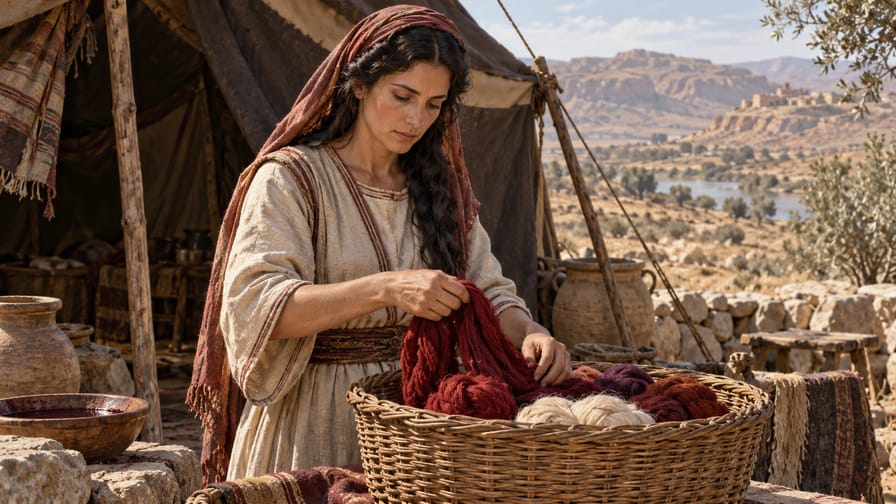
The figure of Baara, though singularly and ambiguously mentioned in the Hebrew Scriptures, offers a fertile ground for exegetical and theological analysis. Her appearance in 1 Chronicles 8:8, within the context of a Benjamite genealogy, raises important questions regarding textual interpretation, the purpose of genealogical lists, and divine sovereignty amidst the complexities of human life in Ancient Israel. This entry aims to deeply explore the identity, context, and theological significance of Baara from a conservative evangelical Protestant perspective, emphasizing biblical authority and exegetical precision, even for the most obscure characters.
1. Etymology and meaning of the name
The name Baara, as it appears in some Portuguese translations (e.g., Almeida Revista e Corrigida), derives from the Hebrew בַּעֲרָה (Ba'arah). The etymological root for this term is בָּעַר (ba'ar), which possesses multiple meanings in biblical Hebrew.
Primarily, ba'ar can mean "to burn," "to consume," "to kindle" (as in Exodus 3:2, where the bush burned, ba'ar). In a figurative sense, it can denote intense passion or fervent judgment. If interpreted as a proper name, Baara could mean "burning," "flame," or "she who burns," suggesting a vehement character or an association with fire.
However, the interpretation of בַּעֲרָה as a proper name in 1 Chronicles 8:8 is a subject of significant debate among scholars. The Masoretic Hebrew text presents the phrase וּבַעֲרָה נָשָׁיו (u-va'arah nashav). While some ancient translations, such as the Septuagint (καὶ βααρα) and the Vulgate (et Baara), and some modern ones (like the Portuguese ARC and the English KJV) consider it a proper name, many other modern translations and commentators interpret it differently.
The ambiguity lies in the fact that בַּעֲרָה can be read as a common noun or a verbal form. Some propose it to be a nominalized form of the root ba'ar in the sense of "to remove," "to eliminate," "to send away," referring to Shaharaim's act of dismissing his wives. Thus, the phrase could be translated as "and his wives who were dismissed/removed," or "and his wives, the unoccupied/abandoned one."
The New International Version (NIV), for instance, translates the passage as: "Shaharaim had sons in Moab after he had divorced his wives Hushim and Baara." However, the New American Standard Bible (NASB) and the English Standard Version (ESV) opt for a construction that avoids the proper name, translating as "and his wives Baara" or "and his wives, [who were] sent away." The Brazilian Literal Translation (BLT) translates as "and Baara, his wives," maintaining the ambiguity. This diversity reflects the exegetical uncertainty.
If Baara is indeed a proper name, her inclusion in the Chronicler's genealogies, alongside Hushim, would indicate the importance of recording all family members, even those who were subsequently "dismissed" or "divorced." The "burning" etymology could, speculatively, allude to a strong personality or difficult circumstances that led to the divorce.
There are no other biblical characters explicitly named Baara. The singularity of the mention, combined with etymological and grammatical uncertainty, makes Baara one of the most enigmatic characters in the biblical canon. The theological significance of the name, if it is a name, lies in how God preserves genealogical records, including figures who, perhaps, played complex roles in the history of their families.
2. Historical context and biblical narrative
The mention of Baara is found in the book of 1 Chronicles, specifically in chapter 8, which details the genealogies of the tribe of Benjamin. The books of Chronicles were written after the Babylonian exile, probably between 450 and 400 BC, by an author traditionally known as the Chronicler.
2.1 Family origin and genealogy
The Chronicler's main purpose was to reaffirm Israel's identity after the exile, connecting the post-exilic community with its historical roots and covenantal promises. Genealogies were crucial for this purpose, establishing the continuity of the tribes, eligibility for the priesthood, and the Davidic lineage. 1 Chronicles chapter 8 focuses on the descendants of Benjamin, a tribe that had been almost exterminated in an episode of civil war (Judges 20-21).
Baara is mentioned in connection with Shaharaim, a descendant of Benjamin. Verse 8 states: "And Shaharaim begot sons in the land of Moab, after he had sent away his wives Hushim and Baara" (1 Chronicles 8:8, ARC). Shaharaim is listed as the father of sons born in Moab, after having "sent away" (from the Hebrew שִׁלֵּחַ, shilleach, "to send away," "to divorce") Hushim and Baara.
The narrative provides no details about the reason for the divorce or the exact period in which it occurred. However, the fact that Shaharaim had sons in Moab, after dismissing his previous wives, suggests a period of life or residence in that foreign land. Moab, east of the Dead Sea, was a neighbor of Israel and often in conflict or complex relations with it (cf. Numbers 22-25 Judges 3:12-30 Ruth 1:1-5).
2.2 Key events and geography
The main "event" in Baara's life, as recorded, is her marriage to Shaharaim and the subsequent divorce or "dismissal." This is the only biographical detail provided. She is categorized as one of the wives whom Shaharaim "sent away" before having children in Moab with other women. The mention of Moab is geographically significant, indicating a period or location of life for Shaharaim and, presumably, for his previous wives.
The passage does not specify whether Baara was Moabite or Israelite. If she were Israelite, her divorce would have occurred under Mosaic laws (cf. Deuteronomy 24:1-4). If she were Moabite, this would add a layer of complexity to inter-ethnic relations, which were often disapproved of, though not prohibited in all circumstances (cf. Ruth 1:4 Ezra 9:1-2).
The absence of additional information about Baara is notable. She is an example of how biblical genealogies, though meticulous, can be laconic about individuals, focusing more on the line of descent than on personal biographies. Her relevance lies, therefore, in her function within the genealogical structure and in what her mention tells us about the social and legal practices of the time.
3. Character and role in the biblical narrative
Given the extremely brief and ambiguous mention of Baara in 1 Chronicles 8:8, it is challenging to construct a detailed analysis of her character or role in the biblical narrative. The Scriptures provide no direct information about her actions, words, virtues, or flaws. Her presence is purely referential, as one of Shaharaim's wives who was dismissed.
If we consider Baara as a proper name, and its etymology as "burning" or "flame," we could speculate about a strong personality or perhaps a difficult temperament that contributed to the divorce. However, such an inference is merely conjectural and lacks explicit basis in the sacred text. Reformed and evangelical theology emphasizes the necessity of deriving character and meaning directly from what is revealed in the Scriptures, avoiding speculation without textual foundation.
Therefore, Baara's role in the narrative is that of a passive figure, the object of an action (divorce or dismissal) by her husband Shaharaim. She represents the reality of marital relations in antiquity, including instances of divorce, which were permitted, though not the divine ideal (cf. Malachi 2:16 Matthew 19:8). The inclusion of her name, even in this context, suggests that her existence was relevant to the genealogical record of Benjamin's family.
The Chronicler, in recording these details, makes no explicit moral judgment about Shaharaim or about the divorce. The focus is on the preservation of the lineage and the continuity of the people of Israel. The mention of Baara, therefore, serves to complete the genealogical record, indicating that she was a wife of Shaharaim before he had children in Moab with other women.
In a broader sense, the lack of details about Baara can serve as a reminder of the vast majority of people in biblical history who lived and died without having their individual stories extensively told. Nevertheless, even these seemingly minor figures are part of God's great plan and contribute, in their own place, to the tapestry of salvation history. Her "calling" or "function" was, at minimum, to be part of Benjamin's family and, consequently, of the nation of Israel.
4. Theological significance and typology
Despite the scarcity of information about Baara, her brief mention in 1 Chronicles 8:8 possesses theological significance that can be explored from a conservative evangelical Protestant perspective.
4.1 Role in redemptive history and progressive revelation
As part of a genealogy, Baara is embedded in God's redemptive history. Biblical genealogies are not mere records of names they demonstrate God's faithfulness in preserving a lineage through which His promises would be fulfilled, culminating in the coming of the Messiah, Jesus Christ (cf. Genesis 12:3 Matthew 1:1-17 Luke 3:23-38). Each individual, however obscure, contributes to the continuity of this lineage.
Even if Baara had no recorded children with Shaharaim in the passage, her existence as a legitimate wife (albeit divorced) of a member of the tribe of Benjamin connects her to covenant history. The inclusion of her name, even if subsequently "dismissed," underscores the comprehensive nature of the Chronicler's records, which aimed to document the complete history of the family of Israel.
4.2 Connection with central theological themes
The mention of Baara and Shaharaim's divorce raise questions about marriage and divorce in the Old Testament. Although God permitted divorce due to the hardness of human hearts (Matthew 19:8), He expressed His displeasure with it (Malachi 2:16). The Chronicler's narrative merely records the fact, without moralizing, which is typical of genealogies that prioritize the factual recording of lineage.
God's sovereignty is evident even in complex and imperfect human circumstances, such as divorce. Despite human failures and decisions, God continues to work His purposes through the families and the nation of Israel. The preservation of Benjamin's lineage, even with its internal challenges, points to God's faithfulness to His covenant.
The figure of Baara also highlights the importance of each individual in divine providence. While there is no direct Christocentric typology for Baara, her presence in the genealogies reminds us that God values every life. The absence of a detailed personal story does not diminish the fact that she was a real person, part of Israel's history.
For evangelical theology, the inclusion of less prominent names in the genealogies reinforces the truth that salvation history is built not only upon the great heroes of faith but also upon the lives of ordinary people. God uses the totality of human experience, including family challenges and ruptures, to advance His redemptive plan.
5. Biblical-theological legacy and canonical references
Baara's legacy is almost entirely contained in the single reference in 1 Chronicles 8:8. She is not mentioned in any other biblical book, neither in the Old nor in the New Testament. Consequently, there are no literary contributions attributed to her, nor does she have a direct role in the formation of specific doctrines or teachings.
However, the existence of Baara, or the ambiguity surrounding her name, has an indirect influence on biblical theology and interpretive tradition. The main discussion surrounding Baara in Jewish and Christian exegetical literature has been whether "Baara" is a proper name or a common noun describing Shaharaim's wives.
Evangelical commentators, such as Keil and Delitzsch in their Commentary on the Old Testament, discuss the textual difficulty and the interpretation of בַּעֲרָה. They tend to view the difficulty as an indication that it is not a proper name, but a description. On the other hand, older commentators, like Matthew Henry, following the KJV, treat Baara as a person's name, though without attributing any meaning to her beyond being one of Shaharaim's wives.
Reformed and evangelical theology values exegetical precision and the authority of Scripture. The case of Baara illustrates the challenges of interpreting genealogical texts and the importance of consulting the original languages and biblical scholarship. The ambiguity serves as a reminder of the humility required in biblical interpretation, acknowledging the limitations of human knowledge and God's sovereignty over revelation.
The presence of Baara in the biblical canon, even if minimal, reinforces the importance of genealogies for understanding the history of Israel and the preparation for the coming of Christ. They establish the identity of the covenant people and the continuity of the divine promise, even through lives that seem marginal or enigmatic. The Chronicler, by including such details, ensures that the complete history of Israel, with all its family complexities, is recorded for future generations.
In summary, Baara is a testament to the richness and, at times, the mystery of the Word of God. Her figure, though briefly mentioned, invites reflection on divine faithfulness amidst human frailty and the importance of each link in the vast stream of salvation history, which culminates gloriously in Jesus Christ.