


Aziel
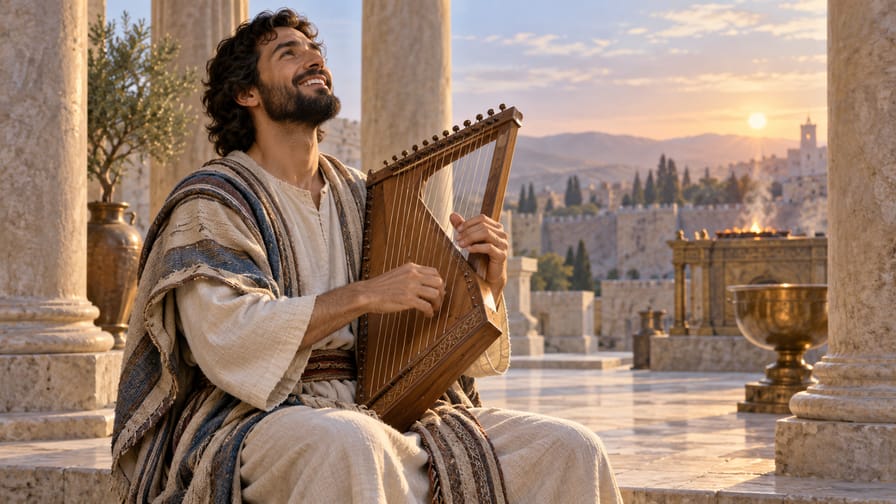
The figure of Aziel, though briefly mentioned in the Scriptures, offers a rich opportunity for onomastic analysis and theological reflection within the context of Levitical worship in Israel. His sole biblical appearance is in 1 Chronicles 15:20, where he is identified as one of the Levitical musicians tasked with playing harps at the return of the Ark of the Covenant to Jerusalem. The scarcity of details about his personal life does not diminish the importance of his symbolic and theological role, especially when understood in light of David's organization of worship and the Chronicler's theology.
The conservative evangelical Protestant perspective values every biblical mention, however concise, as part of God's inspired revelation. Thus, the analysis of Aziel transcends the mere identification of a name, seeking to extract eternal principles about the nature of worship, service to God, and the meaning of the divine presence among His people. Although there is no extensive narrative about him, his name and function place him within a larger panorama of redemptive history and preparation for the Messiah.
This study will delve into the meaning of the name Aziel, his historical context, and the function he performed, to then explore the theological implications of his service. We will see how, even in secondary characters, the Scriptures reveal God's sovereignty and the importance of faithfulness in fulfilling a divine calling, ultimately pointing to Christ as the center of all worship and the source of all strength.
1. Etymology and meaning of the name
The name Aziel is of Hebrew origin, spelled as עֲזִיאֵל ('Aziel) in the Masoretic text. It is a theophoric form, common in Hebrew onomastics, which combines an element referring to God with a descriptive or attributive term. In this case, the name is composed of two significant parts that reveal aspects of Israelite theology and personal faith.
The first part, עָז ('az), derives from the Hebrew root עָזַז ('azaz), which means "to be strong," "to be powerful," or "to have strength." This root is frequently used in the Scriptures to describe God's strength or the strength He grants to His people. Examples include Psalm 28:7, where the Lord is described as the strength and shield of His faithful, and Isaiah 40:29, which speaks of God giving strength to the weary.
The second part of the name is אֵל ('El), one of the oldest and most common names for God in the Old Testament, meaning "God" or "powerful." The combination of these elements results in a literal meaning of "My strength is God," "God is my strength," or "Strength of God." This meaning is profoundly theological, expressing a confession of dependence and trust in divine sovereignty and power.
The meaning of the name Aziel resonates with a fundamental truth of biblical faith: that true human strength does not reside in one's own capabilities, but in the provision and power of God. This truth is echoed by numerous psalmists and prophets, as in Psalm 46:1: "God is our refuge and strength, an ever-present help in trouble." The name, therefore, serves as a constant reminder of the divine source of all vigor and resilience.
There are no other significant variations of the name Aziel (H5813) in biblical languages that refer to the same character. It is important to note the distinction of names like Uzziel (עֻזִּיאֵל, 'Uzziel, H5816), which means "My strength is God" or "Strength of God," and which appears in several Levitical genealogies (such as in Exodus 6:18 Leviticus 10:4 1 Chronicles 6:2, 18), but which, phonetically and in its Hebrew spelling, is a distinct name from Aziel.
The theological significance of the name Aziel in the biblical context is that of a declaration of faith. For a Levitical musician participating in an event as sacred as the return of the Ark, to bear a name that proclaims "My strength is God" is particularly fitting. It suggests that the service and worship he rendered were motivated and enabled not by his own skill, but by the strength God granted him, a testimony to the divine dependence inherent in true worship.
2. Historical context and biblical narrative
The sole mention of Aziel occurs in 1 Chronicles 15:20, placing him in the period of David's reign, specifically during the crucial event of the transportation of the Ark of the Covenant to Jerusalem. This event marks a turning point in Israel's history, symbolizing the centralization of worship and the presence of God in the kingdom's capital. David's period, approximately between 1010-970 B.C., was an era of great political, military, and religious reorganization in Israel.
The political and social context of the time was one of kingdom consolidation. David had unified the tribes, established Jerusalem as the capital, and expanded Israel's borders. However, the religious dimension was equally fundamental. After the failure of the first attempt to transport the Ark (2 Samuel 6:1-11 1 Chronicles 13:1-14), David understood the need to rigorously follow divine instructions, especially concerning the Levites.
The genealogy of Aziel is inferred from his context. 1 Chronicles 15:17-20 lists the Levites designated for music: Heman, Asaph, and Ethan as leaders, and others as secondary, among whom was Aziel. He is mentioned as one of the musicians who played harps "according to Alamoth." Although not explicitly stated as Heman's son, he is listed in the group of "their brethren" (1 Chronicles 15:18) who are "of the second rank" (1 Chronicles 15:18), indicating a hierarchical position within the Levitical musical organization.
The main narrative in which Aziel appears is that of the transportation of the Ark of the Covenant. After the incident with Uzzah, David sought to understand and apply the Mosaic laws concerning the handling of the Ark. He gathered the Levites, the only ones authorized to carry the sacred objects of the tabernacle (Numbers 4:15), and instructed them to sanctify themselves and to carry the Ark on their shoulders, according to the Law (1 Chronicles 15:12-15).
Within this organization, David also designated the Levites for musical service. He "ordered the chiefs of the Levites to appoint their brethren, the singers, with musical instruments, with lutes, with harps and with cymbals, to play with joy and raise their voices with gladness" (1 Chronicles 15:16). It is in this context that Aziel is named among the musicians who played harps (nebalim, נְבָלִים) "according to Alamoth" (על־עֲלָמוֹת).
The geography related to Aziel is, therefore, the city of Jerusalem, specifically the place where the Ark was taken and where the temporary tabernacle was set up, before the construction of Solomon's Temple. He was part of the great procession that brought the Ark from the house of Obed-Edom to the City of David, an event of profound religious and national significance for Israel.
Aziel's relationships with other important biblical characters are indirect but significant. He was under the leadership of King David, who organized the entire event, and of the Levitical leaders, such as Heman, Asaph, and Ethan. His participation connects him to a lineage of Levitical service that would be fundamental for worship in the Temple, establishing a pattern for Israel's public worship for generations.
3. Character and role in the biblical narrative
The Bible does not offer a detailed description of Aziel's character, nor does it record any specific actions or discourses attributed to him. However, his inclusion in the list of Levitical musicians in 1 Chronicles 15:20 allows for the inference of certain qualities and the role he played, in light of the Chronicler's theology and the requirements of Levitical service.
The fact that Aziel was selected for musical ministry in the transportation of the Ark suggests that he possessed the necessary qualifications. This implied not only musical skill, but also ritual purity and dedication to God's service. The Levites were set apart for the service of the Lord, and their ministry was considered sacred and of great responsibility (Numbers 3:5-10).
Among the virtues and spiritual qualities that can be inferred, obedience and faithfulness stand out. He was part of a group that followed the instructions of David and the Levitical leaders to ensure that the transportation of the Ark was done correctly and reverently. This obedience was crucial after the previous disaster with Uzzah, emphasizing the importance of following God's commands in all details (1 Chronicles 15:13).
Furthermore, the role of Aziel as a musician indicates that he possessed an artistic talent that was consecrated to God. Music in the Old Testament was not merely entertainment, but an essential form of worship and expression of praise, gratitude, and intercession. Aziel's skill with the harp (nebel) was, therefore, a divine gift used for God's glory and to edify the congregation.
There are no documented records of sins, weaknesses, or moral failures for Aziel. His mention is purely positive, in the context of sacred service. This positions him as an example of someone who faithfully fulfilled his calling without staining his record with transgressions that the Scriptures would deem noteworthy, a virtue in itself.
Aziel's vocation was that of a Levitical musician. His specific function was to play harps "according to Alamoth." The term Alamoth (על־עֲלָמוֹת) is a musical term that appears in other Psalms (e.g., Psalm 46:1) and is generally interpreted as "for maidens' voices" or "in high pitch" (soprano), perhaps indicating a musical style or a type of instrument with a higher tessitura. This suggests technical knowledge and specialization within the Levitical orchestra.
The role played by Aziel was that of a facilitator of corporate worship. He, along with the other musicians, created an atmosphere of joy and reverence that accompanied the Ark of the Covenant. Music was a vital component to express the joy and holiness of God's presence among His people. His significant actions, though not individually described, were an integral part of the great act of bringing God's symbolic presence to the heart of Israel.
There is no character development for Aziel throughout the narrative, given that he is mentioned only once. However, his presence in this crucial list reinforces the idea that every member of the body of worshipers, however low their visibility, plays an indispensable role in God's plan. His faithfulness in service, though anonymous to history, was known and valued by God.
4. Theological significance and typology
Although Aziel is a minor figure in the Scriptures, his role as a Levitical musician in the transportation of the Ark of the Covenant grants him theological significance that fits into Israel's redemptive history and God's progressive revelation. He is not a direct typological figure of Christ, but his ministry and the context in which he serves prefigure aspects of worship and God's presence that culminate in Jesus Christ.
The transportation of the Ark to Jerusalem was an event that solidified God's promise to dwell among His people, a central theme in redemptive history. The Ark represented God's presence and the throne of His glory (Exodus 25:22). Aziel's service, playing the harp with joy, was part of the people's response to the manifestation of the divine presence, a prefiguration of the joy and worship that accompany the coming of the Kingdom of God.
Christocentric typology can be discerned in the broader meaning of Levitical worship. The ministry of the Levites, including musicians like Aziel, pointed to the need for mediation and sacrifice for man to approach a holy God. Christ is the High Priest and the perfect sacrifice who abolished the need for the Levitical system, making direct access to God possible through His redemptive work (Hebrews 9:11-14).
Furthermore, the music and worship of Aziel in the context of the Ark point to Christ as the center of all worship. If the Ark symbolized God's presence, Christ is the full and final manifestation of that presence, Immanuel, "God with us" (Matthew 1:23). He is the Master of Ceremonies of the new covenant, the only one who can truly lead us into the Father's presence (John 14:6).
The connection to central theological themes is evident. The name "My strength is God" reflects the theme of divine dependence, a fundamental doctrine of evangelical faith. True faith recognizes human inability and God's sufficiency. Aziel's participation in the transportation of the Ark highlights the importance of obedience to God's commands in worship, a principle that Christ reaffirmed in His life and teachings (John 4:23-24).
The joy and gladness expressed through music during the return of the Ark are an echo of the joy of salvation. The Ark, which had been removed due to Israel's sin, was now being restored to its place of honor. Likewise, Christ, through His death and resurrection, restored fellowship between God and man, bringing true joy and the basis for genuine worship (Romans 5:10-11).
There are no direct quotes or references to Aziel in the New Testament, which is expected for such a secondary figure from the Old Testament. However, the principles of worship and service that he represents are broadly developed. Christian worship is seen as a response to the Gospel, performed in spirit and truth, and involving the use of talents for the glory of God (Romans 12:1 Colossians 3:16).
In summary, the service of Aziel, though humble, is part of the divine tapestry that weaves the history of salvation. He illustrates the truth that all faithful service, even in the background, contributes to God's greater purpose, pointing to the day when all creation will worship Christ, the true manifestation of God's strength and glory (Philippians 2:9-11 Revelation 5:13).
5. Biblical-theological legacy and canonical references
The only direct canonical reference to Aziel is found in 1 Chronicles 15:20. His mention, though isolated, is significant in the context of the book of Chronicles, which has a particular focus on the Davidic lineage, the priesthood, and the organization of Levitical worship. The Chronicler, in detailing the preparations for the transportation of the Ark and the institution of musical worship, emphasizes the order and sanctity that David sought to restore in the worship of Yahweh.
Aziel's contributions are not literary, as he is not the author of any biblical book or psalm. However, his existence attests to the authenticity and meticulousness of the Old Testament's genealogical and ministerial records. He is part of the "cloud of witnesses" (Hebrews 12:1) who, in their respective roles, contributed to the history of God's people.
The influence of Aziel on biblical theology resides more in his representative role than in any individual action. He represents the dedication and service of the Levites, who were essential for maintaining the covenant between God and Israel. The Levitical musical ministry, of which he was a part, was a prophetic expression of celestial worship and a preparation for the perfect worship that would come with the new covenant.
In Jewish and Christian interpretive tradition, Aziel is not a prominent figure, being rarely the subject of extensive commentary. However, his group, the Levitical musicians, receives considerable attention. They are seen as models of dedicated service and of the importance of art in worship. Rabbinic tradition and Christian exegesis frequently explore the role of music and musicians in the Temple, using passages like 1 Chronicles 15 as a foundation.
There are no references to Aziel in intertestamental literature or other extrabiblical sources. His relevance, therefore, remains strictly canonical, limited to his sole mention. This underscores the selective nature of biblical revelation, where every detail is intentional, even if not extensively elaborated.
In Reformed and evangelical theology, the figure of Aziel, as a Levitical musician, reinforces important principles about worship. First, the conviction that worship must be regulated by God's Word (the regulative principle of worship), as David sought to do after the initial error (1 Chronicles 15:13). Second, the valuing of excellence and skill in service to God, for the musicians were "skilled" (1 Chronicles 15:22) in their instruments.
The importance of Aziel for understanding the canon lies in his contribution to the complete picture of worship in Israel. He reminds us that God's glory is manifested not only by great leaders and prophets, but also by those who faithfully serve in more humble capacities, using their talents for the praise of the Lord. The name "My strength is God" echoes the truth that the ability to serve and worship comes solely from God, a theological legacy that endures through the centuries.