


Abigail
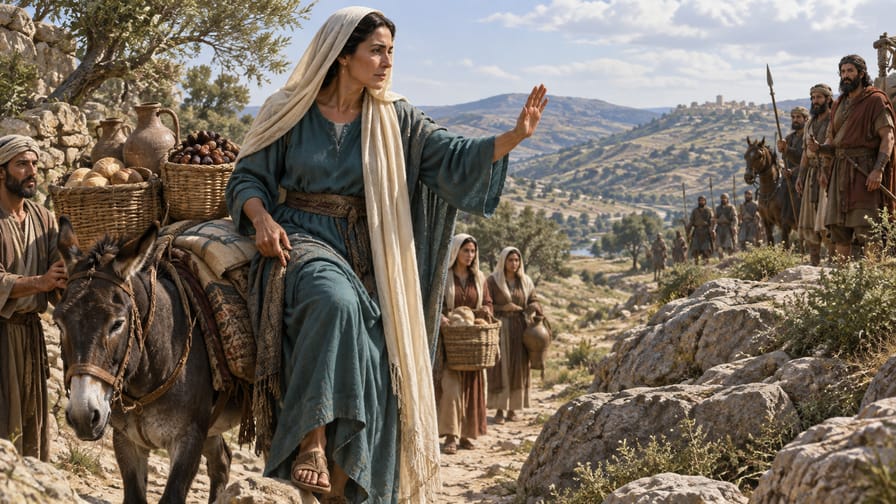
The figure of Abigail emerges in the Old Testament as a woman of notable wisdom, discernment, and decisive action, playing a crucial role in the life of David before his ascent to the throne of Israel. Her story, primarily recorded in 1 Samuel 25, offers rich theological and ethical lessons, serving as a vivid example of divine providence and the human capacity to act with righteousness in adverse circumstances. The analysis of her life and character is fundamental to understanding aspects of David's leadership and divine intervention in redemptive history.
From an evangelical Protestant perspective, Abigail is celebrated not only for her practical intelligence but also for her implicit faith and her ability to mediate, preventing unnecessary bloodshed and saving David from committing a grave sin. Her narrative is a testament to the power of godly wisdom and moral courage, resonating with principles that transcend her historical context and continue to instruct believers today.
1. Etymology and meaning of the name
The name Abigail, in Hebrew ʾĂḇîḡayil (אֲבִיגַיִל), is composed of two significant parts. The first part, ʾāḇ (אַב), means "father," and the second part, gîl (גִיל), means "joy," "exultation," or "source of joy." Thus, the name is generally translated as "My father is joy" or "Source of joy."
This etymology is deeply symbolic and prophetic in relation to Abigail's character and actions in the biblical narrative. She indeed becomes a source of joy and relief, first for her own household by averting David's wrath, and then for David, by preventing him from committing an impulsive act of vengeance. Her name, therefore, prefigures her function as a peacemaker and bearer of good tidings.
There are no significant variations of the name Abigail in biblical languages, which attests to the uniqueness of the main character bearing this name. Although there is another Abigail mentioned in the Scriptures – David's sister and mother of Amasa (2 Samuel 17:25 1 Chronicles 2:16-17) – the main focus and theological relevance fall upon Nabal's wife and, subsequently, David's.
The theological significance of the name lies in the idea that true joy comes from God and His wisdom. Abigail's action, guided by divine wisdom, resulted in joy and peace, contrasting sharply with the foolishness and danger that Nabal represented. She personifies the wisdom that pleases God and brings tangible benefits, reflecting the wisdom that is a "tree of life" (Proverbs 3:18).
The name Abigail, therefore, is not merely an identification, but an intrinsic description of her being and her redemptive impact on history. She is a joy to David, who recognizes the hand of God in her intervention (1 Samuel 25:32-33), and an example of how God's wisdom can operate through individuals to fulfill His sovereign purposes.
2. Historical context and biblical narrative
The story of Abigail unfolds in a crucial period of Israel's history, approximately at the end of the 11th century B.C. or the beginning of the 10th century B.C., during the transition from the era of the judges to the established monarchy. David, already anointed king by Samuel (1 Samuel 16:13), was a fugitive from King Saul, who relentlessly sought his life. David and his men lived as mercenaries and protectors of communities, depending on the provision of those they served.
The political landscape was unstable, with Saul losing divine favor and control over the kingdom, while David gained popularity and support, albeit clandestinely. The social context was marked by a tribal and patriarchal structure, where honor and vengeance were powerful concepts. Abigail's story occurs specifically in the desert and mountainous regions of southern Judah, around Maon and Carmel, where Nabal owned extensive properties and flocks.
Abigail was married to Nabal, a rich and influential man from the family of Caleb (1 Samuel 25:3). The Bible describes him as "harsh and evil in his deeds," contrasting him directly with Abigail, who was "discerning and beautiful." David and his men had protected Nabal's shepherds and flocks against thieves and raiders, ensuring the safety of his vast wealth. In gratitude, David sent messengers to Nabal, asking for provisions for his men.
Nabal, in his arrogance and foolishness, refused David's request disrespectfully, insulting him and questioning his legitimacy (1 Samuel 25:10-11). His response provoked David's wrath, who swore vengeance, promising to exterminate Nabal and all the men of his household (1 Samuel 25:21-22). David set out with four hundred of his men, determined to carry out his threat.
It was at this critical moment that one of Nabal's servants informed Abigail of the imminent danger. She acted with speed and determination, without consulting her husband. She prepared a large quantity of food and gifts – bread, wine, meat, parched grain, and cakes of figs and raisins – and set out to meet David (1 Samuel 25:18-20). Upon finding him, she prostrated herself before him and interceded eloquently, taking Nabal's guilt upon herself and appealing to David's wisdom and future reign (1 Samuel 25:23-31).
Abigail's intervention was successful. David listened to her words, recognized the hand of God in her coming, and gave up his vengeance (1 Samuel 25:32-35). Upon returning home, Abigail found Nabal drunk and waited until the next morning to report the events to him. When he heard, Nabal suffered a stroke, and ten days later, the LORD struck him, and he died (1 Samuel 25:37-38).
Upon learning of Nabal's death, David sent for Abigail to take her as his wife (1 Samuel 25:39-40). She readily accepted, becoming one of David's wives, along with Ahinoam. She accompanied him on his journeys, including when they were captured by the Amalekites in Ziklag and rescued by David (1 Samuel 30:5, 18). Later, in Hebron, she gave birth to a son named Chileab (2 Samuel 3:3) or Daniel (1 Chronicles 3:1), who is listed among David's sons.
3. Character and role in the biblical narrative
Abigail's character is one of the most commendable and well-developed among female characters in the Old Testament. She is described as "discerning and beautiful" (1 Samuel 25:3), a combination of outer beauty and, more importantly, inner wisdom. Her story reveals her as a woman of profound discernment, remarkable courage, and genuine humility.
One of her most prominent virtues is practical wisdom. She quickly assessed the gravity of the situation created by Nabal's foolishness and acted with a shrewd and effective strategy. Without hesitation, she prepared a generous offering and went to meet David, demonstrating not only intelligence but also an impressive capacity for leadership and organization in a crisis (1 Samuel 25:18-20).
Her courage is evident in confronting David, an angry warrior with hundreds of men by his side, and in taking responsibility for her husband's offense, even though she was blameless. She prostrated herself before David, a position of extreme humility and submission, and spoke with boldness and respect, appealing to his reason and his faith in the LORD (1 Samuel 25:23-31).
Abigail's humility is repeatedly demonstrated. She does not exalt herself but humbles herself before David, calling herself "your servant" and offering to bear the blame. Even after becoming David's wife, she describes herself as "a servant to wash the feet of my lord's servants" (1 Samuel 25:41), an expression of genuine servitude and modesty, unusual for someone who ascended to such a position.
Abigail also demonstrates remarkable faith and spiritual discernment. She recognized David's calling as the future king of Israel and the promise that the LORD would build him an enduring house. In her intercession, she appeals to David not to defile his hands with unnecessary vengeance, for that would be a "stumbling block" in his future reign and a stain on his conscience (1 Samuel 25:26-31). She prophetically anticipated God's blessing upon David.
Her role in the narrative is multifaceted: she is a peacemaker, preventing bloodshed an intercessor, defending her household and David himself from error and a counselor, whose wise words divert David from a path of sin. She acts as an agent of divine providence, channeling God's grace and mercy to David, who otherwise would have acted impulsively.
There are no sins, weaknesses, or moral failures documented for Abigail in Scripture. Her only "weakness" might be seen in the circumstance of her marriage to Nabal, a wicked man, but even this situation is used by God to manifest her virtue and wisdom. She develops from the wife of a foolish man to one of the wives of the future king, maintaining her integrity and wisdom throughout all transitions.
4. Theological significance and typology
The theological significance of Abigail's story is profound and multifaceted, revealing aspects of divine providence, the nature of sin and grace, and the wisdom that comes from God. She plays a crucial role in redemptive history by protecting God's anointed, David, from committing an act of vengeance that could have compromised his integrity and his future reign.
Abigail's intervention is a clear example of divine providence in action. David explicitly recognizes this: "Blessed be the LORD, the God of Israel, who sent you this day to meet me! Blessed be your discretion, and blessed be you, who have kept me this day from shedding blood and from avenging myself with my own hand!" (1 Samuel 25:32-33). God used a wise woman to guide David, preventing him from acting outside of divine will, demonstrating that God's sovereignty operates through His servants.
The figure of Abigail can be seen as a prefiguration or type of Christ in some aspects. She acts as a mediator and intercessor, offering a "sacrifice" (the gifts) and taking upon herself the guilt of others to avert wrath. Nabal, the foolish man, deserved death, but Abigail intercedes for him and his household, just as Christ intercedes for sinners who deserve divine judgment, offering Himself as a sacrifice to avert God's wrath (Romans 5:8-9 1 Timothy 2:5).
Her appeal to David not to have "stumbling block" or "remorse of heart" (1 Samuel 25:31) for having shed innocent blood anticipates the New Testament teaching on the importance of avoiding sin and seeking peace (Romans 12:18 Hebrews 12:14). Abigail's wisdom and her ability to discern God's plan for David also point to Christ as the incarnation of God's wisdom (1 Corinthians 1:24, 30).
Abigail's story also illustrates the connection between faith and obedience and the consequences of sin. Nabal, in his arrogance and lack of fear of God, faces divine judgment, while Abigail, through her wisdom and righteous actions, is rewarded and elevated. This reinforces the principle that God exalts the humble and brings down the proud (Matthew 23:12 James 4:6).
Although not directly cited in the New Testament, the principles her life exemplifies – wisdom, discernment, intercession, prevention of sin, and trust in divine providence – are central themes of Christian theology. She serves as a model for how believers should act with wisdom and grace in a fallen world, seeking peace and protecting God's anointed ones.
Her story connects with central theological themes such as grace (David is prevented from sinning by divine intervention), justice (Nabal receives what he deserves), and God's sovereignty (He orchestrates events to protect David and fulfill His promises). She is a testament that God can use anyone, regardless of gender or social status, to fulfill His redemptive plans.
5. Biblical-theological legacy and canonical references
Abigail's legacy in biblical theology is significant, although she is mentioned in few canonical passages beyond 1 Samuel 25. Her other mentions are primarily genealogical, identifying her as one of David's wives and the mother of one of his sons. In 2 Samuel 3:3, she is named as the mother of Chileab, and in 1 Chronicles 3:1, her son is called Daniel. These references confirm her place in David's royal family, contributing to the lineage of the future Messiah.
Abigail left no direct literary contributions, but her story is a crucial narrative contribution to understanding David's character and God's providence in his life. The narrative of 1 Samuel 25 is a case study on the temptation of vengeance and the grace of divine intervention, modeled through human wisdom. She is a classic example of how wisdom can disarm wrath and promote justice and peace.
Her influence in biblical theology lies in the practical demonstration of wisdom principles found in the sapiential books, such as Proverbs. She embodies the "virtuous woman" (Proverbs 31:10-31) in her proactivity, discernment, and ability to manage her household and positively influence others. Her story reinforces the importance of seeking wise counsel and avoiding impulsive anger, recurring themes in Scripture.
In Jewish and Christian interpretive tradition, Abigail is consistently praised as a model of intelligence, diplomacy, and faith. Ancient and medieval commentators frequently highlight her as a heroine who knew how to act prudently in a time of danger. She is seen as a counterpoint to Nabal's foolishness and an example of how piety can manifest in concrete actions.
In Reformed and evangelical theology, Abigail's story is often used to illustrate the doctrine of divine providence, the ethics of non-vengeance, and the importance of spiritual discernment. Theologians like John Calvin and commentators like Matthew Henry underscore divine intervention through Abigail to protect David from a grave sin, emphasizing that God uses human means to fulfill His purposes and protect His anointed ones.
Abigail's story is vital for understanding the canon, as it reveals crucial aspects of the development of David's character, the future king of Israel. It shows that, despite being God's anointed, David was human and prone to failures, needing divine intervention to stay on the path of righteousness. This underscores David's dependence on God and God's grace in preserving him for his messianic role.
In summary, Abigail is not merely an interesting character she is a theological pillar that demonstrates divine wisdom manifested in human action, God's providence in protecting His servants, and the importance of intercession and discernment to avoid sin and promote justice. Her legacy is an enduring testimony to the power of a godly woman to change the course of history and glorify God.