


Zerah
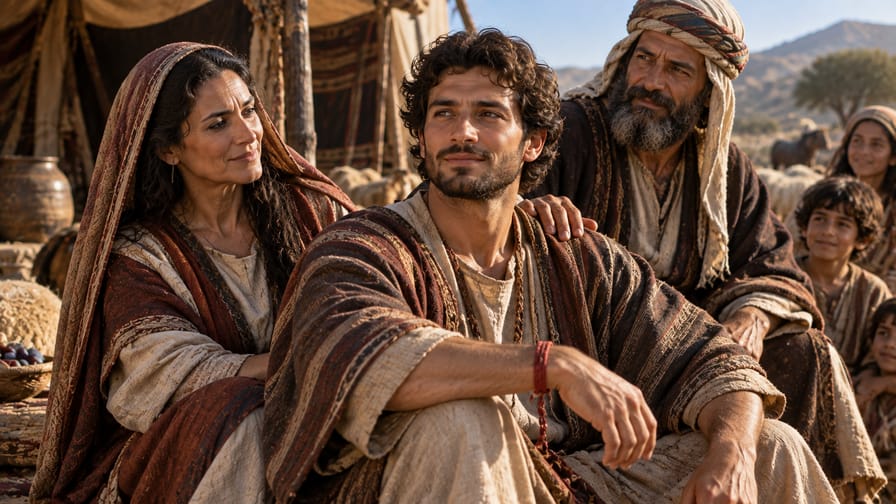
The biblical figure of Zerah (Hebrew: זֶרַח, Zeraḥ) is multifaceted within the sacred canon, with various occurrences of the name attributed to distinct characters. However, the deepest theological analysis and onomastic relevance fall upon Zerah, son of Judah and Tamar, whose story is intrinsically linked to the messianic genealogy. This study aims to explore the etymology, historical context, role in the biblical narrative, theological significance, and legacy of this character from a conservative evangelical Protestant perspective, highlighting divine sovereignty in the history of redemption.
Despite not being a protagonist with extensive actions, the mention of Zerah in the Scriptures is crucial for understanding the complexity of the messianic lineage and how God often operates in unexpected ways, contrary to human expectations. His story, though brief, is a testament to divine providence and the grace that permeates the history of Israel and the arrival of Christ.
1. Etymology and meaning of the name
The Hebrew name זֶרַח (Zeraḥ), transliterated as Zerah, has a rich etymological basis. It derives from the Hebrew verb זָרַח (zaraḥ), meaning "to rise," "to shine," "to radiate," or "to appear." Consequently, the name Zerah can be interpreted as "sunrise," "birth of light," "brightness," or "dawn."
This meaning evokes ideas of light, beginning, and revelation, suggesting a new start or a prominent emergence. In the Septuagint, the Greek translation of the Old Testament, the name is transliterated as Ζαρα (Zara), maintaining the original Hebrew sound and meaning.
The root zaraḥ is used in various biblical contexts to describe the sunrise (Judges 9:33), the brightness of God (Isaiah 60:1), or the emergence of a king (Psalm 110:3, in some interpretations). The name, therefore, carries a connotation of hope and manifestation.
There are other biblical characters named Zerah, though less prominent than the son of Judah. Among them are Zerah, one of the Edomite chiefs, son of Reuel (Genesis 36:13, 17), and Zerah, a Levite from the lineage of Gershon (1 Chronicles 6:21, 41).
There is also Zerah, the Ethiopian (Cushite), a king who attacked Judah in the time of King Asa (2 Chronicles 14:9). Although this latter figure is a significant historical character, his analysis differs because he does not belong to the lineage of Israel or have an internal genealogical role.
For Zerah, son of Judah, the meaning of "sunrise" can be seen as an irony or an anticipation of a "brightness" that, ultimately, would come through his twin brother Perez. The narrative of his birth, as we will see, emphasizes the inversion of human expectations and divine sovereignty.
The theological significance of the name, in this context, lies in its promise of light and emergence, which is divinely redirected. Although Zerah was the first to "emerge" with his hand, the true "dawn" of the messianic lineage occurred through Perez, demonstrating divine election.
2. Historical context and biblical narrative
The story of Zerah, son of Judah, is situated within the patriarchal period of Israel's history, approximately between 1800 and 1600 B.C. His events are narrated in Genesis 38, a chapter that, although it seems like a digression in the story of Joseph, is fundamental for understanding the lineage of Judah and, consequently, the messianic lineage.
The social and religious context of the time was marked by family and tribal customs, including the law of levirate marriage, which obliged a brother to marry his deceased brother's childless widow to perpetuate the offspring (Deuteronomy 25:5-10). This chapter also reveals the complex and, at times, flawed morality of the patriarchs.
Zerah's genealogy connects him directly to Judah, the fourth son of Jacob and Leah. His mother is Tamar, Judah's daughter-in-law, who conceived Zerah and his twin brother Perez through a stratagem, disguising herself as a prostitute to secure offspring for her deceased husband, Er, Judah's firstborn (Genesis 38:13-26).
The main events of Zerah's life are recorded in the final verses of Genesis 38. The narrative describes Tamar's childbirth, where Zerah was the first to put his hand out of the womb. The midwife marked his hand with a scarlet thread, indicating him as the firstborn (Genesis 38:28).
However, Zerah drew back his hand, and his brother Perez broke through, being born first. The midwife exclaimed, "What a breach you have made!" Therefore, he was named Perez, which means "breach" (Genesis 38:29). Zerah was born afterward, with the scarlet thread on his hand (Genesis 38:30).
This unique birth narrative is the only direct mention of Zerah in action. He is subsequently listed in the genealogies of Israel, confirming his descent and the formation of the clan of the Zerahites (Numbers 26:20). His lineage is also mentioned in 1 Chronicles 2:4-6, where his five sons are listed.
The geography related to Zerah is linked to Judah's movements, who had separated from his brothers and was dwelling near Adullam and Timnah (Genesis 38:1, 12). The conception of Zerah and Perez occurred in this regional context, in the land of Canaan.
Zerah's relationships are with his father Judah, his mother Tamar, and his twin brother Perez. Perez is the direct ancestor of David and, consequently, of Jesus Christ (Matthew 1:3 Luke 3:33). Zerah's story is, therefore, intrinsically linked to the messianic lineage, albeit indirectly.
3. Character and role in the biblical narrative
The Bible offers no direct information about Zerah's personal character, nor does it record any actions or decisions taken by him throughout his life. His presence in the narrative is almost entirely genealogical and symbolic, focused on his birth and his position in the lineage of Judah.
No virtues, spiritual qualities, sins, weaknesses, or moral failings are documented as attributed to Zerah. Unlike other biblical characters, his story is not a narrative of personal or moral development. He is more of a genealogical marker than an active moral agent.
Nevertheless, Zerah's role in the biblical narrative is of utmost importance. His birth story, in Genesis 38:27-30, serves as a powerful drama about divine sovereignty in choice and election. The midwife's attempt to identify the firstborn with the scarlet thread is thwarted by the "breach" that Perez opens.
This event demonstrates that the natural order of primogeniture can be subverted by God's will. Zerah, although he extended his hand first, did not become the firstborn who would continue the main lineage. Perez, the "breaker," is the one who assumes this crucial role.
Zerah's specific calling or function, as revealed, is to be the progenitor of the clan of the Zerahites. This clan is mentioned in Numbers 26:20 as part of the tribe of Judah. In Joshua 7:1, we learn that Achan, the man who brought disaster to Israel by his disobedience, belonged to the lineage of Zerah (Achan, son of Carmi, son of Zabdi, son of Zerah).
The inclusion of Zerah in the genealogies of 1 Chronicles 2:4 and in the genealogies of Jesus in Matthew 1:3 and Luke 3:33, although secondary to Perez, attests to his relevance as part of God's redemptive plan.
The development of Zerah's character throughout the narrative is, therefore, nonexistent in terms of personal actions, but profoundly significant in terms of his structural role. He is a vivid reminder that God's ways are not men's ways and that His election transcends human expectations.
4. Theological significance and typology
The theological significance of Zerah lies primarily in the narrative of his birth, which serves as a powerful illustration of divine sovereignty in redemptive history. The "interruption" of the expected primogeniture, where Perez precedes Zerah, prefigures a recurring pattern in divine election in the Old Testament.
God often chooses the least expected or the youngest to fulfill His purposes, challenging social norms and human expectations. Examples include Jacob over Esau (Genesis 25:23), David over his older brothers (1 Samuel 16:6-12), and Ephraim over Manasseh (Genesis 48:19-20).
The story of Zerah and Perez is a microcosm of divine election, where God's grace and sovereignty operate independently of human merit or natural order. The theologian John Calvin, in his commentaries on Genesis, frequently emphasizes God's providence in guiding events, even through seemingly scandalous or irregular circumstances.
The narrative of Genesis 38, which includes the birth of Zerah, is part of the complex and, at times, scandalous lineage of the Messiah. The inclusion of Tamar, a woman who acted unconventionally to secure offspring, and the births of Perez and Zerah, demonstrate that God works through human imperfections to fulfill His promises.
Although Zerah is not a direct typological figure of Christ, his story points to the principle of divine election that culminates in Christ. The Messiah would not come through the "first" or the "expected" (like Zerah, who extended his hand), but through the "breaker" (Perez), who would open a new way.
The scarlet thread (shani, שָׁנִי) on Zerah's hand has been the subject of various interpretations. Some see in it a prophetic symbol of the redemptive blood of Christ, or a mark of divine distinction. However, the conservative evangelical perspective generally avoids excessive allegories, focusing on the literal meaning of an identification mark for the firstborn.
Nevertheless, the scarlet color is associated with redemption in other passages (Joshua 2:18 for Rahab, Isaiah 1:18 for the forgiveness of sins), which may suggest a thematic connection, though not necessarily a direct typological one, with the work of Christ.
The New Testament genealogies, in Matthew 1:3 and Luke 3:33, mention Zerah as Judah's son, but the focus of the messianic lineage is clearly on Perez, who begot Hezron. This reinforces that, although Zerah is part of the lineage, God's redemptive plan followed the path of his brother.
The story of Zerah, therefore, connects to central theological themes such as God's sovereignty, election, grace operating through imperfect human circumstances, and divine faithfulness to His promises, even when the paths seem circuitous. It is a testimony that salvation is the work of God, not of man.
5. Biblical-theological legacy and canonical references
The biblical-theological legacy of Zerah, son of Judah, is predominantly genealogical and symbolic, marking his presence in various canonical passages. He is not an author of books or psalms, but his existence is crucial for understanding the family and tribal structure of Israel, and, more significantly, for the messianic lineage.
Mentions of Zerah are found in Genesis 38:27-30, where his birth story is detailed in Numbers 26:20, which lists the clans of Judah, including the Zerahites and in Joshua 7:1, where Achan's lineage is traced back to Zerah, revealing the continuity of his descent in the history of Israel.
In 1 Chronicles 2:4 and 6, Zerah is again listed with his sons, contributing to the elaborate genealogy of the tribe of Judah, which was of vital importance for the identity and heritage of the people of Israel. These passages reinforce his position as a significant ancestor.
Zerah's greatest contribution to biblical theology lies in his inclusion in the genealogies of Jesus Christ, as recorded in the New Testament. He is mentioned in Matthew 1:3 and Luke 3:33, always alongside his brother Perez, as part of the lineage that leads to David and, ultimately, to Jesus.
Although Perez is David's direct ancestor, the mention of Zerah completes the narrative of Genesis 38 and reaffirms God's providence in every detail of redemptive history. Zerah's presence underlines that the messianic lineage is complex, with twists and turns and characters that defy human expectations.
In the Jewish interpretive tradition, the story of Judah and Tamar, including the birth of Zerah and Perez, is seen as a demonstration of the importance of perpetuating the lineage and Tamar's faithfulness to customs. For the Christian tradition, especially the Reformed and evangelical, the narrative highlights God's sovereignty in election and providence.
Theologians like Martyn Lloyd-Jones and J. Gresham Machen frequently emphasize the doctrine of divine sovereignty, where God uses improbable circumstances and flawed people to fulfill His plans. Zerah's story is a classic example of how God subverts the natural order to demonstrate His election.
Zerah's importance for understanding the canon lies in his function as a genealogical link and a theological illustration. He reminds us that God's plan for redemption is meticulously crafted, encompassing generations and events that, at first glance, may seem insignificant or even problematic.
His story, though brief, reinforces the central message of the Protestant evangelical faith: God's grace is supreme, and His will prevails over all human expectations and attempts, culminating in the glorious coming of Jesus Christ, the promised Messiah.