


Shammah
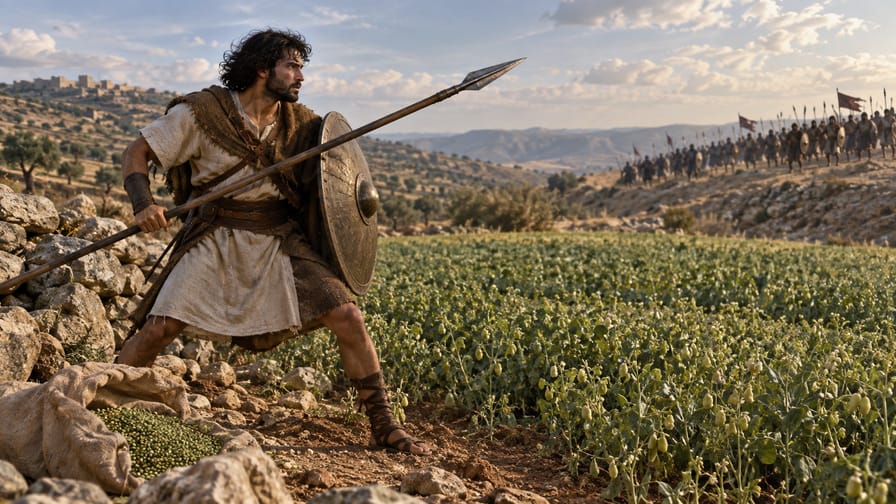
The figure of Shammah, or Shammah in Hebrew, though not among the most prominent in the Scriptures, emerges as a remarkable example of courage and faithfulness at a crucial moment in Israel's history. His story, concisely narrated, offers rich opportunities for a deep theological analysis, especially from a Protestant evangelical perspective. This biblical-theological dictionary entry aims to explore the onomastic meaning, historical context, character, theological relevance, and legacy of this personage, highlighting how his life, even if briefly described, points to eternal principles of faith and divine sovereignty.
The analysis of the life of Shammah, in particular Shammah, son of Agee, the Hararite, one of David's mighty men, reveals the importance of individual acts of faith and bravery in building the kingdom of God. The conservative evangelical perspective emphasizes the inerrancy and authority of the Bible as the inspired Word, seeking to extract lessons that resonate with the truth of the gospel and the person of Jesus Christ. By examining Shammah's story, we are invited to reflect on the nature of true courage, faithfulness amidst adversity, and the impact that a single individual, empowered by God, can have on the history of redemption. His narrative, though peripheral, is an integral part of the larger mosaic of divine revelation.
1. Etymology and Meaning of the Name
The name Shammah, a transliteration of the Hebrew Shammah (שַׁמָּה), possesses etymological roots that suggest different connotations. The most probable root is from a term meaning "astonishment," "desolation," or "awe." Other scholars suggest a connection with the Hebrew verb shamá’ (שָׁמָע), which means "to hear" or "to obey," although this is a less direct derivation for the nominal form.
In the biblical context, the meaning of "astonishment" or "awe" can be interpreted both negatively, as "desolation," and positively, as "that which causes admiration." For Shammah, David's mighty man, the latter interpretation seems more appropriate, given that his actions provoked admiration and astonishment for his bravery. The name, therefore, may have been prophetic or descriptive of his impactful conduct.
It is important to note that there are at least four distinct biblical figures who bear the name Shammah or close variations. The best known is Shammah, son of Agee, the Hararite, one of David's "Three Mighty Men" (2 Samuel 23:11). Another is Shammah, Jesse's third son, David's brother (1 Samuel 16:9 1 Samuel 17:13), who is also called Shimeah in 2 Samuel 21:21 and Shimeah in 1 Chronicles 2:13.
In addition to these, a descendant of Asher is also named Shammah (1 Chronicles 7:37), and there is a mention of a Levite with this name in 1 Chronicles 6:28 (verse 13 in the Vulgate), although some translations identify him as Samuel. The existence of multiple individuals with the same name or variations indicates that it was a relatively common name in the Old Testament period, but each of them is distinguished by their context and actions.
For theological analysis, the focus primarily falls on Shammah, the Hararite, due to the specific narrative of his exploit. The meaning "astonishment" or "admiration" for this Shammah acquires a profound sense, for his courage in single-handedly defending a field of lentils against the Philistines is, indeed, an act that inspires admiration and reverence. This underscores the idea that God can use the "small" or the "forgotten" to accomplish great deeds that make an impact and glorify His name.
The etymology of the name, therefore, is not merely a linguistic detail it intertwines with the character and actions of the individual, lending an additional layer of meaning to his story. The resonance of the name Shammah, the mighty man, with "that which causes astonishment" or "admiration," is a testament to God's ability to work wonders through the faith and obedience of His servants, even in adverse and seemingly insignificant circumstances.
2. Historical Context and Biblical Narrative
The life of Shammah, son of Agee, the Hararite, is situated in the period of the consolidation of David's kingdom, approximately between 1010 and 970 BC. This was a time of intense transition and conflict for Israel, marked by the rise of the Davidic monarchy and the constant threat from the Philistines, who were Israel's main adversaries in the coastal plain and the lowlands of Judah.
Politically, Israel was emerging from a period of fragmented kingdoms under Saul's leadership to a unified nation under David. Socially, society was predominantly agrarian, and the defense of crops was vital for the survival of communities. Religiously, the nation was under the Mosaic covenant, and faithfulness to Yahweh was an imperative, though often challenged by idolatry and disobedience.
The main biblical passage describing Shammah's exploit is found in 2 Samuel 23:11-12 and has a parallel in 1 Chronicles 11:33-34. He is listed among David's "Three Mighty Men," although in the list of 2 Samuel 23 he is categorized after the "Three Chiefs" (Josheb-Basshebeth, Eleazar, and Shammah himself, the Hararite, being one of the three). The text of 2 Samuel 23:11-12 narrates: "Next to him was Shammah, son of Agee, the Hararite. The Philistines gathered at Lehi, where there was a field full of lentils, and the people fled from the Philistines. But he took his stand in the middle of the field, defended it, and struck down the Philistines and the LORD brought about a great victory."
The geographical location of Lehi is significant. It was a region frequently disputed with the Philistines, located in the Shephelah or the lowlands of Judah, a transitional area between the mountains and the coastal plain. The mention of a "field full of lentils" might seem trivial, but for an agrarian society, the loss of the harvest meant famine and dependence, making the defense of that field an act of extreme strategic and economic importance for the sustenance of the people.
The narrative does not provide extensive genealogical details for Shammah, the Hararite, only the name of his father, Agee, and his origin, "the Hararite," which probably refers to a locality or clan. His most prominent relationship is with David, whom he served faithfully as one of his most loyal and courageous warriors. He is part of the select group of "mighty men" who formed David's elite guard, men who demonstrated extraordinary bravery and loyalty.
The flight of the "people" from the Philistines highlights Shammah's solitude and determination. While others retreated, he stood firm, demonstrating unwavering faith in God's ability to grant victory. This episode is not just a display of physical strength, but a testament to moral and spiritual courage, an act of resistance against an oppressive enemy, which resulted in a "great deliverance" brought about by the LORD Himself.
Shammah's narrative is a microcosm of the larger war between Israel and its enemies, and of God's sovereignty in using human instruments for His purposes. He stands out as an example of the faithfulness that David inspired in his men and of Israel's dependence on divine power to achieve victory. His story is a vivid reminder that greatness resides not only in large armies but in the readiness of a heart to fight for God's cause.
3. Character and Role in the Biblical Narrative
The character of Shammah, son of Agee, the Hararite, is revealed through a single, yet powerful, action: his solitary defense of a field of lentils against a Philistine army. This concise narrative in 2 Samuel 23:11-12 and 1 Chronicles 11:33-34 is an eloquent testimony to remarkable virtues, positioning him as a model of courage and faithfulness in the Old Testament.
The main spiritual quality evidenced in Shammah is his unwavering bravery. While "the people had fled from the Philistines," he "took his stand in the middle of the field, and defended it." This decision to remain and fight, even when everyone else retreated, demonstrates extraordinary courage. It was not merely physical bravery, but a deep conviction and confidence that his position was just and that God was with him.
Associated with bravery are perseverance and determination. Shammah not only confronted the Philistines but "struck down the Philistines," which implies a continuous and successful battle. His resilience in a scenario where defeat seemed inevitable underscores his strength of character and his refusal to yield in the face of adversity. He did not fight for personal glory, but for the preservation of a vital resource for his people.
Loyalty is also a striking characteristic. Although the text does not specify his loyalty to David in this episode, his inclusion in the list of David's "mighty men" suggests an unquestioning devotion to the king and the cause of Israel. His action of protecting the field of lentils can be seen as an act of loyalty to the nation and its means of subsistence, crucial elements for the stability of David's kingdom.
There is no record of documented sins, weaknesses, or moral failures for Shammah in this narrative, or anywhere else in the Bible, which enhances his image as an exemplary warrior. His specific calling was that of a warrior, a "mighty man" (Hebrew *gibborim*) in David's army, a group of men selected for their strength, courage, and military skill.
The role played by Shammah in the biblical narrative is that of a deliverer and protector. His action was not just a military feat, but a "great deliverance" (Hebrew *yeshua gedolah*) brought about by the LORD through him. He was not a prophet, priest, or king, but a warrior who, through his faith and obedience, became an instrument of divine providence. His act saved the harvest and, possibly, the lives of many.
Shammah's key decision was to "take his stand in the middle of the field" and fight, instead of fleeing. This solitary decision, contrary to the behavior of the majority, is the central point of his story. It demonstrates that true strength resides not in the number of combatants, but in the disposition of a faithful and courageous heart. The character development is limited to this event, but this single act is enough to immortalize his name among the heroes of faith.
The example of Shammah resonates deeply in evangelical theology, which values individual initiative in response to faith and God's ability to use ordinary people to accomplish extraordinary deeds. His story is a reminder that faithfulness in "small things" or in seemingly insignificant situations can have a monumental impact, and that true victory comes from the LORD, who empowers His servants.
4. Theological Significance and Typology
The story of Shammah, though brief, carries a profound theological significance and can be seen as a reflection of greater truths in the history of redemption. His action of defending the field of lentils is not just a military feat, but a vivid illustration of spiritual principles that resonate with Protestant evangelical theology, especially concerning faith, obedience, and God's role in victory.
Firstly, Shammah's narrative demonstrates the principle of faithfulness amidst adversity. When everyone fled, Shammah stood firm. This attitude echoes the New Testament exhortation to "stand firm in the faith" (1 Corinthians 16:13) and to "withstand in the evil day" (Ephesians 6:13). Shammah's obedience and trust in God, even against all human odds, are a testament to the power that genuine faith bestows upon the believer.
Shammah's exploit also illustrates the sovereignty of God in granting victory. The text explicitly states that "the LORD brought about a great deliverance" (2 Samuel 23:12). Shammah was the instrument, but God was the author of the victory. This perspective is central to evangelical theology, which recognizes that all salvation and deliverance come from God, and that human acts of faith are the response to His grace and power (Philippians 2:13).
Although Shammah is not a direct typological figure of Christ in the classical sense, his action can be interpreted in a Christocentric way through underlying themes. The defense of a "field of lentils"—a vital harvest for the people's subsistence—can be seen as a foreshadowing of Christ's defense of His people and His spiritual "harvest." Christ is the greatest defender, who not only defends but redeems and saves His people from the bondage of sin and death (Colossians 1:13-14).
Shammah's courage in facing the enemy alone, while others retreated, can be seen as a faint echo of Christ's solitude in His battle against sin and death on the cross (Mark 14:50). Christ, the true Hero, stood firm and obeyed the Father to the end, securing victory for all who believe in Him. Shammah's fight for a material field foreshadows Christ's spiritual fight for the Kingdom of God.
Shammah's story connects with central theological themes such as grace (God empowering a man for an impossible task), obedience (Shammah's willingness to fight), and judgment (the defeat of the Philistines). It teaches us that God uses the seemingly weak and insignificant situations to manifest His glory, a recurring theme in Scripture (1 Corinthians 1:27-29).
The absence of direct mentions of Shammah in the New Testament does not diminish his significance. On the contrary, his story serves as an illustrative principle of the faith that "overcomes the world" (1 John 5:4) and of the importance of "standing firm" against the devil's schemes (Ephesians 6:11). He is a practical example of a "soldier of Christ" who fights the good fight of faith (2 Timothy 2:3-4 1 Timothy 6:12).
In this way, Shammah, the Hararite, is not merely a historical figure, but a vehicle for the revelation of divine truths. His story, interpreted in light of evangelical theology, reinforces the doctrine that active faith and dependence on God are essential to experience the "great deliverance" He provides, both in physical and spiritual battles, always pointing to the definitive victory achieved by our Lord Jesus Christ.
5. Biblical-Theological Legacy and Canonical References
The legacy of Shammah, son of Agee, the Hararite, though not translating into a vast literature or complex doctrinal development, is profoundly significant for understanding the faith and history of Israel in the biblical canon. His mentions are concise but powerful, appearing in 2 Samuel 23:11-12, in the list of David's mighty men, and in its counterpart in 1 Chronicles 11:33-34.
The inclusion of Shammah in the lists of David's "mighty men" (Hebrew *gibborim*) is, in itself, an honor and a validation of his importance. These lists are not mere genealogical records, but catalogs of men who demonstrated exceptional courage, loyalty, and faith, contributing to the rise and maintenance of the Davidic kingdom. The mention in both books (Samuel and Chronicles) attests to the canonicity and relevance of his story for the historical narrative of Israel.
Shammah left no direct literary contributions, such as Psalms or prophecies. His "contribution" lies in his example of life, which serves as a model of conduct for believers. His story influences biblical theology by illustrating the principle that God uses courageous and faithful individuals, regardless of their social or military prominence, to fulfill His sovereign purposes. He is a testament to the truth that "the victory comes from the LORD" (Proverbs 21:31).
In Jewish and Christian interpretative tradition, Shammah is often cited as an example of heroism and faith. Evangelical commentators such as Matthew Henry and John Gill highlight his courage and divine providence in his victory. Charles Spurgeon, in his sermons, frequently used figures like Shammah to illustrate the importance of perseverance and individual faith in the face of overwhelming challenges, emphasizing that God can work great things through a single faithful man.
There are no explicit references to Shammah in intertestamental literature, nor is he a central figure in Reformed or evangelical theology in such a way as to have a specific doctrinal treatise. However, the principles that his life exemplifies—faith in action, courage, obedience, and dependence on God—are fundamental pillars of these theologies. He represents the believer who, empowered by the Holy Spirit, stands firm against the forces of evil, defending the interests of the Kingdom of God.
The importance of Shammah for understanding the canon lies in his function as a link in the chain of faith. He is one of many "heroes of faith" whose stories, even if brief, compose the tapestry of God's progressive revelation. His narrative reinforces the idea that every believer, no matter how small their role, is called to be faithful in their sphere of influence, and that their faithfulness contributes to the advancement of God's redemptive plan.
In summary, Shammah, the Hararite, is a vivid reminder of the truth that spiritual greatness is not measured by visibility or human power, but by the readiness of a heart to obey and trust God. His legacy is that of a man who, by his courage and faith, became an instrument of a divine "great deliverance," and whose example continues to inspire the Church to stand firm in defending the truth and values of the Kingdom of God, awaiting the final victory in Christ.