


Samson
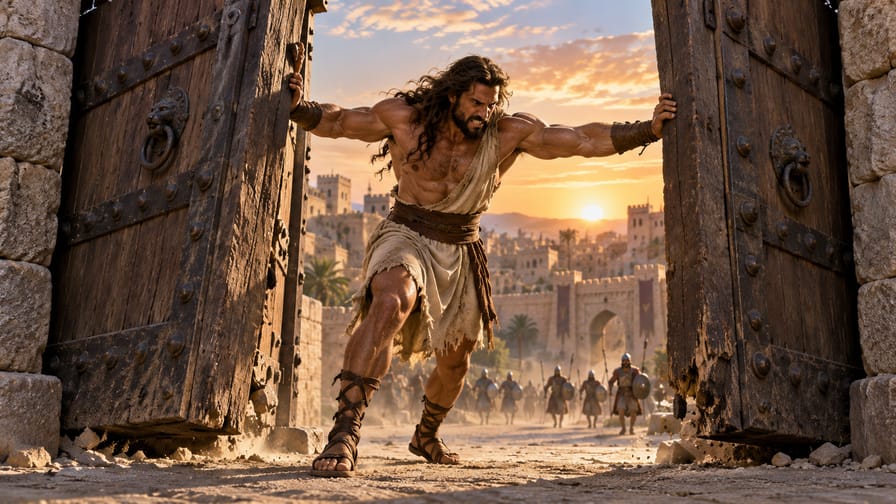
The figure of Samson (Hebrew: שִׁמְשׁוֹן, Shimshon) is one of the most enigmatic and complex in the Old Testament, emerging in the Book of Judges as the last of the great judges of Israel before the monarchy. His story, marked by superhuman strength, tumultuous passions, and a tragic destiny, offers rich layers for biblical and theological analysis. From an evangelical Protestant perspective, Samson is seen as a vivid example of divine sovereignty operating through imperfect human vessels, highlighting themes of election, obedience, the consequences of sin, and the redemptive grace of God.
The narrative of Samson not only illustrates the spiritual and political condition of Israel during the period of the judges but also points, in a contrasting and at times typological manner, to the need for a perfect Deliverer. His life serves as a mirror for the continuous struggle between divine calling and human weaknesses, revealing God's patience and purposes even amidst the disobedience of His people and His chosen leaders. His inclusion in the “roll of faith” in Hebrews 11 underscores the importance of his faith, despite his notorious failures.
1. Etymology and meaning of the name
The name Samson, in Hebrew שִׁמְשׁוֹן (Shimshon), derives from the Semitic root שֶׁמֶשׁ (shemesh), which means "sun." This root is present in various Semitic languages and is clearly identifiable in Hebrew. The transliteration into Portuguese maintains this sonority, although the original Hebrew pronunciation is with a sibilant "sh."
Literally, Shimshon can be interpreted as "man of the sun," "little sun," or "solar." Some scholars suggest that the name may be a diminutive, indicating a connection with the sun. Another interpretation is that it refers to a "servant" or "minister" of the sun, although this link to sun worship is unlikely given the monotheistic context of Israel, except perhaps as an ironic contrast.
The theological significance of the "solar" name is notable. Israel lived under the shadow of Philistine oppression, and Samson was raised up to be a "light" or "sun" for his people, dispelling the darkness of foreign domination. He was meant to bring illumination and deliverance, a role he fulfilled imperfectly but powerfully, through the strength God granted him.
The name does not appear for other biblical characters, making it unique to this judge. The uniqueness of the name reinforces the individuality of Samson's calling and the peculiarity of his story in the biblical canon. His connection with the sun may also symbolize the radiance and strength that emanated from him, although his life was marked by ups and downs, like the daily course of the sun.
Thus, the name Samson prefigures his function of bringing a type of "dawn" or "deliverance" to Israel, even if temporary. Samson's strength was like the energy of the sun, capable of destroying and illuminating, but also subject to eclipses in moments of weakness and personal disobedience. His life, therefore, is a paradox that his very name already hints at.
2. Historical context and biblical narrative
2.1. Period and socio-political context
The story of Samson is embedded in the Book of Judges, specifically in chapters 13 to 16, covering a period of approximately twenty years (Judges 15:20 16:31). This is the post-conquest period of the land of Canaan, before the establishment of the monarchy, characterized by a cycle of apostasy, foreign oppression, cries to God, and deliverance through charismatic judges. The setting is one of chaos and religious and social anarchy, where "everyone did what was right in his own eyes" (Judges 17:6 21:25).
The main external threat to Israel at this time were the Philistines, a sea people who settled on the southwestern coastal plain of Canaan. They were technologically advanced (mastering iron) and militarily superior, oppressing the tribes of Israel, especially those of Judah and Dan, for forty years (Judges 13:1). The tribe of Dan, of which Samson was a member, was particularly exposed to Philistine influence and domination.
2.2. Family origin and divine calling
The narrative of Samson begins with an angelic announcement to his parents, Manoah and his wife, who was barren (Judges 13:2-3). This pattern of miraculous birth to barren women is a recurring theme in the Bible, pointing to divine intervention in salvation history (e.g., Isaac, Samuel, John the Baptist). The angel of the Lord revealed that the son would be a Nazirite from his mother's womb (Judges 13:5).
The Nazirite vow (Hebrew: נָזִיר, nazir) involved three main prohibitions: not drinking wine or any product of the vine, not cutting one's hair, and not touching dead bodies (Numbers 6:1-21). For Samson, these restrictions were a sign of his separation and consecration to God, and his strength was intrinsically linked to his obedience to this vow, especially the prohibition against cutting his hair, which was the external symbol of his commitment.
2.3. Main events of his life
The life of Samson is a series of dramatic episodes that reveal his supernatural strength and his personal weaknesses. From a young age, he showed an attraction to Philistine women, which, although reprehensible from the perspective of Mosaic law (Deuteronomy 7:3), was part of the divine plan to provoke the Philistines (Judges 14:4).
His acts of strength include:
- Killing a lion with his bare hands (Judges 14:5-6).
- Killing thirty Philistines in Ashkelon because of a wager (Judges 14:19).
- Burning the Philistines' crops using three hundred foxes with torches (Judges 15:4-5).
- Killing a thousand Philistines with a jawbone of a donkey (Judges 15:15-16).
- Pulling up the city gates of Gaza and carrying them to a hill near Hebron (Judges 16:1-3).
The tragic turning point in his life was his involvement with Delilah, a Philistine woman bribed to discover the secret of his strength (Judges 16:4-5). After three frustrated attempts, Samson finally revealed that his strength resided in his uncut hair, the mark of his Nazirite vow. Delilah betrayed him, and his hair was cut while he slept, resulting in the loss of his strength and his capture by the Philistines (Judges 16:17-21). They blinded him and forced him to grind grain in prison.
However, the narrative culminates in a final act of faith and redemption. At a festival in honor of Dagon, the Philistine god, Samson was brought to entertain the crowd. With his hair already grown, he cried out to God one last time, asking for strength to avenge himself against the Philistines (Judges 16:28). God answered his prayer, and Samson pulled down the temple pillars, killing himself and more Philistines in his death than in his entire life (Judges 16:29-30). He was then buried in the tomb of Manoah, his father (Judges 16:31).
2.4. Geography related to the character
Samson's life unfolded mainly on the border between the territory of Israel and Philistia. His birthplace was Zorah (Judges 13:2), in the region of the tribe of Dan. Other important locations include Eshtaol, where the Spirit of the Lord began to stir him (Judges 13:25) Timnah, where he sought his first Philistine wife (Judges 14:1) Ashkelon, where he killed thirty Philistines (Judges 14:19) Lehi, where he killed a thousand men with the jawbone (Judges 15:9-17) Gaza, from which he pulled up the city gates (Judges 16:1-3) and the Valley of Sorek, Delilah's home (Judges 16:4).
This coastal and border geography is crucial for understanding the constant interaction and conflict with the Philistines, who were Israel's main enemy at that time. The location of the tribe of Dan, squeezed between the mountain and the coastal plain, explains its vulnerability and the need for a deliverer like Samson.
3. Character and role in the biblical narrative
3.1. Character analysis: Virtues and failures
Samson's character is a study of striking contrasts. He is a walking paradox, a man of extraordinary faith and profound moral failings. His life is a testament to God's grace operating even through imperfect instruments, but also a warning about the consequences of disobedience and self-confidence.
Among his virtues, Samson's faith is undeniable, being recognized in Hebrews 11:32. He trusted in God's empowering strength, and in his moments of crisis, he cried out to the Lord (Judges 15:18 16:28). His courage and intrepidity in facing the Philistines, often alone, demonstrate remarkable bravery. He was a man of action, driven by a sense of justice and vengeance against the oppressors of his people.
However, Samson's failures are equally prominent. His impulsiveness and lack of self-control were evident, especially in his relationships with Philistine women (Judges 14:1-3 16:1, 4). He demonstrated a dangerous complacency with sin, pursuing personal pleasures that often put him at risk and distanced him from his Nazirite vow. His arrogance and recklessness, as evidenced in his revealing the secret of his strength to Delilah, were his downfall.
Disobedience to the Nazirite vow, though subtle at first (touching the lion's carcass, Judges 14:9 perhaps consuming wine at feasts), culminated in the cutting of his hair, the external symbol of his consecration. This progression from small transgressions to a major failure is a cautionary theme in evangelical theology, illustrating how untreated sin can lead to ruin.
3.2. Calling and role as judge and deliverer
Samson's primary role was to be a judge of Israel, a deliverer raised up by God to begin to save His people from the hands of the Philistines (Judges 13:5). He was not a political or military leader in the traditional sense, one who organized armies or implemented social reforms. Instead, his actions were more those of a charismatic warrior, whose individual and spectacular deeds served to weaken Philistine power and instill hope in Israel.
Despite his personal failures, Samson was an instrument of divine sovereignty. God used his strength and even his wrong choices (such as his marriage to the woman of Timnah, Judges 14:4) to accomplish His purposes of judgment against the Philistines. His life is a clear example that God can use imperfect vessels to carry out His will, not because of the instrument's virtue, but because of God's faithfulness and power.
3.3. Character development and redemption
Samson's development is complex. For much of his life, he seems to act on personal impulses and vengeance, using divine power for his own ends. However, his imprisonment, blindness, and humiliation represent a turning point. It is at rock bottom that he seems to genuinely turn to God.
His final cry in Judges 16:28, asking for strength to avenge himself "because of my two eyes," may seem selfish at first glance. However, it is also a recognition of his total dependence on God. The divine response to this prayer demonstrates God's grace and mercy, granting Samson one last act of sacrificial service. His death, which caused the greatest defeat to the Philistines, is seen as an act of faith and redemption, securing his place in Hebrews 11.
4. Theological significance and typology
4.1. Role in redemptive history and progressive revelation
The story of Samson is fundamental to understanding Israel's redemptive history in the period of the judges. It reveals the people's persistent apostasy, the resulting oppression, and God's gracious intervention, who continuously raises up deliverers. Samson is part of the progressive revelation that Israel needed a deliverer, but also that human deliverers were flawed and insufficient.
His narrative underscores God's patience with His disobedient people and His determination to fulfill His promises, even when human instruments repeatedly fail. Divine sovereignty is a central theme: God uses Samson's choices, both good and bad, to advance His purposes against the Philistines (Judges 14:4).
4.2. Prefiguration or Christocentric typology
The typology of Samson in relation to Christ is complex and should be approached with caution, given his moral failures. Nevertheless, some parallels can be observed:
- Miraculous birth and angelic announcement: Both had births announced by angels, indicating a special divine calling (Judges 13:3-5 Luke 1:26-35).
- Consecration from the womb: Samson was a Nazirite from the womb, set apart for God. Christ was uniquely consecrated to the Father in His nature and mission.
- Empowerment by the Spirit: Samson was empowered by the Spirit of the Lord to perform supernatural feats (Judges 14:6, 19). Jesus operated in the power of the Holy Spirit (Luke 4:14 Acts 10:38).
- Deliverer of His people: Both were raised up to deliver their people, Samson from the Philistines and Christ from sin and death.
- Sacrificial death: Samson's death, though motivated by personal vengeance, resulted in the defeat of many enemies of Israel and was an act of sacrifice. Christ's death was the supreme and perfect sacrifice for the redemption of humanity.
- Divine sovereignty amidst betrayal: Both were betrayed (Samson by Delilah, Jesus by Judas), but God used these betrayals to fulfill His redemptive plans.
4.3. Connection with central theological themes
The story of Samson highlights several crucial theological themes:
- God's sovereignty and human freedom: God uses Samson despite his choices, but Samson is still responsible for them.
- The nature of sin and its consequences: Samson's life is a powerful reminder of how sin, especially lust and disobedience, can lead to personal ruin, even for those with a divine calling.
- God's grace in redemption: Samson's final act and God's response to his last prayer demonstrate God's grace in accepting repentance and using even the last moments of a flawed life for His purposes.
- The importance of obedience: Samson's strength was linked to his Nazirite vow. Disobedience to this vow led to the loss of his strength and his capture, illustrating the importance of obedience to God's revealed will.
5. Biblical-theological legacy and canonical references
5.1. Mentions in other biblical books
The primary reference to Samson outside the Book of Judges is found in Hebrews 11:32, in the famous "gallery of faith." He is listed among other heroes of faith such as Gideon, Barak, Jephthah, and David. This inclusion is significant because it validates his faith despite his many failures and highlights that God looks at the heart and at faith, even when life is not perfect. His faith is seen in his ultimate dependence on God for strength, which resulted in the defeat of the Philistines.
This mention in the New Testament is crucial for the evangelical interpretation of Samson, as it prevents us from reducing him to a mere anti-hero. Instead, he is a reminder that God uses real and imperfect people to fulfill His purposes, and that faith is the key to pleasing God, even amidst human frailties.
5.2. Influence on biblical theology and interpretive tradition
The story of Samson has profoundly influenced biblical theology and the Jewish and Christian interpretive tradition. In the Jewish tradition, he is often seen as a tragic hero, an example of Israel's potential and decline. His acts of strength are celebrated, but his weaknesses are used as a warning.
In the Christian tradition, especially in Reformed and evangelical theology, Samson is a case study on God's sovereign grace. He demonstrates that divine election and calling do not depend on the perfection of the individual, but on God's faithfulness. He is a testament to God's ability to work through flawed people, transforming even their mistakes into instruments of His will.
Commentators such as Matthew Henry emphasize God's sovereignty in using Samson to deliver Israel, despite his disordered passions. John Calvin, in commenting on Hebrews 11, highlights that Samson's faith is not seen in his "perfect" life, but in his trust in God in his final moment, demonstrating that faith is the principle that pleases God, even amidst great imperfections.
5.3. Importance for understanding the canon
The story of Samson is vital for understanding the biblical canon, especially for the narrative of the Book of Judges. It vividly illustrates the cycle of disobedience and oppression that characterized the period, but also the persistence of God's grace in raising up deliverers. Samson's failure to be a consistently pious judge and Israel's failure to consistently follow God point to the need for a righteous king and, ultimately, for the perfect Messiah.
His story serves as a bridge to the books of Samuel, which describe the transition to the monarchy. Samson's tumultuous life and the anarchy of his time set the stage for Israel's cry for a king, in the hope that a human leader could bring the order and deliverance that the judges, with their flaws, could not permanently ensure. Thus, he is an integral part of the grand narrative that culminates in Christ.
In summary, Samson remains a captivating and instructive figure in the canon. He reminds us of the power of sin, the need for self-control, the unwavering sovereignty of God, and the redemptive capacity of faith, even if manifested in a life full of paradoxes. His story is a powerful sermon on grace manifested in weakness and on the faithfulness of a God who fulfills His purposes through imperfect vessels.