


Othniel
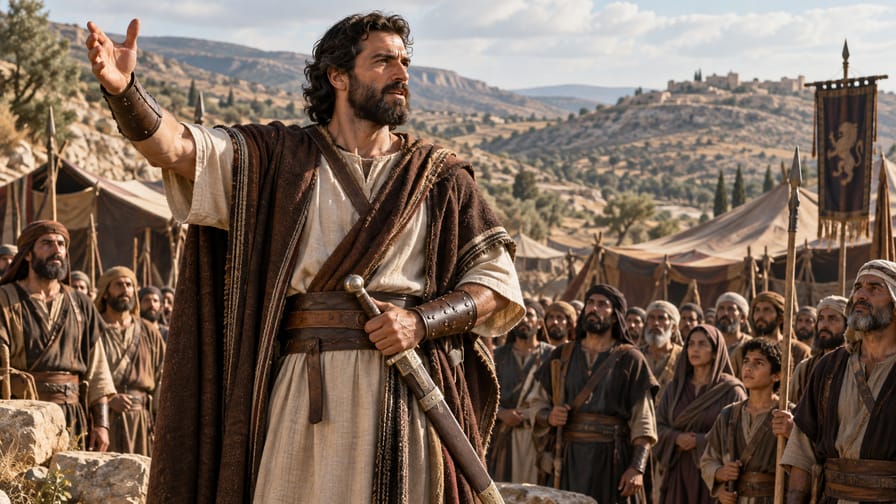
The figure of Othniel, the first of the judges of Israel, emerges in the Scriptures as a pillar of faith and courage, marking the beginning of a turbulent period in the history of the chosen people. His story, though concise, is profoundly significant, serving as a microcosm of the recurring themes in the book of Judges: the apostasy of the people, divine judgment manifested in foreign oppression, the cry for help, and the gracious intervention of God through a deliverer. The analysis of Othniel from a Protestant evangelical perspective reveals not only a human hero but also a divinely empowered instrument, whose actions prefigure the redemptive work of Christ.
This in-depth study will seek to unravel the layers of Othniel’s onomastic meaning, examine his historical context and the biblical narrative of his life, analyze his character and role, explore his theological and typological relevance, and finally, ponder his lasting legacy in the canon and in Reformed theology. Through careful exegesis and consideration of the original languages, we will seek to extract timeless lessons about the sovereignty of God, the necessity of obedience, and divine provision for salvation.
1. Etymology and meaning of the name
The name Othniel, in Hebrew עָתְנִיאֵל (‘Otniel), is a theophoric name that encapsulates a profound spiritual truth about the character's identity and role. Its structure is composed of two distinct elements: עֹתֶן (‘oten) and אֵל (‘El). The element ‘El is an abbreviated form of Elohim, meaning "God," a common component in Hebrew names that express a relationship with the divine.
The first element, עֹתֶן (‘oten), is more debated, but it is generally associated with concepts of "strength," "power," or "lion." Some scholars suggest it may derive from a root meaning "strength" or "vigor." Therefore, the name Othniel is commonly translated as "My strength is God," "God is my strength," or "Lion of God."
This etymology is not merely descriptive but deeply prophetic and theological for Othniel’s life. He was not strong in himself, but his strength came from God. In the context of Judges 3:10, when the "Spirit of the Lord came upon him," this divine empowerment manifested the truth inherent in his name. His strength to deliver Israel was not human, but divine, echoing the meaning of his own name.
There are no other prominent biblical characters with the same name, which makes Othniel singular in his mention. This uniqueness reinforces the idea that his name was given with a specific and prophetic purpose, reflecting the work God would accomplish through him. The absence of significant variations of the name in biblical languages attests to the consistency of its form and meaning throughout the canon.
The theological significance of the name lies in the confession of dependence on God. In a period of anarchy and idolatry, Othniel’s name serves as a constant reminder that the true strength of Israel, and of any individual or nation, resides in the Lord. It points to the truth that deliverance and salvation come exclusively from God, and not from human capability, a central theme in Protestant evangelical theology.
2. Historical context and biblical narrative
2.1. Period and setting
Othniel’s story is set in the period of the judges, an era spanning approximately 300 to 400 years after the death of Joshua and before the establishment of the monarchy in Israel, generally dated between 1375 and 1050 B.C. This was a time of transition, characterized by political and religious decentralization. The nation of Israel was in a cycle of apostasy, oppression by neighboring nations, crying out to God, and deliverance through charismatic judges, as described in Judges 2:16-19.
The political context was fragmented, with the Israelite tribes often acting independently and failing to completely eradicate the Canaanite peoples, disobeying divine commands (Judges 1:21-36). Socially, the absence of a king or strong central leadership led to the maxim "everyone did what was right in their own eyes" (Judges 17:6 21:25), resulting in moral and religious disorder. Religion was in decline, with the worship of Baalim and Ashtaroth replacing loyalty to Yahweh (Judges 2:11-13).
2.2. Genealogy and family origin
Othniel is presented as the son of Kenaz and, more notably, as the brother (or nephew, depending on the interpretation of ‘ach) of Caleb, the valiant spy and one of the few of the Exodus generation who entered the Promised Land (Joshua 14:6-15). This family connection is crucial. Caleb, from the tribe of Judah, was a man of unwavering faith and courage, characteristics that seem to have been inherited by or inspired in Othniel.
The lineage of Kenaz was a prominent clan within the tribe of Judah, and the mention of Othniel as "son of Kenaz" (Judges 1:13 3:9) firmly situates him within the royal tribe, which would later give rise to David and, prophetically, to Jesus Christ. His origin from Judah is significant, as this tribe was designated for leadership and preeminence among the twelve tribes of Israel (Genesis 49:8-10).
2.3. Main events of his life
Othniel’s life is narrated in two main passages, which complement each other. The first mention occurs in Joshua 15:13-19 and Judges 1:9-15, where he stands out for his bravery. Caleb offers his daughter Achsah in marriage to the man who would conquer Kiriath-sepher (also known as Debir), a fortified city in the territory of Judah. Othniel accepts the challenge, demonstrates great courage and success, and thus marries Achsah.
This initial feat establishes Othniel as a capable military leader and a man of action. Achsah, his wife, also plays an important role by asking Caleb for the springs of water, both the upper and lower springs, thereby ensuring the prosperity of her husband's inheritance and her own. This episode not only demonstrates Othniel's capability but also his connection with Caleb's family and the possession of the promised land.
The second and most significant narrative of Othniel is found in Judges 3:7-11. After the death of Joshua, the Israelites "did what was evil in the eyes of the Lord" (Judges 3:7), worshiping the Canaanite gods. As a consequence, God allowed Cushan-rishathaim, king of Mesopotamia, to oppress them for eight years. Faced with the severity of the oppression, the children of Israel "cried out to the Lord" (Judges 3:9).
In response to the people's cry, God raised up Othniel. The Scripture declares that "the Spirit of the Lord came upon him" (Judges 3:10), empowering him for the task of judge and deliverer. Othniel went to war against Cushan-rishathaim and defeated him, restoring peace and order. After his victory, "the land had rest for forty years" (Judges 3:11), a period of relative shalom under his leadership. His death is recorded at the end of this period of rest.
2.4. Geography and relationships
The geography associated with Othniel is centered in the southern region of Judah. Caleb gave him Hebron and its surroundings as an inheritance (Joshua 15:13), and the conquest of Kiriath-sepher (Debir) consolidated his presence in this mountainous area. His judgeship, though not explicitly restricted to one region, probably had its epicenter in Judah, given his tribal origin. The mention of Cushan-rishathaim as king of Mesopotamia (Aram Naharaim) indicates the extent of the threat Israel faced, coming from a distant and powerful region.
His most important relationships are with Caleb, his relative and mentor, and with Achsah, his wife. The connection with Caleb associates him with a lineage of faith and obedience, while his marriage to Achsah demonstrates not only his bravery but also divine providence in the formation of his family. He is the first in a series of judges, setting the standard for those who would come after him.
3. Character and role in the biblical narrative
3.1. Analysis of character and qualities
Othniel’s character, as revealed in the brief biblical passages, is markedly positive, serving as a model of godly and courageous leadership. His first appearance already shows him as a man of initiative and bravery in accepting Caleb’s challenge to conquer Kiriath-sepher (Judges 1:13). This action demonstrates a practical faith and a willingness to face great obstacles in the name of God's promise.
One of Othniel’s most prominent qualities is his obedience and readiness to serve God. When Israel cries out for deliverance, it is Othniel whom God raises up. The Scripture highlights that "the Spirit of the Lord came upon him" (Judges 3:10), indicating a divine empowerment for his calling. This is not mere natural ability, but a supernatural empowerment, essential for the fulfillment of his mission.
He demonstrates effective military leadership, gathering the people and leading them to victory against the oppressor. His ability to judge (Judges 3:10) implies wisdom, justice, and discernment, indispensable qualities for a spiritual and civil leader. The absence of any documented flaw or sin in his narrative distinguishes him from many other biblical leaders, presenting him as an example of faithfulness.
3.2. Calling and specific function
Othniel’s calling is clear: to be a judge (שֹׁפֵט, shofet) and deliverer (מֹשִׁיעַ, moshia’) for Israel. He is the first to inaugurate the office of judge, setting the standard by which other judges would be evaluated. His role was not only military the judges exercised judicial, administrative, and religious functions, acting as charismatic leaders raised up by God to govern and guide the people.
The text of Judges 3:10 states that he "judged Israel," which implies that, in addition to his military victory, he also administered justice and taught God's law to the people. He was God's instrument to restore order and peace, bringing Israel out of servitude and leading them back, albeit temporarily, to obedience to the Lord. His function was to mediate divine justice and the deliverance of his people.
3.3. Significant actions and key decisions
Two actions stand out in Othniel’s life. The first is his conquest of Kiriath-sepher, which not only secured his marriage to Achsah but also demonstrated his courage and military capability even before he was formally called as judge (Judges 1:13). This initial victory may have been a preparation for his larger role, showing his aptitude for leading in battle.
The second and most crucial action was his leadership in delivering Israel from Cushan-rishathaim. His decision to respond to God's call, trusting in the empowerment of the Spirit of the Lord, was fundamental to the history of Israel. He did not hesitate to confront a powerful enemy, and his victory brought a period of peace and rest of forty years (Judges 3:11), the longest period of peace recorded for any judge until Samuel.
Othniel’s development in the narrative is direct: from a brave warrior who conquers a city to win a bride, he is elevated to a national leader, divinely anointed to deliver his people. His narrative is an example of how God can use faithful and courageous individuals to fulfill His purposes, even in times of great apostasy and disorder. He remains a model of Spirit-empowered leadership.
4. Theological significance and typology
4.1. Role in redemptive history and progressive revelation
Othniel plays a crucial role in the redemptive history of Israel and in the progressive revelation of God's plan. His story, the first in the cycle of the judges, establishes the pattern for divine intervention in times of apostasy and oppression. He demonstrates God's faithfulness to His covenant, even when Israel is unfaithful. God never completely abandons His people, but always provides a way for restoration when there is repentance and crying out.
His appointment as judge is a manifestation of divine grace in the midst of judgment. The oppression by Cushan-rishathaim was a direct judgment upon Israel's idolatry (Judges 3:7-8), but the raising up of Othniel was an act of mercy. This illustrates the theological principle that God is just in His judgment, but also rich in mercy toward those who turn to Him.
4.2. Prefiguration or Christocentric typology
The figure of Othniel, as the first divinely empowered deliverer, serves as a type or prefiguration of Christ, the supreme Deliverer. Christocentric typology views Old Testament characters, events, and institutions as shadows or patterns that point to the full reality found in Jesus Christ. In Othniel, we can identify several connections:
- Divinely Chosen Deliverer: Just as Othniel was raised up by God to deliver His people from bondage and oppression (Judges 3:9), Jesus Christ is God's chosen Deliverer to rescue humanity from the bondage of sin and death (John 8:36 Romans 6:22-23).
- Empowerment by the Spirit: The phrase "the Spirit of the Lord came upon him" (Judges 3:10) is central to Othniel’s work. In an analogous and infinitely superior way, Jesus Christ was anointed by the Holy Spirit for His messianic mission (Isaiah 61:1 Luke 4:18-19 Acts 10:38). Empowerment by the Spirit is a distinguishing mark of both deliverers.
- Conquest of Enemies and Restoration of Peace: Othniel defeated the oppressive king and brought "rest" (שֶׁקֶט, sheqet) to the land for forty years (Judges 3:10-11). Jesus Christ, through His death and resurrection, defeated the powers of sin, death, and Satan (Colossians 2:15 Hebrews 2:14-15), and offers true peace (John 14:27 Romans 5:1). The rest that Othniel brought was temporary, but the rest in Christ is eternal.
- Righteous Judge: Othniel’s role as "judge of Israel" (Judges 3:10) points to Christ as the righteous Judge of the living and the dead (Acts 10:42 2 Timothy 4:1). Both exercise authority to bring order and justice.
4.3. Connection with central theological themes
Othniel’s story reinforces several central theological themes in the Protestant evangelical perspective. Firstly, the sovereignty of God is evident, as He raises up and empowers His instruments according to His will and timing (Psalm 75:6-7). Secondly, human depravity is illustrated by Israel's constant apostasy, showing the necessity of divine intervention for salvation (Romans 3:23). Israel's cry and God's response highlight divine grace and mercy (Ephesians 2:8-9).
Obedience and faith are also underscored, as Othniel acted in faith and obedience to the divine call. His story teaches that true strength for the Christian life and for service to God comes from the empowerment of the Holy Spirit, not from self-reliance (Zechariah 4:6). The narrative of Othniel, therefore, is not merely a historical record, but a living lesson about the dynamic of salvation and life with God.
5. Biblical-theological legacy and canonical references
5.1. Mentions in other biblical books
The figure of Othniel is primarily delineated in the book of Judges, but he is also mentioned in other parts of the canon, reinforcing his importance. His first appearance, as already noted, is in Joshua 15:13-19, where his bravery is rewarded with marriage to Achsah and the springs of water. This mention in Joshua serves to connect the possession of the promised land with the lineage of Caleb and, by extension, with Othniel.
An additional genealogical mention is found in 1 Chronicles 4:13, where Othniel is listed as the son of Kenaz and father of Hathath, and his brother Seraiah is the father of Joab, the father of Ge-Harasim. This genealogy, though brief, firmly situates Othniel within the tribe of Judah and highlights his importance in the lineage of Israel. These references, though not expanding his narrative, confirm his historical existence and his place in Israel's memory.
5.2. Influence on biblical theology
Othniel’s influence on biblical theology resides primarily in his role as the first judge, establishing the paradigm for the period of the judges. He demonstrates the cyclical nature of Israel's relationship with God: sin, oppression, crying out, and deliverance. This repetition is not merely historical, but theological, illustrating God's patience, His justice, and His unwavering mercy, as articulated by John Gill in his commentaries on Judges.
The empowerment by the Spirit of the Lord in Othniel (Judges 3:10) is a crucial theological point. It prefigures the anointing of the Messiah and the outpouring of the Holy Spirit in the New Testament to empower believers. Reformed and evangelical theology emphasizes that all true strength and wisdom for service to God come from the Spirit, and Othniel is a prime example of this truth in the Old Testament.
5.3. Treatment in Reformed and evangelical theology
In Reformed and evangelical theology, Othniel is often studied as an example of godly leadership and dependence on God. Commentators like Matthew Henry and Keil & Delitzsch highlight his courage and divine providence in raising him up. He is seen as a testimony to God's faithfulness in preserving His people, even in their unfaithfulness. Daniel Block, in his work on Judges, emphasizes God's sovereignty in choosing and empowering His instruments.
His story is used to illustrate the doctrine of common grace and saving grace, showing how God interacts with humanity. It is also a reminder of the necessity of prayer and repentance, as Othniel’s deliverance was a response to Israel's cry. The forty years of peace he brought is often contrasted with the eternal peace offered by Christ, reinforcing the typology.
5.4. Importance for understanding the canon
Othniel’s importance for understanding the biblical canon lies in his inaugural position. He is the starting point for the narrative of the judges, a period that bridges the conquest of the land under Joshua and the establishment of the monarchy under Samuel and Saul. His story establishes the themes and patterns that will be repeated and developed in subsequent accounts of the judges, preparing the ground for the need of a righteous king, who will ultimately point to the King of kings, Jesus Christ.
In summary, Othniel is more than a military hero he is an agent of divine providence, whose name, character, and actions resonate with profound theological truths about God's strength, deliverance, and Spirit-empowered leadership. He remains a significant figure for Protestant evangelical faith, a testimony to God's faithfulness in all generations.