


Nicodemus
1. Etymology and Meaning of the Name
The name Nicodemus, found exclusively in the Gospel of John, has its origin in ancient Greek, Nikodēmos (Νικόδημος). It is composed of two significant Greek roots: nikos (νῖκος), meaning "victory," and dēmos (δῆμος), meaning "people" or "population."
Thus, the literal meaning of the name Nicodemus is "victory of the people" or "victor of the people." There is no direct equivalent in Hebrew or Aramaic for this specific name, as it is Hellenistic in nature, common in the Jewish Diaspora and in circles influenced by Greek culture in first-century Judea.
Although the name itself does not carry an inherent theological or explicit prophetic significance in the biblical narrative, it can be interpreted symbolically in light of the character's development. The "victory" that Nicodemus experiences is not over a people in a political or military sense, but rather a personal victory over fear and spiritual ignorance, culminating in a public confession of faith in Jesus Christ.
He represents a "victory" for the "people" of God, by demonstrating that even members of the religious elite could be reached by the grace and truth of the Gospel. His journey from a secret inquirer to a courageous disciple illustrates the transformation wrought by the Holy Spirit.
There are no other biblical characters with the exact name of Nicodemus. His uniqueness in the biblical canon highlights the importance of his narrative and the theological dialogues in which he is involved, making him a memorable and instructive figure.
The name, therefore, acquires a retrospective theological significance, mirroring the overcoming of his own prejudices and fears to embrace the truth revealed by Jesus, a true victory of faith that becomes a testimony to the people.
2. Historical Context and Biblical Narrative
Nicodemus emerges in the biblical narrative at the beginning of the first century A.D., during the earthly ministry of Jesus Christ. This period was marked by the Roman occupation of Judea, which generated significant political and religious tensions among the Jews.
Jewish society was stratified and profoundly religious, with various sects and parties vying for influence, such as the Pharisees, Sadducees, and Essenes. The Sanhedrin, the highest Jewish religious and political court, held great power over the lives of the people.
Nicodemus is presented as "a man of the Pharisees" and "a ruler of the Jews" (John 3:1). His position as a Pharisee indicates that he was a scholar of the Mosaic Law, a devout observer of traditions, and a respected member of the religious and intellectual elite. His mention as "a ruler" suggests that he was part of the Sanhedrin.
His specific genealogy is not detailed in the Scriptures, which is common for characters who do not play a messianic or foundational genealogical role. However, his social and religious position is clearly established, denoting his prominence in Jewish society at the time.
2.1 Nicodemus's Encounters with Jesus
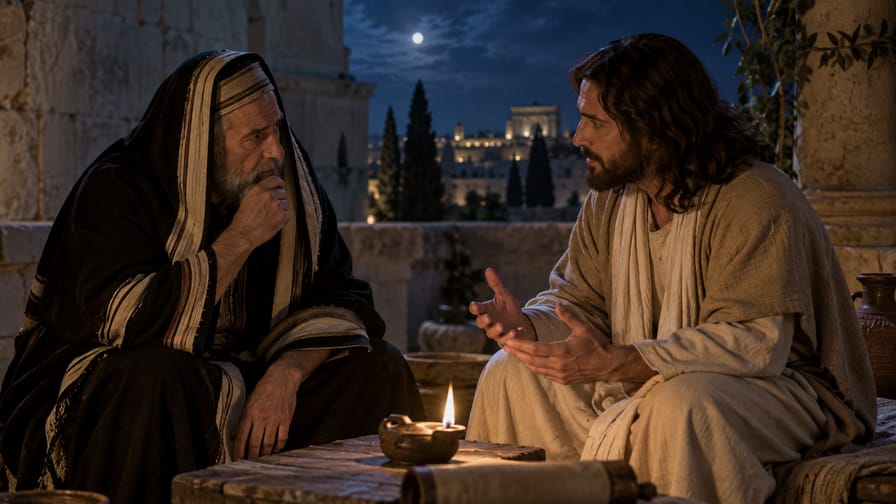
Nicodemus's life in the biblical narrative is punctuated by three crucial interactions with Jesus, all recorded in the Gospel of John. The first and most famous encounter occurs at night, as described in John 3:1-21. He seeks Jesus secretly, perhaps out of fear of his peers or desiring a more intimate and uninterrupted conversation.
In this nocturnal conversation, Nicodemus recognizes Jesus as "a teacher come from God," evidencing his perception of the divine origin of Jesus' miracles (John 3:2). Jesus then introduces the radical concept of the new birth, stating that "unless one is born again he cannot see the kingdom of God" (John 3:3).
The dialogue reveals Nicodemus's difficulty in understanding the spiritual nature of the kingdom, questioning how an adult could "enter a second time into his mother's womb" (John 3:4). Jesus explains that the birth is "of water and the Spirit" (John 3:5), distinguishing between physical and spiritual birth.
The second episode involving Nicodemus occurs during the Feast of Tabernacles, when the chief priests and Pharisees send guards to arrest Jesus (John 7:45-52). After the guards return without Jesus, the Pharisees rebuke them, and Nicodemus intervenes.
He questions the legality of condemning Jesus without a hearing and without proof, citing the Mosaic Law: "Does our law judge a man before it hears him and knows what he is doing?" (John 7:51). This intervention, though cautious, demonstrates a growing sympathy for Jesus and a defense of justice.
The third and final record of Nicodemus occurs after the crucifixion of Jesus, in John 19:38-42. Here, he appears alongside Joseph of Arimathea, another secret disciple and member of the Sanhedrin. Together, they take responsibility for preparing Jesus' body for burial.
Nicodemus brings a mixture of myrrh and aloes, about a hundred pounds (approximately 34 kg), an extremely generous and costly amount, worthy of a royal burial (John 19:39). This public and courageous act contrasts sharply with his initial nocturnal visit and marks the full manifestation of his faith.
The main geography associated with Nicodemus is Jerusalem, the center of Jewish religious life and the setting for all his encounters with Jesus. His most important relationships are with Jesus, Joseph of Arimathea, and, antagonistically, with the other members of the Sanhedrin who opposed Christ.
3. Character and Role in the Biblical Narrative
The character of Nicodemus is progressively revealed in the Scriptures, showing a remarkable evolution from a cautious inquirer to a courageous disciple. Initially, he presents himself as an intellectual and a seeker of truth, coming to Jesus under the cloak of night (John 3:2), which suggests a mixture of respect and fear.
His virtues include genuine intellectual curiosity and honesty in recognizing the divine signs in Jesus. He was not a fierce opponent like many of his fellow Pharisees instead, he was open to the possibility that Jesus was "a teacher come from God" (John 3:2), which demonstrates a less prejudiced mind.
Nicodemus's initial weakness was undoubtedly the fear of the social and political implications of his association with Jesus. His position as "a ruler of the Jews" (John 3:1) put him at risk of ostracism and loss of prestige if his sympathy for Jesus became public. This fear is evident in his nocturnal visit.
His vocation was that of "a teacher of Israel" (John 3:10), which implied a deep knowledge of the Law and the Scriptures. However, Jesus confronts him with his lack of understanding of spiritual realities, despite being an instructor of God's people, challenging the sufficiency of merely intellectual knowledge.
Nicodemus's role in the biblical narrative is multifaceted. He serves as an example of a religious and morally respectable person who, despite his erudition and position, still needed the radical transformation of the new birth. He personifies the spiritual blindness that can affect even the most learned.
His significant actions include the dialogue with Jesus about the new birth, which became a cornerstone of Christian theology. His defense of Jesus before the Sanhedrin (John 7:51) shows a growth in courage and a commitment to justice, even if still indirect.
The culmination of his character development is his participation in the burial of Jesus (John 19:39). This act was not merely a gesture of respect, but a public declaration of loyalty to a condemned and crucified man, an act of great personal risk that demonstrates the overcoming of his initial fear.
Nicodemus's journey illustrates that true faith often requires overcoming social and personal obstacles. He represents those who, though initially hesitant, are finally compelled by the truth of Christ to make a public confession, regardless of the cost.
4. Theological Significance and Typology
The theological significance of Nicodemus lies primarily in his dialogue with Jesus about the new birth, recorded in John 3:1-21. This text is foundational for Christian soteriology, revealing the absolute necessity of spiritual regeneration for salvation and entry into the Kingdom of God.
The conversation emphasizes that salvation is not achieved by lineage, works of the law, intellectual knowledge, or religious position, but by a sovereign work of the Holy Spirit. Jesus declares: "Unless one is born of water and the Spirit, he cannot enter the Kingdom of God" (John 3:5), distinguishing between physical birth ("of the flesh") and spiritual birth ("of the Spirit").
This concept of new birth is a central doctrine in the evangelical Protestant perspective, which emphasizes the total depravity of the human being and the necessity of divine intervention for the transformation of the heart. Nicodemus, a teacher of the Law, illustrates that human wisdom and religiosity are not sufficient to comprehend or experience spiritual realities.
The dialogue also introduces the image of the bronze serpent lifted up in the wilderness (Numbers 21:8-9) as a prefiguration of Christ's crucifixion: "And as Moses lifted up the serpent in the wilderness, so must the Son of Man be lifted up" (John 3:14). This is a clear Christocentric typology, where physical healing by faith in the bronze serpent points to eternal salvation by faith in the crucified Christ.
The passage in John 3 also contains one of the most well-known and beloved verses in the Bible, John 3:16: "For God so loved the world, that he gave his only Son, that whoever believes in him should not perish but have eternal life." This verse summarizes the core of the gospel, highlighting God's love, Christ's sacrifice, and the condition of faith for salvation.
Although Nicodemus is not a typological figure in the sense of prefiguring Christ, his experience is a paradigm of the spiritual journey. He represents the individual who, despite his position or knowledge, needs to be humbled and transformed by divine revelation and the regenerating power of the Holy Spirit.
His story connects to central theological themes such as God's sovereign grace in salvation, the necessity of faith in Christ as the only way to eternal life, and human incomprehension of spiritual things without divine illumination. He embodies the tension between law and grace, flesh and spirit, light and darkness.
Nicodemus's evolution from a nocturnal seeker to a public and bold disciple demonstrates the transformative power of the Gospel and the Spirit's capacity to work faith and courage, even in initially hesitant hearts. He is a testimony to the truth that "the light has come into the world, but people loved the darkness instead of light" (John 3:19), and also to the possibility of coming to the light.
5. Biblical-Theological Legacy and Canonical References
The figure of Nicodemus is mentioned exclusively in the Gospel of John, without references in other books of the biblical canon. His importance, however, is not diminished by this concentration, as his interactions with Jesus provide crucial theological foundations for the Christian faith.
There are no literary contributions attributed to Nicodemus in the biblical canon. Although there are apocryphal works, such as the so-called Gospel of Nicodemus (also known as the Acts of Pilate), these are not considered part of the inspired Scriptures and are generally dated centuries after the biblical event, reflecting legendary and not historical traditions.
The influence of Nicodemus on biblical theology is immense, particularly through the dialogue in John 3. This text is the primary source of the doctrine of the new birth or regeneration, a vital concept for understanding salvation in evangelical Protestant theology. Theologians such as John Calvin and Martin Luther, as well as modern commentators like D.A. Carson and F.F. Bruce, frequently turn to this chapter to articulate the nature of conversion.
Nicodemus's story serves as a powerful illustration of the truth that salvation is by grace through faith, and not by works or personal merit (Ephesians 2:8-9). He, being a Pharisee and a teacher in Israel, represents the pinnacle of religiosity and knowledge of the Law, yet still needed a radical transformation wrought by the Holy Spirit.
In the Christian interpretive tradition, Nicodemus is often seen as a model of the sincere seeker who, despite his initial limitations and fears, is led to full faith. His journey from a secret encounter at night to a public act of discipleship at Jesus' burial is a testimony to the transformative power of the Spirit.
Reformed and evangelical theology emphasizes God's sovereignty in regeneration, as expressed in the image of the wind in John 3:8, which "blows where it wishes." Nicodemus's experience is cited to show that the new birth is a mysterious and divine work, beyond human comprehension or control, essential for entry into the Kingdom of God.
His importance for understanding the canon lies in his contribution to the clarity of the New Testament's soteriological message. He underscores the universality of the need for salvation, which transcends social, intellectual, and religious barriers. Nicodemus's story is a perennial reminder that "there is no distinction: for all have sinned and fall short of the glory of God" (Romans 3:23), and all need to be born again.
The legacy of Nicodemus, therefore, is that of a figure who, though briefly mentioned, is central to the articulation of fundamental doctrines of the Christian faith, especially regeneration and saving faith. He continues to inspire and instruct believers about the depth of transformation that Christ offers.