


Joash
1. Etymology and Meaning of the Name
The name Joash (Hebrew: יְהוֹאָשׁ, Yeho'ash or יוֹאָשׁ, Yo'ash) is composed of theophoric elements that connect it directly to the name of God, Yahweh. The longer form, Yeho'ash, begins with the prefix Yeho-, an abbreviation of Yahweh (יהוה). The shorter form, Yo'ash, uses the abbreviation Yo-, also referring to Yahweh.
The second element of the name, 'ash (אש), is interpreted by scholars in various ways, which leads to some variations in the proposed meaning for Joash. Some suggest that 'ash derives from the root meaning "fire" or "man," resulting in "Yahweh is fire" or "Yahweh is man," although these are less common. The most widely accepted and linguistically founded interpretation is that 'ash comes from the root meaning "to give" or "to support," or even from a root related to "strength."
Thus, the predominant meaning for Joash is "Yahweh gave" or "Yahweh has given," or "Yahweh is strong" and "Yahweh has supported." This interpretation of "Yahweh gave" reflects gratitude and divine dependence, a recurring theme in the naming of children in the Old Testament, especially in contexts of deliverance or blessing. For King Joash of Judah, whose birth and ascent were marked by providential divine intervention, this meaning resonates deeply.
There are other biblical figures named Joash. A notable Joash is Gideon's father, from the tribe of Abiezer, who was a worshiper of Baal before divine intervention through his son (Judges 6:11, 29-31). There is also a Joash, son of Ahaziah, who appears in a genealogy (1 Chronicles 7:8), but he is not the king of Judah.
The theological significance of the name Joash for the king of Judah is notable. His name, "Yahweh gave," ironically contrasts with his reign, which began under divine provision but ended in apostasy and judgment. The life of Joash, in a sense, became an example of how divine gift can be scorned and Yahweh's strength challenged by human infidelity.
2. Historical Context and Biblical Narrative
2.1. Historical Period and Context
King Joash of Judah reigned for 40 years, approximately between 835 and 796 BC. His reign occurred during a period of great political and religious turmoil in the history of Israel and Judah. He ascended to the throne at a very young age, which marked the beginning of his rule under the guardianship of the high priest Jehoiada.
The political context was complex, with the Northern Kingdom (Israel) and the Southern Kingdom (Judah) frequently in conflict or under the threat of regional powers like Aram (Syria). Religiously, Judah was in a state of spiritual decline, influenced by the idolatry introduced by Ahab and Jezebel through their daughter Athaliah, Joash's grandmother. Athaliah's usurpation of the throne, which attempted to exterminate the Davidic lineage, represented one of the darkest moments for the monarchy of Judah.
2.2. Genealogy and Family Origin
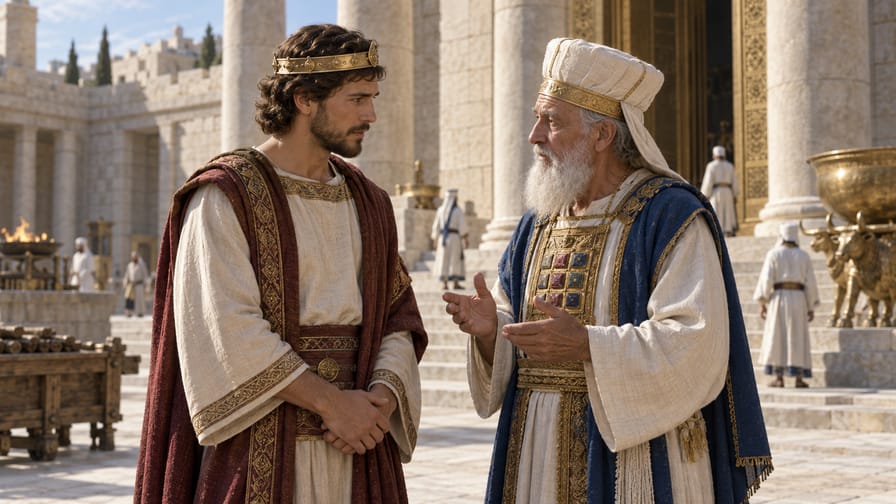
Joash was the son of King Ahaziah of Judah and grandson of Queen Athaliah. His genealogy is crucial to understanding divine providence in his ascent. After Ahaziah's death, his mother, Athaliah, murdered all the royal heirs to usurp the throne, but Joash, still a baby, was rescued by his aunt Jehosheba, Ahaziah's sister (and therefore Athaliah's half-sister), and by her husband, the high priest Jehoiada.
They hid him in the Temple of the Lord for six years (2 Kings 11:1-3 2 Chronicles 22:10-12), thus preserving the Davidic lineage. This act was a turning point in Judah's history, demonstrating God's faithfulness to His covenant with David (2 Samuel 7:12-16), which promised a perpetual successor to his throne. The survival of Joash was a miracle of divine grace.
2.3. Main Events of Life and Reign
The narrative of Joash's life is detailed in 2 Kings 11-12 and 2 Chronicles 23-24. At seven years of age, Joash was anointed king in a revolt led by Jehoiada, who deposed and executed Athaliah (2 Kings 11:4-16 2 Chronicles 23:1-15). This event restored the Davidic monarchy and the worship of Yahweh in Jerusalem.
During most of his initial reign, Joash "did what was right in the eyes of the Lord all the days in which the priest Jehoiada instructed him" (2 Kings 12:2 2 Chronicles 24:2). His most notable act during this period was the restoration and repair of the Temple of the Lord, which had been neglected and damaged during the reigns of Athaliah and her predecessors (2 Kings 12:4-16 2 Chronicles 24:4-14). He instituted a system for raising funds and diligently supervised the works.
However, after the death of Jehoiada, Joash's mentor and guardian, the king began to stray from the Lord. He succumbed to the influence of Judahite princes who instigated him to abandon the Temple of the Lord and worship Asherah poles and images (2 Chronicles 24:17-18). This apostasy led to the rebuke of the prophet Zechariah, son of Jehoiada.
In an act of ingratitude and wickedness, Joash ordered the death of Zechariah, who was stoned in the court of the Temple (2 Chronicles 24:20-22). This event is particularly tragic, as Zechariah was the son of the man who saved and protected Joash, and his martyrdom was remembered as an act of shedding innocent blood.
As a consequence of his apostasy and the murder of Zechariah, Judah was invaded by the Syrians under the command of Hazael. Although the Syrian army was smaller, God used it to judge Joash and his people (2 Chronicles 24:23-24). Joash was forced to hand over the treasures of the Temple and the palace to Hazael (2 Kings 12:17-18).
Wounded and humiliated by the Syrian incursion, Joash was assassinated by his own officers, Jozachar and Jozabad, at Beth-Millo (2 Kings 12:20-21 2 Chronicles 24:25-26). He was buried in the City of David, but not in the tombs of the kings, which indicates the disfavor into which he fell. His son, Amaziah, succeeded him.
3. Character and Role in the Biblical Narrative
3.1. Analysis of Character and Virtues
Joash's character is complex and markedly divided into two distinct phases, strongly influenced by his associations. In his early years, under Jehoiada's guardianship, Joash demonstrated admirable qualities of piety and zeal for the worship of Yahweh. His readiness to restore the Temple is proof of his good intention and initial obedience (2 Kings 12:4-5 2 Chronicles 24:4-5).
He not only initiated the project but also showed persistence when the work stalled, holding the priests accountable and implementing an effective system for raising funds and supervising the works (2 Kings 12:6-15). This initiative reveals a king with administrative capacity and a genuine concern for the house of God, at least as long as Jehoiada was alive to guide him.
3.2. Sins, Weaknesses, and Moral Failures
Joash's main weakness lay in his excessive dependence on Jehoiada's influence. He was a king who "did what was right in the eyes of the Lord all the days in which the priest Jehoiada instructed him" (2 Kings 12:2 2 Chronicles 24:2), implying that his righteousness was not intrinsic but conditional. After Jehoiada's death, Joash revealed a lack of deep personal conviction and quickly yielded to the pressure of idolatrous counselors (2 Chronicles 24:17-18).
His apostasy was drastic: he and the people abandoned the Temple of the Lord to serve idols. The culmination of his moral failure was the assassination of Zechariah, Jehoiada's son, who confronted him prophetically (2 Chronicles 24:20-22). This act not only demonstrated extreme ingratitude but also a direct rejection of God's word and a disregard for the sanctity of life.
Joash's response to the Syrian invasion also exposed his weakness and lack of faith. Instead of trusting in God, he plundered the Temple's treasures to bribe Hazael, king of Syria (2 Kings 12:17-18), an action that demonstrated more worldly pragmatism than divine trust. His death by assassination by his own servants is a testament to the discontent and degeneration of his reign.
3.3. Role and Character Development
Joash's role in the biblical narrative is multifaceted. He is, initially, a symbol of God's faithfulness in preserving the Davidic lineage, a vital link in the messianic genealogy. His ascent to the throne through Jehoiada's intervention is a testament to divine sovereignty over human wickedness (Athaliah).
However, the development of his character is tragic. He begins as a promising king, a Temple reformer, but ends as an apostate and murderer, a clear example of how external influence can mold, but not necessarily transform, the heart. His story serves as a powerful warning about the need for personal and unwavering faith, not merely dependent on godly mentors.
The narrative of Joash illustrates the fragility of faith without deep roots and the dangerous influence of bad company. His reign shows that even an auspicious beginning under divine blessing can be undone by disobedience and the rejection of God's Word, leading to severe consequences for both the individual and the nation.
4. Theological Significance and Typology
4.1. Role in Redemptive History and Progressive Revelation
The story of Joash plays a crucial role in the redemptive history of the Old Testament, mainly due to its connection with the preservation of the Davidic lineage. His miraculous survival of Athaliah's attempt at extermination ensured the continuity of the promise made to David that he would always have a descendant on the throne (2 Samuel 7:12-16). Without Joash, the messianic lineage would have been broken, threatening the fulfillment of the promise of the Messiah.
In this sense, the story of Joash is a vivid demonstration of God's unwavering faithfulness to His covenant, even in the face of the deepest human wickedness and betrayal. The divine providence that hid him and elevated him to the throne is a testament to Yahweh's sovereignty over the evil plans of men, ensuring the path for the coming of Christ.
4.2. Christocentric Typology and Covenants
The figure of Joash is not typologically strong in the sense of directly prefiguring Christ in a positive way. On the contrary, his life serves more as a contrast or a negative example, illustrating the need for a king with a truly transformed heart and an unwavering faith. While Joash fails in his faithfulness, Christ is the perfect King who never falters in His obedience to the Father.
Nevertheless, the preservation of Joash is an indispensable link in the chain of the Davidic covenant that culminates in Jesus Christ. God's faithfulness in maintaining the royal seed of David through Joash indirectly points to the absolute certainty of the fulfillment of the messianic promise in Jesus (Luke 1:32-33 Romans 1:3). The story of Joash reinforces that, despite the failures of human kings, God's promise is infallible.
4.3. Connection with Theological Themes
Joash's life illustrates several central theological themes. First, the importance of godly influence: while Jehoiada was alive, Joash did what was right. This underscores the need for spiritual mentorship and the fragility of faith that is not internalized and personal, but dependent on others.
Second, the gravity of apostasy and its consequences. The abandonment of Yahweh worship and the persecution of God's prophets resulted in divine judgment, manifested in the Syrian invasion and Joash's violent death. This is a vivid reminder that God judges unfaithfulness, especially that of leaders (2 Chronicles 24:23-25).
Third, the persistence of sin and the need for genuine repentance. Despite being saved and elevated by God, Joash allowed his heart to harden, culminating in the murder of Zechariah, who cried out: "May the Lord see and avenge!" (2 Chronicles 24:22). This cry is a prefiguration of the divine justice that would come upon the nation.
Although there are no direct quotes of Joash in the New Testament, the story of Zechariah, son of Berechiah (whom some identify with Zechariah, son of Jehoiada), is mentioned by Jesus in Matthew 23:35 and Luke 11:51, as one of the righteous whose blood was shed, from Abel. This provides a New Testament perspective on the gravity of Joash's sin and the long history of prophetic rejection by Israel.
5. Biblical-Theological Legacy and Canonical References
5.1. Mentions in Other Biblical Books and Contributions
The figure of Joash is primarily described in the books of 2 Kings (chapters 11-12) and 2 Chronicles (chapters 22-24). These are the canonical sources that provide us with the wealth of detail about his life, reign, and the consequences of his choices. There are no other biblical books where Joash is the main focus or to which he contributed literary authorship.
However, Jesus' mention of Zechariah's martyrdom in Matthew 23:35 and Luke 11:51, referring to the "blood of Abel to the blood of Zechariah, son of Berechiah, whom you murdered between the temple and the altar," is an indirect and powerful reference to Joash's reign. This passage highlights the depth of Joash's sin and places him among the persecutors of the righteous, from the beginning of biblical history.
5.2. Influence on Biblical Theology and Interpretative Tradition
The story of Joash has significant influence on biblical theology, serving as a case study on the nature of faith, the importance of persistent obedience, and the consequences of apostasy. For Reformed and evangelical theology, Joash is often cited as an example of external faith or "historical faith" that is not accompanied by a true transformation of the heart.
Commentators like Matthew Henry and John Gill, and more modern theologians like John Walton and Walter Kaiser, frequently use Joash to illustrate the truth that salvation is not merely a matter of association or religious education, but of a personal and continuous relationship with God. Jehoiada's influence was vital, but not enough to sustain Joash after his death.
The story of Joash underscores the doctrine of the perseverance of the saints from an inverse perspective: the absence of perseverance in Joash raises questions about the genuineness of his initial faith, as seen in Reformed theology. He serves as a severe warning against reliance on external rites or the influence of others without a personal and rooted faith.
In the Christian interpretative tradition, the account of Joash is also a reminder of the persistence of God's grace in preserving His covenant, even when human instruments fail. The preservation of the Davidic lineage through Joash is a recurring theme that points to divine faithfulness in fulfilling His messianic promises, regardless of human infidelity.
5.3. Importance for Understanding the Canon
The story of Joash is vital for understanding the biblical canon for several reasons. It is a crucial link in the messianic genealogy, demonstrating God's faithfulness to His promise to David, which would culminate in Jesus Christ. The interruption and restoration of the Davidic lineage through Joash is a testament to divine sovereignty over human history and evil plans.
Furthermore, the narrative of Joash illustrates the progression of God's revelation about human character and the nature of sin and repentance. It provides a clear example of the consequences of disobedience and apostasy, serving as a precedent for understanding divine judgment throughout the history of Israel and, by extension, for humanity.
In summary, Joash, though a complex and tragic figure, is indispensable for tracing the history of redemption. His life, with its highs and lows, serves as a powerful reminder of the need for personal and unwavering faith in Yahweh, and of God's unbreakable faithfulness to His covenant, which culminated in the coming of the true and eternal King, Jesus Christ.