


Goliath
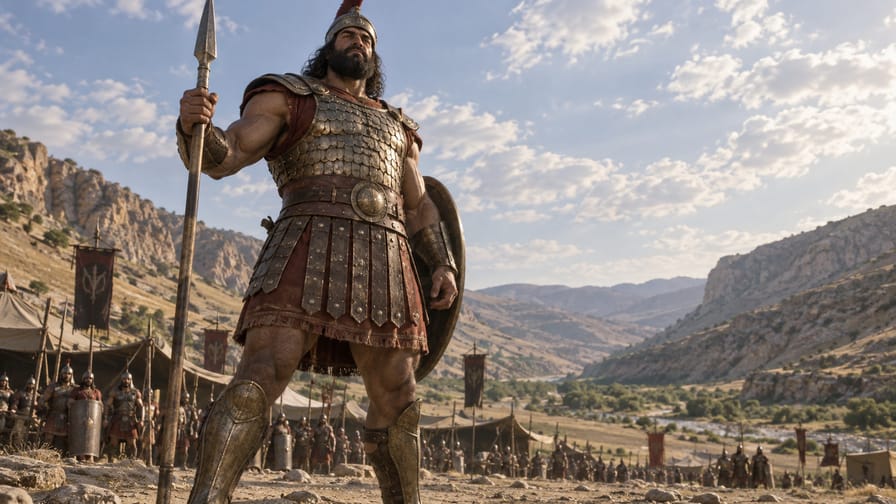
The figure of Goliath, the Philistine giant, emerges in the Hebrew Scriptures as a formidable antagonist whose miraculous defeat by David became one of the most iconic accounts of faith and divine providence in the Bible. His story, though brief, is rich in theological significance, serving as a powerful testimony to the sovereignty of God and the victory of faith over human strength. An analysis of Goliath, from an evangelical Protestant perspective, reveals not merely a historical character but a symbol of opposition to the divine plan, whose fall prefigures Christ's victory over the forces of evil.
This study will delve into the etymology of the name Goliath, its historical context and the biblical narrative in which it is embedded, his character and role in the redemptive plot, his theological and typological significance, and, finally, his biblical-theological legacy and canonical references. The exploration of these aspects will offer a comprehensive understanding of Goliath's enduring relevance to the Christian faith, underscoring the authority of Scripture and the centrality of Christ in the interpretation of the entire canon.
1. Etymology and meaning of the name
The name Goliath, in Hebrew Golyat (גָּלְיָת), is one of the most recognizable names in the Old Testament. Although its exact etymology is a subject of debate among scholars, the main theories point to meanings that resonate with the character's stature and role in the biblical narrative. The Semitic root of the name may offer crucial clues for its interpretation and implicit theological meaning.
One of the suggested linguistic derivations is the connection to the Hebrew root galah (גָּלָה), meaning "to reveal," "to uncover," or "to exile." If this etymology is accurate, the name Goliath could symbolize one who is "revealed" in his arrogance and defiance toward God, or perhaps one who is "exiled" from divine grace due to his impiety. However, this interpretation is less common.
Another theory suggests a link to the word golim (גּוֹלִים), which refers to "exiles" or "captives," or even "to roll" or "to remove." While not directly linked to his strength, it could, metaphorically, describe an oppressor who "rolls" over others or who is destined to be "removed" by divine power. Nevertheless, the context of a giant warrior suggests an etymology more closely tied to strength or size.
The most widely accepted etymology, and one that best aligns with the description of Goliath, relates the name to a root denoting "giant," "great," or "powerful." While there is no direct and unquestionable Hebrew root with this exact meaning for Golyat, the association of the name with the city of Gath (Gath), known for its inhabitants of great stature (such as the Anakim and Rephaim), reinforces the idea that the name itself already evoked the image of a colossal being.
There are no other biblical characters with the name Goliath. This makes the name singular and immediately identifiable with the Philistine giant. Its uniqueness reinforces its specific function in the narrative: to be the archetype of the invincible enemy in human eyes, yet vulnerable before the power of God. The name, therefore, carries a symbolic meaning of defiance and presumption that would be gloriously overthrown.
The theological significance of the name Goliath in the biblical context lies less in an explicit etymological revelation and more in its implicit connotation and the role it plays. He personifies brute force, human arrogance, and self-reliance, in opposition to faith in God. His very existence and his name become a testimony to the arrogance of the world that rises against the Lord and His anointed ones, and to the inevitable fall of those who do so.
Thus, regardless of the precise etymological root, the name Goliath, in the mind of the biblical reader, is inseparable from his gigantic stature and his role as the challenger who was overcome by faith. He becomes an epitome of the massive opposition that God, through His instruments, can and will bring down. His onomastic identity is, therefore, intrinsically linked to his narrative and theological function as the great adversary.
2. Historical context and biblical narrative
The story of Goliath is firmly rooted in the initial period of Israel's monarchy, specifically during the reign of King Saul, around the 11th century B.C. This was a crucial transition period for Israel, which had recently demanded a king to rule over them "like all the other nations" (1 Samuel 8:5), marking the end of the period of the judges and the beginning of the monarchy.
The political and social context of the time was one of constant conflict between Israel and the Philistines, a well-organized and militarily advanced sea people who had settled on the coastal plain of Philistia. The Philistines were a persistent threat to Israel's security and sovereignty, frequently oppressing God's people and dominating their lands, as evidenced in various narratives in the books of Samuel and Judges.
The religious landscape was equally complex. Saul had been anointed king by the prophet Samuel, but his repeated disobedience to God, as in his failure to completely destroy the Amalekites (1 Samuel 15), resulted in the removal of the Spirit of the Lord from him and the divine choice of David as his successor. The battle against Goliath occurs in this interregnum, with Saul still on the throne, but already rejected by God, and David, the future king, still a young shepherd.
Goliath is presented as a Philistine from Gath (Gath), one of the five city-states of Philistia, notorious for harboring descendants of the Rephaim (Rephaim), an ancient people of great stature. Although the Bible does not provide a detailed genealogy for Goliath, he is identified as one of the "giants" or "descendants of Rapha" (2 Samuel 21:19 1 Chronicles 20:5), which explains his impressive height of "six cubits and a span" (approximately 9 feet 6 inches or 2.90 meters), according to 1 Samuel 17:4.
The main events of Goliath's life are concentrated in a single, dramatic confrontation, described in detail in 1 Samuel 17. The narrative places him in the Valley of Elah, between the military positions of Israel and Philistia, near the cities of Sokoh and Azekah. For forty days, morning and evening, Goliath emerges from the Philistine camp to challenge the armies of Israel to single combat, aiming to decide the outcome of the war with the victory of a single champion.
His words were full of scorn and blasphemy against the "God of the armies of Israel" (1 Samuel 17:26), terrifying Saul and all his army. Goliath's armor is described in great detail in 1 Samuel 17:5-7: a bronze helmet, a coat of scale armor of bronze weighing five thousand shekels (about 125 pounds or 57 kg), bronze greaves, a bronze javelin, and a spear whose head weighed six hundred shekels of iron (about 15 pounds or 6.8 kg), with its staff "like a weaver's beam."
David's arrival on the battlefield, sent by his father Jesse to bring provisions to his older brothers, is the turning point of the narrative. Upon hearing Goliath's challenges and seeing the paralyzing fear of the Israelites, David, moved by zeal for the name of the Lord, offers to fight. His refusal to wear Saul's armor and his exclusive trust in the Lord of Hosts (1 Samuel 17:45-47) set the stage for the miraculous victory.
The geography of the Valley of Elah, with its hills and streams, plays a subtle but significant role in providing the stones that David would use in his sling. Goliath's defeat by David's stone and his subsequent decapitation with the giant's own sword (1 Samuel 17:48-51) resulted in the flight of the Philistines and a great victory for Israel, solidifying David's reputation and paving his way to the throne.
Later references to Goliath are found in 2 Samuel 21:19 and 1 Chronicles 20:5. These passages, which some consider problematic at first glance, mention Elhanan, son of Jaare-oregim, killing "Lahmi, the brother of Goliath the Gittite," or in 1 Chronicles 20:5, "Lahmi, the brother of Goliath, the Gittite." Conservative evangelical interpretation generally understands that Elhanan killed a relative of Goliath, perhaps his brother, or that the text of Samuel may have a textual variation that was corrected in Chronicles, or that "Goliath" may have become a title for a Philistine giant, with "the brother of Goliath" being a reference to another giant from the same lineage of Rapha.
3. Character and role in the biblical narrative
The character of Goliath is portrayed in Scripture as the personification of brute force, arrogance, and impiety. He possesses no spiritual qualities and is devoid of any redeeming trait in the narrative. His main characteristic is his impressive stature and physical prowess, complemented by formidable armor and weaponry, which make him a terrifying and seemingly invincible figure in human eyes.
The biblical narrative highlights his arrogance and contempt for the people of Israel and, more significantly, for the God of Israel. In 1 Samuel 17:8-10, he challenges the Israelite armies with scorn, proposing single combat to humiliate them. His words are laden with disdain, questioning Israel's ability to present a champion equal to him. He boasts of his own strength and threatens to make the Israelites his servants, demonstrating blind confidence in his invincibility.
Goliath's central sin is his blasphemy and defiance toward the living God. When David approaches, Goliath despises him for his youth and appearance (1 Samuel 17:42-43), cursing David by his gods. This attitude is not just a personal insult, but a direct challenge to the sovereignty and power of Yahweh, the Lord of Hosts. He represents the spirit of the world that opposes God and His will, relying on material strength and intimidation.
Goliath's role in the biblical narrative is multifaceted and crucial to the development of Israel's history and, in particular, David's rise. Firstly, he serves as the champion of the Philistines, a symbol of the oppression and constant threat that this people represented for Israel. His presence on the battlefield paralyzes the army of Israel and its king, Saul, revealing the weakness of human leadership and the nation's lack of faith.
Secondly, Goliath acts as a catalyst for the revelation of David's character and his unwavering faith in God. The cowardice of the Israelites before the giant contrasts dramatically with David's courage and confidence, who sees in Goliath not an invincible enemy, but an instrument for God to manifest His glory. Goliath's presence is the test that David overcomes, demonstrating his fitness to lead Israel as a king after God's own heart.
Significant actions by Goliath include his daily challenges for forty days (1 Samuel 17:16), his curses against David and his God (1 Samuel 17:43), and his confident advance to combat. Each of these actions underscores his arrogance and the seriousness of the challenge he represents. His decision to accept David's challenge, albeit with contempt, seals his own fate and opens the way for divine intervention.
Throughout the narrative, Goliath shows no character development. He remains a static figure, representing the same threat from beginning to end. His function is to be the insurmountable obstacle that only faith in God can overcome. His fall is not just a military victory for Israel, but a theological demonstration that "the Lord saves not by sword and spear, for the battle is the Lord's, and He will give you into our hands" (1 Samuel 17:47).
Thus, Goliath's role is essentially that of an antagonist who, by his very existence and defiance, allows the sovereignty of God and David's faith to be gloriously manifested. He is a vivid reminder that true strength does not lie in human power, but in trust in the Almighty God, who chooses the weak to shame the strong (1 Corinthians 1:27).
4. Theological significance and typology
The theological significance of Goliath transcends the mere historical narrative of a military battle it is deeply embedded in the redemptive history of Israel and the progressive revelation of God's plan. Goliath represents not just a physical enemy, but a force of spiritual opposition to God's people and His covenant, a challenge to the sovereignty of Yahweh.
His figure embodies the arrogance and power of the fallen world, which opposes the kingdom of God. His defeat is not merely a victory by David, but a victory by God through David, demonstrating that the battle belongs to the Lord (1 Samuel 17:47). This event reinforces the doctrine of divine sovereignty, where God uses unlikely instruments to fulfill His purposes and manifest His glory.
The story of Goliath and David is rich in Christocentric typology, one of the pillars of evangelical Protestant interpretation. Goliath can be seen as a type of God's enemy, be it sin, death, the world, or Satan himself, who rises with great power and intimidates humanity. He represents the insurmountable obstacle for man by his own strength, highlighting the need for a divine deliverer.
David, in turn, acts as a type of Christ. Just as David, the humble and seemingly weak shepherd, defeats the giant through faith and the power of God, Jesus Christ, in His humility and apparent weakness on the cross, won a decisive victory over sin, death, and Satan. David faced Goliath without human armor, trusting only in the name of the Lord, just as Christ faced the forces of evil not with military power, but with the power of sacrificial love and obedience to God (Philippians 2:8).
The confrontation in the Valley of Elah prefigures the spiritual battle that Christ would wage and win. David's victory over Goliath brought deliverance and salvation to Israel, warding off the Philistine threat. Similarly, Christ's victory on the cross and in His resurrection brought eternal salvation and deliverance from the dominion of sin and death to all who believe (Colossians 2:15 Hebrews 2:14-15).
God's covenant with Israel is central to this narrative. Goliath blasphemes the God of Israel's covenant, and David fights to vindicate the name of the Lord and the honor of His people. The victory reaffirms God's faithfulness to His covenant and His ability to protect His chosen ones. This faithfulness of God in fulfilling His promises prefigures the greater covenant, the New Covenant in Christ, where God provides final salvation for His people.
Although Goliath is not explicitly cited in the New Testament, the story of David and Goliath is implicitly referenced as an example of faith. In Hebrews 11:32-34, David is mentioned among the heroes of faith who "through faith... conquered kingdoms, administered justice, obtained promises, shut the mouths of lions, quenched the fury of the flames, escaped the edge of the sword, whose weakness was turned to strength, and who became powerful in battle and routed foreign armies." The victory over Goliath is a primary example of this faith that moves mountains.
The connection with central theological themes is evident. David's faith contrasts with the fear of Saul and the Israelites, teaching that true faith is not based on human strength, but on trust in God. David's obedience to God's call, even in the face of a seemingly impossible challenge, illustrates the importance of submission to the divine will. God's judgment on Goliath's impiety demonstrates divine justice and the certainty of condemnation for those who oppose the Lord.
The doctrine of salvation is vividly illustrated: Israel is saved not by its own strength, but by divine intervention through an anointed deliverer. This is a model for salvation in Christ, where humanity is incapable of saving itself from sin and death, and salvation comes solely by God's grace through faith in Jesus Christ, the true and greater David. Prophetic fulfillment, then, finds its fullness in Christ, who is the champion who defeats the final enemy and establishes the eternal kingdom of God.
5. Biblical-theological legacy and canonical references
Goliath's legacy in biblical theology is paradoxical: although he is an antagonist, his importance lies precisely in what his defeat reveals about God's character and the path of salvation. His story is one of the most impactful and didactic narratives of the Old Testament, echoing throughout Scripture and profoundly influencing the understanding of the Christian faith.
Beyond the main narrative in 1 Samuel 17, Goliath is mentioned in 2 Samuel 21:19 and 1 Chronicles 20:5. These passages, as already noted, refer to Elhanan killing "Lahmi, the brother of Goliath the Gittite." The repetition of the name Goliath, even if in reference to a relative, underscores the prominence and fear that the lineage of the giants from Gath inspired in Israel, and how the victory over them was a sign of God's blessing.
The influence of Goliath's story on biblical theology is vast. It is frequently cited to illustrate the truth of 1 Corinthians 1:27-29: "But God chose the foolish things of the world to shame the wise God chose the weak things of the world to shame the strong. God chose the lowly things of this world and the despised things—and the things that are not—to nullify the things that are, so that no one may boast before him." David's victory over Goliath is the epitome of this truth, showing that God's strength is perfected in human weakness.
In Jewish and Christian interpretive tradition, the story of Goliath has been a perennial tale of courage, faith, and divine intervention. In Judaism, David is a national hero, and his victory over Goliath is a symbol of Israel's ability to overcome powerful enemies through faith in Yahweh. In the Christian tradition, in addition to Christocentric typology, the narrative serves as an encouragement for believers to face seemingly insurmountable challenges with faith in God.
Although there are no references to Goliath in intertestamental literature or apocryphal texts that add substantial information to his story, the impact of his figure is felt in how David's story is told and retold. Flavius Josephus, in his Jewish Antiquities, narrates the story in detail, recognizing its importance for David's rise.
In Reformed and evangelical theology, the treatment of Goliath and his defeat is fundamental for teaching several doctrines. Emphasis is placed on God's sovereignty in choosing David and orchestrating the victory. David's faith is seen as a model of radical trust in God, in contrast to self-reliance or reliance on human resources. The story is a testimony to the effectiveness of prayer and Spirit-led action.
Furthermore, the narrative is used to illustrate the nature of the spiritual battle that believers face. Just as Goliath was a visible and powerful enemy, Christians face spiritual forces of evil, but they are called to fight with God's spiritual weapons, trusting in Christ, the true and greater champion who has already overcome the enemy (Ephesians 6:10-18).
Goliath's importance for understanding the canon lies in his role as a crucial marker in David's history. His defeat is not just an anecdote it is the event that catapults David from obscurity to prominence, confirming his anointing as king and demonstrating his fitness to lead God's people. Without Goliath, David's rise would be less dramatic and less divinely attested.
Therefore, Goliath, the Philistine giant, remains a figure of immense biblical-theological relevance. He personifies opposition to God's plan, but his defeat serves as a perennial testimony to the power of God, the importance of faith, and the prefiguration of Jesus Christ's definitive victory over all forces of evil. His story continues to inspire and teach profound truths about divine sovereignty and redemption.