


Eliakim
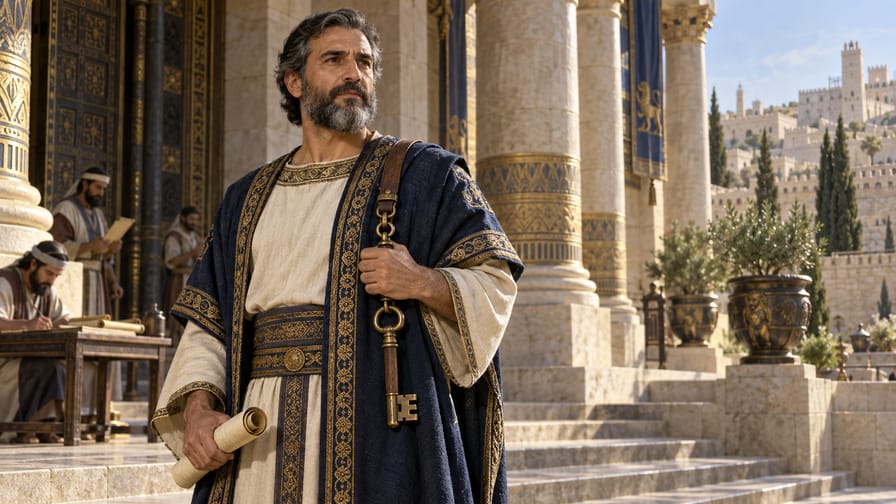
The figure of Eliakim, whose name resonates with profound theological significance, emerges in the Hebrew Scriptures as a figure of notable importance, especially in the context of the Kingdom of Judah during a period of intense crisis. Although there is more than one individual with this name in the Bible, the most substantial and theologically rich analysis focuses on Eliakim, son of Hilkiah, King Hezekiah's chief steward.
His story, though concise, is laden with symbolism and prophetic implications that transcend his own time. From an evangelical Protestant perspective, Eliakim is not merely a faithful servant, but also a typological figure who points to the authority and messianic role of Jesus Christ, the true bearer of the keys of the House of David.
This study will delve into the etymology, historical context, character, theological significance, and legacy of Eliakim, as revealed in the Scriptures. The analysis will seek to extract the enduring lessons and Christ-centric connections that make his narrative relevant for Christian faith and doctrine today.
1. Etymology and Meaning of the Name
The name Eliakim is of Hebrew origin, derived from the combination of two elements: ’el (אֵל), meaning "God" or "Lord," and the verbal root qum (קוּם), meaning "to raise," "to establish," "to lift up," or "to resurrect." The Hebrew transliteration is אֶלְיָקִים (’Elyaqim).
Literally, the name can be interpreted as "God raises," "God establishes," or "God lifts up." This onomastic meaning is deeply prophetic and resonates with the events in the life of the Eliakim of Isaiah 22, where he is divinely raised to a position of authority in place of Shebna.
The root qum is frequently used in the Old Testament to describe the divine action of establishing kingdoms, raising leaders, or restoring what was fallen. Thus, the name Eliakim is not merely descriptive, but carries a theological connotation of divine sovereignty in the elevation and appointment of His servants for specific purposes.
Although the Eliakim of Isaiah 22 is the most prominent, there are other biblical figures with this name. One of them is the son of King Josiah, whose original name was Eliakim, but which was changed to Jehoiakim by Pharaoh Neco II when he placed him on the throne of Judah (2 Kings 23:34 2 Chronicles 36:4).
Another Eliakim is mentioned in the genealogy of Jesus in Matthew 1:13, a post-exilic ancestor of Christ. There is also a priest named Eliakim who participated in the dedication of the wall of Jerusalem in the days of Nehemiah (Nehemiah 12:41).
Despite these other occurrences, the deepest theological meaning and prophetic relevance fall upon Eliakim, the son of Hilkiah. His name aligns perfectly with the narrative of his ascent, pointing to the hand of God who raises him up and establishes him as a pillar of authority in the royal palace of Judah.
The divine choice of Eliakim to replace Shebna, as described in Isaiah 22:20, is a clear demonstration that God is the one who "raises" and "establishes" His servants. The name, therefore, prefigures divine intervention in history, appointing a faithful steward for the people of Judah.
This divine intervention is central to Reformed theology, which emphasizes God's sovereignty over all things, including the appointment and removal of leaders. The name Eliakim is a vivid reminder of divine providence acting behind the scenes of human history.
2. Historical Context and Biblical Narrative
The central figure of Eliakim, son of Hilkiah, emerges in the political and religious landscape of Judah during the reign of King Hezekiah (c. 715-686 BC), a period marked by great challenges and external threats. This was a time of intense pressure from the Assyrian Empire, the superpower of the era, which sought to expand its dominion over the Levant.
The social and religious context was complex. Hezekiah had initiated significant religious reforms, seeking to eradicate idolatry and restore the worship of Yahweh, according to the Law of Moses (2 Kings 18:3-6 2 Chronicles 29-31). However, the Assyrian threat constantly loomed, culminating in Sennacherib's invasion in 701 BC.
It is in this setting that Eliakim appears in the biblical narratives. His family origin is given as "son of Hilkiah" (Isaiah 22:20 2 Kings 18:18), but no additional details are provided about his genealogy. Hilkiah was a common name in Judah, and there is no indication that this Hilkiah is the high priest who found the Book of the Law in the days of Josiah, who lived decades later.
The main events in Eliakim's life are narrated in two crucial passages. Firstly, in Isaiah 22:15-25, a divine prophecy announces the dismissal of Shebna, the chief steward (’asher al-bayit), and the subsequent elevation of Eliakim to the same position. This passage is fundamental to understanding his role and significance.
The prophecy describes Shebna as someone who sought personal glory and built a lavish tomb for himself, an act of pride and self-confidence that displeased God (Isaiah 22:16-18). In contrast, Eliakim is chosen by God to replace him, being described as a "servant" (’ebed) of God (Isaiah 22:20).
Eliakim's second significant appearance occurs during Sennacherib's Assyrian invasion, specifically during the siege of Jerusalem. He is one of three high-ranking officials sent by Hezekiah to meet with the Rabshakeh, the Assyrian commander, who mocked the people of Judah and their God (2 Kings 18:17-19:7 Isaiah 36:2-37:7).
In these passages, Eliakim is identified as the "steward of the palace" (2 Kings 18:18 Isaiah 36:3), confirming his high position. He, along with Shebna (the scribe) and Joah (the recorder), hear the Rabshakeh's threats and blasphemies and return to Hezekiah with their clothes torn, a sign of mourning and despair (2 Kings 18:37 Isaiah 36:22).
The geography related to Eliakim is primarily Jerusalem, the capital of Judah, where he exercised his function in the royal palace. He was a key figure in the administration of the kingdom and a direct representative of King Hezekiah. His interactions with other biblical figures are mainly with King Hezekiah, Shebna, and the prophet Isaiah, who prophesied about his ascent.
His divine appointment and his role during the Assyrian crisis demonstrate that Eliakim was not merely a bureaucrat, but an instrument of God's providence. He was placed in a position of influence to serve the people and the king in a time of great need, highlighting God's sovereignty over the affairs of nations and of men.
3. Character and Role in the Biblical Narrative
Eliakim's character, though not extensively detailed in the Scriptures, is revealed through the contrast with his predecessor, Shebna, and by the responsibilities God entrusted to him. While Shebna is portrayed as proud and self-centered (Isaiah 22:16-18), Eliakim is presented as a faithful and trustworthy servant, chosen by God.
Isaiah's prophecy describes Eliakim's specific calling and function in a grand manner. He would be "a father to the inhabitants of Jerusalem and to the house of Judah" (Isaiah 22:21). This is an image of pastoral and providing leadership, indicating that he would care for the welfare of the people, not for himself.
His main function was that of "chief steward" or "he who is over the house" (’asher al-bayit), a position of immense responsibility and authority in the ancient Near East. This official was the chief administrator of the palace, responsible for the king's property and the management of the kingdom's internal affairs.
The most significant description of his role is found in Isaiah 22:22: "I will place on his shoulder the key of the house of David he shall open, and no one shall shut and he shall shut, and no one shall open." This "key of the house of David" symbolizes absolute authority over the access and administration of the palace and, by extension, over the kingdom.
Possession of the key implied the power to decide, to permit or deny entry, to appoint or dismiss. It was a sign of trust and an emblem of his position as the highest official below the king. This authority was seen as divinely granted, making him a pillar of stability for the kingdom.
Furthermore, Eliakim is compared to a "peg fastened in a secure place" (Isaiah 22:23). This metaphor suggests stability, reliability, and the ability to bear the weight of "the glory of his father's house," that is, the honor and dignity of the royal lineage and the people of Judah.
Eliakim's significant actions include his participation in the delegation to Sennacherib, where he and his colleagues demonstrated mourning and brought the message back to King Hezekiah. His stance there, though one of submission to the situation, revealed his loyalty to the king and the people, a contrast to Shebna's arrogance.
The narrative does not document Eliakim's sins or moral failures, which suggests that he was a man of integrity and a faithful servant in his responsibilities. His elevation is portrayed as an act of divine judgment on Shebna's unfaithfulness and of grace towards the people, who would receive a more just and dedicated leader.
Eliakim's character development, though not a long narrative arc, is marked by his ascent from a previous position (possibly a lower-ranking official, such as the scribe, according to some interpretations of 2 Kings 18:18 where Shebna is the steward and Eliakim is the scribe before the prophecy of Isaiah 22) to the highest administrative position in the kingdom.
His story is a testimony to divine sovereignty in raising up and deposing leaders, and to the importance of faithfulness and humility in service. Eliakim serves as an example of faithful stewardship, contrasting with the self-gratification and pride that God condemns.
4. Theological Significance and Typology
Eliakim's theological significance transcends his function as chief steward, immersing him deeply in redemptive history and the progressive revelation of God. The prophecy of Isaiah 22 is not merely a historical account, but a prophetic declaration with strong messianic implications, establishing Eliakim as a typological figure of Christ.
Christ-centric typology is the essence of Eliakim's theological relevance. He is a type, or foreshadowing, of Jesus Christ in several crucial aspects. The most evident and powerful connection is found in Isaiah 22:22: "I will place on his shoulder the key of the house of David he shall open, and no one shall shut and he shall shut, and no one shall open."
This passage is quoted directly in the New Testament, in Revelation 3:7, where Jesus Christ is described as "the one who has the key of David, who opens and no one will shut, and who shuts and no one will open." This explicit reference establishes an undeniable link between the authority granted to Eliakim and the supreme authority of Christ.
The "key of the house of David" in Eliakim symbolized power over access to the palace and the administration of the earthly kingdom of Judah. In Christ, this key represents His sovereign authority over the Kingdom of God, over salvation and judgment, over the Church, and over the eternal destiny of individuals.
Jesus holds the authority to open the doors of salvation for those who believe and to close the doors for those who reject. He is the one mediator between God and men (1 Timothy 2:5), and through Him there is access to the Father (Ephesians 2:18). His authority to "bind and loose" (Matthew 16:19) is the full manifestation of the key of David.
Beyond the key, Eliakim's description as a "peg fastened in a secure place" (Isaiah 22:23) also points to Christ. Christ is the unshakable foundation of faith (1 Corinthians 3:11), the secure cornerstone upon which the Church is built (Ephesians 2:20 1 Peter 2:6). He is the stability and security for those who trust in Him.
Eliakim's role as "a father to the inhabitants of Jerusalem and to the house of Judah" (Isaiah 22:21) foreshadows Christ's pastoral care and leadership over His people. Jesus is the Good Shepherd who lays down His life for His sheep (John 10:11), and He is the Everlasting Father in the sense of His care and provision (Isaiah 9:6).
The dismissal of Shebna for his arrogance and self-gratification, and the elevation of Eliakim for his faithfulness, also serve as a typological contrast. Christ is the perfect servant, humble and obedient even to death (Philippians 2:8), in contrast to the fallibility and sin of human leaders.
Eliakim's story, therefore, illustrates central theological themes such as divine sovereignty in the choice and appointment of leaders, the importance of faithfulness and humility in service, and God's judgment on pride. More importantly, it elevates messianic hope, pointing to the true bearer of all authority and the eternal support of the house of David.
The Reformed and evangelical perspective emphasizes that, although Eliakim was a human and limited servant, the prophetic language used to describe him transcends his person and finds its full and perfect fulfillment in Jesus Christ. He is the true and eternal Eliakim, "God who raises," who was raised from the dead to reign eternally.
5. Biblical-Theological Legacy and Canonical References
Eliakim's biblical-theological legacy is remarkably strong, despite his relatively brief appearance in the Scriptures. His importance is manifested not so much through a vast narrative, but by the depth of his typology and by the direct quotation in one of the most prophetic books of the New Testament canon.
The main mentions of Eliakim occur in 2 Kings 18:18, 26, 37 and Isaiah 22:15-25, 36:3, 11, 22. These passages, especially the prophecy of Isaiah 22, are the basis for his significance. Although there are no literary contributions attributed to him, his story is a "work" in itself, revealing divine principles.
Eliakim's influence on biblical theology is felt primarily in the understanding of divine sovereignty over leadership and, crucially, in Christology. As discussed, the quotation of Isaiah 22:22 in Revelation 3:7 is the cornerstone of his legacy.
In Revelation 3:7, Jesus presents Himself to the church in Philadelphia as "the one who is holy, the true one, who has the key of David, who opens and no one will shut, and who shuts and no one will open." This self-reference by Christ using the exact words of Isaiah's prophecy about Eliakim is one of the clearest examples of messianic typology in the New Testament.
For the Christian interpretive tradition, especially evangelical Protestantism, Eliakim is seen as a model of faithful stewardship and a prophetic precursor to Christ. The church fathers and reformers, while perhaps not focusing extensively on Eliakim individually, saw Isaiah's prophecy as fundamentally messianic.
Reformed theology, in particular, underscores God's sovereignty in the elevation of Eliakim and the removal of Shebna, applying this truth to divine providence over all rulers. The figure of Eliakim, with the key of David, is a vivid reminder of delegated authority and, by extension, of Christ's supreme and undelegated authority.
Eliakim's importance for understanding the canon lies in how he demonstrates the unity of biblical revelation. A minor figure from the Old Testament becomes a vital link to understanding Christ's authority in the New Testament, showing the continuity of God's redemptive plan through the ages.
He helps us understand the nature of Christ's authority over the Church, which is the true "people of God" or the spiritual "house of David." Christ is the ultimate bearer of the keys of the Kingdom, with power over life and death, over heaven and hell, and over entry into and exclusion from His Kingdom.
In summary, Eliakim, Hezekiah's steward, is more than a mere royal official. He is a testament to divine providence, a contrast to human arrogance, and, above all, a prophetic type that unmistakably points to the person and work of Jesus Christ, the Messiah who holds all authority in heaven and on earth.