


Heber
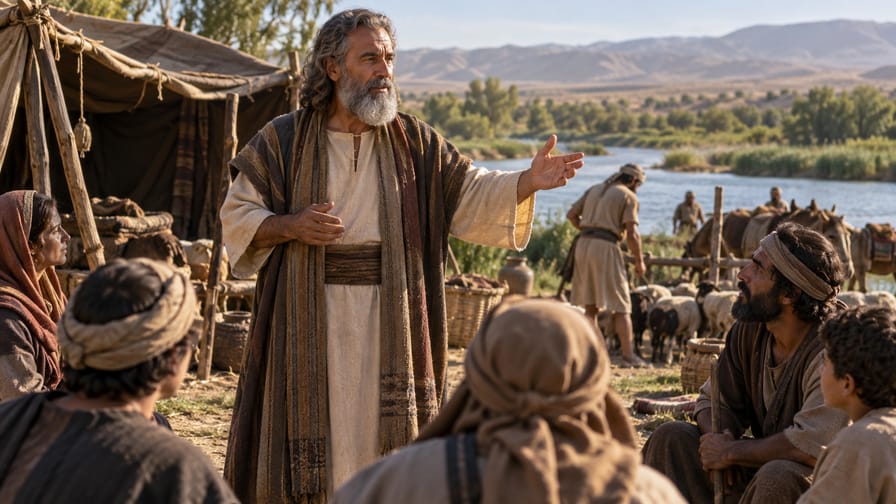
The figure of Heber, or Eber in some translations, emerges in the post-diluvian genealogies of the book of Genesis as a character of profound, though concise, theological and historical relevance. His importance does not lie in great narrated deeds, but in his crucial role in the messianic lineage and in the etymology of the term "Hebrew." He serves as a vital bridge between post-Flood humanity and the nation of Israel, prefiguring the people chosen by God to carry the promise of redemption.
From a Protestant evangelical perspective, the analysis of Heber emphasizes divine sovereignty in the preservation of the lineage of the promise and God's faithfulness in fulfilling His redemptive designs. Although the Scriptures offer few details about his life, his repeated mention in canonical genealogies underscores his significance in salvation history, culminating in Christ. This study will delve into his onomastic meaning, historical context, role in the narrative, theological implications, and his enduring legacy for the Christian faith.
1. Etymology and Meaning of the Name
The name Heber, transliterated from the Hebrew עֵבֶר (ʿĒber), possesses a rich etymological connotation that is fundamental to understanding its biblical relevance. The underlying verbal root is עָבַר (ʿābar), which means "to pass over," "to cross," "to traverse," or "to go to the other side." This root is widely used in the Old Testament in various contexts, from crossing rivers to the passage of time or covenants.
Literally, the name Heber can be interpreted as "one who passes," "the one who crosses," or "one who is on the other side." This interpretation gains depth when we consider the possible connection to the term "Hebrew," עִבְרִי (ʿivri). While not all scholars agree that Heber is the direct eponym of all Hebrews, the etymological link is undeniable and strongly suggested by the Scriptures.
The Septuagint, the Greek translation of the Old Testament, transliterates the name as Eber (Ἔβερ), maintaining the Hebrew phonetics. There are no significant variations of the name in other biblical languages that alter its fundamental meaning. In genealogies, the name is consistently presented as Heber, reinforcing his unique identity.
It is important to note that, although there are other biblical characters with similar names or names derived from the same root (such as the clan of Heber in Numbers 26:45 or 1 Chronicles 5:13), the Heber of the Genesis genealogies is distinctly identified as an ancestor of Abraham and, therefore, of particular theological importance. There is no confusion or overlap of identity with other Hebers mentioned.
The symbolic meaning of the name "one who crosses over" resonates with the journey of faith and the separation of a people for God. Abraham, a descendant of Heber, is instructed to "cross over" from the land of Ur of the Chaldeans to a promised land, becoming, in fact, a "Hebrew" in the sense of a "pilgrim" or "sojourner" (Genesis 12:1-4 Hebrews 11:8-10). Thus, Heber's name may prefigure the calling of his descendants.
For the theologian John Calvin, the meaning of the name "Hebrew" and its connection to Heber is crucial for understanding the identity of God's people. He argues that "the Hebrews are so called from Heber, not because he was their first father, but because the church of God was preserved in his family" (Commentaries on the First Book of Moses Called Genesis). This suggests a theological significance that goes beyond mere genealogy.
The name Heber, therefore, is not merely a genealogical marker, but a symbol of transition and separation. He represents the lineage that "passed over" the apostasy and idolatry of the post-diluvian world, preserving faith and the divine promise. This interpretation aligns with the evangelical perspective that God always maintains a faithful remnant.
2. Historical Context and Biblical Narrative
Heber is situated in the post-diluvian historical period, a time of the repopulation of the Earth and the dispersion of nations, as narrated in Genesis 10 and 11. He is one of the most important links in the genealogy that connects Noah to Abraham, the central figure of the covenant. Chronologically, his life spans a period of declining human longevity, yet still with considerably long lives compared to modern standards.
According to Genesis 11:14-17, Heber was born when his father, Shelah, was thirty years old. He lived 464 years after the birth of his son Peleg, totaling 464 years of life. This places him as a figure who witnessed the events of the Tower of Babel and the subsequent dispersion of languages and peoples, although the Scriptures do not record his direct participation in these events.
His genealogy is presented in Genesis 10:21-25 and 11:14-17, and repeated in 1 Chronicles 1:18-19, 25, and also in the genealogy of Jesus in Luke 3:35. He is the son of Shelah, grandson of Arphaxad, and great-grandson of Shem, one of Noah's sons. This lineage is crucial because Shem is the son of Noah through whom the messianic promise would be transmitted, according to the blessing in Genesis 9:26-27.
Key biblical passages that mention Heber are:
- Genesis 10:21: "Also to Shem, the father of all the children of Heber, the older brother of Japheth, children were born."
- Genesis 10:24: "Arphaxad begot Shelah, and Shelah begot Heber."
- Genesis 10:25: "To Heber were born two sons: the name of one was Peleg, for in his days the earth was divided and his brother's name was Joktan."
- Genesis 11:14-17: Details his age and descent in the lineage from Shem to Terah.
- 1 Chronicles 1:18-19: Repeats the genealogy from Genesis 10:24-25.
- Luke 3:35: Includes Heber in the genealogy of Jesus Christ.
The geography associated with Heber and his descendants is Mesopotamia, the region between the Tigris and Euphrates rivers, especially the area of Chaldea, from where Abraham would be called. The name of his son, Peleg (פֶּלֶג, Peleg), which means "division" or "stream," is explained by Genesis 10:25 with the phrase "for in his days the earth was divided." This is generally interpreted as a reference to the division of nations and languages at the Tower of Babel (Genesis 11:1-9).
Although Heber does not directly interact with prominent historical figures in detailed narratives, he is a direct ancestor of Abraham, the patriarch of faith and the father of a multitude of nations (Genesis 17:5). His existence is crucial for establishing the continuity of the lineage of the promise from Shem to Abraham and, subsequently, to the Messiah. He is a vital link in the chain of God's redemptive history.
Evangelical theology emphasizes that God, in His providence, carefully preserved the messianic lineage through figures like Heber, even in times of great apostasy and dispersion. The inclusion of Heber in the genealogy of Jesus by Luke (Luke 3:35) solidifies his importance not only for the history of Israel but for the salvation history of all humanity.
3. Character and Role in the Biblical Narrative
The Bible offers very few details about Heber's personal character, his mention being almost exclusively genealogical. Unlike figures such as Abraham, Moses, or David, there are no narratives describing his actions, decisions, virtues, or failures. His importance is, therefore, inferred from his strategic positioning in the history of redemption and the meaning of his name.
The absence of narratives about his character should not be interpreted as insignificance. On the contrary, his inclusion in the sacred genealogies, both in the Old Testament and the New Testament, grants him a role of immense importance. He is a "custodian" of the messianic lineage, a silent yet essential link in the chain of faith leading to Christ.
His primary role is that of an ancestor. He is the father of Peleg and Joktan, and through Peleg, the lineage leading to Abraham is continued. The Bible emphatically points to Heber's descendants as the source of the "children of Heber" (Genesis 10:21), suggesting that his family maintained a distinct identity or tradition, possibly linked to the preservation of monotheistic faith amidst growing idolatry.
Although there is no explicit mention of his faith or obedience, Jewish tradition and some Christian commentators suggest that Heber may have been one of the few to resist the construction of the Tower of Babel and the subsequent idolatry. The theologian Matthew Henry, for example, comments that "the children of Heber were those who preserved the true religion and the purity of language" (Matthew Henry's Commentary on the Whole Bible), though this is a pious inference and not a direct biblical statement.
His longevity, 464 years (Genesis 11:17), is notable and positions him as a witness to several post-diluvian generations. He lived long enough to see the birth of Abraham and, possibly, Isaac and Jacob, although the Scriptures do not record any encounters or interactions. This longevity allowed for the oral transmission of traditions and knowledge about God from the times of Noah and Shem.
Heber's role, therefore, is passive but fundamental. He is not a prophet with a message, a priest with an office, nor a king with a kingdom. He is, first and foremost, a recipient and a conveyor of the divine promise through his offspring. His life, though obscure in detail, is a testament to God's faithfulness in preserving the seed of the woman promised since Genesis 3:15.
The evangelical perspective sees in Heber an example of God's providence, which operates through ordinary individuals to accomplish His great purposes. His inclusion in the sacred Scriptures, despite the lack of narrative, serves to underscore that every link in the messianic genealogical chain is divinely ordained and significant, regardless of its fame or prominence.
4. Theological Significance and Typology
The theological significance of Heber is deeply rooted in his position in the history of redemption and in the progressive revelation of God. He is not a figure of direct Christocentric typology, in the sense of prefiguring a specific aspect of Christ's person or work through his actions. Instead, his relevance lies in his function as an indispensable link in the lineage of the promise that culminates in the Messiah.
Heber's main theological contribution is his connection, through his name, with the identity of the "Hebrew" people. If, as many scholars believe, the term עִבְרִי (ʿivri) derives from Heber, then he is the nominal patriarch of a people chosen by God to be the bearer of the covenant and revelation. Abraham is called "Abram the Hebrew" (Avram ha-ʿivri) in Genesis 14:13, identifying him with this distinct lineage.
This connection with the term "Hebrew" suggests a separation and a unique identity. The Hebrew people would be those who "passed over" or "crossed" to God's side, distinguishing themselves from the surrounding idolatrous nations. The theologian Bruce Waltke observes that the term "Hebrew" can have connotations of a "foreigner" or "sojourner," which aligns with Abraham's calling and the nature of Israel as a people set apart by God (Genesis: A Commentary).
Although Heber did not receive a direct covenant or promise, he is intrinsically linked to the Abrahamic Covenant and, by extension, to the New Covenant in Christ. His existence guarantees the continuity of the lineage that God promised to Shem (Genesis 9:26-27) and that would be realized in Abraham, promising offspring through whom all the families of the earth would be blessed (Genesis 12:3).
The inclusion of Heber in the genealogy of Jesus in Luke 3:35 is the most explicit proof of his importance for the New Testament and for Christocentric theology. Luke traces Jesus' lineage back to Adam, emphasizing the universality of salvation, and Heber is one of the ancestors who connects Jesus to ancient humanity, but specifically to the Semitic lineage of the promise.
The doctrine of divine providence is strongly evidenced in Heber's life. God, in His sovereignty, preserved a righteous lineage amidst a world in rapid moral and spiritual decay after the Flood and the confusion of Babel. Heber represents the line of faith that remained faithful to God, even if discreetly, while the majority of humanity turned to idolatry.
For Reformed theology, Heber is a testament to God's sovereign grace in the election and preservation of His people. He is not chosen by merit or action, but by his position in the divinely ordained lineage. His life points to God's faithfulness in keeping His promise of a seed that would crush the serpent's head (Genesis 3:15), a promise that finds its ultimate fulfillment in Jesus Christ.
The figure of Heber reminds us that salvation history is a tapestry woven by God, where every thread, however insignificant it may seem, is essential to the complete work. His life, though without great events, is a silent pillar upon which the structure of redemption is built, connecting the distant past to the future hope in Christ.
5. Biblical-Theological Legacy and Canonical References
Heber's legacy, though not marked by literary works or great narrative events, is profound and enduring in biblical theology. His main contribution lies in the genealogical foundation of Israelite identity and his uninterrupted presence in the canonical genealogies, serving as a crucial link between the antediluvian/post-diluvian patriarchs and Abraham, the father of faith.
Mentions of Heber in other biblical books are primarily genealogical. He appears in Genesis 10 and 11, in 1 Chronicles 1:18-19, 25, and in the genealogy of Jesus in Luke 3:35. These repetitions are not mere lists but serve to legitimize the descent and identity of individuals and peoples, especially in the context of the messianic promise. The inclusion in Luke is particularly significant, connecting Jesus to the Semitic lineage and, by extension, to all humanity.
There are no literary contributions attributed to Heber, nor is he cited in contexts other than genealogical ones. Nevertheless, his existence is fundamental to the narrative structure of Genesis and to understanding the origin of the people of Israel. He represents the continuity of the godly lineage (the promised "seed") that persists through generations, despite widespread corruption.
Heber's influence on biblical theology lies in his association with the term "Hebrew" (עִבְרִי, ʿivri). This designation is not merely ethnic but carries connotations of identity and calling. The Hebrews would be those called to be a separate people, who "crossed" or "passed over" to God's side, maintaining the worship of the true God in contrast to pagan nations (Exodus 3:18, Jonah 1:9).
In Jewish interpretive tradition, Heber is often seen as a pillar of monotheistic faith. Some midrashim and rabbinic commentators suggest that Heber, along with his father Shelah and his grandfather Shem, maintained a Torah school or a center for studying God's will, transmitting divine knowledge from generation to generation, protecting it from the corruption prevalent at the time of the Tower of Babel.
In Christian tradition, especially in Reformed and evangelical theology, Heber is valued for his role in preserving the lineage of the promise. Theologians like Herman Bavinck, in his Reformed Dogmatics, emphasize God's faithfulness in maintaining the messianic line, even through figures who are not prominent in the narrative. Heber is a testament to God's providence in salvation history.
The importance of Heber for understanding the biblical canon is that he solidifies the transition from the universal history of humanity (Genesis 1-11) to the particular history of the people of Israel (Genesis 12 onwards). He is the link that connects creation and the flood to the election of Abraham and the establishment of the nation that would be the vehicle of divine revelation and the Messiah. His life, though without details, is a pillar of the genealogical structure that validates the authenticity of the divine promise.
In summary, Heber, the "one who crosses over" or "from the other side," represents the continuity of faith and God's faithfulness in preserving His elect lineage. His figure, though discreet, is a powerful reminder that every individual in divine providence has a crucial role in the grand narrative of redemption, culminating in the person and work of Jesus Christ, the true "Hebrew" who invites us to "cross over" from death to life (John 5:24).