


Zophar
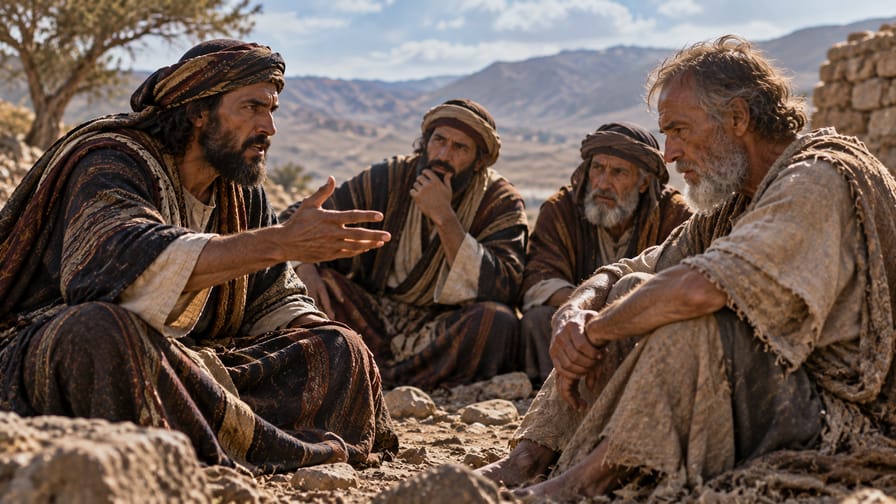
1. Etymology and Meaning of the Name
The name Zophar is transliterated from the Hebrew Tsofar (צֹפַר). The exact etymology of this name has been the subject of some discussion among scholars. The most probable underlying verbal root is tsafar (צָפַר), which means "to chirp," "to twitter," or "to peep" (like a bird).
Other suggestions include a connection to a root meaning "to leap" or "to jump," or even "to be alert," "to observe." However, the association with the sound of a bird is the most widely accepted, although its symbolic meaning for the character Zophar is not immediately obvious in the biblical narrative.
There are no other notable biblical characters with the name Zophar. He is distinctly identified as "Zophar the Naamathite" (Job 2:11), indicating his geographical or tribal origin. The term Naamah (נַעֲמָה) may refer to a place in Arabia, although its exact location is uncertain.
Despite the etymological uncertainty, Zophar's name does not seem to carry a direct theological or prophetic meaning in relation to his role in the narrative. Unlike names such as Yeshua (Jesus) or Immanuel (Immanuel), which reveal aspects of divine character or mission, Zophar is more of a personal identifier.
However, some commentators speculate that if the name is linked to "chirping," it could metaphorically suggest the nature of his words – perhaps shrill, repetitive, or, in contrast, full of a wisdom he considers profound, but which proves inadequate in the face of the complexity of Job's suffering.
The absence of an explicit theological meaning in Zophar's name, in contrast to the depth of other biblical characters' names, may subtly indicate the limitation of his own theological understanding, which proves flawed before divine wisdom. His name is a detail, while his words are the focus.
2. Historical Context and Biblical Narrative
2.1. Historical Period and Setting
Zophar is one of Job's three friends, whose story is recounted in the Book of Job. This book is generally situated in the patriarchal period, possibly between the times of Abraham and Moses, or even earlier than Abraham. Although the exact date is debated, the lifestyle, cultural references, and implicit theology point to a remote era.
The Book of Job does not specify chronological dates, but the patriarch Job is described as living in Uz, a region likely located east of Palestine, in northern Arabia or southern Syria. The absence of references to Mosaic Law, the Levitical priesthood, or the nation of Israel suggests a pre-Mosaic context.
The social context is that of a tribal society, where wealth was measured in livestock and servants, and the wisdom of elders was highly valued. Religion was monotheistic, centered on the worship of El, the Most High God, and the belief in divine retribution was a fundamental pillar of the worldview.
At the time, the predominant theology, advocated by Job's friends, including Zophar, was that of immediate and direct retribution: the righteous prosper and the wicked suffer. This simplified view of divine justice is the core of the theological conflict in the book.
2.2. Origin and Relationships
Zophar is identified as "the Naamathite" (Job 2:11). Naamah (נַעֲמָה) is probably the name of his clan or city of origin. The location of Naamah is uncertain, but it is generally associated with the region of Arabia, as are Teman (land of Eliphaz) and Shuah (land of Bildad).
He is one of the three friends who come to comfort Job after the loss of his children, possessions, and health (Job 2:11-13). Along with Eliphaz the Temanite and Bildad the Shuhite, Zophar represents the traditional wisdom of his time and culture.
His relationship with Job begins as one of friendship and solidarity, expressed by silent mourning for seven days and seven nights (Job 2:13). However, this solidarity quickly turns into accusation as Job expresses his anguish and questions the reason for his suffering.
The friends, including Zophar, act as Job's theological debaters, each presenting arguments intended to convince Job of his sin and of God's justice in punishing him. This dynamic forms the greater part of the body of the Book of Job.
2.3. Key Events and Biblical Passages
Zophar's presence in the narrative is concentrated in the cycles of debates with Job. He participates in two of the three cycles of speeches.
His first discourse is found in Job 11:1-20. In this, Zophar accuses Job of being an arrogant talker and insinuates that God's punishment is less than Job deserves. He urges Job to repent, promising restoration if he turns to God.
Zophar's second discourse is in Job 20:1-29. Here, he vividly describes the inevitable fate of the wicked, reiterating the doctrine of retribution. He emphasizes that the prosperity of the wicked is temporary and that their end is destruction.
Notably, Zophar does not speak in the third cycle of discourses (chapters 22-27), where Eliphaz and Bildad still pronounce. This may indicate an exhaustion of his arguments or an inability to respond to Job's last statements.
At the climax of the book, God rebukes the three friends, including Zophar, for not speaking what was right about Him, unlike Job (Job 42:7-9). They are instructed to offer sacrifices and ask for Job's intercession so that they may be forgiven.
3. Character and Role in the Biblical Narrative
3.1. Character Analysis
Zophar stands out among Job's friends for his vehemence and dogmatism. He is the most impatient and the most intransigent in his convictions. His argumentation is direct and often aggressive, revealing a mind less philosophical than Eliphaz and more practical and impetuous.
He demonstrates unwavering confidence in his own wisdom and in the validity of the traditional theology of retribution. Zophar does not hesitate to accuse Job of hypocrisy and of deserving an even greater punishment than what he is suffering, as if he knew the secrets of Job's heart (Job 11:4-6).
A notable weakness of Zophar is his lack of empathy. Although he came to comfort, his inability to put himself in Job's place and to consider the complexity of his suffering leads him to judge severely. He cannot conceive that Job's pain might not be the direct result of a hidden sin.
His theology, although based on partial truths about God's justice, is applied rigidly and insensitively. He represents the danger of a cold and inflexible orthodoxy that disregards human experience and divine sovereignty in its multiple manifestations.
3.2. Role and Function in the Narrative
Zophar's main role is to act as one of Job's chief theological antagonists. He represents the voice of conventional wisdom which, while correct in general principles (God is just, the wicked will be punished), drastically fails in its application to Job's specific case.
In his first discourse (Job 11), Zophar challenges Job's presumption of being righteous and accuses him of speaking too much. He argues that Job must have hidden sins, for God is too great to be understood and too just to err. He invites Job to repent to find restoration.
In the second discourse (Job 20), Zophar paints a vivid and terrifying picture of the fate of the wicked, emphasizing that the happiness of the wicked is fleeting and that divine punishment will come inevitably and painfully. He seems to use these images to intimidate Job and force him to confess his supposed sins.
Throughout his discourses, Zophar serves as a catalyst for Job's profound reflections on divine justice, suffering, and wisdom. The accusations of the friends, including Zophar, propel Job to seek an answer from God, intensifying the theological drama of the book.
Zophar's absence in the third cycle of debates may symbolize the failure of his argumentative approach. His arguments, though forceful, fail to shake Job's integrity or explain the complexity of his situation, leaving him without further words.
4. Theological Significance and Typology
4.1. Role in Redemptive History and Theology
Zophar's role in redemptive history is indirect but significant. He, along with the other friends, serves to highlight the complexity of the problem of suffering and the limitation of human wisdom in fully understanding it. His simplistic theology is confronted by the reality of Job's experience.
Zophar personifies the doctrine of retribution (lex talionis) in its strictest and most mechanical form, where cause and effect are always direct and visible. He represents the human difficulty in reconciling God's goodness and justice with the existence of innocent suffering.
His discourses contribute to the development of biblical theology by demonstrating the need for a deeper understanding of divine sovereignty and God's purposes, which go beyond human perception. Zophar's "truth" is partial and, when applied incorrectly, becomes a source of pain and accusation.
The divine rebuke to Zophar and his friends in Job 42:7 ("You have not spoken of Me what is right, as My servant Job has") is a crucial theological point. It validates Job's integrity and condemns the limited and accusatory theology of the friends, including Zophar.
4.2. Connection to Central Theological Themes
Zophar, through his words, raises central theological themes such as the justice of God, divine sovereignty, the nature of sin, human suffering, and wisdom. He argues for God's retributive justice, insisting that Job's punishment is proportionate to his sins (Job 11:6).
Zophar's view of wisdom is limited. He believes that human wisdom can unravel the mysteries of God and that truth lies in established dogmas. However, the Book of Job, especially God's discourses (Job 38-41), demonstrates that true wisdom belongs to God and is inaccessible to the human mind by itself (Job 28).
Although there is no direct Christocentric typology in Zophar, his character and arguments can be seen as a contrast that highlights the person and work of Christ. Zophar's theology offers no grace for the sufferer and does not comprehend vicarious suffering.
Christ, on the other hand, suffered innocently, not for His own sins, but for those of others (Isaiah 53:4-6 1 Peter 2:24). The inability of Zophar and his friends to comprehend Job's suffering prefigures the world's incomprehension of Christ's suffering.
Job's final vindication, not by his own strength, but by God's intervention, points to salvation that comes only from the Lord. God's grace and mercy, which forgive the friends through Job's intercession (Job 42:8-9), prefigure Christ's intercession and the remission of sins through Him.
5. Biblical-Theological Legacy and Canonical References
5.1. Influence on Biblical Theology
Zophar is not mentioned in any other canonical book of the Bible apart from the Book of Job. He is not the author of any biblical text nor does he have a genealogy that directly connects him to other prominent figures in Israel's history. His contribution is entirely within the context of the debate with Job.
However, the figure of Zophar, as part of the trio of friends, has a lasting influence on biblical theology, especially in the discussion about theodicy (the justification of God's justice and goodness in the face of evil and suffering). He serves as a classic example of an inadequate approach to suffering.
His presence in the biblical canon is crucial for understanding the depth and complexity of divine wisdom. Zophar's words, although containing elements of truth about God's justice, are presented as insufficient and, ultimately, wrong in their application to Job's case.
The theology of Zophar and his friends is a necessary counterpoint to Job's persevering faith and God's final revelation. It demonstrates that orthodoxy without compassion and the rigid application of theological principles can lead to misguided judgments and a distorted view of God.
5.2. Treatment in Tradition and Reformed Theology
In Jewish and Christian interpretive tradition, Zophar and Job's friends are often seen as examples of well-intentioned but flawed theologians. They represent human wisdom that attempts to fit God into logical and predictable schemes, failing to recognize divine transcendence and sovereignty.
Reformed and conservative evangelical theology, when addressing the Book of Job, often highlights Zophar as a warning against legalism and a lack of grace in interacting with those who suffer. Commentators like John Calvin and Matthew Henry, for example, criticize the harshness and presumption of the friends.
Calvin, in his commentaries on Job, emphasizes that the friends, including Zophar, "sinned by speaking unadvisedly of God, and by condemning an innocent man." He stresses that human wisdom, however well-intentioned, is incapable of penetrating God's secret counsels.
Zophar's importance for understanding the canon lies in his contribution to the diversity of voices in the Old Testament's theological dialogue. He teaches us that not every assertion about God made by biblical characters is necessarily "the word of God" in the sense of being divinely inspired and correct in its entirety.
His figure reinforces the doctrine of biblical inerrancy, not because his words are true, but because the Bible faithfully records his erroneous words and the subsequent divine correction, thus serving as an infallible guide to the truth about God and the nature of suffering. He is an integral part of the drama that reveals the complexity of divine justice and the need for theological humility.