


Lot
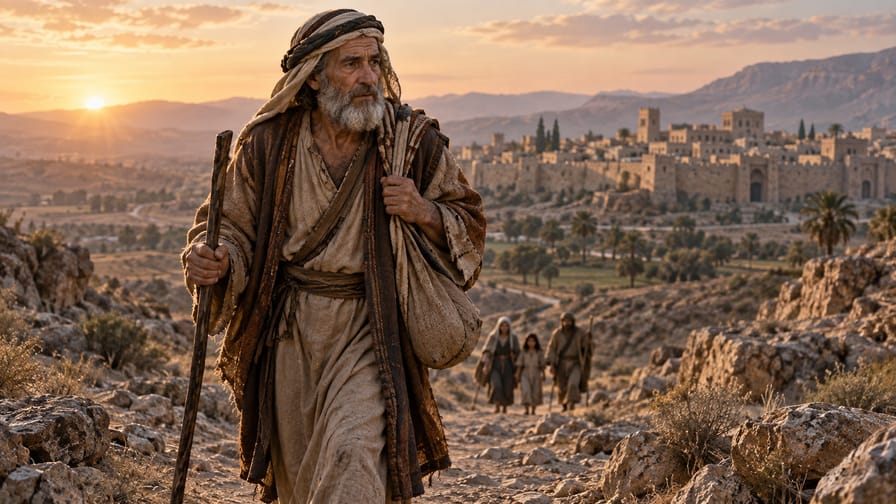
The figure of Lot, Abraham's nephew, emerges in the narratives of Genesis as a complex and multifaceted character, whose story intertwines with fundamental themes of biblical theology. His journey, marked by choices, blessings, and tragedies, offers rich lessons on the nature of faith, the consequences of compromise with the world, and divine justice.
From a Protestant evangelical perspective, Lot's life is a case study on the preservation of faith amidst apostasy and the seriousness of God's judgment. His narrative not only complements the patriarchal history but also serves as a mirror for the church in its relationship with secularized culture, highlighting the need for separation and holiness.
1. Etymology and meaning of the name
The name Lot, in Hebrew Lōṭ (לֹוט), has an etymology that has been the subject of some discussion among scholars. The exact root and primary meaning are not universally accepted, but some proposals deserve consideration. He is the only prominent biblical character with this name.
One of the suggested derivations connects Lōṭ to the Hebrew root meaning "covering," "veil," or "to conceal," possibly alluding to a sense of mystery or protection. Another theory, though less common, relates it to a root meaning "to fold" or "to roll up." Both interpretations, however, lack direct exegetical consensus.
Considering the narrative context, the meaning of the name Lot does not seem to have an explicit theological or symbolic function in the way, for example, Abraham's name ("father of many nations") clearly does. His importance lies more in his actions and the implications of his choices than in his onomastics.
The name is consistently transliterated as Lōṭ in the Hebrew Old Testament and appears as Λωτ (Lōt) in the Septuagint (LXX), the Greek translation of the Old Testament. In the New Testament, he is mentioned in Luke 17:28-32 and 2 Peter 2:6-8, always maintaining this form.
The absence of an evident onomastic meaning for Lot can, paradoxically, highlight the universality of his story. He represents an ordinary individual, whose decisions have profound repercussions, serving as a lesson for any believer, regardless of a "destiny" prefigured in their name.
2. Historical context and biblical narrative
The story of Lot is set within the patriarchal period, approximately between 2100 and 1800 BC, according to traditional biblical chronology. He is first introduced in Genesis 11:27 as the son of Haran and nephew of Abram (the future Abraham), living in Ur of the Chaldeans.
After the death of his father and his grandfather Terah, Lot accompanied his uncle Abram on his journey from Haran to the land of Canaan, according to the divine call (Genesis 12:4-5). This period was characterized by a tribal and nomadic society, with city-states established in fertile regions, such as Sodom and Gomorrah.
2.1 Family origin and genealogy
Lot was the son of Haran, one of the brothers of Abram, Nahor, and Sarai (Genesis 11:27). His mother is not named. After Haran's death in Ur of the Chaldeans, Lot came under the guardianship of his grandfather Terah and, subsequently, his uncle Abram, with whom he developed a close and dependent relationship.
He had no sons, but two daughters, who would play a tragic role at the end of his story. His genealogy is crucial for understanding his connection to Abraham and the inheritance of the promises, albeit indirectly.
2.2 Main events of his life
The life of Lot is marked by several significant episodes. It begins with his migration with Abraham from Ur to Haran and then to Canaan (Genesis 11:31 12:5). The prosperity of both led to a dispute between their herdsmen, culminating in an amicable separation (Genesis 13:5-7).
At this crucial point, Lot chose the plains of the Jordan, attracted by the land's fertility, although he knew that the cities of that region, including Sodom, were inhabited by exceedingly wicked people (Genesis 13:10-13). This decision was the watershed of his life.
Later, Lot was captured during a war between kings of the East and kings of Sodom and Gomorrah (Genesis 14:11-12). Abraham, upon learning of his nephew's capture, organized a military rescue, freeing Lot and recovering his possessions (Genesis 14:14-16), demonstrating loyalty and compassion.
The most dramatic event in Lot's life is the destruction of Sodom and Gomorrah. God, through angels, warned Lot about the imminent judgment (Genesis 19:1-13). Despite his hesitation and the disbelief of his sons-in-law, Lot, his wife, and his two daughters were rescued by the angels (Genesis 19:15-17).
However, his wife looked back, disobeying the divine command, and turned into a pillar of salt (Genesis 19:26). Lot and his daughters took refuge in Zoar and, subsequently, in the mountains. The end of his story is defiled by incest with his daughters, which resulted in the origin of the Moabites and Ammonites (Genesis 19:30-38).
2.3 Geography and relationships
The life of Lot spans several regions: Ur of the Chaldeans (Mesopotamia), Haran, Canaan (Bethel, Ai, Hebron), and, most notably, the plain of the Jordan, with its city-states of Sodom and Gomorrah, and the small town of Zoar. His most significant interaction was with his uncle Abraham, who protected him and interceded for him.
He also had contact with the kings of the region, the inhabitants of Sodom, and, finally, with the angels of the Lord. The geography of his story is vital for understanding the choices and consequences, especially the attraction to the "cities of the plain of the Jordan," which were like the "garden of the Lord" but also the "Valley of Siddim" (Genesis 13:10 14:3).
3. Character and role in the biblical narrative
The character of Lot is a tapestry of contrasts, revealing both admirable qualities and significant moral failings. The biblical narrative presents him realistically, without idealizing him, which allows for an in-depth analysis of his human and spiritual complexity.
A notable virtue of Lot is his hospitality, evidenced when he welcomed the angels into Sodom, offering them shelter and protection (Genesis 19:1-3). This characteristic was highly valued in the ancient Near East and is a trait that distinguishes him from the city's depraved inhabitants.
Furthermore, the apostle Peter describes him as a "righteous" (dikaios) man who was "distressed day after day by the lawless deeds" of the people of Sodom (2 Peter 2:7-8). This statement is crucial, as it attests that Lot, despite his flaws and physical location, maintained an inner faith and righteousness, distinguishing him from the wicked.
However, Lot's weaknesses are equally evident. His choice of the plain of the Jordan, "like the garden of the Lord," was motivated by materialistic pragmatism and the beauty of the land, ignoring the moral corruption of its inhabitants (Genesis 13:10-13). This decision revealed a lack of spiritual discernment and an inclination towards worldly advantages.
He demonstrated indecision and hesitation at the moment of judgment, needing to be dragged by the angels out of Sodom (Genesis 19:16). His offer of his virgin daughters to the men of Sodom to protect his guests (Genesis 19:8), although a reflection of the extreme hospitality of the time, is morally disturbing and reveals deep desperation or distorted judgment.
The final episode of incest with his daughters (Genesis 19:30-38), although provoked by them in a context of isolation and despair, exposes Lot's vulnerability to drunkenness and its consequences. This tragic event seals the moral decline of a man who, though righteous in God's eyes, succumbed to human weaknesses.
Lot's role in the biblical narrative is multifaceted: he is a companion of Abraham, a beneficiary of divine intercession, an example of a believer living in compromise with the world, and a witness to God's judgment. His story serves as a warning about the dangers of association with ungodliness and the consequences of seeking material prosperity at the expense of spiritual integrity.
4. Theological significance and typology
The story of Lot holds deep theological significance, acting as a microcosm of larger themes in redemptive history. While Lot is not a direct typological figure of Christ, his life illustrates divine principles and prefigures aspects of judgment and salvation that find their fulfillment in Christ.
He is a vivid example of the preserving grace of God amidst judgment. Despite his flaws and his association with iniquity, Lot was saved from fire and brimstone because of Abraham's intercession (Genesis 19:29) and divine mercy. This points to God's sovereignty in rescuing His own, even when their choices are questionable.
The description of Lot as "righteous" in 2 Peter 2:7-8 is theologically significant. This does not mean he was impeccable, but that he possessed a genuine faith and a conscience that discerned evil, even while immersed in it. His righteousness is, therefore, an imputed righteousness by faith, not an intrinsic righteousness by perfect works, aligning with the Protestant evangelical doctrine of justification.
The story of Lot serves as an eschatological warning. Jesus Christ makes a clear reference to the days of Lot when speaking about His second coming, comparing the indifference and pursuit of worldly pleasures before divine judgment (Luke 17:28-32). The instruction "remember Lot's wife" is a call to vigilance and separation from the world.
The destruction of Sodom and Gomorrah, with Lot as an eyewitness, is a powerful symbol of divine judgment against sin and God's holiness. This narrative reinforces the seriousness of sin and the certainty that God will not leave evil unpunished, a theme fully revealed at the cross of Christ, where judgment was poured out on the Son to save sinners.
Lot's separation from Abraham and his choice of the fertile yet corrupt plain illustrates the danger of compromise with the world. The pursuit of material advantages led Lot into an environment that corrupted his family and almost destroyed him. This resonates with the exhortation in 1 John 2:15-17 not to love the world or the things in the world.
Abraham's intercession for Sodom, though it did not save the city, ensured Lot's salvation (Genesis 18:22-33 19:29). This prefigures the intercession of Christ for His elect. Lot's salvation was not due to his merits, but by grace mediated through faith and intercession, pointing to the vicarious work of Jesus.
Finally, the story of Lot, by generating the Moabites and Ammonites through an act of incest, highlights the lasting consequences of sin and disobedience. These nations would become adversaries of Israel, demonstrating how individual failings can have generational and historical implications in the narrative of redemption.
5. Biblical-theological legacy and canonical references
The figure of Lot, though secondary to Abraham, left a significant biblical-theological legacy, reverberating in various parts of the canon and influencing Christian and Jewish theology. His story serves as a point of reference for understanding themes such as judgment, salvation, intercession, and the believer's relationship with the world.
Beyond the book of Genesis, Lot is explicitly mentioned in the New Testament in two crucial passages. In Luke 17:28-32, Jesus uses the destruction of Sodom in the days of Lot as an analogy for the sudden and decisive coming of the Son of Man, warning against attachment to earthly possessions and pleasures.
The second reference is in 2 Peter 2:6-9, where Peter describes him as a "righteous" man who was saved by God, serving as an example of divine capacity to rescue the godly from trial and to reserve the unrighteous for punishment. This passage is fundamental for Reformed theology, as it underlines the perseverance of the saints and God's faithfulness to His own, even in adverse circumstances.
The mention of Lot in 2 Peter is particularly important because, by calling him "righteous," the New Testament validates his faith, despite his flaws. This reinforces the doctrine of justification by faith, where an individual's righteousness is not based on their moral perfection, but on the imputation of God's righteousness through faith.
In the Jewish interpretative tradition, Lot is often seen as an example of someone who, despite having had the opportunity to follow Abraham fully, succumbed to the temptations of the world. Some midrashim explore his choices and their consequences, serving as parables about morality and devotion.
In Reformed and evangelical theology, the story of Lot is frequently used to illustrate the tension between the believer and secular culture. His decision to dwell in Sodom, his experiences of anguish over wickedness, and his miraculous rescue are seen as a call to separation and holiness, emphasizing the importance of not conforming to the patterns of this world (Romanos 12:2).
The story of Lot also contributes to the understanding of the biblical canon by demonstrating the coherence of divine revelation concerning sin and judgment. It provides a historical precedent for prophetic exhortations against idolatry and immorality, and for the eschatological warnings of the New Testament.
Thus, the life of Lot is more than a simple narrative it is a vivid illustration of the sovereign grace of God that saves and preserves His elect, of the severity of divine judgment upon sin, and of the need for discernment and separation for those who desire to live in obedience to the Lord, resonating with the central message of the gospel.