


Jair
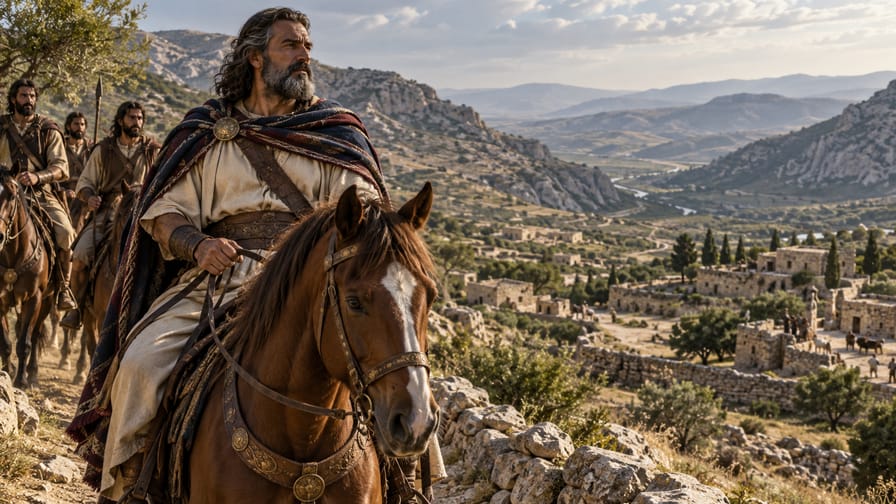
The biblical figure of Jair, one of the minor judges of Israel, emerges from the pages of the book of Judges, offering a glimpse into the complex tapestry of Israel's post-Joshua history. Although his narrative is concise, his mention is crucial for understanding the period of the Judges, a time marked by cycles of apostasy, oppression, and divine deliverance. This in-depth analysis will explore the onomastic meaning of Jair, his historical context, the characteristics of his rule, his theological significance, and the legacy he left for biblical theology, all from a conservative evangelical Protestant perspective.
The approach aims at rigorous exegesis of the Scriptures, recognizing their inerrancy and authority, and seeking to discern the eternal truths that the story of Jair reveals about God's faithfulness and the nature of leadership in the redemptive plan. The brevity of his account does not diminish its importance, but serves to underscore divine sovereignty in using diverse instruments to sustain His people, even in times of moral and spiritual decline.
1. Etymology and meaning of the name
The name Jair, in Hebrew יָאִיר (Ya'ir), is a name of rich etymological significance. It derives from the Hebrew root אוֹר ('or), meaning "light" or "to shine." Consequently, the name Jair can be translated as "he enlightens," "he gives light," or "he shines." This connotation of light is profoundly symbolic in the biblical context, frequently associated with divine revelation, truth, justice, and the presence of God.
The transliteration of the name may vary slightly in different Bible versions, but the form Jair is the most common in Portuguese. The Hebrew root 'or is fundamental for understanding the symbolism, as light is a recurring theme in the Scriptures, from creation ("Let there be light," Genesis 1:3) to the description of God as light (1 John 1:5) and Christ as the Light of the World (John 8:12).
It is important to note that there are other biblical figures who share the name Jair, though with distinct profiles and contexts. One of the most notable is the ancestor of Jair, the judge, also named Jair, who conquered the "villages of Jair" (חַוֺּת יָאִיר, Havvoth-Ya'ir) in the region of Gilead (Numbers 32:41 Deuteronomy 3:14). This repetition of the name suggests a lineage or a family tradition associated with possession and leadership in that area.
Other Jairs include the father of Mordecai, a Benjamite, mentioned in Esther 2:5, and a Jair whose son, Elhanan, killed Lahmi, the brother of Goliath (1 Chronicles 20:5), though in 2 Samuel 21:19 the reference is to Elhanan, the son of Jaare-Oregim. These distinctions are crucial to avoid confusion and maintain exegetical precision when studying the figure of Judge Jair.
The theological significance of the name "he who enlightens" for a judge is noteworthy. In an era of chaos and spiritual darkness, judges were raised up by God to bring order, justice, and, metaphorically, light to the nation. They were divine instruments to guide the people back to the ways of the Lord, illuminating the path of righteousness and obedience to the Torah. Thus, the name Jair, though possibly merely descriptive of a parental hope, acquires a prophetic and functional meaning in his role.
Light, in biblical theology, represents truth against falsehood, life against death, and the presence of God against the darkness of sin. For a judge, "to enlighten" meant to shine God's law upon the darkness of idolatry and social injustice. The divine choice of a man with such a name for a position of leadership in Israel is not mere coincidence, but echoes God's providence in providing guides for His people.
2. Historical context and biblical narrative
Jair, the judge, appears in the book of Judges, specifically in Judges 10:3-5, after the judgeship of Tola, of the tribe of Issachar, and before the judgeship of Jephthah, the Gileadite. This period is generally dated between the 12th and 11th centuries B.C., a turbulent phase in Israel's history, characterized by an absence of centralized government and the intermittent application of God's law. The recurring phrase "In those days there was no king in Israel everyone did what was right in his own eyes" (Judges 17:6 21:25) encapsulates the spirit of the age.
The political, social, and religious context was one of great instability. After the conquest of Canaan under Joshua, the tribes of Israel failed to completely expel all the Canaanite peoples, resulting in a coexistence that frequently led to cultural and religious assimilation. The worship of Canaanite gods, such as Baal and Ashtoreth, became common, provoking God's wrath and resulting in oppression by neighboring nations.
The genealogy of Jair is crucial for understanding his origin and connection to the land. He is described as "a Gileadite" (Judges 10:3), indicating his provenance from the region of Gilead, east of the Jordan River. This region had a particular history, having been inhabited by the tribes of Reuben, Gad, and the half-tribe of Manasseh. The mention that he was "of Gilead" is significant, as his eponymous ancestor, Jair, son of Manasseh, had conquered the "villages of Jair" (חַוֺּת יָאִיר, Havvoth-Ya'ir) in that same region (Numbers 32:41 Deuteronomy 3:14). This establishes a strong family and territorial link, suggesting that Judge Jair belonged to a prominent and established lineage in Gilead.
The main events of Jair's life are concisely presented in Judges 10:3-5. He judged Israel for twenty-two years, a relatively long period, indicating a time of relative stability under his leadership. The narrative highlights that he had thirty sons, who rode on thirty donkeys, and that they owned thirty towns in the land of Gilead, which were called Havvoth-Jair to this day. This description is not merely genealogical, but underscores his wealth, influence, and patriarchal authority.
The possession of thirty donkeys by his sons was a sign of status and prosperity in ancient society, as donkeys were valuable animals for transport and trade. The thirty towns (or villages) in Gilead, referred to as Havvoth-Ya'ir, reinforce the idea that Jair's family held considerable power and exercised control over a vast area. The mention that these towns were called this "to this day" is an editorial note confirming the perpetuation of his geographical legacy.
The geography of his judgeship was centered in Gilead, a mountainous and fertile region east of the Jordan, known for its luxuriant vegetation and pastures. Jair's location in this area was strategic, as it was a frequently disputed border and therefore required strong leadership. He was buried in Kamon (Judges 10:5), a town in Gilead, whose exact location is debated, but is presumed to be in the region where his family exercised influence.
Jair's relations with other biblical figures are limited to his place in the succession of judges. He succeeded Tola and was succeeded by Jephthah. The transition to Jephthah's judgeship is marked by a new cycle of apostasy and oppression by the Ammonites, which suggests that Jair's period, although not described with great military exploits, was a time of relative peace and order, in contrast to the turbulence that preceded and followed it.
3. Character and role in the biblical narrative
The analysis of Jair's character, as revealed in the Scriptures, is an exercise in inference, given the brevity of his account. The biblical text does not offer direct descriptions of his personality or heroic deeds, as it does with Gideon or Samson. However, the absence of criticism or mention of significant moral failings is, in itself, an important datum in the book of Judges, which frequently exposes the imperfections of its leaders.
One of the virtues that can be inferred from Jair's judgeship is his ability to maintain stability. Judging Israel for twenty-two years in such a chaotic period suggests that he possessed qualities of leadership, administrative wisdom, and perhaps diplomatic skills to avoid internal and external conflicts. The longevity of his rule is proof of his effectiveness in a scenario of political and social fragility.
The description of his thirty sons riding on thirty donkeys and owning thirty towns in Gilead (Judges 10:4) not only points to his wealth and status, but may also indicate a successful and influential family structure. In a tribal society, a numerous and prosperous family, with control over territories, was a pillar of power and stability. This suggests that Jair was a capable patriarch, whose sons continued his legacy of influence.
Unlike other judges who are presented with dramatic narratives of military deliverance, Jair is described more succinctly, focusing on his function of "judging" (שָׁפַט, shafat). The role of the judge (שֹׁפֵט, shofet) went beyond mere administration of justice it included military, political, and religious leadership. The lack of mention of battles or miracles does not mean inactivity, but perhaps a period of rule more focused on maintaining law and order, and promoting civil and religious life. He may have been a judge who brought peace through just administration, rather than through war.
Regarding sins, weaknesses, or moral failings, the Scriptures are silent. This silence is notable, especially when compared to the detailed accounts of the failures of Gideon (his idolatry with the ephod, Judges 8:27), Samson (his weakness for women, Judges 16), or even Eli (his failure to discipline his sons, 1 Samuel 2:12-17, 27-36). The absence of recorded failures may indicate that Jair, within the standards of the book of Judges, was a relatively upright and effective leader in his calling.
His role was, therefore, that of a judge who provided an interlude of stability in an era of turbulence. He is not presented as a charismatic prophet or a legendary warrior, but as a leader who, for over two decades, ensured governance and relative peace in a part of Israel. His significant actions, though not detailed, were the maintenance of order and the transmission of his authority and possessions to his descendants, an indication of successful leadership in terms of succession and family prosperity.
The development of Jair's character in the narrative is limited by its brevity. He enters the scene as a judge and exits after his death and burial. There are no narrative arcs of personal conflict, repentance, or transformation. His story serves more as a temporal marker and an example of a type of leadership that, though less dramatic, was equally vital for the preservation of Israel in a period of anarchy and deviation from God.
4. Theological significance and typology
The theological significance of Jair, though not explicit in grand discourses or prophecies, is intrinsically linked to his role in Israel's redemptive history and the progressive revelation of God's plan. He is part of the series of judges raised up by God to deliver and govern Israel, a testament to divine faithfulness even when His people strayed.
The presence of Jair in the narrative of Judges reinforces the theme of God's sovereignty in providing leadership. Amid Israel's disobedience and apostasy, God does not abandon His people, but continues to raise up individuals to bring order and justice. Jair represents God's provision for a period of relative peace and stability, a reminder that divine grace manifests in diverse ways, not always through spectacular events or charismatic prophets.
Although Jair is not directly cited in the New Testament and there is no explicit and strong Christocentric typology, like that of Moses or David, we can discern indirect and thematic prefigurations that point to Christ. The name Jair, "he who enlightens" or "he who gives light," resonates deeply with the identity of Jesus Christ, who is the "Light of the World" (John 8:12 9:5) and the "true light that gives light to everyone" (John 1:9).
Christ, as the perfect Judge (John 5:22 Acts 17:31), brings the light of truth and justice into a world immersed in spiritual darkness. The period of stability and prosperity under Jair can be seen as a faint shadow of the peace and abundance found in the kingdom of Christ. Jair's rule, though temporary and limited, offered a glimpse of the order that God desires for His people, an order that is fully realized in Christ and His eternal kingdom.
The stability provided by Jair can also be interpreted as an example of the blessing God grants to obedience and righteous leadership, even if imperfect. In contrast to the cycles of oppression that resulted from disobedience, Jair's time may have been a period when Israel enjoyed some measure of divine favor, a testament to God's patient grace toward His covenant people.
The Mosaic covenant, with its promises of blessings for obedience and curses for disobedience (Deuteronomy 28), is the theological backdrop for the entire book of Judges. Jair, as a judge, was an agent of God to uphold this covenant, applying the law and seeking justice. Although the text does not detail his actions in this regard, his function implies a commitment to the principles of the Torah. His life and ministry connect with central theological themes such as divine providence, the need for godly leadership, and God's patience with His wandering people.
The figure of Jair, therefore, contributes to the progressive revelation of God as the Lord who governs history, raising up and bringing down leaders according to His purpose. He points indirectly to the need for a perfect King and Judge, who would finally bring lasting peace and full justice, a role fulfilled only in Jesus Christ. The brevity of Jair's account, paradoxically, highlights the need for a Messiah whose story is complete and whose salvation is eternal.
Reformed and evangelical theology emphasizes God's sovereignty over all aspects of creation and history. The story of Jair illustrates this sovereignty, showing how God works through human instruments, some more prominent than others, to carry out His redemptive purposes. He is an example that faithful service to God, even if not glorified with extensive narratives, is valued and fulfills a vital purpose in the divine plan.
5. Biblical-theological legacy and canonical references
The biblical-theological legacy of Jair, though less prominent than that of judges like Gideon or Samuel, is significant inasmuch as it contributes to the understanding of the canon and biblical theology as a whole. His mentions are primarily restricted to the book of Judges (Judges 10:3-5), with references to an eponymous ancestor in Numbers 32:41 and Deuteronomy 3:14, who established the "Havvoth-Jair."
Jair's contribution to biblical theology lies in his representation of a type of leadership that is often overlooked in more dramatic stories. He is a reminder that faithfulness and stability in governmental and administrative roles are just as crucial as heroic acts of deliverance. His story underscores God's continuous providence in sustaining Israel, even in the "times of the judges," which were marked by cycles of sin and judgment.
In the Jewish and Christian interpretative tradition, Jair is generally classified as a "minor judge" due to the conciseness of his account. However, evangelical commentators such as J. Sidlow Baxter, in his work "Explore the Book," and John Gill, in his "Exposition of the Old and New Testaments," frequently point to the importance of his long and apparently peaceful administration as a testament to God's grace and the need for stable leadership.
Reformed and evangelical theology sees in Jair an example of the diversity of gifts and functions that God grants to His servants. Not all are called to be charismatic prophets or miraculous warriors some are called to lead with wisdom and prudence, maintaining order and justice in their respective contexts. The story of Jair, despite its brevity, serves to illustrate the truth that all faithful service, however "silent" it may be in the biblical narrative, is an integral part of God's sovereign plan.
The absence of mentions of Jair in intertestamental literature or the New Testament, beyond the references already cited, is consistent with the concise nature of his account in Judges. However, the principle that his life represents — God's providence in providing leaders and the importance of stability — is a recurring theme throughout Scripture, from the patriarchs to the leadership of the early church (Acts 6:1-7 Titus 1:5-9).
Jair's importance for understanding the canon lies in his contribution to the complete panorama of the book of Judges. He fills a chronological gap and demonstrates that not every period of judgeship was marked by great wars and open apostasies. His existence testifies to the complexity of Israel's history and the manifold wisdom of God in governing His people through different types of leaders. He is a reminder that the Lord of history is not limited to a single model of leadership or intervention.
In summary, the figure of Jair, the Gileadite, though not a central character with an extensive narrative, offers valuable theological lessons. His name, "he who enlightens," his long and apparently prosperous administration, and his position in the book of Judges, contribute to a richer understanding of divine providence, the nature of leadership in difficult times, and God's unwavering faithfulness to His covenant people, prefiguring, albeit faintly, the light and order that would come fully in Christ Jesus.