


Ittai
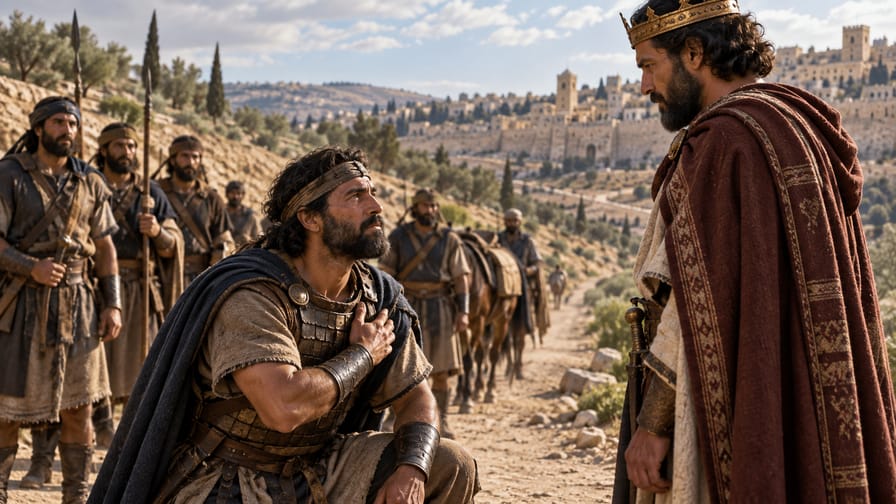
The figure of Ittai, the Gittite, emerges in the Scriptures during one of the most turbulent and revealing moments of David's reign: the rebellion of his son Absalom. Although his appearance is brief, his unwavering loyalty and his willingness to follow King David, even in the midst of the deepest adversity, bestow upon him theological significance and a notable place in the history of salvation. His story is a powerful testament to faithfulness, a stark contrast to the betrayal that surrounded David, and a foreshadowing of the inclusion of Gentiles in the people of God.
This study will delve into the etymology of his name, the historical context of his actions, an analysis of his character and role, the theological and typological significance he represents, and the legacy that his brief, yet impactful, presence left for understanding the biblical canon, all from a conservative evangelical Protestant perspective.
1. Etymology and Meaning of the Name
The name Ittai (in Hebrew: אִתַּי, Ittay) appears in the Masoretic Text in 2 Samuel 15:19, 21, 22 and 18:2, 5, 12. Its etymology is the subject of some discussion among Hebraists, but the most widely accepted interpretation connects it to a meaning that deeply resonates with his actions in the biblical narrative.
One line of thought suggests that Ittay may derive from the Hebrew preposition ’et (אֵת), which means "with" or "alongside." In this sense, the name could mean "with me" or "the one who is with me/alongside." This interpretation is particularly poetic and significant, considering that Ittai refuses to abandon David, declaring: "Wherever my lord the king goes, whether to death or to life, there will your servant be also" (2 Samuel 15:21).
Another etymological possibility links the name to a root denoting "to arrive," "to come," or "to be present," which would result in meanings such as "the opportune one" or "the one who comes." This interpretation also aligns with the narrative, as Ittai appears at a critical moment in David's life, offering help and loyalty when David most needed it.
It is less probable, but some scholars hypothesize a non-Hebrew origin for the name, given his identity as a "Gittite" (גִּתִּי, Gittiy), indicating that he was from Gath, one of the five principal Philistine city-states. If the name were Philistine, its original meaning would be more difficult to determine based on Hebrew roots.
There are no significant variations of the name Ittai in the biblical languages, and there are no other prominent biblical characters with the same name who play a comparable role. This makes Ittai of Gath a unique figure in his mention and impact.
The theological significance of the name, especially under the interpretation of "with me" or "the one who is alongside," is profound. He personifies loyalty and presence in times of affliction, an echo of the divine promise to be "with us" (Matthew 28:20 Isaiah 41:10). His willingness to remain with David, the Lord's anointed, even in his exile and humiliation, foreshadows the faithfulness God expects from His people and, typologically, the adherence of Gentiles to the suffering Messiah.
2. Historical Context and Biblical Narrative
The appearance of Ittai is set within the dramatic and somber period of Absalom's rebellion against his father, King David. This event occurred around the late 11th or early 10th century B.C., a time of consolidation for the kingdom of Israel, but also of palace intrigues and internal conflicts resulting from David's sins and Nathan's prophecies (2 Samuel 12:10-12).
The political context was one of instability. David, though established as king, faced the consequences of his moral failures, which had generated discord and violence in his own house. Absalom, his son, capitalized on popular discontent and the pursuit of power, usurping his father's throne in Jerusalem. David's flight from Jerusalem was a moment of extreme humiliation and vulnerability for the monarch anointed by God (2 Samuel 15:13-17).
2.1 Family Origin and Genealogy
The genealogy of Ittai is not provided in the Scriptures. What we know is that he was a "Gittite," meaning a man from Gath, a Philistine city. This is a crucial detail. The Philistines were historical enemies of Israel, and David had many confrontations with them, including the famous victory over Goliath, also from Gath (1 Samuel 17). The presence of Ittai and his men in David's retinue suggests a complex arrangement.
It is probable that Ittai and his men were mercenaries, personal guards, or exiles who had sought refuge with David, perhaps after David had served Achish, king of Gath, at an earlier time in his life (1 Samuel 27). His foreign origin makes his loyalty to David even more remarkable, contrasting with the unfaithfulness of many Israelites.
2.2 Main Events of Life and Biblical Passages
Ittai is introduced at the climax of David's flight from Jerusalem, when the king and his retinue, including his servants, the army, and the personal guard, cross the Kidron Valley and head toward the desert (2 Samuel 15:18). At this moment of uncertainty, David turns to Ittai, who led six hundred men from Gath.
David tries to dissuade Ittai from accompanying him, arguing about his foreign origin and the uncertainty of his own destiny: "Why should you also go with us? Go back and stay with King Absalom, for you are a foreigner and also an exile from your own land. You came only yesterday, and shall I make you wander about with us today, while I myself go wherever I can? Go back and take your brothers with you may the Lord show you steadfast love and faithfulness" (2 Samuel 15:19-20).
Ittai's response is one of the most beautiful and powerful declarations of loyalty in the Bible: "As the Lord lives, and as my lord the king lives, wherever my lord the king shall be, whether for death or for life, there also will your servant be" (2 Samuel 15:21). This declaration sealed his destiny with David.
In the face of such faithfulness, David accepted him, and Ittai and his men crossed the Kidron Valley, following the king. Later, when David organized his army for the battle against Absalom in the forest of Ephraim, he divided his forces into three companies, placing Ittai in command of one of them, alongside Joab and Abishai (2 Samuel 18:2). This demonstrates the great trust David placed in him, a foreigner, granting him a position of strategic military leadership.
The geography related to Ittai includes Gath, his hometown, Jerusalem, from which David fled, the Kidron Valley, which they crossed, and the forest of Ephraim, where the decisive battle took place. His story is a testament to the universality of loyalty and God's ability to raise allies from unexpected places.
3. Character and Role in the Biblical Narrative
The character of Ittai is revealed through a single, yet profound, interaction with King David. In contrast to many of David's own countrymen who abandoned him or turned against him, Ittai, a foreigner, demonstrates exemplary qualities of loyalty and courage.
The primary virtue that emerges from Ittai is his unwavering loyalty. His declaration to David in 2 Samuel 15:21 is not merely an oath of faithfulness, but a promise of total dedication, even unto death. He does not seek personal advantage, nor does he cling to the security of his own life or the possibility of an easier life with Absalom, the usurping king. His motivation is pure and disinterested, focused on the person of David, the Lord's anointed.
His faithfulness is even more remarkable because he is a foreigner. In a society where tribal and national loyalty was paramount, Ittai transcends these barriers, choosing to remain with a disgraced king who could offer him nothing but danger and uncertainty. This positions him as a model of commitment and devotion.
Ittai's courage is also evident. He resolves to face death or life alongside David, aware of the risks of civil war and the precariousness of the king's situation. This courage is recognized by David, who entrusts him with the command of one-third of his army in the battle against Absalom (2 Samuel 18:2), a position of great responsibility and danger.
There is no record of documented sins, weaknesses, or moral failings for Ittai in the Scriptures. He is presented in a uniquely positive light, emerging as an unexpected hero in a time of crisis. His integrity and sense of duty are unquestionable.
The role of Ittai in the biblical narrative is that of a faithful military leader and a crucial ally. Although perhaps originally a Philistine mercenary, his loyalty transforms him into an integral member of David's army. He is not a prophet, priest, or king in the traditional Israelite sense, but a warrior who offers his service and his life to King David.
His significant actions include the decision to accompany David, defying the king's suggestion that he return, and his subsequent leadership on the battlefield. These key decisions not only indirectly saved David's life but also provided a powerful moral example for the rest of the army and for future generations.
The development of Ittai's character does not occur through internal change but rather through the revelation of an already formed character. He emerges in the narrative as a man of loyalty and strength, whose presence serves to highlight the depth of David's crisis and the divine providence that raises faithful allies even among foreigners. He is a testament to the universality of the virtues that God values.
4. Theological Significance and Typology
The figure of Ittai, the Gittite, though briefly mentioned, carries a profound theological significance relevant to the evangelical Protestant perspective, especially concerning the universality of God's grace and Christocentric typology.
In the context of redemptive history, Ittai demonstrates that faithfulness to God and His anointed is not restricted by lineage, nationality, or ethnicity. He, a Philistine, a foreigner from an enemy nation of Israel, manifests a loyalty and commitment to David that many Israelites, including the king's own son, did not possess. This points to the truth that God can raise faithful servants from any people, foreshadowing the inclusion of Gentiles in the plan of salvation.
From a typological perspective, Ittai serves as a type of the Gentiles who unite with the suffering Messiah. David, in his flight from Absalom, is a king in exile, humiliated and rejected by his own people, a scenario that many commentators view as a foreshadowing of Christ. Jesus, the true Son of David, was rejected by His own people (John 1:11), suffered persecution, and went to the cross in humiliation (Philippians 2:8).
Just as Ittai, a foreigner, joins David in his darkest hour, forsaking security out of loyalty, so too are the Gentiles called to unite with Christ in His humiliation, death, and resurrection. Ittai's declaration: "Wherever my lord the king goes, whether to death or to life, there will your servant be also" (2 Samuel 15:21), is a remarkable echo of Christ's call to discipleship, which demands self-denial and unconditional following: "If anyone would come after me, let him deny himself and take up his cross daily and follow me" (Luke 9:23).
Ittai's story is a practical and early manifestation of the Abrahamic promise that "in you all the families of the earth shall be blessed" (Genesis 12:3). The faithfulness of a Gentile to the king of Israel is a glimpse of the future union of Jews and Gentiles in one body in Christ, a central theme in New Testament theology (Ephesians 2:11-22 Galatians 3:28 Colossians 3:11).
Although Ittai is not explicitly cited in the New Testament, his narrative vividly illustrates fundamental New Testament principles. He embodies the spirit of faith, which trusts in God's sovereignty even amidst adversity, and the grace of God, which extends beyond ethnic and cultural boundaries. His loyalty is a model of genuine discipleship, characterized by sacrifice and unconditional commitment to the Lord.
The inclusion of Ittai in David's army and his subsequent leadership are a miniature fulfillment of the prophetic vision that Gentiles would gather around the Messiah and participate in His kingdom. He is a testament to divine sovereignty that, even in the chaos of rebellion, operates to protect His anointed and fulfill His promises, using improbable instruments for His glorious purposes.
His story connects with central theological themes such as faith (trust in David as God's anointed), grace (God using a foreigner), discipleship (unconditional loyalty), and divine sovereignty (God controlling events for the good of David and his kingdom). Ittai is, therefore, a small, yet powerful, link in the progressive revelation of God's plan of salvation, which would culminate in the universal church composed of believers from every tribe, tongue, people, and nation (Revelation 7:9).
5. Biblical-Theological Legacy and Canonical References
The figure of Ittai, the Gittite, although appearing exclusively in the book of 2 Samuel, possesses a biblical-theological legacy of considerable weight, especially in Christian interpretive tradition. His absence in other biblical books or in intertestamental literature does not diminish the impact of his story.
Ittai's literary contribution is indirect, through the testimony of his life narrated in 2 Samuel. His influence on biblical theology lies in how his story reinforces God's sovereignty in using whomever He wills, regardless of their origin, to fulfill His purposes. He is a vivid testament to the universality of God's call and the nature of true loyalty that transcends human barriers.
In the Jewish interpretive tradition, Ittai is often pointed to as a notable example of loyalty and faithfulness to the anointed king, a model of human hesed (loyal love or kindness). His decision not to abandon David is seen as a virtue to be imitated.
In the Christian tradition, especially in Reformed and evangelical theology, Ittai acquires an even deeper significance. Commentators like Matthew Henry highlight his faith and faithfulness, seeing him as a prototype of the Gentiles who convert and demonstrate loyalty to Christ, the true King. His story is frequently used to illustrate the inclusion of Gentiles in the covenant of grace, a central theme in Pauline theology (Romans 9-11).
Theologians such as John Gill and Charles Spurgeon, in their sermons and commentaries, might have used Ittai to exemplify the nature of true faith and discipleship, which is not based on ethnic privilege but on a personal and unconditional commitment to the Lord. He is a symbol of the universal church, comprised of believers from all nations who unite with Christ in His journey, whether of suffering or of glory.
The treatment of the character in Reformed and evangelical theology emphasizes his loyalty as a spiritual virtue, his courage as an act of faith, and his foreign origin as a foreshadowing of the gospel's extension to all nations. He is a reminder that God's grace is not confined to one ethnic or national group but is offered to all who, like Ittai, demonstrate a loyal heart willing to follow the Lord's anointed, "whether for death or for life."
The importance of Ittai for understanding the canon lies in his ability to illustrate crucial theological principles in a concise narrative. He shows that, even in times of crisis and betrayal, God raises faithful allies from unexpected places. His story is a link in the chain of progressive revelation, pointing to universal inclusion in God's redemptive plan, which culminates in the New Covenant in Christ, where there is no longer "neither Jew nor Greek, there is neither slave nor free, there is no male and female for you are all one in Christ Jesus" (Galatians 3:28).
Thus, the brief, yet powerful, presence of Ittai in the Scriptures serves as an enduring testimony to God's faithfulness in providing, to the loyalty He expects from His followers, and to the breadth of His love that embraces people of all origins into the family of faith.