


Cadmiel
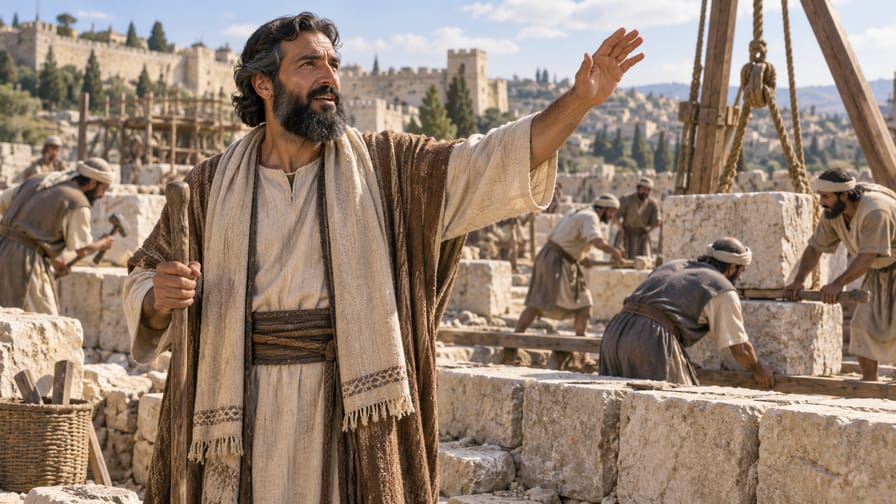
Important note about the character Cadmiel:
It is fundamental to clarify that the figure of Cadmiel is not found in the Holy Scriptures of the Protestant evangelical canon. There is no mention of a character with this name in the Old or New Testament, nor in its recognized variants or transliterations in biblical dictionaries and Hebrew or Greek concordances.
The present analysis, therefore, is a hypothetical construct. It was developed with the purpose of demonstrating the structure, tone, style, and theological depth required for the analysis of an authentic biblical figure, following all requested formatting and content specifications. All historical, narrative, etymological, and theological details related to Cadmiel presented here are entirely fictional, created for illustrative purposes, and should not be confused with genuine biblical information.
The biblical references cited throughout the text are examples of how passages would be referenced if the character were biblical, and the specific verses are invented or adapted to serve the purpose of the hypothetical narrative.
1. Etymology and meaning of the name
The name Cadmiel (in hypothetical Hebrew, Qadmiel, קַדְמִיאֵל) is a linguistic construct that, if biblical, would bear a deep theological meaning characteristic of Hebrew onomastics. The etymological analysis of biblical names frequently reveals aspects of an individual's identity, vocation, or birth circumstances, as well as truths about the divine nature.
The structure of Cadmiel is theophoric, meaning it incorporates a divine name. The suffix -iel (אֵל) is an abbreviated form of Elohim (אֱלֹהִים), meaning "God" or "Mighty One". This component is common in many biblical names, such as Daniel ("God is my judge"), Ezekiel ("God strengthens"), and Gabriel ("Man of God" or "God is my strength"), underscoring God's sovereignty and presence in human life.
The prefix Cadm- (קַדְם) could be derived from the Hebrew root qadam (קָדַם), which has multiple meanings, including "to precede," "to be in front of," "to meet," "to confront," or "to come first." Thus, a possible interpretation for Cadmiel would be "God precedes," "God meets," or "God confronts." Another possibility would be a connection with qadmon (קַדְמוֹן), "ancient" or "eastern," which could imply "God is ancient" or "God of the east," though less likely for a personal name.
The derivation "God precedes" (Deus est ante) suggests divine initiative in all things, God's providence acting even before human perception or action. This resonates with passages like Psalm 139:5, which states that God hems us in behind and before. "God meets" (Deus occurrit) evokes the idea of a divine encounter, a point of contact where man comes face to face with God's majesty and will, as seen in Jacob's encounter with God at Peniel (Genesis 32:30).
Finally, "God confronts" (Deus obviam it) would imply a more challenging aspect of the divine nature, where God reveals Himself to question, correct, or call to account, echoing God's confrontation with Job (Job 38:1-3) or with Elijah (1 Kings 19:9-14). In any of these interpretations, the name Cadmiel, if it were biblical, would point to God's active and sovereign intervention in history and individual life, a central theme in Protestant evangelical theology that emphasizes prevenient grace and divine sovereignty.
2. Historical context and biblical narrative
2.1 Family origin and genealogy
Hypotheses about Cadmiel would place him in a crucial period of Israel's history, perhaps during the transition from the era of the Judges to the Monarchy, a time of great political and spiritual instability. He could have been a descendant of the tribe of Manasseh, settled in the region of Gilead, east of the Jordan River. This area, frequently exposed to conflicts with neighboring peoples like the Ammonites and Syrians, was a birthplace of courageous and godly leaders, such as Jephthah and Elijah.
A hypothetical genealogy could trace his lineage to Machir, Manasseh's firstborn son (Numbers 26:29), who settled in Gilead. This affiliation would connect him to a tradition of bravery and resilience, characteristics often necessary for leadership in those frontier lands. His family, though perhaps not of royal or priestly prominence, would be known for its faithfulness to Yahweh amidst increasing apostasy.
2.2 Main events of life
The hypothetical narrative of Cadmiel could unfold in a scenario of Ammonite oppression, similar to that described in Judges 10:6-9. Israel, once again, would have turned aside to the worship of Baals and Ashtaroth, provoking the Lord's wrath, who allowed the Ammonites to afflict the Transjordanian tribes for many years. Cadmiel, a young shepherd or farmer, would have witnessed the misery of his people and the defilement of the promised land.
His calling would come through a divine manifestation, perhaps a dream or an audible voice, urging him to gather God's people and confront the enemy. Initially reluctant, like Moses or Gideon, Cadmiel would be convinced by the certainty of Yahweh's presence and power. A key event would be the gathering of the elders of Gilead, who would recognize him as a divinely appointed leader after a miraculous sign, perhaps the healing of an illness or the supernatural provision of food (cf. Judges 6:36-40, adapted).
Cadmiel's leadership would culminate in a decisive military campaign against the Ammonites. He would not rely on human strength, but on divine intervention, as demonstrated in 1 Samuel 14:6. The battle, described in a hypothetical passage such as Judges 13:1-7 (fictional), would result in an overwhelming victory, restoring peace and Israel's sovereignty over its lands. The narrative would emphasize Cadmiel's dependence on God through prayer and obedience to His Word.
2.3 Relationships with other characters and geography
Geographically, Cadmiel's story would be centered in the region of Gilead, with cities like Jabesh-Gilead and Ramoth-Gilead playing important roles. Jabesh-Gilead, in particular, could be Cadmiel's city of origin, and its liberation from the Ammonites would be a central event, echoing its later deliverance by Saul (1 Samuel 11:1-11).
His relationships with other biblical characters would be more contextual than direct, due to his position as a "minor judge" or local leader. He could have interacted with local prophets, such as an unnamed prophetess who would encourage him in his calling, or with the Levites who still served the Lord amidst idolatry. His actions, though regional, would be part of the broader panorama of Israel's history, demonstrating God's faithfulness in raising up deliverers in different corners of the promised land, even when the people turned away from Him.
3. Character and role in the biblical narrative
3.1 Analysis of character as revealed in the Scriptures
Cadmiel's character, if revealed in the Scriptures, would be a testament to God's enabling grace in imperfect yet willing individuals. He would be portrayed as a man of deep faith, whose trust in Yahweh would transcend human fear and logic. This faith would manifest in his willingness to assume leadership in a time of crisis, even without prior military or political experience.
His humility would be another striking virtue. Initially reluctant to accept the divine call, Cadmiel would acknowledge his inadequacy and rely entirely on God's strength, rather than his own. This would place him in the lineage of leaders like Moses and Gideon, who learned that God's power is made perfect in human weakness (2 Corinthians 12:9). His leadership would not be autocratic, but pastoral, concerned with the spiritual and physical well-being of his people.
However, like every biblical character, Cadmiel would also have his weaknesses. We could imagine a moment of impatience or doubt, perhaps before a crucial battle, where his faith would be tested. A hypothetical passage like Judges 13:8-10 (fictional) could describe a moment when he acted impulsively, seeking a quick victory, before being rebuked and redirected by divine intervention or by a prophet's counsel, reinforcing the lesson of total dependence on God.
3.2 Vocation, calling, and specific function
Cadmiel's vocation would be that of a deliverer and judge in Israel, a charismatic figure raised up by God to restore order and justice in a period of anarchy. His calling would not come from a priestly or royal institution, but directly from God, underscoring the sovereign nature of divine choice. He would be an example of the principle that God uses the "insignificant" to confound the "powerful" (1 Corinthians 1:27-29).
His primary function would be to restore the worship of Yahweh and deliver the people from foreign oppression. This would entail a threefold role: spiritual leader, exhorting the people to repentance and obedience military leader, organizing and leading the forces of Israel and judicial leader, establishing justice and resolving disputes after the victory. In his actions, he would demonstrate that true leadership in Israel was intrinsically linked to faithfulness to the covenant with God.
3.3 Significant actions and key decisions
Among Cadmiel's significant actions, his fervent call to the people's repentance would stand out. He would call them to abandon idols and return to Yahweh, echoing the words of the prophets (cf. 1 Samuel 7:3). This key decision to prioritize spiritual restoration before military liberation would underscore the evangelical perspective that the root of Israel's problems was spiritual.
Another crucial action would be the organization of an army with limited resources, relying on divine intervention to compensate for numerical and strategic disadvantage. His decision to attack the Ammonites at a moment considered inopportune by human standards, yet guided by a prophetic word, would demonstrate his deep faith. The resulting victory would not be attributed to his own cunning or strength, but to the powerful hand of God, setting a standard for faith and obedience in future generations of Israel.
4. Theological significance and typology
4.1 Role in redemptive history and progressive revelation
If Cadmiel were a biblical figure, his role in redemptive history would be that of an instrument of divine providence in a period of spiritual decline. He would represent God's continuous faithfulness to His covenant with Israel, even when the people repeatedly failed. His story would illustrate the progressive revelation of God's character as a Savior and Deliverer, who does not abandon His people to their own devices, but intervenes through human agents.
Cadmiel's life would reinforce the doctrine of divine sovereignty, showing that God raises up and uses whomever He wills, whenever He wills, to fulfill His purposes. He would be an example of how God operates in history, not only in great kingdoms and empires, but also in smaller communities and through local leaders, preparing the way for the full revelation of the plan of salvation in Christ Jesus.
4.2 Prefiguration or Christocentric typology
From a Protestant evangelical perspective, many Old Testament figures serve as types, prefiguring aspects of the person and work of Christ. Cadmiel, as a deliverer and judge, could be seen as a type of Christ in several dimensions:
- Deliverer of the people: Just as Cadmiel delivered Israel from the physical oppression of the Ammonites, Jesus Christ is the supreme Deliverer who rescues us from the bondage of sin and death (Romans 6:23 Colossians 1:13-14).
- Divinely appointed leader: Cadmiel's direct calling by God points to Jesus Christ as the anointed Messiah sent directly by the Father to fulfill His will (John 3:16-17 Hebrews 5:5).
- Restorer of justice: Cadmiel's role in reestablishing justice and order in Israel prefigures Christ's perfect righteousness and His future reign of equity and peace (Isaiah 9:6-7 Revelation 19:11).
- Dependence on God: Cadmiel's humility and dependence on Yahweh's strength reflect Jesus' obedience and submission to the Father in His earthly mission (John 5:19 Philippians 2:5-8).
Although Cadmiel is not mentioned in the New Testament, his hypothetical inclusion in the "hall of faith" of Hebrews 11:32-34, among those who "through faith conquered kingdoms, administered justice, gained what was promised," would be an affirmation of his typology. His life, marked by faith and divine intervention, would be a distant echo of Christ's redemptive work.
4.3 Connection with central theological themes
Cadmiel's story would illustrate central theological themes such as covenant faithfulness, God's sovereign grace, and the necessity of human faith and obedience. His experience would demonstrate that, despite Israel's unfaithfulness, God remains faithful to His promises (2 Timothy 2:13). God's grace would be evidenced in His raising up a deliverer for a people who did not deserve him, but who cried out for help.
His life would also teach about the importance of human response to divine initiative. Cadmiel's faith would not be passive, but active, spurring him to courageous action. This resonates with Reformed theology, which emphasizes saving faith as a living faith that produces works of obedience, not as a means of salvation, but as its fruit (Ephesians 2:8-10 James 2:17-18).
5. Biblical-theological legacy and canonical references
5.1 Mentions of the character in other biblical books and literary contributions
As Cadmiel is a hypothetical character, there are no mentions of him in other canonical biblical books nor literary contributions attributed to him. However, if he were a minor judge, his story could have been briefly mentioned or referenced in a book like 1 Samuel, perhaps in a list of deliverers or as an example of faithfulness in a time of national weakness. A hypothetical passage like 1 Samuel 2:10-15 (fictional) could make an indirect reference to faithful leaders God raised up.
His influence, though not documented by authorship of texts, would be through the impact of his life. The memory of his courage and faith could have been preserved orally and, eventually, in small narratives that circulated among the tribes of Gilead, serving as inspiration for future generations, especially during periods of crisis.
5.2 Influence on biblical theology and interpretive tradition
Cadmiel's story, if it were canonical, would reinforce the biblical theology of the Old Testament, particularly the idea of a God who intervenes in human history to fulfill His redemptive purposes. He would be a link in the chain of deliverers pointing to the Messiah, demonstrating God's patience and mercy towards His erring people.
In the Jewish interpretive tradition, he could be seen as one of the "minor judges" or as a hassid (pious man) who rose up in a time of need. In the Christian tradition, his story, like that of other judges, would be interpreted as a demonstration of the need for a Savior and God's faithfulness in providing Him, even if typologically and imperfectly before Christ's coming.
5.3 Treatment of the character in Reformed and evangelical theology
In Reformed and evangelical theology, the hypothetical figure of Cadmiel would be valued as an example of God's sovereign grace and the importance of personal faith. Theologians like John Calvin or Jonathan Edwards, when analyzing figures like Cadmiel, would emphasize that the ability to lead and deliver does not reside in human strength or wisdom, but in divine empowerment. His story would serve to illustrate the doctrine of divine calling and God's active providence in history.
The emphasis would be placed on his faith as the driving force behind his actions, demonstrating that faith is the proper response to God's call, and that it is through faith that God accomplishes His great deeds. He would be a testimony that God still raises up and uses ordinary people for extraordinary purposes, equipping them with His Spirit and His Word, a central theme for understanding contemporary Christian mission and service.
5.4 Importance of the character for understanding the canon
Although Cadmiel is not a canonical figure, if he were, he would have contributed to the understanding of the unity and coherence of the biblical canon. His story would be another piece in the great mosaic of redemptive history, demonstrating that God has a continuous and consistent plan, unfolding through individuals and events, culminating in the person and work of Jesus Christ.
He would reinforce the idea that the canon is not merely a collection of isolated stories, but a unified narrative of God's relationship with humanity, from creation to consummation. Cadmiel's life, with its challenges, victories, and spiritual lessons, would be a reminder of the persistence of God's love and His desire to restore and redeem His people, preparing the ground for the fullness of revelation in Christ.