


시편
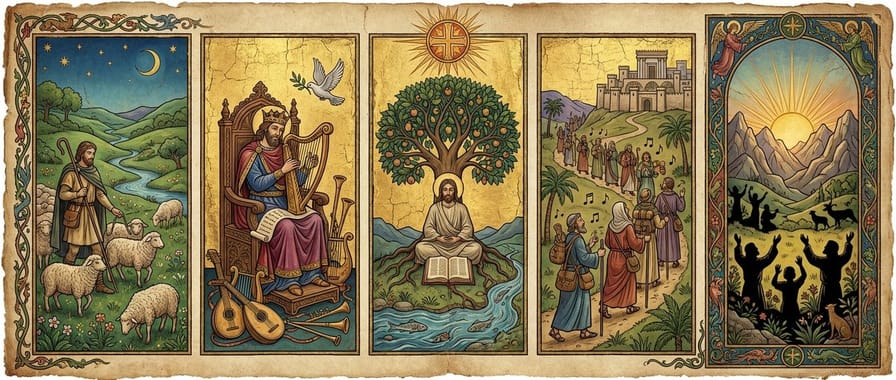
Illustration of the Book of Psalms, one of the 39 books of the Old Testament (Nano Banana Pro).
The Book of Psalms, an inestimable jewel in the crown of the Holy Scriptures, represents not merely a collection of poems and songs, but a microcosm of human experience before divine majesty and grace. For the evangelical Protestant perspective, the Psalms are more than an ancient hymnal; they are the very inspired Word of God, infallible and inerrant, inviting us to a profound interaction with the Creator. This introduction seeks to unfold the multifaceted richness of this book, establishing an analytical framework that can serve as a model for approaching any other canonical text, always with a lens that prioritizes textual fidelity, theological erudition, and pastorally relevant application.
The erudition sought here is not an end in itself, but a means to deepen the understanding of divine revelation, honoring inspired authorship and the eternal message. As we delve into the Psalms, we are confronted with the reality of a sovereign God who interacts with His people amidst joy and anguish, justice and lament. This book, central to the Old Testament canon, echoes the voice of faith, doubt, hope, and worship, offering a mirror for the believing soul and a guide for the spiritual journey. Its poetic structure and theological depth make it an enduring resource for meditation, prayer, and praise, consistently pointing to the Lord and, prefiguratively, to the promised Messiah, Jesus Christ.
Our analysis will be based on essential doctrinal pillars, such as the verbal and plenary inspiration of the Scriptures, the sovereignty of God over history and redemption, and the centrality of Christ as the culmination point of all revelation. We will acknowledge the importance of traditional authorship, historical accuracy, and the theological cohesion that permeate the Psalms, even in the face of literary complexities and modern academic criticisms. Our ultimate goal is to equip the reader to approach the Psalms with reverence, discernment, and robust faith, extracting timeless lessons that inform the life and practice of the contemporary church, always under the authority of the Word of God.
1. Historical Context, Dating, and Authorship
The Book of Psalms, in its current form, is a compilation of songs and prayers that spans a vast period of Israel's history, from the Mosaic era to the post-exilic period. The question of authorship and dating is complex, and the conservative evangelical perspective, while acknowledging the composite nature of the book, firmly upholds the traditional authorship attributed by the Hebrew superscriptions and the testimony of the New Testament, in opposition to many higher critical approaches that tend to date the majority of the Psalms as post-exilic and to minimize Davidic authorship.
1.1 Traditional Authorship and Biblical Testimony
Traditionally, King David is considered the principal author of the Psalms, with 73 of the 150 songs attributed to him by the Hebrew superscriptions. This attribution is widely corroborated by the New Testament, which frequently cites Psalms as being by David. For example, in Acts 4:25, the early church prayed, saying: "You are the God who, through the Holy Spirit, by the mouth of our father David, your servant, said: 'Why did the Gentiles rage, and the peoples plot in vain?'" referring to Psalm 2. Likewise, in Acts 2:25-31, Peter attributes Psalm 16 to David, and in Romans 4:6-8, Paul quotes Psalm 32 as a writing of David.
In addition to David, the superscriptions identify other authors: Asaph (12 Psalms), the sons of Korah (11 Psalms), Solomon (Psalm 72 and 127), Moses (Psalm 90), and Heman and Ethan (Psalm 88 and 89, respectively). Around 50 Psalms are anonymous or "orphan" Psalms. This diversity of authorship and temporal span suggest that the Psalter is a carefully organized anthology, reflecting Israel's experience of faith over centuries.
1.2 Period of Writing and Historical Context
The period of writing for the Psalms spans approximately a millennium, from the song of Moses (c. 1440 BC) to the return from the Babylonian exile (c. 538 BC onwards). The majority of the Psalms, however, are traditionally associated with the period of the united monarchy, especially the reign of David (c. 1010-970 BC). The political and social context varied drastically throughout this time, influencing the tone and content of the Psalms.
During the Davidic era, Israel experienced a period of national consolidation and territorial expansion, but also internal and external conflicts, and moral failures of the king himself. Many Psalms reflect David's personal struggles, his military victories, his laments of repentance, and his expressions of trust in God. The establishment of worship in the Tabernacle and, later, in the Temple, also provided a vital liturgical context for the composition and use of many Psalms.
Psalms by Asaph and the sons of Korah, for example, frequently relate to Temple worship, the nation's history, and questions of divine justice. Psalms such as Psalm 137 clearly date from the period of the Babylonian exile, expressing the pain and longing for Jerusalem. Others, like the Songs of Ascent (Psalms 120-134), are associated with the annual pilgrimages to Jerusalem, perhaps during the post-exilic period, when the nation sought to rebuild its identity and faith.
1.3 Response to Modern Academic Criticisms
Higher textual and historical criticism, especially from the 19th century onwards, frequently questioned the traditional authorship of the Psalms, arguing that many superscriptions are later additions and that the language and theology of many Psalms point to a much later, often post-exilic, dating. Critics such as Hermann Gunkel and Sigmund Mowinckel pioneered the classification of the Psalms by genre and the attempt to reconstruct their liturgical use, but often at the expense of traditional authorship.
The conservative evangelical perspective, however, defends the reliability of the superscriptions as an integral part of the inspired text, unless there is overwhelming internal and contextual evidence to the contrary. It is argued that the systematic rejection of Davidic authorship, for example, underestimates the capacity of a poetic genius like David to compose a vast range of Psalms and ignores the strong testimony of the New Testament. Furthermore, the presence of linguistic archaisms and references to ancient customs in many Psalms supports an older dating.
The criticism that views the Psalms as predominantly post-exilic often stems from methodological presuppositions that question the possibility of predictive prophecy or sophisticated theology in earlier periods. However, covenant theology and Israel's rich oral tradition allow for complex themes to have been articulated in earlier periods. The evangelical approach recognizes the complexity of the Psalter's formation as a collection, but insists on the veracity of the authorial attributions and the divine inspiration of each Psalm in its final form, rejecting the idea that a Psalm's "evolution" nullifies its original authorship or its theological message.
2. Structure, Division, and Main Content
The Book of Psalms is a masterpiece of Hebrew literature, characterized by its poetic structure and its organization into five distinct books, each culminating in a doxology. This structure is not merely arbitrary, but reflects a careful compilation that may have theological and liturgical purposes, echoing the division of the Torah into five books. The richness of the content is diverse, encompassing a vast range of human emotions and expressions of faith.
2.1 Literary Organization and the Five Books
The Hebrew poetry of the Psalms is marked by characteristics such as parallelism (synonymous, antithetical, synthetic), chiasm, repetition, and the abundant use of figures of speech. Unlike Western poetry, the rhyme of ideas and rhythm are more prominent than sound rhyme. This poetic structure facilitates memorization and recitation, making the Psalms accessible for public worship and personal devotion.
The Psalter is divided into five "books," each ending with a doxology (a blessing or praise to God), except for the fifth book which is concluded by Psalm 150 itself, an extended doxology. The divisions are as follows:
- Book 1: Psalms 1-41 (ends with Psalm 41:13)
- Book 2: Psalms 42-72 (ends with Psalm 72:18-19)
- Book 3: Psalms 73-89 (ends with Psalm 89:52)
- Book 4: Psalms 90-106 (ends with Psalm 106:48)
- Book 5: Psalms 107-150 (ends with Psalm 150:6)
This division may suggest a theological or narrative flow, beginning with David's individual experience (Book 1), moving to the community (Book 2), national crisis (Book 3), reflection on Israel's history and God's reign (Book 4), and culminating in a universal song of praise (Book 5). Some scholars see a progression from individual lament to communal praise, or from the Davidic monarchy to the eternal kingdom of God.
2.2 Classification by Psalm Types
Hermann Gunkel popularized the classification of Psalms by genre (Gattung), which has become a valuable hermeneutical tool for understanding the purpose and context of each Psalm. While categories can overlap, the main ones include:
- Lament Psalms: These are the most numerous, expressing pain, suffering, pleas for deliverance, and trust in God. They can be individual (e.g., Psalm 22, 51) or communal (e.g., Psalm 44, 79). They generally follow a pattern of invocation, lament, confession of trust, petition, and vow of praise.
- Praise Psalms: These express gratitude and worship to God for His character and His works. They can be descriptive (e.g., Psalm 8, 19, 104), focusing on God's majesty as Creator and King, or declarative (e.g., Psalm 34, 107), testifying to God's faithfulness in response to a prayer.
- Thanksgiving Psalms: Similar to praise Psalms, but focused on a specific deliverance or blessing received from God (e.g., Psalm 30, 116).
- Trust Psalms: These express an unwavering faith in God, even amidst adversity (e.g., Psalm 23, 27, 91).
- Royal Psalms: These celebrate the king of Israel, often David or his successors, but with a strong messianic dimension, pointing to the eternal reign of the Messiah (e.g., Psalm 2, 45, 110).
- Wisdom Psalms: These offer moral and practical instruction, contrasting the way of the righteous with that of the wicked, and exalting the Law of God (e.g., Psalm 1, 37, 119).
- Imprecatory Psalms: These contain pleas to God to punish the enemies of the psalmist or of Israel (e.g., Psalm 35, 69, 109).
- Historical Psalms: These recall the history of Israel's salvation, God's interventions, and the people's failures (e.g., Psalm 78, 105, 106).
- Songs of Ascent: A special collection of 15 Psalms (Psalms 120-134) sung by pilgrims on their way to Jerusalem for the annual feasts.
2.3 Synthetic Outline of Content
Although each Psalm is a unit in itself, the Psalter as a whole can be seen as a journey of faith. The first Psalms (Book 1) often establish the contrast between the righteous and the wicked (Psalm 1) and introduce the theme of the messianic king (Psalm 2), followed by many laments and expressions of David's trust.
Book 2 continues with laments and hymns, many by the sons of Korah and Asaph, but also with Psalms by David, culminating in Solomon's messianic Psalm (Psalm 72). Book 3 is dominated by Psalms of Asaph and the sons of Korah, addressing national crisis, exile, and the apparent absence of God, with a strong sense of lament and questioning of divine justice, but also reaffirming God's faithfulness to His covenant.
Book 4 marks a transition, beginning with the Psalm of Moses (Psalm 90) about God's eternity and the brevity of human life. This section contains many Psalms that celebrate God's reign over all creation and history, and His sovereignty over Israel. Book 5 is a varied collection that includes many Psalms of praise, thanksgiving, the Songs of Ascent, and Psalms that exalt the Word of God (especially Psalm 119), culminating in the great doxology of Psalms 145-150, which invites all creation to praise the Lord. The Psalter, thus, traces a path from individual and national lament to universal praise and the acknowledgment of divine sovereignty.
3. Central Theological Themes and Purpose
The Book of Psalms is a treasure trove of theological truths, offering deep insight into the character of God, human nature, and the dynamics of faith. For evangelical Protestant theology, the Psalms are not merely human expressions of religiosity, but divine revelation that shapes our understanding of God and ourselves. We will address some of the central themes that permeate the Psalter.
3.1 The Sovereignty and Character of God
One of the most prominent themes in the Psalms is the absolute sovereignty of God over all creation and history. God is portrayed as the Creator (Psalm 8, 19, 104), whose power and wisdom are manifest in everything that exists. He is the eternal King, whose throne is established in the heavens (Psalm 93, 96, 97, 99), ruling with justice and righteousness. His will prevails, and nothing can frustrate His purposes. This sovereignty is a source of comfort for the righteous and a warning for the wicked.
Beyond His sovereignty, the Psalms reveal a God with a multifaceted and perfectly just character. He is holy, faithful, loving (hesed – covenant loyal love), merciful, and just. He is the refuge and strength for those who seek Him (Psalm 46, 91), the Shepherd who cares for His sheep (Psalm 23), and the Judge who will do justice to the oppressed and punish the wicked (Psalm 7, 9, 58). Reformed theology finds in the Psalms a strong echo of the doctrine of God's omnipotence, omnipresence, and omniscience, as well as His immutability and goodness.
3.2 Human Depravity and the Need for Redemption
In contrast to God's majesty, the Psalms also expose the reality of human depravity and man's fragility. Penitential Psalms such as Psalm 32 and 51 reveal the depth of sin, the anguish of guilt, and the need for forgiveness and restoration. David, in Psalm 51:5, confesses: "Behold, I was brought forth in iniquity, and in sin did my mother conceive me," echoing the doctrine of man's innate sinfulness.
The Psalms also describe the wickedness of the ungodly, their arrogance, deceit, and oppression (Psalm 10, 14, 36). However, even amidst the lament over ungodliness, there is a clear understanding that salvation and redemption come solely from God. The psalmist's hope is not in his own righteousness, but in divine grace and mercy. This theme resonates deeply with the Reformed doctrine of irresistible grace and regeneration as the exclusive work of the Holy Spirit.
3.3 Divine Law and Wisdom for Life
The Law of God (Torah) is exalted in the Psalms as the source of life, wisdom, and joy. Psalm 1 begins with the blessedness of the man who "delights in the law of the Lord, and on His law he meditates day and night." Psalm 19 celebrates the perfection of the Law, which "restores the soul" and "makes wise the simple." The magnum opus on the Law is Psalm 119, the longest Psalm, which in each of its 176 lines exalts the Word of God in its multiple facets (law, precepts, statutes, commandments, judgments, testimonies, etc.).
The Psalms teach that obedience to the Law is not a burden, but a path to spiritual prosperity and communion with God. Divine wisdom, revealed in the Torah, guides the believer in all areas of life, offering discernment, protection, and direction. This theme is fundamental to evangelical ethics, emphasizing the importance of the Word of God as the final authority for faith and practice. Meditation on the Law, according to the Psalms, is a means of sanctification and conformity to the image of Christ.
3.4 The Messianic Reign and the Kingdom of God
A central and deeply Christocentric theme in the Psalms is the expectation of the Messiah and the establishment of God's eternal kingdom. The Royal Psalms (such as Psalm 2, 45, 72, 110) celebrate the Davidic king, but in a way that transcends the figure of any human monarch, pointing to an ideal and eternal King. The New Testament explicitly applies these Psalms to Jesus Christ, the promised Messiah.
Psalm 2 describes the Son of God reigning over the nations with divine authority – a prophecy clearly fulfilled in Christ (cf. Acts 4:25-26, Hebrews 1:5). Psalm 110, the most quoted Psalm in the New Testament, portrays the Messiah as Priest after the order of Melchizedek and King at the right hand of God, a central theme for the doctrine of Christ's ascension and intercession (cf. Matthew 22:44, Hebrews 5-7). The Psalms prophesy the coming of a King who will establish a kingdom of justice and peace, a kingdom that is universal and eternal, and that finds its fulfillment in Jesus Christ and His present and future reign.
3.5 Worship and Adoration
Finally, the Psalms are, in their essence, a book of worship and adoration. They provide the language for the community of faith to express its devotion to God in all circumstances of life. Whether in joy or sorrow, in victory or defeat, in the confession of sin or the celebration of redemption, the Psalms offer a rich and authentic vocabulary for prayer and praise.
They describe the setting of Temple worship, the pilgrimage to Jerusalem, the sacrifices, and the feasts of Israel. More importantly, they teach that true worship involves not just external rituals, but a contrite heart and a broken spirit (Psalm 51:17), as well as a life of obedience and gratitude. The Psalms serve as a manual for Christian worship, teaching the church to praise God with songs, instruments, and with a life that glorifies His name. They remind us that worship is a response to God's revelation and a means of cultivating a deeper communion with Him.
4. Relevance and Canonical Connections
The Book of Psalms occupies a singular position in the biblical canon, acting as a vital link between the Law and the Prophets, and as the most frequently crossed bridge to the New Testament. Its relevance transcends the ages, offering the contemporary church an enduring model of worship, prayer, and discipleship, always with a Christocentric perspective that illuminates the totality of divine revelation.
4.1 Importance of the Book within the Complete Canon
The Psalms are the heart of the Old Testament, distilling the theology of the Torah and prophetic themes into poetic and devotional expressions. They personify Israel's response to God's Law and His covenant promises. More than any other book in the Old Testament, the Psalms are a window into the soul of the Israelite believer, with their joys, sorrows, doubts, and hopes, all expressed in dialogue with God. They serve as a compendium of practical theology, demonstrating how doctrinal truths are to be lived and felt.
As a book of praise and lament, the Psalms prepare the ground for the coming of the Messiah, expressing the deep aspirations of a people longing for divine intervention and the restoration of His kingdom. Its central position in the canon is evidenced by its influence on other biblical books and its function as the most quoted book in the New Testament, which underscores its importance for understanding the person and work of Christ.
4.2 Typological Connections with Christ and Christocentric Reading
A faithful and evangelical reading of the Psalms is inherently Christocentric. Although written centuries before the incarnation, many Psalms point to Jesus Christ in a typological and prophetic manner. Jesus Himself and the New Testament authors interpreted the Psalms in this way, revealing that much of the Psalter is, ultimately, about Him. King David, in his kingship, suffering, and victory, is a prominent type of Christ, the definitive King and Messiah.
The messianic Psalms are the clearest examples. Psalm 2 describes the enthronement of the Son of God, who will rule the nations with a rod of iron, a theme that finds its fulfillment in Christ (Revelation 19:15). Psalm 22, with its vivid description of suffering and abandonment, is a striking prefiguration of Jesus' crucifixion, with its opening words "My God, my God, why have you forsaken me?" quoted by Jesus on the cross (Matthew 27:46). Psalm 110, as already mentioned, is the basis for the doctrine of Christ's ascension and priesthood.
Even Psalms of individual lament, like those of David, can be read as the voice of Christ in His suffering humanity, identifying with the pain of His people. The Christocentric reading does not nullify the original meaning of the Psalm for the psalmist and the community of Israel, but elevates and completes it, revealing the fullness of divine intention behind the inspiration. Christ is the focal point where all thematic and typological lines of the Psalms converge.
4.3 New Testament Fulfillments and Allusions
The Psalms are the most quoted book of the Old Testament in the New Testament, with over 400 direct quotations or allusions. This abundance demonstrates the conviction of the apostles and Jesus Himself that the Psalms were prophetic and found their fulfillment in Him. The quotations are not merely illustrative; they are argumentative, used to prove that Jesus is the promised Messiah.
- The divinity of Christ is affirmed by quotations from Psalm 45:6-7 in Hebrews 1:8-9.
- The resurrection of Christ is predicted in Psalm 16:8-11, as Peter explains in Acts 2:25-31.
- The betrayal of Judas is seen in the fulfillment of Psalm 41:9 and Psalm 69:25 in John 13:18 and Acts 1:20.
- The suffering and death of Jesus are extensively foreseen in Psalm 22 (Matthew 27:35, 39, 43, 46) and Psalm 69 (John 19:28-29).
- The reign of Christ is established based on Psalm 110:1 (Matthew 22:44, Hebrews 1:13).
These examples are just a sample of the deep intertextuality between the Psalms and the New Testament, reinforcing the unity of the canon and the truth of progressive revelation that culminates in Jesus Christ.
4.4 Relevance for the Contemporary Church
For the contemporary church, the Psalms continue to be an indispensable resource for the life of faith and ecclesiastical practice. They offer a manual of prayer and worship that encompasses the entire range of human experience, validating our emotions before God. The Psalms teach us to:
- Lament with honesty: They give us permission to express our pain, anger, and confusion to God, knowing that He hears and cares.
- Praise with passion: They inspire us to celebrate God's majesty, goodness, and faithfulness in all circumstances.
- Trust amidst adversity: They remind us of God's sovereignty and His providence in times of trial.
- Seek wisdom in the Law of God: They encourage us to meditate on the Word of God as a guide for life.
- Live in community: Many Psalms are communal, teaching us to worship and intercede for one another.
The Psalms are, therefore, a book that nurtures individual and collective spirituality, shaping the believer's worldview to be profoundly theocentric and Christocentric. They provide the language for liturgy, for pastoral counseling, and for the formation of disciples who seek to live in constant communion with their Lord and Savior.
5. Hermeneutical Challenges and Critical Issues
The interpretation of the Book of Psalms, while richly rewarding, is not without its challenges. Its poetic nature, distant cultural context, and certain ethically complex passages require a careful and biblically grounded hermeneutical approach. The conservative evangelical perspective seeks to address these issues with intellectual honesty and faithfulness to the inerrancy and authority of the Scriptures, responding to skeptical criticisms with robust arguments.
5.1 Specific Interpretive Difficulties of the Book
The main difficulty in interpreting the Psalms lies in their poetic literary genre. Hebrew poetry employs figurative language, metaphors, similes, personifications, and hyperboles that should not be read literally, but rather as artistic and emotional expressions of truth. Understanding parallelism, for example, is crucial to grasping the meaning of many passages. Furthermore, the culture of the Ancient Near East was very different from ours, with concepts of honor, shame, justice, and retribution that may seem strange or even shocking to the modern reader.
Another challenge is the attribution of authorship in the superscriptions. While the evangelical perspective defends their reliability, we recognize that some superscriptions contain musical or liturgical terms whose exact translation and meaning have been lost over time. Dating certain Psalms can also be difficult, requiring careful analysis of the historical context and linguistic evidence, without yielding to the tendency to late-date all Psalms that express sophisticated theology or messianic hope.
5.2 Issues of Literary Genre and Cultural Context
The correct identification of each Psalm's literary genre is fundamental to its interpretation. A lament Psalm, for example, should not be interpreted with the same expectations as a wisdom or praise Psalm. Lament is an expression of pain and petition, not necessarily an exhaustive doctrinal statement. Likewise, the royal Psalms, while celebrating the king of Israel, must be understood within the context of the Davidic monarchy and, simultaneously, their typological messianic dimension.
The cultural context of the Old Testament is also vital. Concepts such as "an eye for an eye," "vengeance," and "holy war" must be understood within a worldview that emphasized God's retributive justice and the protection of His covenant people. Ignoring the cultural context can lead to anachronisms and distorted interpretations, especially when dealing with ethical issues. Evangelical hermeneutics insists on the primacy of the original meaning for the original audience, before seeking contemporary application.
5.3 Apparent Ethical or Theological Problems: The Imprecatory Psalms
One of the greatest ethical and theological challenges in the Psalms are the so-called Imprecatory Psalms (e.g., Psalm 35, 69, 109, 137), where the psalmist cries out to God to severely punish his enemies, often with language that seems violent and full of hatred. For the New Testament believer, who is called to love enemies and pray for them (Matthew 5:44), these passages can be disturbing.
The evangelical response to these passages includes several considerations:
- Expressions of divine justice: The imprecations are pleas to God, the righteous Judge, that He would exercise His retribution against wickedness and injustice. They are not expressions of arbitrary personal vengeance, but a request for God's justice to prevail.
- Covenant context: The psalmist's enemies were often the enemies of God and His covenant people. The desire for justice was, therefore, a desire for the vindication of God's name and His covenant.
- Poetic language: The language is hyperbolic and poetic, not necessarily a mandate for literal human action. It is a cry of anguish and faith in divine justice.
- Prophecy of judgment: Many imprecations can be understood as prophetic pronouncements of judgment that will be fully fulfilled in Christ's final judgment.
- Progression of revelation: The New Testament, with the coming of Christ, reveals a fuller understanding of love and forgiveness, but it does not nullify God's justice. The imprecations remind us that God is a God of justice who, ultimately, will punish sin and wickedness.
These Psalms teach us that it is legitimate to bring our anger and our sense of injustice to God, trusting that He will do what is just in His own time and in His own way. They point us to the final judgment, when all evil will finally be eradicated.
5.4 Faithful Evangelical Response to Skeptical Criticisms
Skeptical criticisms, which question the authorship, dating, unity, and even the morality of certain passages in the Psalms, are often based on naturalistic presuppositions that deny the possibility of divine intervention and prophecy. The evangelical perspective, founded on biblical inerrancy and verbal and plenary inspiration, defends the historical and theological reliability of the Psalms.
- Authorship and dating: As discussed, the defense of traditional authorship and earlier dating is made based on the superscriptions, the testimony of the New Testament, and internal evidence, arguing that the systematic rejection of these is often motivated by methodological prejudices.
- Unity of the Psalter: Although it is a collection, the evangelical perspective argues that the Psalter possesses a theological unity and an intentional flow, culminating in messianic hope and universal praise, counteracting the view that it is merely a random collection.
- Morality: The issue of the imprecations is addressed with an understanding of God's justice, the covenant context, and the progression of revelation, without compromising the ethical authority of Scripture.
Evangelical scholarship seeks to dialogue with academic criticism, but always from a position of submission to the authority of the Word of God, affirming that the Bible is God's revelation to man, and not merely a product of human culture.
5.5 Hermeneutical Principles for Correct Interpretation
To interpret the Psalms correctly, some hermeneutical principles are essential:
- Canonical context: Interpret each Psalm in light of the entire biblical canon, recognizing the unity of Scripture and the progression of revelation.
- Historical-cultural context: Understand the historical, social, and cultural background of the Psalm to grasp its original meaning.
- Literary genre: Identify and respect the literary genre (lament, praise, wisdom, etc.) to avoid mistaken readings.
- Christocentric reading: Seek the fulfillment and relevance of each Psalm in Jesus Christ, recognizing that He is the center of all Scripture.
- Systematic theology: Connect the themes of the Psalms with the doctrines of systematic theology, such as the sovereignty of God, human depravity, grace, and redemption.
- Pastoral application: Extract practical and pastoral applications that nourish the faith and life of the contemporary church, always based on biblical truth.
By applying these principles, the evangelical interpreter can uncover the depth and lasting relevance of the Psalms, allowing this book to continue to be a vital source of inspiration, instruction, and worship for all who seek to know and glorify God.