


창세기
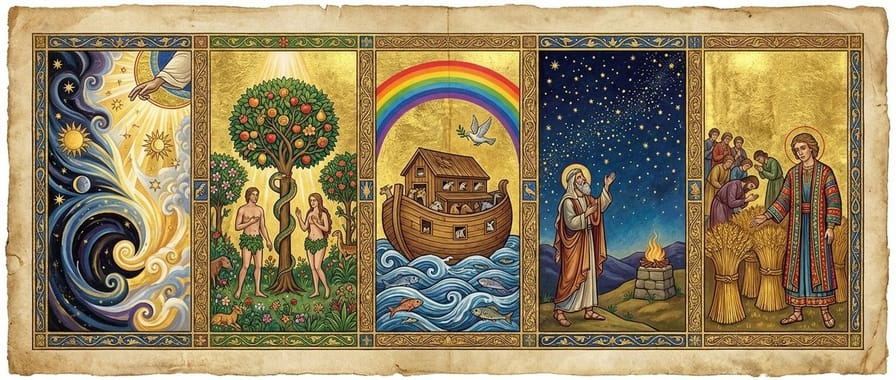
Illustration of the Book of Genesis, one of the 39 books of the Old Testament (Nano Banana Pro).
This introduction's primary objective is to unveil the multifaceted richness of the book of Genesis, the cornerstone of all biblical revelation, from a conservative evangelical Protestant perspective. Genesis is not merely a compendium of ancient narratives; it is the divine prolegomenon for understanding reality, the human being, sin, and, above all, God's majestic work of redemption. As we delve into its pages, we are confronted with the origins of all things: the universe, life, humanity, sin, the covenant, and the promise of salvation.
This foundational book establishes the essential theological and historical presuppositions that permeate all Scripture, serving as the fertile ground from which the great doctrines of the Christian faith spring. Its importance transcends mere historical curiosity, for it offers the lens through which we must interpret the human condition, the nature of God, and the grand drama of salvation history. Without Genesis, the rest of the Bible would lack its logical and theological foundation, becoming a fragmented narrative devoid of its intrinsic coherence.
We will adopt an approach that values the inerrancy and infallibility of God's Word, defending the traditional authorship and the historicity of the narrated events, even in the face of complexities and challenges raised by modern criticism. Our analysis will be permeated by a Christocentric reading, recognizing that Genesis, in its promises and typologies, consistently points to the person and work of Jesus Christ, the promised Messiah. We will seek to balance academic rigor with pastoral accessibility, providing a deep and edifying understanding.
The analytical model proposed in this introduction – encompassing context, structure, theological themes, canonical relevance, and hermeneutical challenges – is intentionally designed to be replicable in studies of any other biblical book. It aims to provide a robust framework so that students of the Bible can approach the Scriptures with discernment and reverence, extracting from them the divine truth that transforms lives. May this journey through Genesis reinforce our faith in the sovereign God who creates, sustains, and redeems.
May the reading of this study be not just an intellectual exercise, but an experience of worship, as we contemplate the wisdom and power of the Creator revealed from the very beginning. Genesis is, in essence, the prologue to God's love story for humanity, a story that culminates in the cross and resurrection, and that finds its eternal echo in the new creation. It is with this expectation and reverence that we approach this monumental book.
1. Historical Context, Dating, and Authorship
1.1 Mosaic Authorship and Internal Evidence
Jewish and Christian tradition, over millennia, has attributed the authorship of the Pentateuch – the first five books of the Bible, including Genesis – to Moses. This position, known as Mosaic authorship, is deeply rooted and supported by various lines of evidence, both internal and external to Scripture itself. Although Genesis narrates events that precede Moses' own existence, its compilation and final editing by him are fully compatible with ancient historiographical practice and divine inspiration.
Internally, the Pentateuch exhibits a remarkable literary and theological unity, suggesting a single author or a cohesive editorial process under a single guiding mind. The narrative flow from Genesis to Exodus, for example, is uninterrupted, with the second book beginning precisely where the first ends: with Jacob's family in Egypt. Familiarity with Egyptian culture, laws, and customs, as well as the geography and conditions of the desert, are evident throughout the Pentateuch, reflecting Moses' personal experience as an Egyptian prince and leader in the exodus.
Furthermore, Genesis contains elements that set the stage for Mosaic legislation, such as the institution of the Sabbath in creation (Genesis 2:2-3) and dietary purity laws (implicit in the distinction between clean and unclean animals before the Flood, Genesis 7:2). The book's structure is marked by the formula "these are the generations of" (toledot), which appears eleven times and serves as a genealogical and narrative skeleton, a feature that may have been compiled by Moses from ancestral records, under the guidance of the Holy Spirit.
1.2 Dating and Historical-Cultural Context
The dating of Genesis's writing is intrinsically linked to Moses' life and the period of the Exodus. The conservative view, which adopts the early dating of the Exodus (around 1446 B.C., based on 1 Kings 6:1), places the composition of Genesis during Israel's forty years of wandering in the wilderness, between 1446 and 1406 B.C. During this period, Moses would have had the opportunity and need to record the origins of his people and the foundations of their faith, before entering the Promised Land.
The cultural context of the Ancient Near East (ANE) is crucial for understanding Genesis. Israel, upon leaving Egypt, was immersed in a world where polytheistic mythologies and complex cosmogonies were the norm. Genesis radically distinguishes itself from these pagan narratives. While Mesopotamian cosmogonies (like Enuma Elish) described gods in conflict and creation emerging from violence and chaos, Genesis presents a unique, sovereign, transcendent, and benevolent God who creates the universe and humanity by His Word, in an orderly and purposeful manner.
For the newly freed people of Israel, Genesis served vital purposes. It explained their identity as descendants of Abraham, Isaac, and Jacob, a people chosen by God. It justified their claim to the land of Canaan as the fulfillment of divine promise. And, fundamentally, it established the nature of their God – Yahweh – as the Creator of all, distinct from and superior to all pagan deities of Egypt and Canaan. Genesis, therefore, is not just history; it is theology and identity for a nation in formation.
1.3 Response to Higher Criticism
From the 19th century onwards, "higher criticism" or "documentary criticism" (notably the JEDP Documentary Hypothesis) challenged Mosaic authorship and the unity of the Pentateuch, postulating that Genesis (and the other books) would be a collage of different sources (Jahwist, Elohist, Deuteronomist, Priestly) written in distinct periods, much later than Moses. This theory, though dominant in certain academic circles, faces serious objections from a conservative evangelical perspective.
Firstly, the JEDP hypothesis lacks substantial external evidence. There are no ancient manuscripts that corroborate the existence of these separate sources before their supposed merger. The fragmentation of the text into different "authors" is often based on subjective and inconsistent criteria, such as the variation of divine names or literary styles, which can be explained by the author's own literary and theological purposes, or by the nature of the oral and written tradition of the time.
Secondly, Jesus and the apostles consistently attributed the books of the Pentateuch to Moses (cf. John 5:46-47; Luke 24:27; Romans 10:5). For an evangelical perspective that believes in the inerrancy of Scripture and the authority of Christ, this is a powerful testimony. To assert that Moses did not write Genesis, or that it is a late compilation, implies undermining the credibility of biblical testimony and, ultimately, divine inspiration itself.
The theological unity and cohesive purpose of Genesis, which points to a redemptive plan from the very beginning, are difficult to reconcile with the idea of a collage of fragments from different eras and intentions. The conservative view, therefore, argues that Genesis is a work inspired by God, written by Moses (or under his direction), which faithfully preserves and transmits the events and truths about the origins of the world and the people of Israel, with unquestionable divine authority.
2. Structure, Division, and Main Content
2.1 The Formula "These Are the Generations of" (Toledot)
The literary structure of Genesis is uniquely marked by the repetition of the Hebrew phrase toledot (תּוֹלְדֹת), which can be translated as "these are the generations of," "the history of," or "the descendants of." This formula appears eleven times throughout the book and serves as a thematic and chronological organizer, dividing Genesis into distinct but interconnected sections. Each occurrence introduces a new phase in the narrative, usually focusing on a genealogical line or a new set of events crucial to salvation history.The first occurrence, "these are the generations of the heavens and the earth" (Genesis 2:4), marks the transition from the narrative of cosmic creation to the history of humanity. Subsequent toledot introduce the stories of Adam (Genesis 5:1), Noah (Genesis 6:9), the sons of Noah (Genesis 10:1), Shem (Genesis 11:10), Terah (Genesis 11:27), Ishmael (Genesis 25:12), Isaac (Genesis 25:19), Esau (Genesis 36:1, 9), and Jacob (Genesis 37:2). This structure demonstrates a clear purpose to trace the lineage of the promise and the progression of redemptive history, focusing on the individuals and families God chose to carry out His plan.
The toledot formula is not merely a list of genealogies; it introduces narrative blocks that detail the history and events related to the named person or group. This gives Genesis a logical organization and a continuous flow, allowing the reader to follow the history of humanity from its origin to the establishment of the family that would become the nation of Israel. It is a testament to the precision and care with which the text was composed, serving as a guide for understanding its message.
2.2 Main Divisions: Primeval and Patriarchal History
Genesis can be broadly divided into two main sections, each with its own scope and focus, but both essential to the biblical panorama. The first part, primeval history (chapters 1-11), spans from the creation of the universe to the formation of post-diluvian nations, culminating in the Tower of Babel. This section has a universal character, addressing the origins of all humanity and fundamental questions about the relationship between God, the world, and man.
In this first macro-section, we are introduced to God's perfect creation, humanity's fall into sin, the progression of human depravity (Cain, Lamech, pre-diluvian wickedness), the Flood as divine judgment, and the new beginning with Noah. The story of the Tower of Babel explains the origin of different languages and the dispersion of nations. These chapters establish the reality of universal sin and the urgent need for redemption, setting the stage for divine intervention through a specific covenant.
The second part of the book, patriarchal history (chapters 12-50), marks a drastic shift in focus from the universal to the particular. It details the history of a specific family: Abraham, Isaac, Jacob, and their descendants. This section is the heart of Genesis, where God's divine promise of redemption begins to manifest concretely through the election of a man and his posterity. The narrative follows the formation of the people of Israel, from Abraham's call in Ur of the Chaldeans to Jacob's migration to Egypt and Joseph's death.
The patriarchal chapters emphasize the Abrahamic covenant, the promises of land, numerous descendants, and blessing for all nations. The faith and failures of these patriarchs are vividly portrayed, showing God's faithfulness even amidst human imperfection. The story of Joseph, in particular, illustrates divine providence, demonstrating how God uses adverse circumstances to fulfill His purposes and preserve His people, preparing the ground for the formation of Israel as a nation in Egypt.
2.3 Synthetic Outline of Content
- Chapters 1-2: Creation. God's sovereignty as Creator of heaven and earth, the formation of life, the creation of man and woman in God's image, and the establishment of marriage.
- Chapter 3: The Fall. The temptation, the sin of Adam and Eve, the introduction of sin and death into the world, and the first promise of redemption (protoevangelium).
- Chapters 4-5: The Development of Sin and Genealogies. The murder of Abel by Cain, the progression of human wickedness, and the lineages from Adam to Noah.
- Chapters 6-9: The Flood and the Noahic Covenant. The universal corruption of humanity, divine judgment through the Flood, the salvation of Noah and his family, and God's covenant with all creation.
- Chapters 10-11: The Table of Nations and the Tower of Babel. The dispersion of peoples and the origin of nations from Noah's sons, and the story of the rebellion at Babel that resulted in the confusion of languages.
- Chapters 12-25: The Story of Abraham. The call of Abraham, the establishment of the Abrahamic covenant, the promises of land, descendants, and universal blessing, and Abraham's faith and trials.
- Chapters 26-27: The Story of Isaac. The life of Isaac, the renewal of the covenant promises, and family conflicts.
- Chapters 28-36: The Story of Jacob. Jacob's flight, his encounter with God at Bethel, his years in Haran, his return to Canaan, the struggle with the angel, and his transformation into Israel.
- Chapters 37-50: The Story of Joseph. The drama of Joseph, sold into slavery, his ascent in Egypt, the divine providence that uses him to save his family from famine, and the establishment of Jacob's family in Egypt.
3. Central Theological Themes and Purpose
3.1 The Sovereignty of God and Creation
The most prominent and fundamental theme of Genesis is the sovereignty of God as the transcendent and immanent Creator of all things. From the very first verse, "In the beginning, God created the heavens and the earth" (Genesis 1:1), the book establishes the truth of a unique, eternal, and almighty God who exists before all creation and brings it into existence by His Word. The creation narrative in Genesis 1-2 is a profound theological declaration that refutes any form of polytheism, pantheism, or materialism.
God is portrayed as the intelligent and benevolent architect who orders chaos and creates life in its complexity and beauty. His creation is "very good" (Genesis 1:31), reflecting His own perfection. The distinction between Creator and creature is absolute, and the dependence of everything that exists on Him is unquestionable. The creation of human beings in the image of God (imago Dei) confers dignity, purpose, and responsibility upon humanity, establishing us as stewards of creation and bearers of His moral and rational likeness.
God's sovereignty is not limited to initial creation; it extends to His continuous providence over the universe and history. Even after the fall, God remains in control, governing events and the lives of individuals and nations, as masterfully illustrated in the story of Joseph. The message is clear: God is the absolute Lord, and His plan will prevail, regardless of human actions or adverse circumstances.
3.2 Human Depravity and the Problem of Sin
Parallel to the revelation of divine sovereignty, Genesis exposes the dark reality of human depravity and the universal problem of sin. Chapter 3 narrates the fall of Adam and Eve, a cataclysmic event that introduced sin, death, and the curse into all creation. The original disobedience was not a mere slip, but an act of rebellion against God's authority, resulting in the corruption of human nature and the breaking of fellowship with the Creator.
Subsequent chapters demonstrate the inexorable progression of sin in human history. The murder of Abel by Cain (chapter 4), the polygamy and violence of Lamech, the widespread corruption before the Flood (chapter 6), and the rebellion at Babel (chapter 11) are testimonies to the radical and invasive nature of sin. Reformed theology correctly identifies this as total depravity, which affects all facets of the human being – mind, emotions, and will – making them incapable of seeking God by their own strength.
Genesis not only diagnoses the problem of sin but also reveals God's justice in His judgment. The Flood, the destruction of Sodom and Gomorrah (in Genesis 18-19, though technically outside primeval history, is a clear example of divine judgment), and the dispersion at Babel are manifestations of God's holy wrath against ungodliness. However, even in the midst of judgment, divine grace always manifests, offering a way of escape and a promise of restoration, pointing to the need for a Redeemer.
3.3 The Grace of God and the Promise of the Covenant
In contrast to human depravity and divine judgment, Genesis shines with the theme of God's grace and His covenant promises. From the protoevangelium in Genesis 3:15, where God promises that the seed of the woman would crush the serpent's head, divine grace is the driving force of the narrative. God takes the initiative to seek and save His fallen creation, offering hope where there was none.
The Noahic covenant (chapter 9) is a universal pact, promising that God would never again destroy the earth by a flood, but it is the Abrahamic covenant (chapters 12, 15, 17) that becomes the core of God's redemptive plan. Through Abraham, God promises a great nation, a specific land (Canaan), and that all the families of the earth would be blessed through his offspring. This covenant is unconditional, based on God's faithfulness, and serves as the foundation for the entire salvation history of Israel and, by extension, the Church.
The promise of a "seed" (offspring) is central, and it is reiterated to Isaac and Jacob, tracing the messianic lineage. God's grace is evident in how He continues to work through imperfect individuals – Abraham, Isaac, and Jacob, with their failures and deceptions – to fulfill His purposes. The covenant is a testimony to God's faithfulness in keeping His promises, even when humanity repeatedly fails. It is the basis of hope for future redemption.
3.4 Divine Providence and Election
Genesis unequivocally demonstrates divine providence, the doctrine that God not only created the world but also actively sustains and governs all events within it, working toward the fulfillment of His sovereign purposes. The story of Joseph (chapters 37-50) is the most vivid and prolonged example of this truth. Sold into slavery by his brothers, falsely accused, and imprisoned, Joseph experiences a series of adversities that, from a human perspective, seemed tragic and meaningless.
However, the narrative reveals that every step of Joseph was divinely orchestrated for a greater end: to preserve Jacob's family (the future Israel) from a devastating famine and thus ensure the continuity of the lineage of the promise. Joseph's statement to his brothers, "As for you, you meant evil against me, but God meant it for good, to bring it about that many people should be kept alive, as they are today" (Genesis 50:20), perfectly encapsulates the theme of providence. God works through human choices and even sins to accomplish His will.
Intimately linked to providence is election – God's sovereign choice of a people for Himself. Abraham's call (chapter 12) is an act of divine election, not based on human merit, but on God's grace and purpose. Through Abraham, Isaac, and Jacob, God establishes a chosen lineage through which His covenant and His promises would be transmitted. This election is not for exclusive privilege, but so that this chosen people might be a channel of blessing to all the nations of the earth, pointing to the universal redemptive mission.
3.5 The Primary Purpose of the Book
Considering the central theological themes, the primary purpose of Genesis for its original audience (the Israelites in the wilderness) and for the Church today is multifaceted. Firstly, it aims to explain the origins – the origins of the universe, humanity, sin, suffering, nations, and, crucially, the people of Israel. It answers fundamental questions about where we came from, why we are here, and what our problem is.
Secondly, Genesis seeks to establish the nature and character of God. It reveals a God who is sovereign, Creator, just, holy, faithful, and gracious. This knowledge of God is the foundation for the worship, obedience, and trust that the people of Israel would need upon entering the Promised Land and for the faith that the Church must profess. The book confronts pagan views of capricious and impotent deities, presenting Yahweh as the one true God.
Thirdly, the book serves to define the identity and purpose of Israel. They are the descendants of Abraham, a people chosen by God to carry His promises and be a channel of blessing to the world. Genesis gives them a history, a heritage, and a hope, grounding their existence as a nation in the faithfulness of the God of the covenant. Finally, Genesis establishes the foundation for the history of redemption, introducing the promise of the Messiah and preparing the way for the full revelation of God's saving plan in Jesus Christ.
4. Relevance and Canonical Connections
4.1 The Foundation of Biblical Theology
Genesis is, without doubt, the most fundamental book in the entire Bible, serving as the "seed plot" or "fertile ground" from which all the great doctrines and themes that unfold throughout the Scriptures emerge. Without a solid understanding of Genesis, many of the truths presented in later books would be incomprehensible or would lose their depth and meaning. It is the foundation upon which all biblical theology is built.
All crucial doctrines of Christianity have their roots in Genesis: the doctrine of God (His eternity, power, goodness, sovereignty), the doctrine of man (created in God's image, his dignity and responsibility), the doctrine of sin (its origin, nature, and universal consequences), the doctrine of salvation (the promise of redemption, God's grace), the doctrine of the covenant (God's covenants with humanity), the doctrine of family and marriage (instituted by God), and even the doctrine of eschatology (the hope of a new creation that restores paradise lost).
The rest of the Pentateuch (Exodus, Leviticus, Numbers, Deuteronomy) presupposes the history of Genesis to explain Israel's identity, the validity of the Law, and the purpose of the tabernacle and priesthood. Historical and prophetic books constantly refer to the events and figures of Genesis to ground their exhortations, prophecies, and narratives. Genesis is not just the first book; it is the book that makes all others intelligible and cohesive, providing the interpretive framework for God's progressive revelation.
4.2 Typological Connections and the Christocentric Reading
A Christocentric reading of Genesis reveals numerous typological connections to the person and work of Jesus Christ. Typology is the doctrine that recognizes Old Testament people, events, or institutions as "types" or patterns that prefigure and find their "antitype" or fulfillment in Christ in the New Testament. Genesis is richly populated with such types.
The protoevangelium in Genesis 3:15 is the first and most explicit messianic promise, announcing the "seed of the woman" who would crush the serpent's head – a clear prophecy of Christ. Adam is a type of Christ (Romans 5:12-21), for both are heads of a humanity: Adam as head of fallen humanity, Christ as the "last Adam" and head of a new, redeemed humanity. The sacrifice of Isaac on Mount Moriah (Genesis 22) is a powerful type of the sacrifice of God's only begotten Son, Jesus Christ, on Calvary. Melchizedek, king of Salem and priest of God Most High (Genesis 14:18-20), is a type of Christ as eternal priest according to the order of Melchizedek (Hebrews 7).
The story of Joseph is perhaps the most detailed in its typology. Joseph, rejected by his brothers, sold into slavery, suffers unjustly, but is exalted to save his people and the nations – a clear parallel with Christ, rejected by His people, suffering on the cross, but exalted to be the Savior of the world. The Abrahamic covenant, with its promise that all nations would be blessed through Abraham's seed, finds its fulfillment in Christ (Galatians 3:16), through whom salvation is extended to Jews and Gentiles.
4.3 New Testament Fulfillments and Citations
The New Testament demonstrates the vitality and authority of Genesis through numerous citations and allusions, confirming its historicity and prophetic relevance. Jesus Himself refers to Genesis to ground His teachings on marriage and creation (Matthew 19:4-6, citing Genesis 1:27 and 2:24), attesting to the historicity of Adam and Eve and the divine institution of marriage. He also alludes to the Flood and the days of Noah as a parallel for His second coming (Matthew 24:37-39).
The apostle Paul makes extensive use of Genesis in his theology. In Romans 5, he contrasts Adam and Christ, explaining the origin of sin and the provision of grace. In Romans 4 and Galatians 3, Paul builds on Abraham's faith in Genesis 15:6 to develop the doctrine of justification by faith, showing that salvation has always been by grace through faith, and not by the works of the Law. He also cites Genesis 3:15 and the promise of Abraham's seed in Galatians 3:16, identifying this seed as Christ.
The book of Hebrews dedicates an entire chapter (chapter 11) to celebrating the heroes of faith, beginning with Abel, Enoch, and Noah from Genesis. The same book elaborates on the superiority of Christ's priesthood over the Levitical, using the figure of Melchizedek from Genesis 14 (Hebrews 7). The book of Revelation, in turn, echoes the themes of Genesis by describing the "Lamb who was slain from the foundation of the world" (Revelation 13:8) and the vision of "new heavens and a new earth," a restoration of the paradise lost in Genesis (Revelation 21-22).
4.4 Relevance for the Contemporary Church
The message of Genesis is timeless and profoundly relevant for the contemporary church. It offers us a fundamental understanding of our identity as human beings created in the image of God, conferring dignity and value on every individual. In an age of moral relativism and gender confusion, Genesis reaffirms the biblical truth about the creation of man and woman and the divine institution of heterosexual marriage as the foundation of the family.
The book also confronts us with the persistent reality of sin and its devastating consequences. In a world that often minimizes or denies sin, Genesis reminds us of our innate depravity and our desperate need for a Savior. At the same time, it celebrates God's sovereign grace and His faithfulness in fulfilling His promises, offering hope and security in an uncertain world. Divine providence, so evident in the story of Joseph, encourages believers to trust in God's sovereignty even amidst trials and injustices.
Finally, Genesis establishes the basis for the church's mission. The promise that all nations would be blessed through Abraham's seed (Genesis 12:3) is the original missionary mandate. The church, as heir to the Abrahamic promises in Christ, is called to carry the blessing of the gospel to all peoples, fulfilling Genesis's divine purpose to bless humanity. Genesis calls us to discipleship, stewardship of creation, and to live a life that glorifies the Creator and Redeemer.
5. Hermeneutical Challenges and Critical Questions
5.1 The Literary Genre and Historicity of the Initial Chapters
One of the greatest hermeneutical challenges in Genesis lies in the interpretation of its initial chapters (1-11), known as primeval history. The literary genre of these chapters has been the subject of intense debate. While the conservative evangelical perspective affirms the historicity of the narrated events – a literal six-day creation, the fall of a literal Adam and Eve, a global flood, and the Tower of Babel as real events – it is crucial to recognize the unique nature of its language.
These chapters employ phenomenological (describing things as they appear), poetic, and theological language to communicate profound historical and doctrinal truths. They are not "myths" in the sense of fiction or falsehood, like pagan narratives, but rather factual history presented in a majestic and concise way. The question of the "age of the earth" and the duration of the "days" of creation (Genesis 1) has generated various positions within evangelicalism (young earth, old earth, framework hypothesis), but all generally agree on creation ex nihilo by God and the existence of a historical Adam and Eve as the first parents of humanity.
Faithful evangelical interpretation must affirm the historicity of Adam and Eve as real people, for the Pauline doctrine of original sin and salvation in Christ depends directly on this premise (Romans 5). Likewise, the Flood is presented as a global and cataclysmic event of divine judgment, not a mere local flood. The challenge is to interpret these texts seriously, recognizing their literary genre and theological purpose, without compromising the inerrancy and authority of Scripture.
5.2 Apparent Ethical and Theological Problems
Genesis presents narratives that, at first glance, may raise ethical and theological questions for the modern reader. The polygamy of the patriarchs (Abraham, Jacob), the deceptions and lies (Abraham and Isaac with their wives, Jacob deceiving Esau and his father), and the violence and divine judgment (the Flood, Sodom and Gomorrah) are examples of passages that require careful hermeneutics.
It is fundamental to understand that the Bible is descriptive before it is prescriptive. The narratives of the patriarchs portray the reality of their lives, including their failures and sins, but do not endorse their actions. Genesis 2 establishes God's original pattern for marriage (monogamy), and the negative consequences of polygamy and deceptions are often visible in the narratives themselves (family conflicts, suffering). God works through imperfect people, but this does not mean He approves of their sin. On the contrary, God's faithfulness is glorified despite human unfaithfulness.
Regarding violence and divine judgment, Genesis reveals God's holiness and justice. The judgment of the Flood or of Sodom and Gomorrah are not arbitrary acts, but just responses to widespread human depravity and persistent rebellion against God's will. Understanding that God is the sovereign Creator and Judge, with the right to intervene and judge the sinfulness of His creation, is essential for a balanced biblical theology. He is a God of love and grace, but also of justice and wrath against sin.
5.3 The Complexity of Chronology and Genealogies
The genealogies and chronology in Genesis also represent an interpretive challenge. The long lives of the antediluvian patriarchs, the apparent gaps in some genealogies (where "son of" can mean "descendant of"), and the difficulty in reconciling biblical chronology with modern scientific data (especially concerning the age of the earth and human history) are points of friction.
The evangelical perspective recognizes that biblical genealogies have a theological and historical purpose, but they are not always exhaustive in the sense of a complete list of all direct ancestors. They serve to trace important lineages (especially the messianic one), demonstrate continuity, and establish the passing of the promise. The long lives of early humans are accepted as part of the inspired historical narrative, a reflection of a different pre-diluvian environment or God's special grace in an early period.
In relation to science, the conservative position upholds the inerrancy of the Bible in everything it affirms, including its historical and scientific statements when these are the focus of the text. The challenge is not to reject science, but to interpret science in light of God's Word and vice versa, recognizing that both nature and Scripture are revelations of God. The Bible is not a scientific textbook, but its affirmations about reality are true. Humility and dependence on the Holy Spirit are crucial when navigating these complexities, seeking harmony between God's special revelation and general revelation.
5.4 Hermeneutical Principles for a Faithful Interpretation
To approach Genesis and any other biblical book faithfully, some hermeneutical principles are indispensable. Firstly, belief in the inerrancy and infallibility of the Scriptures is the starting point. The Bible is the inspired Word of God, without error in everything it affirms.
Secondly, grammatical-historical interpretation is fundamental. We must seek to understand the text in its literal sense, taking into account the historical, cultural, and literary context in which it was written. This includes identifying the literary genre of each passage (narrative, poetry, law, prophecy) and interpreting it according to its conventions. We should not impose meanings foreign to the text, but extract the meaning that the author intended to communicate to his original audience.
Thirdly, a canonical and Christocentric reading is vital. Genesis must be interpreted in light of the entire Bible, recognizing its position as the first book of a redemption story that culminates in Jesus Christ. Every part of Scripture points to Christ, and Genesis, with its promises and typologies, is a powerful testimony to this truth. Understanding the Old Testament is enhanced by the light of the New Testament, and vice versa.
Finally, dependence on the Holy Spirit is crucial. Interpreting God's Word is not merely an intellectual exercise, but a spiritual quest that requires the illumination of the Holy Spirit (1 Corinthians 2:14). Humility, prayer, and submission to the authority of Scripture are essential attitudes for correct interpretation and transformative application. Genesis, as the gateway to divine revelation, invites us to approach the Word with reverence, faith, and a heart willing to be taught by God.