


Rabe
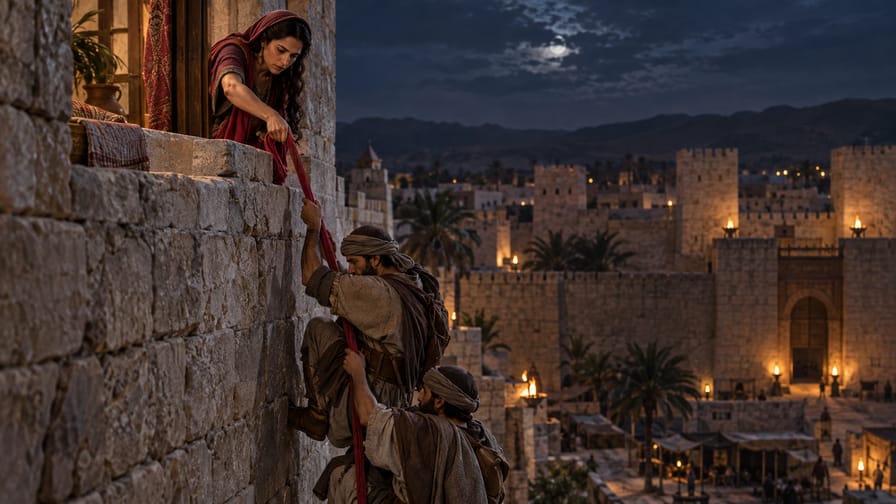
The figure of Rahab is one of the most remarkable and theologically rich characters in the Old Testament, standing out for her faith and crucial role in the conquest of Jericho. Her story, recorded in the book of Joshua, transcends the narrative of a simple Canaanite woman, becoming a powerful testimony to divine grace and the inclusion of Gentiles in God's redemptive plan. The analysis of Rahab from a Protestant evangelical perspective reveals profound lessons about faith, salvation, and the sovereignty of God.
Her mention in the New Testament, both in the hall of faith in Hebrews and in Jesus' genealogy in Matthew, solidifies her theological importance and her relevance for understanding the history of salvation. This entry seeks to explore the etymology of her name, the historical context in which she lived, the nuances of her character, the theological significance of her actions, and the enduring legacy she left for the Christian faith.
Throughout this analysis, we will address the complexity of her profession, the courage of her decision, and the impact of her faith, which transformed her from a marginalized foreigner into a matriarch in the messianic lineage. The life of Rahab serves as a beacon of God's grace, which reaches the improbable and transforms them into instruments of His sovereign will.
1. Etymology and meaning of the name
The name Rahab, in Hebrew, is רָחָב (Rakhav or Rachab), and its etymological root is associated with the verb רחב (rakhav), which means "to be wide," "to be ample," or "to be spacious." Literally, the name can be translated as "amplitude," "width," or "spacious one." This meaning can have important symbolic connotations, such as the amplitude of her faith or the openness of her life to the divine will.
It is crucial to distinguish this Rahab, the Canaanite woman of Jericho, from another biblical figure of the same name that appears in some poetic texts of the Old Testament. In passages such as Psalm 87:4 and Isaiah 51:9, "Rahab" refers to a mythological sea monster or a poetic symbol of Egypt and primordial chaos, representing the power of evil or oppressive nations. This usage is completely distinct from the woman of Jericho.
For the Rahab of Joshua, the meaning of "amplitude" can be interpreted in various theologically relevant ways. It can allude to her ability to open her home and her life to the Israelite spies, or to the amplitude of God's grace that extended to her, a Gentile and a prostitute. Some scholars suggest that the name may have been given by her parents, perhaps reflecting the hope of a prosperous life or an expansive personality.
From a Protestant evangelical theological perspective, the name of Rahab, meaning "ample," can be seen as a prefiguration of the amplitude of salvation offered by God, which transcends ethnic and social barriers. Her life demonstrates that the door of faith is open to all, regardless of their origin or past. The vastness of divine mercy finds an echo in the very etymology of her name.
There are no significant variations of Rahab's name in biblical languages that alter its fundamental meaning. The consistency of the transliteration and the etymological sense reinforces the uniqueness and intentionality of her name in the context of the biblical narrative. The divine choice to use someone with a name that evokes "amplitude" for such an inclusive act of faith is, in itself, a point of theological reflection.
2. Historical context and biblical narrative
The story of Rahab is set in the period of the conquest of Canaan by the Israelites, approximately between 1400 and 1200 B.C., according to traditional biblical chronology. After forty years of wandering in the desert, Israel, under the leadership of Joshua, was about to enter the Promised Land. Jericho, one of the oldest and most fortified cities in Canaan, represented the first major obstacle to possessing the land.
The political, social, and religious context of Canaan was marked by idolatry, polytheism, and morally depraved practices, including the worship of gods such as Baal and Ashtoreth, child sacrifices, and cultic prostitution. Canaanite culture was radically opposed to the commandments of Yahweh, the God of Israel. The destruction of Jericho was not just a military strategy, but a divine judgment on Canaanite impiety and the inauguration of the possession of the holy land by a people who were to be holy.
The narrative of Rahab begins in Joshua 2:1, when Joshua sends two spies to reconnoiter the land and, in particular, Jericho. The spies lodge in the house of Rahab, who is identified as a prostitute (zonah, in Hebrew). The choice of her house, located on the city wall, may have been strategic, as it offered access and discretion. The term zonah has been debated, with some suggesting "innkeeper" or "hostess," but the traditional and most widely accepted interpretation is "prostitute," which further highlights God's grace.
When the king of Jericho is informed of the spies' presence, he sends officers to capture them. Rahab, demonstrating remarkable courage and faith, hides the spies under stalks of flax on the roof of her house and deceives the pursuers, directing them out of the city (Joshua 2:4-7). This action is not merely an act of hospitality, but a clear demonstration of alliance with the God of Israel and His people.
After the pursuers' escape, Rahab makes a deep and sincere declaration of faith to the spies. She recognizes Yahweh's power and Israel's imminent victory, stating: "I know that the Lord has given you this land and that the dread of you has fallen upon us... For the Lord your God is God in the heavens above and on the earth below" (Joshua 2:9-11). This confession reveals a genuine faith, based on what she had heard about God's deeds, such as the opening of the Red Sea and the victories over Sihon and Og.
In exchange for her help, Rahab asks the spies to swear to save her and all her family when the city is destroyed. The spies agree, instructing her to tie a scarlet cord in her window and to gather her family in her house to be protected (Joshua 2:12-20). This scarlet cord would become the sign of her salvation, an image rich in theological symbolism.
The spies escape with the help of Rahab, who lets them down by a rope through the window, as her house was on the city wall (Joshua 2:15). They return to Joshua, reporting Rahab's faith and the fear that had gripped the inhabitants of Canaan (Joshua 2:23-24). When Jericho is destroyed by the Israelites, Rahab and her family are spared according to the promise, being rescued by Joshua and assimilated into the people of Israel (Joshua 6:17, 22-25).
The geographical location of Jericho, a key city at the entrance to Canaan, and Rahab's role in its fall, are fundamental. Her story is not a mere interlude, but a crucial event that demonstrates God's sovereignty, the efficacy of faith, and the universality of His grace, which reaches even the Canaanites.
3. Character and role in the biblical narrative
Rahab's character is complex and multifaceted, revealing a woman of remarkable discernment, courage, and, above all, faith. Her profession as a prostitute (zonah) is frequently highlighted, not to glorify sin, but to accentuate the depth of divine grace that reached and transformed her. Reformed evangelical theology emphasizes that God's grace is not limited to "worthy" people, but extends to the marginalized and sinners, as exemplified in Rahab.
Rahab's most prominent virtue is her unwavering faith in Yahweh. In Hebrews 11:31, she is listed among the heroes of faith, and in James 2:25, her faith is cited as an example of faith that is manifested by works. She not only heard of God's deeds but actively believed in His power and sovereignty, recognizing Him as "God in the heavens above and on the earth below" (Joshua 2:11).
Her courage is evident in hiding the spies and deceiving the officers of the king of Jericho. This action represented an extreme risk to her own life and that of her family. She chose to ally herself with the enemies of her people, not out of betrayal, but out of a spiritual conviction that the God of Israel was the true God. This bold decision demonstrates a deep trust in Yahweh's promise.
The question of Rahab's lie is a point of ethical debate. Evangelical theologians generally do not justify it as a morally acceptable practice in all circumstances, but interpret it within the context of a "war lie" or a "lesser evil" in a life-or-death situation, where the intention was to protect God's servants and advance the divine plan. The biblical focus is not on the morality of the lie itself, but on the faith that motivated her action, which was praised by God.
Rahab's role in the biblical narrative is crucial and multifaceted. She is not merely a supporting character her actions were instrumental to the success of the spies' mission and, consequently, to the conquest of Jericho. By protecting the spies, she ensured that Joshua received the necessary information and that the morale of the Israelites was raised by the confirmation of the Canaanites' fear.
Her calling, initially defined by her profession, is dramatically transformed by her faith. From a marginalized woman in a pagan society, she becomes a convert, a member of the community of Israel, and, notably, an ancestor of the Messiah. This transformation highlights God's redemptive power, which not only saves individuals but integrates them into His history of salvation.
Rahab's significant actions – hiding the spies, her confession of faith, her request for salvation for her family, and the use of the scarlet cord – are all key decisions that shaped not only her destiny but also the course of Israel's history. Her character development is a testament to the grace that justifies and sanctifies, proving that faith in God can lead to redemption and a new beginning, regardless of one's past.
4. Theological significance and typology
The theological significance of Rahab is vast and profound, serving as a pivot in God's redemptive history and in the progressive revelation of His grace. Her story transcends the event of the conquest of Jericho, offering enduring lessons about the nature of faith, the inclusion of Gentiles, and divine sovereignty.
Rahab is one of the earliest and most prominent Gentile figures to be explicitly included in the people of God and, more significantly, in the messianic lineage. Her salvation demonstrates that God's plan for redemption is not restricted to a specific ethnicity or nation, but extends to all who exercise faith in Him. This prefigures the future inclusion of Gentiles in the Church, as revealed in the New Testament (Ephesians 2:11-22).
The Christocentric typology in her story is notable. The scarlet cord that Rahab hung in her window (Joshua 2:18-21) is often interpreted as a type of the blood of Christ. Just as the blood of the lamb at Passover protected the Israelite homes from the angel of death (Exodus 12:13), and the scarlet cord saved Rahab and her family from the destruction of Jericho, the blood of Jesus Christ offers protection and salvation from eternal condemnation (Romanos 5:9).
Her faith, as praised in Hebrews 11:31, is a primary example of salvation by grace through faith, a central theme of Protestant evangelical theology. Rahab was not saved by her works, but by her belief in the God of Israel, which led her to act. James, in James 2:25, uses Rahab to illustrate that true faith is not barren, but manifests itself in works that confirm its authenticity. This is a harmonization of the doctrine of faith and works, essential for the evangelical perspective.
The inclusion of Rahab in the genealogy of Jesus Christ in Matthew 1:5 is of immense theological significance. She married Salmon and bore Boaz, who, in turn, was the father of Obed, grandfather of David. Her presence in Jesus' lineage underscores the universality of God's love and His ability to use people of all backgrounds, including those with troubled pasts, to fulfill His redemptive purposes. This demonstrates that God's grace is greater than any sin or social barrier.
Rahab's story also connects with central theological themes such as judgment and grace. Jericho was the object of divine judgment, but Rahab's house was spared by grace manifested through her faith. This illustrates the principle that, even in the midst of judgment, God offers a path of salvation for those who turn to Him. God's sovereignty is evident in how He uses a Canaanite woman to advance His plan for Israel and for humanity.
Rahab's story also highlights the importance of obedience to God's Word. She obeyed the spies' instructions regarding the scarlet cord and the gathering of her family in her house, which resulted in her salvation. This obedience, born of her faith, is a model for believers who seek to live in conformity with the divine will.
In summary, Rahab is a living testimony to the grace that saves, the faith that justifies, and the inclusion that redeems. Her life is a prophetic fulfillment of God's promise to Abraham that "all the families of the earth will be blessed through you" (Genesis 12:3), anticipating the coming of Christ, who would break down the barriers between Jews and Gentiles.
5. Biblical-theological legacy and canonical references
Rahab's legacy in biblical theology is profound and enduring, being one of the most celebrated figures of the Old Testament for her faith and role in salvation history. Her canonical references in the New Testament solidify her importance for understanding the Christian faith and the messianic genealogy.
Besides the book of Joshua, where her story is detailed (Joshua 2 and 6), Rahab is mentioned in two key New Testament epistles and in the Gospel of Matthew. In Hebrews 11:31, she is honored in the "hall of faith" as an example of someone who, "by faith, Rahab the prostitute did not perish with those who were disobedient, because she received the spies in peace." This mention places her alongside patriarchs and prophets, emphasizing the universality and saving nature of faith.
In James 2:25, Rahab is cited as an example that "faith without works is dead." James writes: "In the same way, was not also Rahab the prostitute justified by works when she received the messengers and sent them out by another way?" This passage is fundamental for evangelical theology, which understands that genuine faith will always produce fruits of obedience and good works, without these being the cause of salvation, but rather its evidence.
Her mention in Matthew 1:5 in the genealogy of Jesus Christ is perhaps the most impactful. She is one of four Gentile women (with Tamar, Ruth, and the wife of Uriah, Bathsheba) explicitly mentioned in Christ's lineage, which is unusual for patriarchal genealogies. Her inclusion highlights the universality of God's grace and the divine intention that salvation be for all peoples, not just for Israel. This serves as a reminder of the inclusive nature of God's plan for the Messiah.
In Jewish interpretative tradition, Rahab is often seen as a model convert, and some midrashim portray her as a woman of great merit, who married Joshua and became a mother of prophets. While these traditions are not canonical, they illustrate the recognition of her importance in Jewish history.
In Reformed and evangelical theology, Rahab is often studied as an exemplary case of justification by faith. Theologians such as John Calvin and Matthew Henry highlight her faith as the root of her actions and the basis of her salvation. Calvin, for example, in his commentaries, praises Rahab's faith, which led her to prefer divine security over loyalty to her own people. Her story is a powerful testimony to God's sovereignty in using the improbable and the marginalized to fulfill His purposes.
Rahab's contribution to biblical theology lies in her practical demonstration of several crucial doctrines: the universality of grace, the nature of saving faith (which manifests in works), the inclusion of Gentiles in the divine covenant, and God's providence in the messianic lineage. She is a vital link in the chain of redemption history, pointing to the Christ who was to come, the Savior of Jews and Gentiles.
Her story reinforces biblical authority and historical accuracy, showing how God operates in the details of human life to accomplish His great plans. Rahab, the Canaanite prostitute, became an eternal symbol of divine mercy and the transformation that faith in Yahweh can effect, securing her a place of honor in the canon and in the history of the Church.