


Noah
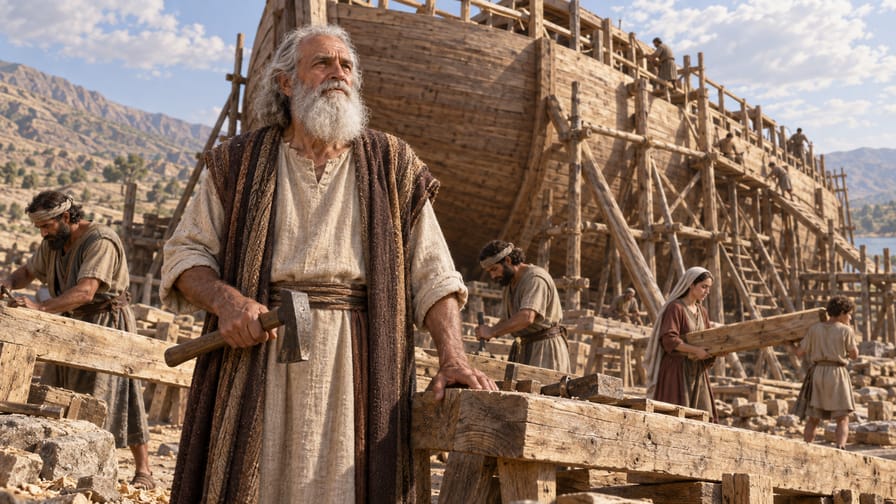
The figure of Noah emerges in the Hebrew Scriptures as a fundamental pillar of God's redemptive history, marking the transition from a corrupted world to a new era under the divine covenant. His narrative, central to the book of Genesis, offers profound insights into human nature, God's justice and grace, and divine sovereignty over creation.
From an evangelical Protestant perspective, Noah is not merely a historical character, but a type and a forerunner, whose experiences and faith prefigure greater truths about Christ and salvation. This analysis will explore the etymology of his name, the context of his life, his complex character, his theological significance, and his enduring legacy in the biblical canon.
1. Etymology and Meaning of the Name
The name Noah is the Portuguese transliteration of the Hebrew Noach (נֹחַ), which is derived from the verbal root nuakh (נוּחַ). This root means "to rest," "to repose," "to settle," or "to comfort." The choice of this name was not arbitrary, but prophetic, as revealed in the biblical narrative.
His father, Lamech, in naming him, uttered a significant declaration: "This one will comfort us (yenachamenu) from our work and from the toil of our hands, because of the ground that the Lord has cursed" (Genesis 5:29). The Hebrew word yenachamenu, "he will comfort us," is etymologically linked to the root nacham (נָחַם), which means "to comfort," "to repent," "to have pity."
Although there is a slight difference between the roots nuakh and nacham, the sound and context of Lamech's prophecy establish a clear connection. The name Noah, therefore, carries the expectation of relief and comfort amidst humanity's arduous existence under the Edenic curse, a longing for a new beginning.
The literal meaning of "rest" or "comfort" for Noah acquires a remarkable theological depth, as he becomes the instrument through whom humanity and creation would find a type of "rest" from the impending judgment. He would be the starting point for the restoration of order and for a new relationship with God.
There are no other prominent biblical characters with the same name. Noah's uniqueness in the biblical narrative is, in part, underscored by the exclusivity of his name and the prophecy associated with it, distinguishing him as a central and irreplaceable figure in salvation history.
The theological significance of the name resides in the hope it embodies. In a world of increasing violence and corruption, the name Noah represents the divine promise of relief, a new beginning, and a rest from the curse that afflicted the earth. He would be the means by which God would preserve the seed of humanity for a redemptive future.
2. Historical Context and Biblical Narrative
Noah's life unfolds in the antediluvian period, an era that precedes the emergence of nations and the patriarchs of Israel, chronologically situated between the Fall of Adam and the call of Abraham. Exact dates are difficult to ascertain, but the narrative of Genesis positions him as the tenth generation from Adam, living for 950 years (Genesis 9:29).
The social and religious context of the time was marked by widespread depravity. The Scriptures describe humanity as completely corrupted, with "the wickedness of man was great in the earth, and that every intention of the thoughts of his heart was only evil continually" (Genesis 6:5). Violence (chamas) and corruption (shachat) dominated, to the extent that God regretted having made man (Genesis 6:6-7).
Noah's genealogy is traced in Genesis 5, which lists Adam's descendants through Seth. He was the son of Lamech and grandson of Methuselah. This lineage is crucial, as it demonstrates the continuity of the divine promise through a godly line, despite widespread apostasy. He was part of the lineage that maintained faith in God.
2.1 Family Origin and Genealogy
Noah's lineage is that of Seth, Adam's third son, who was given as a substitute for Abel. This "godly seed" is contrasted with the lineage of Cain, which is characterized by violence and city-building. Through Seth, the worship of the Lord was maintained, as indicated in Genesis 4:26.
The main events of Noah's life are detailed in Genesis 6-9. The chronology begins with God's realization of human wickedness and His decision to destroy the earth with a flood (Genesis 6:1-7). In contrast, Noah is found righteous in God's eyes (Genesis 6:8-9).
God then instructs Noah to build an ark, providing him with precise details about its dimensions, materials, and occupants (Genesis 6:14-21). Noah faithfully obeys (Genesis 6:22 7:5). The Flood occurs, covering the entire earth and destroying all terrestrial life outside the ark (Genesis 7:11-24).
After 150 days, the waters begin to recede, and the ark rests on the mountains of Ararat (Genesis 8:4). Noah sends out a raven and doves to check the conditions of the earth (Genesis 8:6-12). Finally, God instructs them to leave the ark (Genesis 8:15-19).
Noah's first act outside the ark is to build an altar and offer sacrifices to God (Genesis 8:20). In response, God establishes a covenant with Noah and his descendants, promising never again to destroy the earth with a flood and giving the rainbow as a sign of this covenant (Genesis 9:8-17).
The narrative proceeds with an incident of Noah's drunkenness and the subsequent conduct of his sons, Shem, Ham, and Japheth, resulting in the curse of Canaan, Ham's son, and blessings upon Shem and Japheth (Genesis 9:20-27). This event is crucial for understanding future relationships among peoples.
The primary geography associated with Noah is the region of Mesopotamia, where antediluvian civilization likely flourished, and the "mountains of Ararat" (Genesis 8:4), a mountainous region in present-day eastern Turkey, where the ark is said to have landed. His most important relationships were with God, his parents, and, crucially, his three sons, from whom all humanity descended (Genesis 9:19).
3. Character and Role in the Biblical Narrative
Noah's character is uniquely delineated in the Scriptures. He is described as a "righteous man, blameless among his contemporaries" (Genesis 6:9). The Hebrew word for "righteous" (tsaddiq) denotes moral and legal uprightness, while "blameless" (tamim) suggests perfection or completeness, without serious flaws, especially in his relationship with God.
Noah's most notable spiritual quality is his unquestioning faith and obedience. In Hebrews 11:7, he is praised for his faith: "By faith Noah, being warned by God concerning events as yet unseen, in reverent fear constructed an ark for the saving of his household. By this he condemned the world and became an heir of the righteousness that comes by faith." His faith led him to obey a command that seemed absurd to human reason.
The construction of the ark, a monumental task that lasted decades, required extraordinary perseverance and absolute trust in God's word. Noah neither questioned nor hesitated, but "did everything just as God commanded him" (Genesis 6:22 7:5). This obedience is a testament to his reverent fear of God.
Furthermore, Noah is called a "preacher of righteousness" in 2 Peter 2:5. Although the Bible does not record his preaching words, his life, his obedience, and the very act of building the ark served as a testimony and a constant warning to an ungodly generation. He was a herald of impending judgment and of God's grace for those who would repent.
However, the biblical narrative does not present Noah as an impeccable being. After the Flood, he experiences a significant moral failure: his drunkenness and nakedness in his tent (Genesis 9:20-21). This incident reveals the persistence of sinful nature, even in the most righteous, and serves as a reminder that salvation by grace does not immediately eradicate all human weaknesses.
Noah's role in the biblical narrative is multifaceted and crucial. His primary calling was to be the preserver of life. God chose him to be the means by which humanity and all species of animals would be saved from the total destruction of the Flood. He was the guardian of the seed for the repopulation of the earth.
He also acted as the patriarch and priest of his family. His sacrifice after leaving the ark (Genesis 8:20) is the first recorded act of worship after the Flood, establishing a model of gratitude and recognition of divine sovereignty. This sacrificial act moved God's heart to promise never again to curse the ground because of man.
Noah's key actions and decisions—his faith in building the ark, his obedience to divine instructions, and his act of worship—shaped the course of redemptive history. Despite his later failure, his development as a character is of someone who, through faith, became an instrument of divine providence for the continuity of life and the covenant.
4. Theological Significance and Typology
The theological significance of Noah is immense, firmly embedding him in redemptive history and the progressive revelation of God. His narrative is a microcosm of the grand biblical story: divine judgment on sin, God's saving grace, the preservation of a faithful remnant, and the establishment of a covenant.
Noah's story is a powerful prefiguration or Christocentric typology, pointing to Christ and His work of salvation. The ark, which offers refuge and salvation from God's judgment, is a clear type of Christ. Just as the ark was the only means of escape from the Flood, Christ is the only way to salvation from final judgment on sin (John 14:6 Acts 4:12).
The water of the Flood, which brought judgment upon the ungodly world, paradoxically, was the means of salvation for Noah and his family. This duality is echoed in the New Testament, where Peter makes a direct connection between the Flood and baptism: "who formerly did not obey, when God's patience waited in the days of Noah, while the ark was being prepared, in which a few, that is, eight persons, were brought safely through water. Baptism, which corresponds to this, now saves you" (1 Peter 3:20-21).
Baptism, like the Flood, symbolizes death to the old man of sin and resurrection to a new life in Christ. It is a sign of the purification and salvation that comes through union with Christ. The righteousness of Noah, by which he was saved, points to the righteousness of Christ, which is imputed to believers by faith.
The Noahic Covenant (Genesis 9:8-17) is God's first universal covenant with all creation, promising that there will never again be a flood to destroy the earth. This covenant is unconditional and has the rainbow as its sign, a visible reminder of God's faithfulness. It establishes the basis for the continuity of life and history until the final consummation.
This universal covenant prefigures the New Covenant in Christ, which is also universal in its scope, offering salvation to all nations (Matthew 28:19 Revelation 7:9). While the Noahic Covenant is about physical preservation, it sets the stage for the spiritual covenant of redemption in Christ.
In the New Testament, Noah is explicitly mentioned in several passages. Jesus Himself refers to the "days of Noah" as a parallel to the days preceding His second coming: "For as were the days of Noah, so will be the coming of the Son of Man. For as in those days before the flood they were eating and drinking, marrying and giving in marriage, until the day when Noah entered the ark, and they were unaware until the flood came and swept them all away, so will be the coming of the Son of Man" (Matthew 24:37-39 Luke 17:26-27).
This reference underscores humanity's ignorance and complacency in the face of impending judgment, and the need for vigilance and preparation. Noah's faith is celebrated in the "hall of faith" in Hebrews 11:7, highlighting him as an example of trust in God and obedience to His word, even in the face of the unseen.
Noah's story connects with central theological themes such as divine judgment on sin, God's sovereign grace in saving a remnant, faith as a response to divine revelation, and obedience as evidence of faith. It establishes the pattern for new creation, where the earth is purified and humanity receives a new mandate to be fruitful and multiply.
5. Biblical-Theological Legacy and Canonical References
Noah's legacy resonates throughout the biblical canon, in both the Old and New Testaments, affirming his importance in the history of redemption. In the Old Testament, besides Genesis, Noah is mentioned in Isaiah 54:9, where God's covenant with him is used as a symbol of God's unwavering faithfulness to His covenant with Israel: "For this is like the days of Noah to me: as I swore that the waters of Noah should no more go over the earth, so I have sworn that I will not be angry with you, and will not rebuke you."
In Ezekiel 14:14, 20, Noah is listed alongside Job and Daniel as one of the three most righteous men, whose prayers could save only themselves amidst divine judgment. This mention highlights Noah's reputation as a paradigm of righteousness, even in times of great apostasy, and the depth of his communion with God.
In the New Testament, references to Noah are consistently positive, focusing on his faith and obedience. In Hebrews 11:7, he is one of the heroes of faith, an example of how faith moves the believer to act in response to God's word. In 1 Peter 3:20-21, his act of salvation through water is typologically linked to Christian baptism, as already mentioned.
Noah's influence on biblical theology is profound. He is the central figure in understanding God's first major intervention of judgment and grace in post-Fall history. His story establishes a pattern for understanding divine sovereignty, human depravity, and the providence that preserves the seed of redemption.
In Jewish interpretive tradition, Noah is seen as one of the "righteous among the nations," a model of universal righteousness before the formation of Israel. Midrashim and aggadah expand upon his story, detailing his challenges in building the ark and his patience. He is the father of all post-diluvian humanity, and the Noahic Covenant is the basis for universal moral laws.
In Christian tradition, especially in Reformed and evangelical theology, Noah is fundamental to covenant theology. The Noahic Covenant is recognized as the second covenant in God's series of redemptive covenants, preceding the Abrahamic and Mosaic Covenants. It demonstrates God's common grace, which sustains the world and life, even in the face of continuous sin.
Reformed commentators such as John Calvin emphasize God's sovereignty in Noah's judgment and salvation, highlighting divine election and faith as a gift from God. Noah's story is a testament to justification by faith, as he was declared righteous by his trust in God, and not by his own merit, amidst a perverse generation.
The importance of Noah for understanding the canon lies in his position as a vital link in the progression of redemptive history. He connects creation and the Fall with the call of Abraham, the establishment of Israel, and, ultimately, the coming of Christ. His story demonstrates that, despite the depth of human sin, God always preserves a remnant through whom His plan of salvation advances.
The narrative of Noah is a perennial reminder of the seriousness of sin, the certainty of divine judgment, and the glorious depth of God's grace and faithfulness. He is a prophet of righteousness, a builder of salvation, and the father of a new humanity, pointing to the greater Savior who would come to offer rest and definitive salvation.