


Mnason
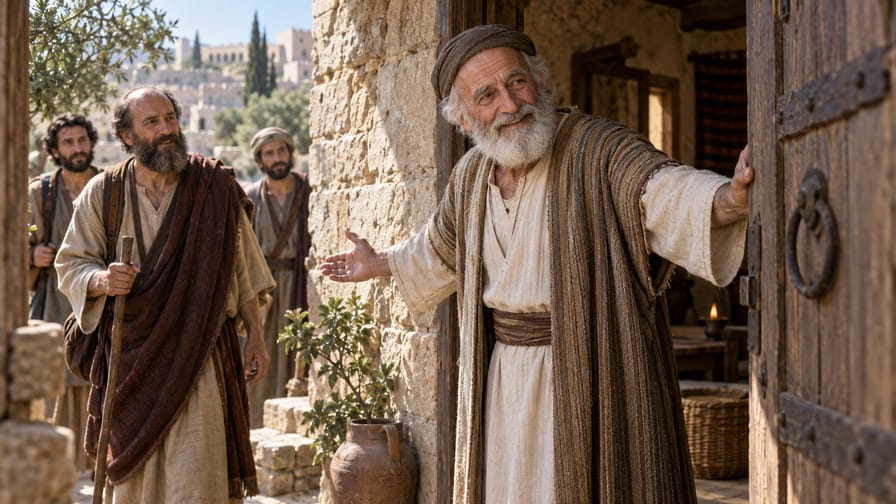
The figure of Mnason, though mentioned only once in the Holy Scriptures, offers a rich opportunity for biblical and theological analysis, especially from an Evangelical Protestant perspective. His brief appearance in Acts 21:16, as the host of the apostle Paul in Jerusalem, is notable for the designation attributed to him: archaĩos mathētḗs, an "early disciple" or "disciple from the beginning." This designation elevates Mnason from a mere name to a symbol of faithfulness and perseverance in the early Christian faith.
The depth of his significance does not lie in the length of his narrative, but in the implication of his character and the function he performed in the crucial context of Paul's visit to Jerusalem. He represents the many faithful, non-apostolic believers who formed the backbone of the nascent church. His life, though minimally documented, resonates with fundamental theological principles such as hospitality, enduring discipleship, and the importance of anonymous service in the kingdom of God.
This analysis will seek to unravel the meaning of Mnason, exploring the etymology of his name, the historical context in which he lived, the virtues that his single mention reveals, his theological significance for the church, and the legacy that, even in its brevity, he left for the understanding of Christian discipleship. The perspective will be consistently evangelical, emphasizing biblical authority and the relevance of every detail of God's Word.
1. Etymology and Meaning of the Name
The name Mnason (in Greek: Μνάσων, Mnásōn) is of Greek origin, and its etymology is linked to the Greek verb μνάομαι (mnáomai), which means "to remember," "to recall," "to recollect," or "to bear in mind." Consequently, the name can be interpreted as "one who remembers" or "one who recalls." This meaning is particularly resonant in the context of the Christian faith.
There are no significant variations of the name Mnason in biblical languages, nor other biblical characters with this exact name. His uniqueness in Scripture contributes to the focus on his specific identity and what his brief mention represents. The root of his name evokes a central theme in biblical theology: the importance of memory.
From a theological point of view, the meaning of the name "rememberer" acquires notable depth. The Bible frequently exhorts the people of God "to remember" His works, His commandments, and His faithfulness. For example, God "remembered" His covenant with Noah (Genesis 8:1) and with Abraham (Genesis 19:29). The people of Israel are instructed "to remember" their liberation from Egypt (Deuteronomy 5:15).
In the New Testament, memory is vital for the Christian faith. Jesus instituted the Lord's Supper with the instruction: "Do this in remembrance of me" (Luke 22:19 1 Corinthians 11:24-25), using the Greek term anamnesis (ἀνάμνησις), which means "remembrance" or "memorial." Thus, Mnason, the "rememberer," can be seen as a figure who embodies the essence of recalling the work of Christ and the apostolic tradition, a crucial aspect for an "early disciple."
His designation as archaĩos mathētḗs (ἀρχαῖος μαθητής), which means "ancient disciple" or "disciple from the beginning," aligns perfectly with the meaning of his name. He was someone who, by his long journey in the faith, was a guardian of the living memory of the early church, of the words and deeds of Jesus Christ and the apostles. Memory, in this sense, is not merely a mental faculty, but an act of faithfulness and theological continuity.
2. Historical Context and Biblical Narrative
The only mention of Mnason occurs in Acts 21:16, placing him in the historical narrative around 57-58 A.D., during the apostle Paul's third and final missionary journey. This period was marked by intense political, social, and religious tensions. Jerusalem, under Roman rule, was a cauldron of Jewish fervor and growing animosity against Christians, especially those who, like Paul, preached the Gospel to the Gentiles.
The religious context was one of deep division between Jews who rejected Jesus as Messiah and Jewish Christians who accepted him, in addition to the emergence of Gentile-Christian communities. Paul's visit to Jerusalem was particularly dangerous, as he was known for preaching freedom from the Mosaic Law for the Gentiles, which was seen as an affront by many zealous Jews.
There is no information about Mnason's genealogy or family origin, except that he was "from Cyprus" (Acts 21:16). Cyprus was an island with a significant Jewish population and was one of the first places where the Gospel was preached by scattered believers after the persecution in Jerusalem (Acts 11:19). Barnabas, one of Paul's early companions, was also a Levite from Cyprus (Acts 4:36), suggesting a possible connection or, at least, a fertile environment for faith on the island.
The main event in Mnason's life recorded in the Bible is his hospitality towards Paul and his companions. Luke, the author of Acts, narrates Paul's arrival in Caesarea, where he was warned by Agabus about the dangers awaiting him in Jerusalem (Acts 21:10-14). Despite the pleas of the brethren, Paul was determined to go to Jerusalem. As they departed from Caesarea for Jerusalem, the narrative mentions: "And some of the disciples of Caesarea went with us, and brought with them one Mnason of Cyprus, an old disciple, with whom we should lodge" (Acts 21:16, King James Version, free translation).
The geography relevant to Mnason includes Cyprus, his homeland, and Jerusalem, where he apparently resided and offered his house as shelter. The journey from Caesarea to Jerusalem was approximately 100-110 km, which made Mnason's hospitality crucial for Paul's group. The lodging was not just a matter of convenience, but an act of solidarity and protection in a hostile environment.
His relationships with other biblical characters are indirect, but significant. He offered refuge to Paul, the apostle to the Gentiles, and to his companions, who included Luke, Timothy, and Trophimus (Acts 20:4). His willingness to host Paul, a controversial figure in Jerusalem, demonstrates courage and unwavering faith, aligned with the values of the early church amidst persecution.
3. Character and Role in the Biblical Narrative
The analysis of Mnason's character must be made from the single, yet powerful, description the Bible offers us: he was an archaĩos mathētḗs (ἀρχαῖος μαθητής), an "ancient disciple" or "from the beginning." This designation is not merely chronological, but carries significant theological and spiritual weight, suggesting a life of mature and established faith.
The expression "disciple from the beginning" may indicate that Mnason converted in the early days of the church in Jerusalem, perhaps even having been one of those who heard Peter's preaching at Pentecost (Acts 2:41) or one of the first believers in Cyprus. This would imply decades of faithfulness to Christ, enduring persecutions and trials that marked the early church.
Among Mnason's virtues and spiritual qualities, hospitality stands out. In an era without safe or accessible public lodgings, opening one's home to travelers, especially to figures like Paul who attracted controversy, was an act of great faith and Christian love. Hospitality was a crucial commandment in the early church (Romans 12:13 Hebrews 13:2 1 Peter 4:9), and Mnason exemplified it remarkably.
His faithfulness and perseverance are inferred from his designation as an "ancient disciple." It is not easy to maintain faith for a long period, especially in a hostile environment. Mnason's life is a silent testimony to the grace of God that sustains His children over time. He remained firm in his conviction, not straying, which demonstrates deep spiritual maturity.
There are no documented records of sins, weaknesses, or moral failures concerning Mnason. The Bible presents him positively, as a model of discipleship. His specific calling or function was not that of an apostolic, prophetic, or priestly leader, but that of a faithful layman, a member of the community who, through his constancy and practical service, sustained the mission of the church.
The role played by Mnason in the biblical narrative is that of a provider of refuge and support. He was a vital link in the chain of care and fellowship that characterized the early church. His house became a meeting and resting place for the apostle Paul before he faced the challenges in Jerusalem, showing the interdependence of the members of the body of Christ.
His significant actions are summarized as opening his house and his heart to Paul, demonstrating courage and an unwavering commitment to the Gospel, regardless of the implications. Although there is no character development in the narrative of Acts, his very existence and Luke's description already attest to a life of fully developed and fruitful faith.
4. Theological Significance and Typology
The figure of Mnason, despite his brief mention, holds deep theological significance in redemptive history and progressive revelation. He represents the continuity of faith and the importance of "ordinary disciples" who form the foundation and sustenance of the church. His designation as archaĩos mathētḗs positions him as a living bridge between the early days of the church and Paul's missionary expansion.
There is no direct Christocentric prefiguration or typology in Mnason. However, the virtues he embodies — faithfulness, perseverance, and hospitality — are reflections of Christ's character and the values of the Kingdom of God. Mnason's life exemplifies what it means to be a faithful and enduring disciple, persevering in faith and love for one's neighbor, virtues that Jesus himself taught and demonstrated.
He is not directly associated with specific covenants, promises, or prophecies. His theological relevance lies in his connection to central themes of the Christian faith. Firstly, hospitality is a recurring and vital theme in the New Testament. Paul exhorts believers to practice hospitality (Romans 12:13), and Peter to practice it without grumbling (1 Peter 4:9). Mnason's hospitality is a practical example of this commandment, an act of love and service that strengthens the community of faith.
Secondly, faithfulness and perseverance in faith are crucial doctrines in Evangelical Protestant theology, often linked to the doctrine of the perseverance of the saints. Mnason, as an "ancient disciple," is a living testimony that it is possible to maintain faith and spiritual integrity over decades, even in the face of adversities. His life illustrates the truth of Colossians 1:23, which speaks of the importance of "continuing in your faith, established and firm, and not moved from the hope of the gospel."
Thirdly, Mnason highlights the importance of the Church as a community and the role of each member, not just the prominent leaders. He shows that the body of Christ is composed of many members, each with its vital function (1 Corinthians 12:12-27). His contribution, though not mass preaching or church leadership, was essential for the well-being and continuity of the apostolic mission.
His existence in Acts 21:16 also reinforces the historicity of the Early Church. The presence of disciples like Mnason, who were "ancient" in faith, demonstrates that Christianity was not a passing phenomenon, but a rooted and established community, with a living history and oral tradition. He is a link to the church's "memory," as his name suggests.
The doctrine of God's sustaining grace is implicitly taught through Mnason's life. It is by God's grace that he was able to persevere in faith for so long and continue to serve the Lord and His people. He is a practical example of how grace empowers believers to live lives of faithful discipleship and selfless service, regardless of their prominence.
5. Biblical-Theological Legacy and Canonical References
Despite being mentioned in only one verse, Mnason's legacy is surprisingly significant for biblical theology and the understanding of the church. There are no mentions of the character in other biblical books, nor is he credited with any literary contributions. His influence lies in the symbolic depth of his single appearance.
In biblical theology, Mnason serves as a model of faithful and enduring discipleship. He validates the existence and importance of a community of mature and established believers who operate outside the closer apostolic circle. His figure is a reminder that the strength of the church does not lie solely in its charismatic leaders, but also in the vast network of ordinary believers who live lives of devotion and service.
In Jewish and Christian interpretive tradition, although Mnason is not a central character of numerous exegeses, Evangelical commentators frequently highlight him as an example. John Stott, in his commentary on Acts, for instance, notes the importance of Christian hospitality that Mnason exemplified. He is seen as an "anonymous hero" of faith, whose contribution, though discreet, was vital.
Reformed and Evangelical theology values the figure of Mnason as a paradigm of the perseverance of the saints and the importance of the laity in the body of Christ. His life demonstrates that true faith is manifested in constancy and practical service, not just in acts of great visibility. He encourages believers to value their own faith journey, however "common" it may seem, for every part of the body of Christ is indispensable.
Mnason's presence in the biblical canon, even if brief, reinforces the historicity and organic nature of the early church. He shows us that the Christian faith was not a phenomenon restricted to a small group of apostles, but that it spread and took root in ordinary individuals in various regions, such as Cyprus and Jerusalem. He is a testimony to God's faithfulness in preserving His people and expanding His kingdom through dedicated lives.
In summary, Mnason's importance for understanding the canon lies in his representation of the faithful and persevering church. He is a reminder that every believer, regardless of their role or prominence, has a valuable place and contribution in the history of redemption. His life, though a brief glimpse, continues to inspire and teach about the beauty of genuine discipleship and Christian hospitality.