


Lazarus
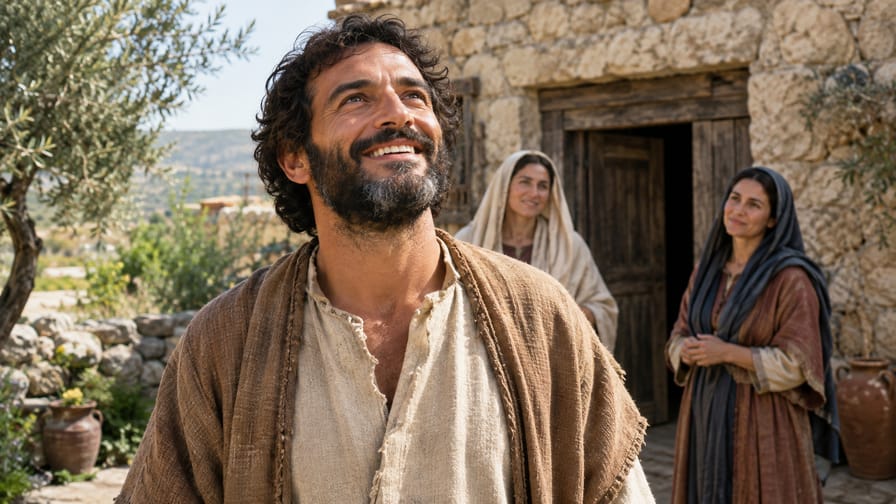
The figure of Lazarus of Bethany, brother of Martha and Mary, emerges in the Scriptures as one of the most notable and theologically rich characters of the New Testament. His story, recorded exclusively in the Gospel of John, serves as a powerful testimony to the divinity of Jesus Christ and His power over death.
The narrative of his resurrection is not merely a spectacular miracle, but a "sign" (semeion, σημεῖον) that points to Jesus' messianic identity and His authority as the Resurrection and the Life itself. This analysis aims to deeply explore the figure of Lazarus from an evangelical Protestant perspective, addressing his onomastic meaning, historical context, character, theological relevance, and canonical legacy.
1. Etymology and meaning of the name
The name Lazarus is the Latinized and Greek form (Lazaros, Λάζαρος) of the Hebrew name Eleazar (אֶלְעָזָר). The Greek transliteration is a common abbreviation at the time, retaining the essence of the original meaning. The etymological root of Eleazar is composed of two elements: ’el (אֵל), meaning "God," and ’azar (עָזַר), meaning "to help" or "to aid."
Thus, the literal meaning of the name Lazarus is "God is my help" or "He whom God helps." This meaning is deeply resonant and ironically prophetic in the life of Lazarus of Bethany, who was literally helped and resurrected by God through Jesus Christ. Divine providence manifested in an extraordinary way in his experience.
There are other biblical figures named Eleazar in the Old Testament, the most prominent being Eleazar, son of Aaron, the high priest (Exodus 6:23 Numbers 3:2). Eleazar played a crucial role in the leadership of Israel, succeeding his father in the priesthood and assisting Moses and Joshua. However, the Lazarus of the New Testament is a distinct figure, with no known direct genealogical connection to the Eleazar of the Old Testament.
It is also vital to distinguish Lazarus of Bethany from the poor Lazarus mentioned in the parable of the rich man and Lazarus in Luke 16:19-31. Although both names are identical in Greek form, Luke's figure is part of a didactic parable, while John's Lazarus is a real historical character, a friend of Jesus, whose resurrection is a factual and verifiable event.
The theological significance of the name "God is my help" in the context of Lazarus is profound. He personifies human dependence on divine intervention and God's sovereignty over life and death. His story demonstrates that even in the most desperate situations, God's help can manifest gloriously, bringing life where there was death and hope where there was despair.
Lazarus's name, therefore, is not just a label, but a foreshadowing and confirmation of God's salvific action in his life. The etymology of the name echoes the central message of the Gospel of John: Jesus is the divine help, the source of eternal life for those who believe.
2. Historical context and biblical narrative
The story of Lazarus is set in the final period of Jesus Christ's earthly ministry, around 30-33 AD, shortly before His crucifixion. This was a time of intense political and religious tension in Judea, under the dominion of the Roman Empire. Jewish religious leaders, Pharisees and Sadducees, were increasingly hostile to Jesus, viewing Him as a threat to their authority and the stability of the nation.
Lazarus lived in Bethany, a small village located about three kilometers east of Jerusalem, on the eastern side of the Mount of Olives (John 11:18). This proximity to the Jewish capital is significant, as the events in Bethany would have great visibility and impact in Jerusalem, the center of religious and political power.
Lazarus's family, consisting of him and his two sisters, Martha and Mary, was evidently much loved by Jesus. The Gospel of John explicitly states: "Now Jesus loved Martha, and her sister, and Lazarus" (John 11:5). This intimate friendship is one of the most touching aspects of the narrative, revealing Jesus' humanity and His ability to form deep bonds of affection.
The narrative chronology begins with the news of Lazarus's illness, sent to Jesus while He was in Perea, across the Jordan (John 10:40 John 11:3). Jesus, to the perplexity of His disciples, intentionally delays His departure to Bethany for two days, stating that the illness was not for death, but for the glory of God and of the Son of Man (John 11:4, 6).
When Jesus finally arrives in Bethany, Lazarus had already been dead and buried for four days (John 11:17). This duration is crucial because, in the Jewish belief of the time, the soul remained near the body for three days, but on the fourth day, decomposition began, and the hope of resurrection was completely abandoned. Jesus' intervention, therefore, could not be attributed to a faint or a misinterpretation of death.
Jesus' interaction with Martha and Mary is marked by His compassion and His profound teachings about resurrection. To Martha, He declares: "I am the resurrection and the life whoever believes in me, though he die, yet shall he live and everyone who lives and believes in me shall never die. Do you believe this?" (John 11:25-26). This declaration is the theological core of the miracle that would follow.
The culmination of the narrative is Jesus' arrival at Lazarus's tomb, where He orders the stone to be removed and, after a prayer to the Father, cries out in a loud voice: "Lazarus, come out!" (John 11:43). Immediately, Lazarus comes out of the tomb, still wrapped in grave clothes. This is an unprecedented miracle, an undeniable testimony to Jesus' divine power.
The resurrection of Lazarus had immediate and dramatic consequences. Many Jews who witnessed the event believed in Jesus, but others reported what had happened to the Pharisees. This led the Sanhedrin to convene a meeting, where Caiaphas, the high priest, unconsciously prophesied Jesus' death for the nation (John 11:47-53). From that moment, the decision to kill Jesus was sealed.
The presence of the resurrected Lazarus at a dinner in Bethany, where Mary anointed Jesus' feet with expensive perfume (John 12:1-8), served as living proof of the miracle. Crowds of Jews came not only to see Jesus, but also to see Lazarus (John 12:9). His continued existence became a source of faith for many and, for this reason, the chief priests conspired to kill him also (John 12:10-11), demonstrating the depth of the opposition to Jesus and to anyone who testified about Him.
3. Character and role in the biblical narrative
Lazarus's character, though not extensively detailed in the Scriptures, is revealed primarily through his relationships and the impact of his story. He is presented as a man loved by Jesus and by his sisters, Martha and Mary (John 11:5, 36). This mutual affection suggests that Lazarus was a person of good character, worthy of such love and friendship.
His illness and death, and the subsequent resurrection, place him in a passive position in the narrative. Lazarus does not speak before his resurrection nor explicitly express any desire or faith in the story. He is the object of divine action, the recipient of the miracle, which highlights Jesus' power and initiative.
After his resurrection, Lazarus also does not utter many recorded words. His main "action" is his very existence as a living witness. He sits at the table with Jesus at the dinner in Bethany (John 12:2), and his presence there is more eloquent than any speech. He is the irrefutable proof of Jesus' power over death, a walking "sign."
Lazarus's role in the narrative is fundamentally that of an instrument in the hands of God to manifest Jesus' glory. His resurrection was not just for his personal benefit or for the comfort of his sisters, but so that "the Son of God might be glorified through it" (John 11:4). He becomes a living witness to Jesus' identity as the Messiah and the Son of God.
His story illustrates God's sovereignty over life and death, and Jesus' ability to bring new life even from the deepest darkness. Lazarus, by coming out of the tomb, foreshadows the hope of resurrection for all believers and Christ's final victory over the last enemy, death (1 Corinthians 15:26).
Despite his silence, Lazarus's impact was immense. His resurrection led many to believe in Jesus (John 12:11), but it also hardened the hearts of the religious leaders, who began to plan the death of Jesus and of Lazarus himself (John 11:53 John 12:10). Thus, Lazarus becomes a pivot in the escalation of the conflict that would culminate in Jesus' crucifixion.
In summary, Lazarus's character is that of a beloved friend, an ordinary man who experienced the extraordinary grace and power of God. His role is passive, but his post-resurrection existence activates one of the most decisive moments in salvation history, serving as a powerful testimony to Jesus' divinity and the promise of resurrection.
4. Theological significance and typology
The resurrection of Lazarus is one of the most theologically charged events in the Gospel of John, serving as a culminating "sign" (σημεῖον, semeion) that reveals Jesus' glory and His divine identity. This miracle is not just a demonstration of power, but a profound theological declaration about who Jesus is and what He offers.
Firstly, the resurrection of Lazarus functions as the seventh and last of the great "works" or "signs" of Jesus recorded by John before the Passion. It is the climax of the progressive revelation of Jesus' divinity, preparing the ground for His own resurrection and the consummation of His salvific work. It demonstrates that Jesus has absolute authority over death, a divine prerogative.
This event is central to Jesus' declaration: "I am the resurrection and the life" (John 11:25). This affirmation is one of Jesus' seven "I Am" statements in John, which reveal His divine nature and mission. By resurrecting Lazarus, Jesus not only demonstrates His ability to give life, but proves that He is the very source and essence of eternal life. Faith in Christ is the key to life, even in the face of physical death.
Although Lazarus was resurrected, he is not a perfect type of Christ in His resurrection, for Lazarus was raised to a mortal life and would die again. Jesus, on the other hand, was resurrected to an immortal and glorified life, definitively triumphing over death and sin. However, Lazarus's resurrection prefigures Christ's resurrection in the sense that it shows the divine power that would be exercised in Jesus. It also points to the future resurrection of believers, as promised by Jesus (John 5:28-29).
Lazarus's story also highlights Jesus' profound humanity. His weeping at the pain of Mary and Martha (John 11:35) reveals His compassion and solidarity with human suffering, even knowing that He was about to reverse the situation. This underscores the doctrine of the hypostatic union, the full divinity and full humanity of Christ.
From the perspective of Reformed and evangelical theology, Lazarus's resurrection reinforces the authority of Scripture and the historical veracity of Jesus' miracles. It is not an allegory, but a real event that serves as a foundation for Christian faith in God's sovereignty and Christ's salvific power. This miracle is an anticipation of the new creation and the restoration that Christ will bring.
Lazarus's resurrection is intrinsically linked to the doctrine of salvation by faith. Martha's response to Jesus' declaration — "Yes, Lord, I believe that you are the Christ, the Son of God, who is to come into the world" (John 11:27) — is a confession of faith that Jesus seeks and that is central to the Gospel. The miracle serves to strengthen and validate this faith.
Finally, this event has eschatological implications. Lazarus's resurrection is a "firstfruit" of the general resurrection of the dead on the last day, when all who are in the tombs will hear Christ's voice and come out to the resurrection of life or of condemnation (John 5:28-29). Thus, Lazarus becomes a symbol of Christian hope in eternal life through Jesus Christ.
5. Biblical-theological legacy and canonical references
The figure of Lazarus of Bethany is mentioned exclusively in the Gospel of John (chapters 11 and 12) within the biblical canon. There are no references to him in other New Testament books, nor in the Old Testament, apart from the distinction of the priest Eleazar. His story, though limited to a single Gospel, has a theological impact disproportionate to its narrative length.
The absence of Lazarus in other synoptic Gospels (Matthew, Mark, Luke) is a point of discussion among scholars. Some suggest that the Synoptics may have omitted the event to protect Lazarus and his family from persecution by Jewish leaders, since Lazarus's resurrection was the trigger for the decision to kill Jesus (John 11:53) and also Lazarus (John 12:10). John, writing later, when persecution of Jewish Christians had already spread, would not have had the same concerns.
Lazarus's influence in biblical theology resides primarily in his function as irrefutable evidence of Jesus' divinity and His authority over death. He is the physical and historical demonstration that Jesus is, indeed, "the resurrection and the life" (John 11:25). His story validates Jesus' promises of eternal life for those who believe in Him.
In Christian interpretive tradition, the story of Lazarus has been consistently understood as a powerful testimony to the truth of the Gospel. Church Fathers like Augustine and Chrysostom frequently cited this miracle to argue for Christ's divinity and the hope of resurrection. He is a pillar in Christian apologetics for Jesus' uniqueness.
In Reformed and evangelical theology, the narrative of Lazarus is emphasized for its historicity and literality. Lazarus's resurrection is not seen as an allegory, but as a factual event that occurred in time and space, confirming the veracity of the Scriptures and the person of Jesus Christ. This is crucial for the doctrine of biblical inerrancy.
Evangelical theologians often highlight how this miracle not only points to Christ's resurrection, but also to the spiritual regeneration of believers. Just as Lazarus was spiritually dead in the tomb and was called out, the sinner is spiritually dead in his trespasses and sins and is called to life by Christ (Ephesians 2:1-5).
The story of Lazarus serves as a constant reminder of Christ's victory over death and the transforming power of the Gospel. His resurrection provides a powerful illustration of Christian hope in life after death and in bodily resurrection on the last day, a central doctrine of Christianity.
Lazarus's legacy, therefore, is not in his own words or actions, but in being the object of the most dramatic demonstration of Jesus' power over death before His own resurrection. He remains in biblical memory as the man whom God extraordinarily helped, an eternal testimony to God's glory and the Messiah's power.