


Jephthah
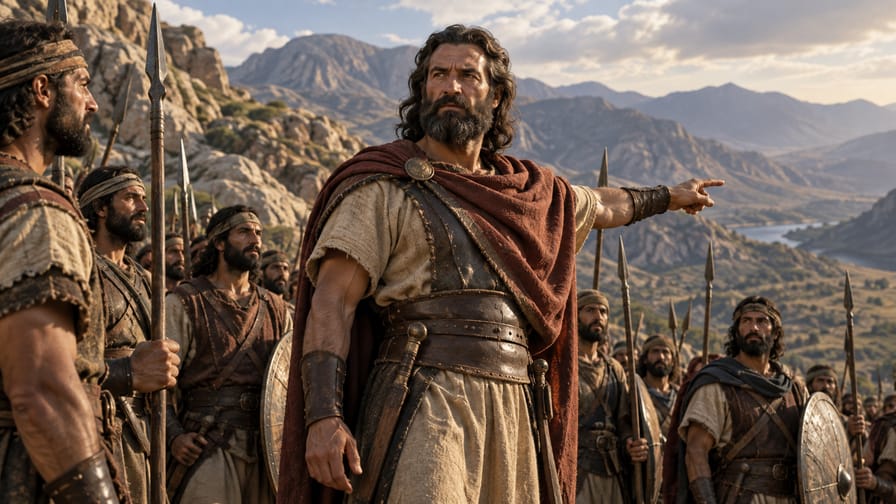
The figure of Jephthah (Hebrew: Yiftach, יִפְתָּח) emerges from the pages of the Book of Judges as one of Israel's most complex and controversial leaders. His story, narrated in Judges 10:6–12:7, is a vivid testament to the era of spiritual and moral decline that characterized the period of the judges. Cast to the margins of society due to his origin, Jephthah ascended to a position of leadership, driven by the need of his people and by divine empowerment.
His narrative is marked by military heroism, unwavering faith, and a tragic decision that has generated debate and theological reflection for millennia. Understanding Jephthah requires a careful analysis of his context, character, and the impact of his actions on redemptive history. This entry seeks to offer a deep and comprehensive analysis, grounded in the evangelical Protestant perspective, exploring the etymology of his name, his biography, his qualities and flaws, and his theological legacy.
1. Etymology and Meaning of the Name
The name Jephthah, in Hebrew Yiftach (יִפְתָּח), derives from the verbal root patach (פָּתַח), which means "to open," "to set free," "to begin," or "to clear away." The form Yiftach is a causative imperfect or a simple future, which can be translated as "he will open," "may he open," "God will open," or "God sets free." This etymology is deeply significant in the context of Jephthah's story, for he was raised up by God to "open" the way for Israel's deliverance from Ammonite oppression.
The meaning of the name Jephthah, "he will open" or "God opens," resonates with his function as a deliverer and judge of Israel. He was the one who opened the way for military victory and for the restoration of peace, even if temporarily. Although there are no other prominent biblical characters with the exact name Jephthah, the root patach is common in Hebrew literature and is associated with acts of liberation and revelation, underscoring divine intervention.
From a theological standpoint, the name of Jephthah can be seen as a foreshadowing of God's role as the great Liberator and Way-Opener. He opens doors that no one can shut and shuts doors that no one can open (Revelation 3:7). In this sense, Jephthah's name, though attributed to a flawed man, points to divine sovereignty in using human instruments to fulfill His purposes of liberation, echoing God's promise to "open" a way for His people.
2. Historical Context and Biblical Narrative
2.1 Period and Socio-Political Context
Jephthah lived during the period of the Judges, a turbulent era in Israel's history, approximately between the 12th and 11th centuries B.C. (c. 1100 B.C.). This period is characterized by a repetitive cycle of apostasy, oppression by neighboring nations, the people's cry to God, and the raising up of a judge-deliverer. The Book of Judges summarizes this era with the phrase: "In those days there was no king in Israel everyone did what was right in his own eyes" (Judges 17:6 21:25).
The setting for Jephthah's rise is established in Judges 10:6-8, where Israel, once again, "did evil in the eyes of the Lord and served the Baals, and the Ashtaroth, and the gods of Syria, and the gods of Sidon, and the gods of Moab, and the gods of the Ammonites, and the gods of the Philistines. And they forsook the Lord and did not serve Him." As a consequence, God allowed the Ammonites and Philistines to oppress Israel for eighteen years, especially the tribes east of the Jordan, including Gilead.
2.2 Family Origin and Ostracism
Jephthah's story begins with his unusual family origin and subsequent ostracism (Judges 11:1-3). He was the son of Gilead, but his mother was a prostitute, which made him an illegitimate son. The sons of Gilead's legitimate wife, motivated by jealousy and concern for the inheritance, drove Jephthah away, saying: "You shall not inherit in our father's house, for you are the son of another woman" (Judges 11:2).
Exiled from his home and community, Jephthah fled to the land of Tob, a region near the border with Ammon. There, he became the leader of a group of "worthless fellows" (Judges 11:3), probably mercenaries or discontented men, who went out with him on his raids. This experience of leading a group of outlaws prepared him for the military and leadership skills that would later be crucial.
2.3 The Call to Leadership and Negotiation with Ammon
When the Ammonite oppression became unbearable, the elders of Gilead, desperate for a military leader, went to Tob to seek Jephthah (Judges 11:4-6). They recognized his reputation as a capable warrior. Initially, Jephthah confronted them for having rejected him before, but accepted leadership on the condition that if God gave him the victory, he would remain as head over them (Judges 11:9-10). This agreement was sealed before the Lord in Mizpah.
Before entering battle, Jephthah attempted a diplomatic solution, sending messengers to the king of Ammon to question the basis of his aggression (Judges 11:12). He argued based on Israel's history, refuting the Ammonite claim over the territory and appealing to the Lord as Judge, saying: "The Lord, the Judge, judge this day between the people of Israel and the people of Ammon" (Judges 11:27). The Ammonite king's refusal to negotiate sealed the fate of the war.
2.4 The Battle Against Ammon and the Tragic Vow
With the negotiation having failed, "the Spirit of the Lord came upon Jephthah" (Judges 11:29), empowering him for war. Before departing for battle, Jephthah made a vow to the Lord: "If you will indeed give the Ammonites into my hand, then whatever comes out from the doors of my house to meet me when I return in triumph from the Ammonites, shall be the Lord's, and I will offer it up as a burnt offering" (Judges 11:30-31).
God granted Jephthah victory, and he inflicted a great defeat on the Ammonites (Judges 11:32-33). Upon returning victorious to his home in Mizpah, the first person to come out to meet him was his only daughter, dancing with tambourines (Judges 11:34). The tragedy of Jephthah's vow was realized, and he fulfilled his promise after a two-month period of mourning, during which his daughter lamented her virginity.
2.5 Conflict with Ephraim and Death
After the victory over Ammon, Jephthah faced an internal conflict with the tribe of Ephraim (Judges 12:1-6). The Ephraimites, offended that they had not been called to battle, threatened to burn Jephthah's house. Jephthah argued that he had called, but they had not responded. The dispute escalated into a battle, in which the men of Gilead, under Jephthah's leadership, defeated the Ephraimites. To identify the Ephraimites attempting to flee, the Gileadites used the word "Shibboleth" (שִׁבֹּלֶת) those who pronounced it as "Sibboleth" (סִבֹּלֶת) were identified and killed. Twenty-two thousand Ephraimites perished. Jephthah judged Israel for six years and was buried in one of the cities of Gilead (Judges 12:7).
3. Character and Role in the Biblical Narrative
3.1 A Complex Character: Virtues and Flaws
Jephthah's character is a tapestry of virtues and flaws, revealing the complexity of the human condition even in those whom God uses. He was, above all, a man of great courage and determination. His ascent from an outcast to a military leader and judge of Israel demonstrates remarkable resilience and an innate capacity for leadership, even in adverse circumstances.
One of his most evident qualities is his faith, recognized in the New Testament in Hebrews 11:32, where he is listed among the heroes of faith. His trust in God as Judge (Judges 11:27) and his dependence on the Spirit of the Lord for battle (Judges 11:29) are testaments to his faith. He was a man of his word, a trait that, though commendable in itself, led to the tragedy of his vow.
However, Jephthah also exhibited significant flaws. His impulsiveness is the most notorious, manifested in the reckless vow he made to the Lord (Judges 11:30-31). This vow, which apparently involved human sacrifice, reveals a possible influence of pagan practices of the time or, at the very least, a lack of theological discernment regarding the nature of vows and the sanctity of human life, which is expressly forbidden by Mosaic Law (Leviticus 18:21 Deuteronomy 12:31). His resolve to keep the vow, though motivated by integrity, led him to a morally questionable act.
Another perceptible flaw is his brutality in dealing with the Ephraimites. Though provoked, the slaughter of twenty-two thousand men over a pronunciation dispute (Shibboleth vs. Sibboleth) demonstrates a cruelty and lack of mercy that contrast with the ideal of leadership in Israel. This episode underscores the violent and disorganized nature of the period of the judges, where law and order were often replaced by tribal vengeance.
3.2 Role as Judge and Deliverer
Jephthah's primary role in the biblical narrative is that of a judge and deliverer (Judges 11:11). He was raised up by God to save Israel from Ammonite oppression, fulfilling the divine cycle of judgment and mercy. As judge, he not only led the people militarily but also administered justice, as evidenced by his attempt at diplomatic negotiation and his decision regarding the dispute with Ephraim. He governed Israel for six years, a relatively short period compared to other judges.
His story illustrates divine providence in using imperfect individuals to fulfill His plans. Despite his marginalized origin, his character flaws, and his tragic vow, Jephthah was an instrument in God's hands to bring deliverance to His people. He is an example of how faith can coexist with human weaknesses, and how God can operate through complex circumstances and decisions to achieve His sovereign purposes.
4. Theological Significance and Typology
4.1 The Role in Redemptive History and Progressive Revelation
Jephthah's story fits into Israel's redemptive history as an example of God's faithfulness in responding to the cry of His people, even when they are in deep apostasy. He is a link in the chain of judges who prepare the way for the monarchy and, ultimately, for the Messiah. His narrative illustrates the need for a righteous and perfect king who would govern Israel according to God's will, in contrast to the imperfect and fragmented leadership of the judges.
The progressive revelation of God's will is evident in the implicit condemnation of Jephthah's vow. Although the narrative does not explicitly censure it, Mosaic Law categorically prohibited human sacrifice (Leviticus 18:21 Deuteronomy 12:31), and the tragedy that followed Jephthah's vow serves as a somber reminder of the dangers of theological ignorance and religious impulsivity. The story underlines that faith does not negate the need for discernment and obedience to God's moral law.
4.2 Christocentric Typology and Jephthah's Vow
Jephthah's typology in relation to Christ is complex and should be approached with caution. As a judge and deliverer raised up by God, he prefigures Christ, the ultimate Judge and Savior. Just as Jephthah "opened" the way for Israel's liberation, Christ "opened" the way for salvation and reconciliation with God through His death and resurrection (John 10:9 Hebrews 10:19-20).
However, the typology should be understood more by contrast than by direct similarity, especially concerning his vow. While Jephthah sacrificed his only daughter due to an imprudent and possibly ignorant vow, God the Father sacrificially gave His only Son, Jesus Christ, as the perfect and voluntary sacrifice for humanity (John 3:16 Romans 5:8). Christ's sacrifice was an act of divine love, in contrast to Jephthah's sacrifice, which was a tragic and problematic human act, born of an unreflective vow and a possibly distorted understanding of God's will. Jephthah's story serves to highlight the perfection of Christ's sacrifice.
Jephthah's vow is one of the most debated points. Conservative evangelical interpretation generally concludes that Jephthah indeed sacrificed his daughter as a literal human burnt offering. This view is founded on the explicit language of the text ("I will offer it up as a burnt offering", Judges 11:31) and on the profound anguish of Jephthah and his daughter, who lamented her virginity, not her death. Although human sacrifice was an abomination to God's Law (Deuteronomy 18:10), the biblical narrative often records the sins of His people without endorsing them, serving as a warning about the spiritual corruption of the period of the judges and the dangers of ill-considered vows. Jephthah's inclusion in Hebrews 11:32 focuses on his faith in God for victory, not on his flawed actions.
4.3 Connection with Central Theological Themes
Jephthah's story connects to several central theological themes:
- Faith and Obedience: Although Jephthah is praised for his faith in Hebrews 11:32, his story also serves as a reminder of the importance of informed obedience. True faith does not operate on the fringes of divine revelation.
- God's Sovereignty and Human Instrumentality: God uses imperfect men and women, like Jephthah, to fulfill His purposes. His sovereignty is not compromised by human flaws but often manifests through them.
- Consequences of Sin: The Ammonite oppression was a result of Israel's sin (Judges 10:6). Jephthah's vow and its tragic consequences illustrate the ramifications of thoughtless decisions and the mixing of pagan practices with faith in the true God.
- Law and Grace: The Mosaic Law prohibited human sacrifice, but the period of the Judges shows a time when the Law was often ignored. God's grace, however, persisted in raising up deliverers.
5. Biblical-Theological Legacy and Canonical References
5.1 Mentions in Other Biblical Books
The most significant mention of Jephthah outside the Book of Judges is found in Hebrews 11:32. In this chapter, known as the "faith hall of fame," Jephthah is listed among the heroes who, "by faith conquered kingdoms, enforced justice, obtained promises, stopped the mouths of lions." This inclusion is crucial for the theological understanding of Jephthah from a Christian perspective. It emphasizes that, despite his flaws and the tragic vow, his faith in God as a deliverer was genuine and active.
The passage in Hebrews does not endorse his problematic actions but celebrates the faith that enabled him to be an instrument in God's hands for the deliverance of Israel. This distinction is vital for evangelical theology, which recognizes God's grace operating through flawed individuals, and the capacity of faith to transcend human imperfections.
5.2 Influence on Biblical Theology and Tradition
Jephthah's story exerts considerable influence on biblical theology by illustrating the depth of human depravity and the persistence of divine grace during the period of the judges. It highlights the need for theologically sound and morally upright leadership, preparing the ground for the institution of the monarchy in Israel. The lack of a righteous king during the era of the judges, where "everyone did what was right in his own eyes" (Judges 21:25), is vividly demonstrated through Jephthah's actions, both heroic and tragic.
In Jewish and Christian interpretive tradition, Jephthah's vow has been the subject of intense debate. Although some ancient commentators, such as Josephus (Jewish Antiquities 5.7.10), and some rabbinic traditions have tried to reinterpret the vow as a dedication to perpetual virginity, the predominant interpretation in evangelical Protestant theology, based on the exegesis of the Hebrew text, tends to confirm that Jephthah indeed sacrificed his daughter. This understanding serves as a poignant reminder of the dangers of literal interpretation of imprudently made vows and of the corrupting influence of pagan cultural practices, even among God's people.
5.3 Treatment in Reformed and Evangelical Theology
In Reformed and evangelical theology, Jephthah is often studied as a complex case of faith amidst human fallibility. His inclusion in Hebrews 11 is seen as an affirmation of God's sovereignty in using imperfect instruments for His purposes, and of the gracious nature of the faith that God values. Evangelical theologians emphasize that Jephthah's faith does not exempt him from his moral failings but demonstrates the reality that salvation is by grace through faith, not by works or human perfection.
Jephthah's story is used to teach about the importance of prudence when making vows to God (Ecclesiastes 5:4-5), the sanctity of human life according to God's Law, and the dangers of religious syncretism. He serves as an example that even those empowered by the Holy Spirit can make serious mistakes, and that the progressive revelation of God's will requires continuous study and discernment. His life points to the need for a perfect Savior and a King who would rule with unwavering justice and wisdom, Jesus Christ.
In summary, Jephthah is a paradoxical figure who embodies the tensions and tragedies of the period of the judges. His story is a reminder of God's faithfulness in raising up deliverers, of the complexity of human faith, and of the profound consequences of disobedience and imprudence. He remains a figure of warning and inspiration, whose faith is praised, but whose actions serve as a perennial warning to all generations.