


Jahziel
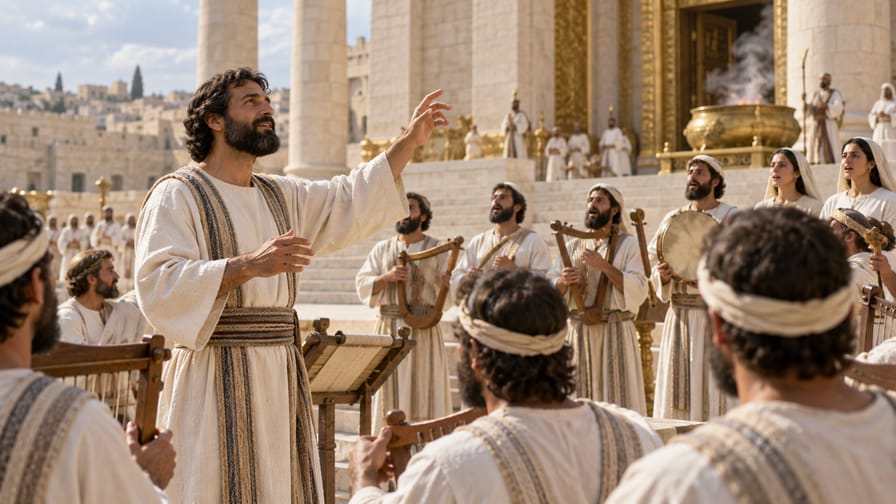
The figure of Jaaziel, though briefly mentioned in the Hebrew Scriptures, offers a rich opportunity for biblical and theological analysis, especially from an evangelical Protestant perspective. His sole appearance in 1 Chronicles 15:18, in the context of the transfer of the Ark of the Covenant to Jerusalem, places him within one of the most significant moments in Israel's history under the reign of David. This entry will explore the meaning of his name, the historical context of his actions, his role in the biblical narrative, his theological relevance, and his canonical legacy, demonstrating how even seemingly secondary characters contribute to the tapestry of redemptive history.
The analysis of Jaaziel illuminates the importance of Levitical service, worship, and obedience to God's law in the Old Testament, pointing, through enduring principles, to fundamental truths of the Christian faith. His inclusion in the Chronicler's record is not accidental, but serves to reinforce divine attention to the details of worship and the dedication of those who serve God.
1. Etymology and Meaning of the Name
The name Jaaziel, in Hebrew, is יַעֲזִיאֵל (Ya‘ăzi’êl). This name is a theophoric name, meaning it incorporates a divine element, in this case, אֵל (’Ēl), which means "God." The first part of the name derives from the verbal root עָזַז (‘āzaz), which means "to be strong," "to be powerful," or "to strengthen."
Therefore, the literal and symbolic meaning of the name Jaaziel is "God strengthens," "God is my strength," or "Strengthened by God." This meaning is profoundly theological and resonates with central themes of biblical faith, such as human dependence on divine power and provision.
Although the exact form Ya‘ăzi’êl is unique to this character in 1 Chronicles 15:18, there are names with similar etymological roots or phonetic variations that can cause confusion. For example, יְעִיאֵל (Yə‘î’êl), translated as Jeiel in some versions, appears in 1 Chronicles 15:20 and in other contexts, also as a Levite and musician.
Some scholars debate whether Jaaziel and Jeiel (from 1 Chronicles 15:20) might be the same person, given the proximity of their names and functions. However, the Hebrew text presents distinct forms. For the purposes of this analysis, we will adhere to the form Jaaziel (Ya‘ăzi’êl) from 1 Chronicles 15:18 as a distinct individual, although we acknowledge the similarity and shared function.
The theological significance of the name Jaaziel in the biblical context is notable. The fact that his name means "God strengthens" is particularly pertinent for a Levite involved in sacred service. Serving God, especially in tasks that required dedication and reverence, did not depend on human strength, but on divine enablement.
This aligns with Old Testament theology, which often emphasizes the strength of Yahweh as the true source of power for Israel and its servants (cf. Psalm 18:1-2 Isaiah 40:29). Thus, the name of Jaaziel is not merely an identification, but a theological statement about the nature of service and worship to God.
2. Historical Context and Biblical Narrative
Jaaziel is mentioned in the book of 1 Chronicles, a text which, along with 2 Chronicles, was written after the Babylonian exile, probably between 450 and 425 B.C. The Chronicler, as the author is known, had as his primary purpose to reaffirm Israel's post-exilic identity, focusing on the Davidic lineage, the temple, and Levitical worship. He sought to inspire hope and faithfulness to God's covenant.
The precise historical period in which Jaaziel was active is the reign of David, specifically during the crucial event of the transfer of the Ark of the Covenant from Kiriath-Jearim to Jerusalem (c. 1000-990 B.C.). This was a moment of great political, social, and religious importance. David had consolidated his kingdom, established Jerusalem as his capital, and now sought to make it also the religious center of Israel by bringing the Ark, the most potent symbol of God's presence.
The biblical narrative in 1 Chronicles 15 describes David carefully organizing the second attempt to transport the Ark, after the tragic failure of the first attempt, which resulted in the death of Uzzah (2 Samuel 6:6-7 1 Chronicles 13:9-10). David learned that the Ark should only be carried by the Levites, according to the Mosaic instructions (Numbers 4:15).
For this solemn and joyful event, David summoned the Levites and priests, instructing them to consecrate themselves and to carry the Ark on their shoulders, instead of a cart. He also appointed Levites to serve as musicians, using instruments to celebrate the occasion. It is in this context that Jaaziel is named.
In 1 Chronicles 15:18, Jaaziel is listed among the gatekeepers (or guards) and musicians, specifically those who played harps, according to 1 Chronicles 15:20 (if the identification with Jeiel is accepted as a textual variant or a distinct person with the same function). The passage says: "and their brethren of the second rank: Zechariah, Ben, Jaaziel, Shemiramoth, Jehiel, Unni, Eliab, Benaiah, Maaseiah, Mattithiah, Eliphelehu, Mikneiah, Obed-Edom, and Jehiel, the gatekeepers" (1 Chronicles 15:18, ARA, with Jaaziel as the transliteration). The mention of "gatekeepers" may indicate that, in addition to musicians, they had the responsibility of guarding the Ark or access to the place of worship.
The geography related to the character is the route of the Ark, from the house of Obed-Edom, where it had remained for three months after the Uzzah incident, to Jerusalem, the newly established Davidic capital. The Ark was taken to the tent that David had prepared for it in the City of David (1 Chronicles 15:1, 29).
Jaaziel's relationships are with other Levites and with King David himself. He was among "their brethren," referring to the Levites appointed for service. The chief musicians were Asaph, Heman, and Ethan (also known as Jeduthun), who were heads of Levitical families and masters of music (1 Chronicles 15:16-17, 19). Jaaziel, therefore, was part of a larger team of worshipers and dedicated servants.
3. Character and Role in the Biblical Narrative
The brevity of Jaaziel's mention does not allow for an in-depth analysis of his individual character on the same level as more prominent figures. However, his inclusion in the list of Levites chosen by David for such a sacred and public task suggests certain qualities and virtues inherent in his role and calling.
Firstly, his appointment implies that he possessed the necessary qualifications for Levitical service. Levites were chosen by God for the service of the tabernacle and, later, the temple (Numbers 3:5-10). They were responsible for various functions, from the transport and guarding of sacred utensils to music and the teaching of the Law.
The fact that Jaaziel is listed among those who played harps (if the identification with Jeiel of 1 Chronicles 15:20 is assumed or if he also had that function) indicates musical ability. Music was an integral part of worship in the Old Testament, not merely as entertainment, but as a means of expressing praise, lament, and instruction (cf. Psalm 33:2-3 Colossians 3:16).
Jaaziel's participation in the procession of the Ark of the Covenant demonstrates his obedience and dedication to the divine calling and to David's leadership. This event was not trivial it required reverence, discipline, and an understanding of the Ark's holiness. The readiness to serve in such a capacity reflects a character of faithfulness and commitment to the worship of Yahweh.
Jaaziel's calling was, therefore, that of a Levite, exercising the function of gatekeeper and, possibly, musician. These functions were essential for order and reverence in worship. The gatekeepers ensured the security and purity of the sanctuary, controlling access and maintaining order. The musicians elevated worship through songs and instruments, creating an atmosphere conducive to the manifestation of God's presence.
There is no record of documented sins, weaknesses, or moral failures for Jaaziel. His mention is purely positive, associated with service and worship. This is common for many secondary characters in the historical books, whose function is to illustrate the faithfulness and fulfillment of divine commands by God's people.
Jaaziel's significant actions, although not described in detail, include his presence and active participation in the solemn and joyful procession of the Ark. His key decision was, presumably, to accept and fulfill his designation as a Levite, contributing to the successful transfer of the Ark and the establishment of worship in Jerusalem.
Character development is not traced, as Jaaziel appears in a single verse. However, his inclusion in the biblical canon serves to underscore the importance of each individual in God's plan, even those whose contributions may seem modest in comparison with the great figures of biblical history. His life, though briefly recorded, is a testament to faithful service.
4. Theological Significance and Typology
Even with a single mention, Jaaziel inserts himself into the grand narrative of God's redemptive history, contributing to the progressive revelation of the divine plan. His participation in the transport of the Ark of the Covenant is theologically charged, for the Ark was the primary symbol of God's covenantal presence among His people.
The Ark prefigured the incarnation of Christ, who is Emmanuel, "God with us" (Matthew 1:23), the perfect manifestation of the divine presence. Just as the Ark was the mercy seat where God met with His people (Exodus 25:22), Christ is the only way to God, the High Priest who offers the perfect sacrifice (Hebrews 9:11-14).
Jaaziel's service as a Levite in the Old Testament typologically points to the priesthood of all believers in the New Testament (1 Peter 2:5, 9). The New Covenant, mediated by Christ, abolished the need for an exclusive Levitical priesthood, making every believer a priest with direct access to God through Jesus (Hebrews 10:19-22). Believers are called to offer "spiritual sacrifices acceptable to God" (Romans 12:1 Hebrews 13:15-16).
The name of Jaaziel, "God strengthens," is a powerful theological declaration that finds its fulfillment and echo in the Christian experience. The strength for service, worship, and Christian life does not emanate from the individual, but from the Holy Spirit who indwells believers (Philippians 4:13 Ephesians 3:16). Dependence on God for enablement is a central theme, both for the Levite of the Old Covenant and for the believer of the New Covenant.
The Chronicler's emphasis on the correct observance of Levitical worship, exemplified by the careful preparation for the transfer of the Ark, underscores the importance of obedience to God's commands. The Uzzah incident (1 Chronicles 13) serves as a stern reminder that God is holy and must be approached on His own terms. Jaaziel's participation in the second, successful, transfer of the Ark represents due obedience and reverence.
This event, and Jaaziel's participation in it, connects with central theological themes such as the holiness of God, the importance of worship, obedience to His Word, and the grace that enables service. The joy and celebration that accompanied the Ark to Jerusalem (1 Chronicles 15:25-28) prefigure the joy of salvation and the celebration of God's presence among His people, culminating in the glorious coming of Christ.
Although Jaaziel is not directly cited in the New Testament, the principles of faithful service, reverent worship, and dependence on divine strength, which his brief mention evokes, are abundantly developed in Christian theology. He represents the myriad of anonymous or little-known servants who, throughout biblical history, contributed to the fulfillment of God's redemptive plan.
5. Biblical-Theological Legacy and Canonical References
Jaaziel's mention is restricted to 1 Chronicles 15:18. There are no other direct references to him in other biblical books, nor is he credited with any literary contributions (such as the authorship of Psalms, for example). His importance, therefore, lies more in his representative role and the theological context in which he is embedded than in an extensive biography or direct influence in other canonical texts.
Jaaziel's influence in biblical theology lies in how he exemplifies the Levitical ideal of service and worship. The Chronicler, by carefully listing the Levites involved in the transport of the Ark, emphasizes the organization, obedience, and holiness necessary for the worship of God. Jaaziel is part of this demonstration, reinforcing the importance of the temple ministry and music as vital elements of Israel's religious life.
In the Jewish and Christian interpretive tradition, figures like Jaaziel are often seen as models of humble and faithful service. Although they are not heroes of faith in a dramatic sense, they represent the foundation of the community of worshipers, whose collective and individual actions sustain the structure of worship and the covenantal relationship with God.
Intertestamental literature makes no specific mention of Jaaziel. However, the value of Levitical service and reverence for the temple continued to be important themes in the intertestamental period and in Second Temple Judaism, which indirectly validates the type of ministry that Jaaziel represented.
In Reformed and evangelical theology, the figure of Jaaziel, as a Levite, is frequently used to illustrate principles of worship and service. The emphasis on biblical authority and the divine regulation of worship (the Regulative Principle of Worship) finds resonance in the meticulous attention of David and the Levites to the instructions of the Mosaic Law for the transport of the Ark. Jaaziel's service is a reminder that worship must be performed according to the revealed will of God.
Jaaziel's importance for understanding the canon lies in his role as a link in the chain of faithfulness that the Chronicler seeks to highlight. He contributes to the image of an Israel that, despite its failures, possessed a faithful remnant dedicated to proper worship. His inclusion demonstrates that God values every servant, even those whose names are only briefly recorded in the vast history of redemption.
In summary, Jaaziel, whose name proclaims that "God strengthens," is a silent testimony to the truth that the ability to serve God comes from Him. His life, like that of so many other Levites, underscores the beauty of ordered worship, the importance of obedience to Scripture, and the dignity of humble service in God's greater plan for the redemption of His people and the glory of His name.