


Huldah
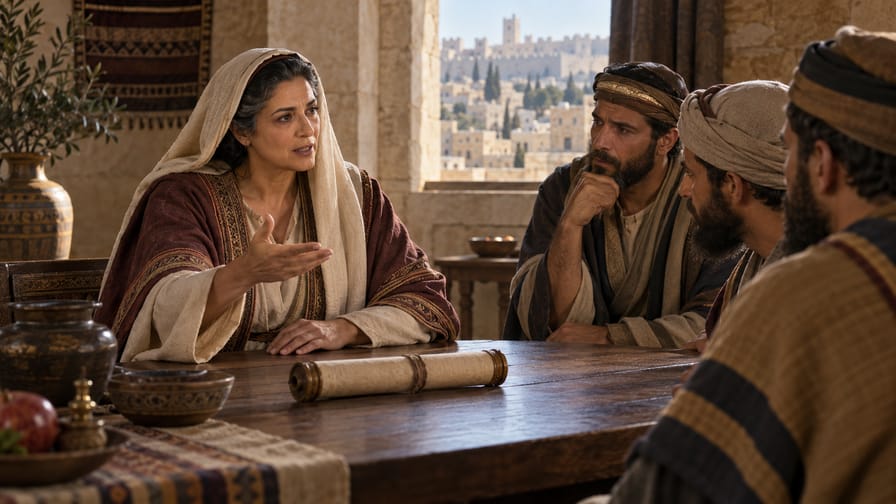
The figure of Huldah emerges in the Hebrew Scriptures as a prominent prophetess, whose brief but impactful appearance is crucial for the religious revival under the reign of Josiah. Her narrative, found in 2 Kings 22 and 2 Chronicles 34, offers a rare glimpse into female prophetic ministry in a critical period of Judah's history.
This study aims to explore the life and ministry of Huldah from a conservative evangelical Protestant perspective, analyzing her onomastic significance, the historical context in which she lived, her character and role in the biblical narrative, and her theological relevance. The analysis will seek to emphasize biblical authority, historical accuracy, and the doctrinal implications of her story for understanding divine revelation.
In examining Huldah's contribution, we will highlight God's sovereignty in using different vessels for His purposes, the centrality of the Word of God, and the importance of obedience and repentance. Her story, though concise, resonates with perennial themes of faith, justice, and divine mercy, offering valuable lessons for biblical theology and Christian life.
1. Etymology and meaning of the name
The name Huldah, in Hebrew חֻלְדָּה (Ḥuldah), is unique in the Holy Scriptures, appearing exclusively in the passages that describe her prophetic ministry during the reign of Josiah (2 Kings 22:14 2 Chronicles 34:22). The etymological root of Ḥuldah is generally associated with the Hebrew word חֶלֶד (ḥeled), which means "mole" or "weasel."
This linguistic derivation is notable, as biblical names often carry meanings that reflect a person's character, circumstance of birth, or destiny. While a name associated with a small animal might seem unusual for a prophetess, some interpretations suggest it could symbolize characteristics such as discretion, humility, or the ability to see what is "hidden," much like a mole lives underground.
Other scholars propose that the name could have a connotation of "longevity" or "age," deriving from a Semitic root that expresses the idea of time or duration. However, the most accepted and linguistically grounded interpretation remains the connection with the animal. There are no other biblical characters with the same name, which makes Huldah even more distinctive.
The theological significance of the name, if linked to "mole" or "weasel," could reside in the paradoxical divine choice. God often uses what is considered humble or insignificant in human eyes to accomplish great purposes, demonstrating that His strength is made perfect in weakness (2 Corinthians 12:9). The prophetess Huldah, with a common animal name, was the voice chosen by God to authenticate the Law and pronounce judgment and grace.
This divine choice underscores the truth that prophetic authority does not reside in social prestige or human eloquence, but in divine enablement and commission. The name Huldah, therefore, can implicitly point to God's sovereignty in choosing His messengers, regardless of their origin or the apparent meaning of their name, to proclaim His Word with unquestionable authority.
2. Historical context and biblical narrative
Huldah's appearance occurs in a crucial period of Judah's history, at the end of the seventh century B.C., specifically during the reign of King Josiah (c. 640-609 B.C.). This was a time marked by decades of apostasy and idolatry under the reigns of Manasseh and Amon, which had led Judah into a deep spiritual and moral decline, with the worship of Canaanite gods and child sacrifices prevailing (2 Kings 21:1-9).
Josiah, however, ascended to the throne at just eight years old and, from an early age, demonstrated a heart devoted to the Lord. At sixteen, he began to seek the God of David, and at twenty, he initiated an extensive religious reform, purifying Judah and Jerusalem from idolatry (2 Chronicles 34:3-7). It was during the restoration of the Temple, in the eighteenth year of his reign (c. 622 B.C.), that the central event involving Huldah took place.
2.1 The discovery of the Book of the Law
High Priest Hilkiah found the "Book of the Law" in the Temple (2 Kings 22:8 2 Chronicles 34:15). The exact identity of this book is debated, but most evangelical scholars identify it as the book of Deuteronomy, or at least a part of it. The discovery was a landmark, as it revealed the extent of Judah's unfaithfulness to the Mosaic covenant and the dire consequences promised by God.
Upon hearing the words of the Book, King Josiah tore his robes as a sign of mourning and repentance, realizing God's wrath upon the people for their disobedience (2 Kings 22:11 2 Chronicles 34:19). In his distress, Josiah sent a delegation composed of Hilkiah, the high priest Shaphan, the scribe Ahikam, Shaphan's son Achbor, Micaiah's son and Asaiah, the king's servant, to "inquire of the Lord" concerning the words of the Book.
The delegation was sent to Huldah, the prophetess, who resided in the Second Quarter (Mishneh) of Jerusalem (2 Kings 22:14 2 Chronicles 34:22). She was married to Shallum son of Tikvah, the son of Harhas (or Tokhath, son of Harhas), the keeper of the wardrobe. The choice of Huldah is significant, as there were other male prophets active at the time, such as Jeremiah and Zephaniah. Her authority and recognition as a divine messenger were, therefore, widely established.
Huldah's message was twofold: it confirmed divine judgment upon Judah for its idolatry and disobedience, but also pronounced a promise of peace for Josiah because of his humility and repentance. She authenticated the Book of the Law as the Word of God, solidifying the foundations for Josiah's reforms and the subsequent revival in Judah. Her location in Jerusalem, in the "Second Quarter," suggests that she was an accessible and recognized figure in the capital.
3. Character and role in the biblical narrative
Huldah's character is revealed through her actions and, most notably, by the message she delivers. Scripture presents her simply as "the prophetess" (2 Kings 22:14 2 Chronicles 34:22), a title that in itself attests to her calling and her recognition as God's spokesperson. Her authority is implicit in the fact that King Josiah, High Priest Hilkiah, and other high-ranking officials sought her out to obtain a word from the Lord.
One of Huldah's most striking qualities is her faithfulness to the Word of God. Upon receiving the delegation, she does not hesitate to utter the divine message in its entirety, without softening the judgment or the severity of the consequences of Judah's disobedience. She declares: "Thus says the Lord, the God of Israel: Tell the man who sent you to me, Thus says the Lord: Behold, I will bring disaster upon this place and upon its inhabitants, all the words of the book that the king of Judah has read" (2 Kings 22:15-16).
Her courage and boldness are evident. She speaks with unquestionable authority, addressing King Josiah through his emissaries with the imperative phrase: "Thus says the Lord," a prophetic formula that establishes the divine origin of her message. This stance is even more remarkable considering the cultural context of the time, where women generally did not hold such prominent public leadership positions.
In addition to the message of judgment, Huldah also demonstrates spiritual discernment and compassion in recognizing Josiah's genuine humility and repentance. She prophesies a specific blessing for the king: "Because your heart was penitent, and you humbled yourself before the Lord, when you heard how I spoke against this place and against its inhabitants, that they should become a desolation and a curse, and you have torn your clothes and wept before me, I also have heard you, declares the Lord" (2 Kings 22:19).
This prophecy to Josiah is a testimony to God's grace in the face of sincere repentance, guaranteeing that he would be gathered in peace and would not see the evil that would come upon Judah (2 Kings 22:20). Huldah's role, therefore, is not limited to a mere oracle she is a messenger who proclaims both divine justice and mercy, depending on the human response to the Word of God.
Her ministry is an example of how God empowers individuals, regardless of gender or social status, to be His faithful spokespersons. There are no documented records of sins, weaknesses, or moral failures for Huldah she is presented as an exemplary figure of prophetic integrity and obedience to God, performing her role with absolute faithfulness and effectiveness.
4. Theological significance and typology
The theological significance of Huldah resides in her role as an instrument of God's progressive revelation and in the confirmation of the authority of His Word. Her prophecy is a crucial point in Israel's redemptive history, as it authenticates the newly discovered Book of the Law, which would be the catalyst for Josiah's reforms and a brief, yet significant, revival in Judah. She demonstrates that God continues to speak to His people, even in times of deep apostasy.
Huldah's message underscores the seriousness of the covenant between God and Israel. She reaffirms the promises of blessing for obedience and the warnings of judgment for disobedience, as stipulated in the Law (Deuteronomy 28). Her pronouncement of judgment upon Judah validates the earlier prophecy that unfaithfulness would lead to desolation and a curse, confirming the immutability of God's character and the certainty of His words.
Although Huldah is not directly a typological figure of Christ in the classical sense, her role as spokesperson for God points to the concept of the supreme prophet. She prefigures, in a broader sense, the One who is the very Word of God incarnate (John 1:1, 14) and the Prophet promised to Israel (Deuteronomy 18:15). Just as Huldah authenticated the Law, Christ came to fulfill all the Law and the Prophets (Matthew 5:17), bringing the definitive revelation of God.
Huldah's prophecy also highlights the connection between repentance and grace. The promise of peace for Josiah, due to his humility and contrition, illustrates the theological principle that God responds to those who humble themselves before Him (James 4:10). This is an anticipation of the saving grace that would be fully revealed in Christ, where repentance and faith lead to justification and peace with God (Romans 5:1).
Her story reinforces the doctrine of the authority of Scripture. The search for a word from God after the discovery of the Book of the Law and the validation of that word by Huldah, a divinely commissioned prophetess, establishes the centrality of written revelation. The faith and obedience of Josiah were directly shaped by the prophetic word, demonstrating the transformative power of Scripture when received with humility.
In summary, Huldah's ministry serves as a theological reminder of God's sovereignty in using whom He wills, of God's faithfulness to His covenant, of the inevitability of judgment for disobedience, and of the availability of grace for the repentant. Her voice, though that of a woman in a patriarchal society, was the authoritative voice of God, crucial for the continuity of salvation history and for the preservation of the faithful remnant in Judah.
5. Biblical-theological legacy and canonical references
Huldah's legacy, though restricted to two canonical passages (2 Kings 22:14-20 and 2 Chronicles 34:22-28), is profoundly significant for biblical theology and the understanding of the canon. Her limited, yet strategic, mention demonstrates that the importance of a biblical character is not measured by the length of her narrative, but by the impact of her contribution to salvation history and divine revelation.
She is not cited in other biblical books outside the accounts of Kings and Chronicles, nor is there evidence of literary authorship on her part. However, her prophecy is a fundamental pillar for understanding the Josianic revival, which is one of the last great moments of faithfulness to Yahweh before the Babylonian exile. The validation of the Book of the Law by Huldah is the turning point that legitimizes and propels Josiah's reforms.
In the Jewish interpretive tradition, Huldah is recognized as one of the seven prophetesses of Israel, alongside Sarah, Miriam, Deborah, Anna, Abigail, and Esther. This tradition underscores her place of honor and prophetic authority. In Christian theology, especially from a Reformed and evangelical perspective, Huldah is often cited as an example of God's sovereignty in granting the prophetic gift to women, challenging restrictive conceptions about women's ministry.
Evangelical commentators such as John Gill and Matthew Henry, though living in different eras, recognize the legitimacy and importance of Huldah's ministry. She serves as a testimony that divine enablement for prophetic service is not determined by gender, but by God's sovereign choice. Her story is used to argue that, in certain dispensations, women were divinely called and equipped to be spokespersons for God with authority over men, including kings and priests.
Huldah's importance for understanding the canon resides in her role as an authenticator of the Word of God. In a moment of spiritual crisis and rediscovery of the Law, Huldah's prophetic voice was essential for confirming the divine origin of the text and for interpreting its implications for the king and the nation. This reinforces the doctrine of the inerrancy and authority of Scripture, for the Word of God, once lost and rediscovered, was confirmed by a messenger of God.
Huldah's prophecy, by declaring judgment upon Judah and mercy for Josiah, demonstrates the coherence of divine revelation throughout history. It echoes the warnings and promises of earlier and later prophets, connecting the generations of Israel under the same covenant and the same principles of God's justice and grace. Her legacy is, therefore, a testimony to God's faithfulness in upholding His Word and raising up messengers to proclaim it, regardless of the circumstances or the instruments He chooses.
The figure of Huldah, though with a brief appearance, remains a beacon of prophetic integrity and a reminder of divine sovereignty throughout salvation history. Her contribution to the Josianic revival and the validation of the Law are indispensable elements for biblical theology, reaffirming the centrality of the Word of God and human responsibility before its truths.