


Gabriel
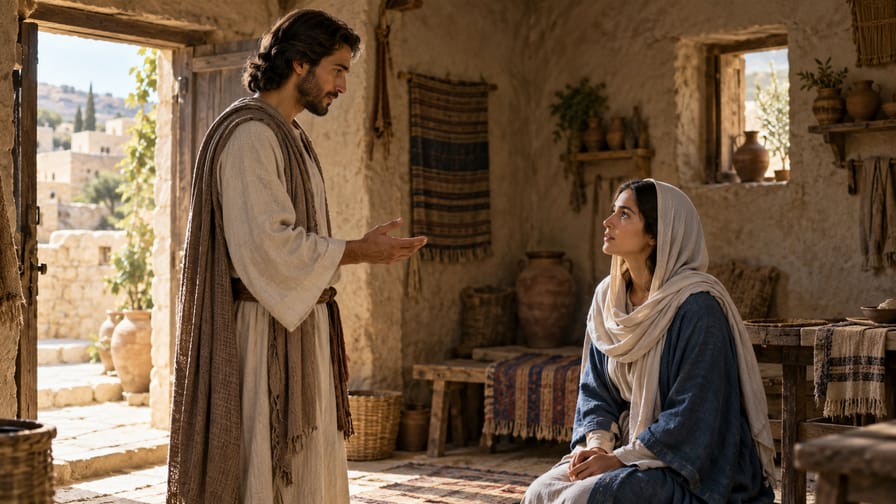
Gabriel is one of only two angels whose names appear in the canonical Scriptures, the other being Michael. He appears four times, always as a messenger sent from the presence of God to explain a vision or to announce a birth: twice to the prophet Daniel (Daniel 8:16; 9:21) and twice in the first chapter of Luke, to the priest Zechariah and to Mary of Nazareth (Luke 1:19, 26).
Unlike the other characters of the Bible, Gabriel is not a human being. He has no parents, no tribe and no genealogy, and Scripture says nothing about his origin beyond the general truth that God created all things, visible and invisible (Colossians 1:16). What the Bible gives us is his function: he stands before God and is sent with words from God.
Much has been written about Gabriel outside the Bible, in Jewish, Christian and Islamic traditions. This article keeps to what the biblical text says, and marks as tradition anything that goes beyond it.
1. Etymology and meaning of the name
The Hebrew name is גַּבְרִיאֵל (Gavrîʼēl), rendered in Greek as Gabriēl (Γαβριήλ) in the Septuagint and in Luke. It combines the element gever, “man, strong man”, or the verb gāvar, “to be strong, to prevail”, with ʼēl, “God”. The name can therefore be understood as “man of God”, “God is my strength” or “mighty one of God”. Scholars differ on the exact nuance, but all these readings point to strength that comes from God.
The book of Daniel seems to play on this meaning. Before Gabriel is named, Daniel sees “one having the appearance of a man” (Daniel 8:15), using the word gever, and later he calls him “the man Gabriel” (Daniel 9:21). This does not mean that Gabriel is human; it describes the form in which he appeared to the prophet.
2. Historical context and biblical narrative
2.1 Origin and nature: an angel, not a man
Because Gabriel is an angel, there is no human genealogy to trace. The Bible teaches that angels are creatures made by God (Psalm 148:2, 5; Colossians 1:16) and that they are “ministering spirits sent out to serve for the sake of those who are to inherit salvation” (Hebrews 1:14). Gabriel describes himself in one sentence: “I am Gabriel. I stand in the presence of God, and I was sent to speak to you” (Luke 1:19). His identity is defined by nearness to God and by the mission he receives.
Two popular ideas deserve care. First, the Bible never calls Gabriel an “archangel”. That title is given by name only to Michael (Jude 9), and the archangel of 1 Thessalonians 4:16 is not named. Calling Gabriel an archangel comes from later tradition, not from the biblical text. Second, the Bible does not describe Gabriel with wings. Daniel 9:21 is often translated “came to me in swift flight”, but the Hebrew expression is difficult, and some translations understand it as referring to the weariness of Daniel. It is not a safe basis for describing the appearance of Gabriel.
2.2 Main events
The vision of the ram and the goat. In the third year of King Belshazzar, Daniel saw a vision by the Ulai canal near Susa: a ram with two horns and a male goat with a prominent horn (Daniel 8:1-14). As he sought to understand it, one with the appearance of a man stood before him, and a voice called: “Gabriel, make this man understand the vision” (Daniel 8:15-16). Daniel was terrified and fell on his face; Gabriel touched him and set him on his feet (Daniel 8:17-18). He explained that the ram represented the kings of Media and Persia and the goat the king of Greece, and he spoke of a fierce king who would arise and be broken “by no human hand” (Daniel 8:20-25). Daniel was so overcome that he lay sick for some days (Daniel 8:27).
The seventy weeks. In the first year of Darius son of Ahasuerus, Daniel understood from the book of Jeremiah that the desolation of Jerusalem would last seventy years (Daniel 9:1-2; Jeremiah 25:11-12; 29:10). He prayed, confessing the sins of his people and pleading for mercy (Daniel 9:3-19). While he was still praying, about the time of the evening offering, Gabriel came to him (Daniel 9:20-21). He said that at the beginning of the prayer a word had gone out, “for you are greatly loved” (Daniel 9:23), and he delivered the prophecy of the seventy weeks, which speaks of an anointed one who would be cut off (Daniel 9:24-27). The details of this prophecy are among the most debated in Scripture; many conservative interpreters see its center fulfilled in the first coming of Christ.
The announcement to Zechariah. In the days of Herod, king of Judea, the priest Zechariah was serving in the temple and burning incense when an angel of the Lord appeared at the right side of the altar (Luke 1:5-11). He announced that Elizabeth would bear a son, John, who would go before the Lord “in the spirit and power of Elijah” (Luke 1:13-17; compare Malachi 4:5-6). When Zechariah asked for a sign, the angel revealed his name, Gabriel, and told him he would be silent until the words were fulfilled (Luke 1:18-20). At the naming of John, Zechariah spoke again (Luke 1:63-64).
The announcement to Mary. In the sixth month, Gabriel was sent from God to Nazareth, to a virgin betrothed to Joseph, of the house of David (Luke 1:26-27). He greeted her as one favored by God and told her not to be afraid (Luke 1:28-30). She would conceive and bear a son, Jesus, who would be called the Son of the Most High, receive the throne of his father David and reign forever (Luke 1:31-33; compare 2 Samuel 7:12-16). The Holy Spirit would come upon her, and the child would be called holy, the Son of God (Luke 1:35). Gabriel added the sign of Elizabeth and the words “nothing will be impossible with God” (Luke 1:36-37). Mary answered: “Behold, I am the servant of the Lord” (Luke 1:38).
Other angels appear in the birth narratives, such as the angel who spoke to Joseph in dreams (Matthew 1:20) and the angel who appeared to the shepherds (Luke 2:9), but the text does not name them. Identifying them with Gabriel is speculation.
3. Character and role in the biblical narrative
Gabriel is always a messenger and an interpreter. He never speaks on his own authority or draws attention to himself; he explains what God has shown and announces what God will do. Even his self-introduction points away from himself: he stands before God and was sent.
His manner fits each situation. With Daniel, who was overwhelmed, he is gentle: he touches him, raises him up and assures him that he is greatly loved (Daniel 8:18; 9:23). With Zechariah, a priest who doubted a clear promise, he is firm, and the silence imposed on him is both discipline and sign (Luke 1:20). With Mary, he is reverent and reassuring, repeating “do not be afraid” (Luke 1:30). In each case his appearance causes fear, which shows the holiness of the one who sent him.
4. Theological significance
4.1 God reveals and keeps his word
Gabriel exists in the biblical story to deliver the word of God. In Daniel he explains the course of empires and the coming of an anointed one; in Luke he announces the arrival of the forerunner and of the Messiah. Scripture does not say why the same messenger was chosen, but the reader can see the continuity: the God who spoke of the future to Daniel is the God who fulfilled his promises in Jesus (Luke 1:32-33).
4.2 Angels serve the Son
The greatest message Gabriel ever carried was not about himself but about Jesus. The letter to the Hebrews insists that the Son is far superior to angels, who worship him and serve those who will inherit salvation (Hebrews 1:4-14). The New Testament also warns against the worship of angels (Colossians 2:18; Revelation 19:10). Gabriel is honored in Scripture as a faithful servant, never as an object of devotion or prayer.
4.3 Grace and faith
The greeting to Mary speaks of favor, that is, grace freely given by God (Luke 1:28, 30). The contrast between the doubt of Zechariah and the humble faith of Mary (Luke 1:18, 38, 45) shows that God's promises call for trust, even when they seem impossible.
5. Legacy and canonical references
Gabriel is named in only four verses: Daniel 8:16, Daniel 9:21, Luke 1:19 and Luke 1:26. The surrounding passages describe his actions: Daniel 8:15-27, where he interprets the vision of the ram and the goat; Daniel 9:20-27, where he brings the prophecy of the seventy weeks; Luke 1:11-20, where he announces the birth of John to Zechariah; and Luke 1:26-38, where he announces the birth of Jesus to Mary. No other biblical book mentions him by name.
Outside the canon, Gabriel became a major figure. Jewish writings such as 1 Enoch list him among the chief angels, Christian tradition calls him an archangel and art has made the Annunciation one of its most painted scenes, and Islamic tradition identifies him with the angel who brought the Qur’an. These traditions are not part of Scripture and should not be read back into the biblical texts.
6. Application for today
The story of Gabriel encourages prayer. Daniel was still praying when the answer came, and Gabriel told him that the word went out at the beginning of his supplication (Daniel 9:23). God hears the prayers of his people, even when the answer takes a form they do not expect.
It also invites us to choose Mary's response over Zechariah's. Both received promises that seemed impossible. One asked for proof, the other surrendered herself to the word of God: “let it be to me according to your word” (Luke 1:38). The same God still says that nothing is impossible for him (Luke 1:37).
Finally, Gabriel models joyful service. He stands in the presence of God, yet he is glad to be sent to a frightened prophet, an aged priest and a young woman in an obscure village. His whole mission pointed to Jesus. Christians today do not need to seek angelic messages; we have the fuller word spoken by the Son (Hebrews 1:1-2). Our calling is the same as his: to listen to God, carry his message faithfully and point others to Christ.