


Smoke
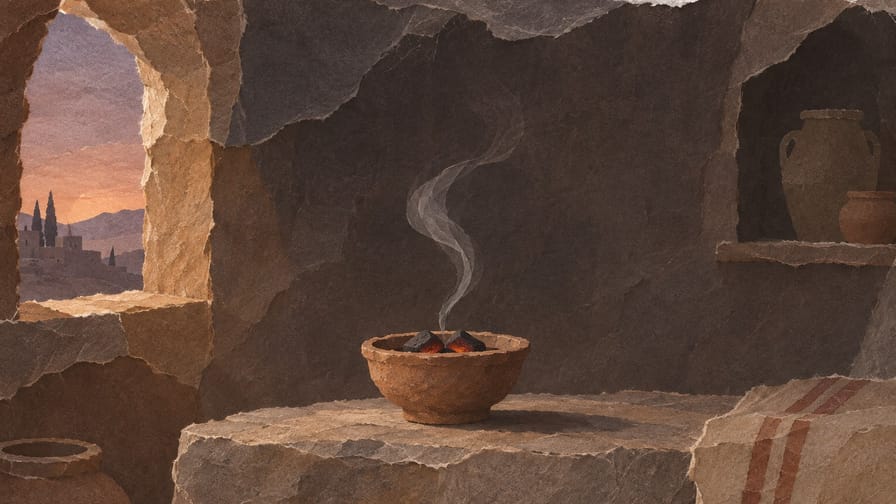
Smoke (Hebrew 'ashan) in the Bible can mark the presence of God: Mount Sinai was wrapped in smoke because the Lord descended on it in fire (Exodus 19:18), and the temple filled with smoke in Isaiah's vision (Isaiah 6:4). The smoke of incense rose before the Lord in worship, and in Revelation 8:4 it goes up with the prayers of the saints.
Smoke is also a sign of judgment, like the smoke of Edom that goes up forever (Isaiah 34:10), and of how quickly the wicked vanish (Psalm 37:20).
1. Etymology and Roots of Smoke in the Old Testament
In the Old Testament, the manifestation of Smoke (smoke, vapor, cloud) is intrinsically linked to the revelation of God and His purposes. The main Hebrew words describing this phenomenon are ‘ashan (עָשָׁן), referring to smoke itself, ‘anan (עָנָן), for cloud, and qetoret (קְטֹרֶת), for incense, which produces smoke.
The use of these words and their contexts reveals multiple facets of the theological meaning of Smoke. Smoke is associated with theophany, the visible manifestation of God. The most vivid example is found on Mount Sinai, where the presence of God is described with dense Smoke.
In Exodus 19:18, we read: “Now Mount Sinai was wrapped in smoke because the Lord had descended on it in fire, and the smoke of it went up like the smoke of a kiln, and the whole mountain trembled greatly.” Here, Smoke is a sign of God's unapproachable holiness, His tremendous power, and His majestic glory. It establishes a barrier between the holy God and the sinful people, emphasizing the need for reverence and awe.
Besides theophany, Smoke is also present in the context of sacrifices and worship. Incense, or qetoret, which produced aromatic Smoke, was an essential part of worship in the tabernacle and the temple. In Leviticus 16:13, the high priest was to burn incense before the Lord, and the cloud of Smoke would cover the mercy seat, serving as a protective covering so that he would not die in the presence of God.
This incense Smoke symbolized the prayers of the people ascending to God, as well as the need for purification and mediation to approach the Holy One. It was a constant reminder of God's holiness and human sinfulness, which required an intercessor and a means of atonement.
Another significant connotation of Smoke in the Old Testament is that of divine judgment and wrath. The prophet Isaiah, in his vision of the Lord in the temple, describes: “and the house was filled with smoke” (Isaiah 6:4), a sign of God’s overwhelming glory that brings both holiness and judgment upon ungodliness. The Smoke here is a foreshadowing of destruction for those who oppose the Lord.
The prophets frequently use the image of cities and nations being destroyed and their smoke rising to heaven as a sign of divine judgment. Isaiah 34:10 describes the desolation of Edom: “It shall not be quenched night or day its smoke shall go up forever. From generation to generation it shall lie waste none shall pass through it forever and ever.” This prophetic usage establishes a basis for New Testament eschatology, where Smoke continues to symbolize eternal judgment.
Finally, Smoke also serves as a metaphor for the transience and futility of human life or the wicked. In Psalm 37:20, the destruction of the wicked is compared to Smoke: “But the wicked will perish the enemies of the Lord are like the glory of the pastures they vanish—like smoke they vanish away.” This reminds us of the fragility of human existence without God and the certainty of punishment for those who reject His sovereignty.
The progressive development of revelation in the Old Testament shows Smoke as an element pointing to the majesty of God, the seriousness of sin, the need for mediated worship, and the inevitability of judgment. It prepares the ground for a more complete understanding of these realities in the superior covenant, through Christ.
1.1 ‘ashan and the Presence of God
The Hebrew term ‘ashan (עָשָׁן) is crucial for understanding the manifestation of God's glory. On Sinai, Smoke was not merely an ordinary cloud, but a visible expression of the presence of Yahweh, accompanied by thunder, lightning, and the sound of a trumpet, instilling awe and reverence in the people of Israel.
This theophany of Smoke and fire served to communicate God's unapproachability in His holiness, reinforcing the distinction between the Creator and the creature. No one could touch the mountain without dying, emphasizing that communion with God would only be possible through a mediator and a path of purification, foreshadowing the work of Christ.
1.2 qetoret and Mediated Worship
The smoke of incense (qetoret, קְטֹרֶת) in Levitical worship is a significant prophetic type. It symbolized the prayers and praise of the people ascending to God, but also the need for an atoning covering. Without the Smoke of the incense covering the mercy seat, the life of the high priest would be at risk, as in Leviticus 16:13.
This illustrates that, even in worship, sinful man cannot approach a holy God without a divinely instituted means. The Smoke of the incense, therefore, points to intercession and atonement, which find their fullness and perfection in the person and work of Jesus Christ, the perfect High Priest, who offers Himself as the definitive sacrifice.
2. Smoke in the New Testament and its Meaning
In the New Testament, the phenomenon of Smoke, whether as smoke or cloud, maintains and expands its theological meanings from the Old Testament, especially in relation to the person and work of Christ, and the consummation of the ages. The corresponding Greek words are primarily kapnos (καπνός) for smoke and nephelē (νεφέλη) for cloud.
Smoke, or more frequently the cloud, continues to be a symbol of divine presence and the glory of God. In the event of Jesus' Transfiguration, a bright cloud (nephelē) overshadowed them, and a voice from heaven declared: “This is my beloved Son, with whom I am well pleased listen to him” (Matthew 17:5). This cloud, similar to the cloud of Sinai and the Shekinah glory of the Old Testament, is a manifestation of the presence of God the Father, validating the divinity and authority of Jesus Christ.
The cloud also marks the point of transition between Jesus' earthly presence and His heavenly glory at the Ascension. In Acts 1:9, we read that, as the disciples watched, Jesus was lifted up, “and a cloud received him out of their sight.” Here, the cloud not only symbolizes the departure to the glory of God, but also foreshadows His return, for the angels declare that “this Jesus, who was taken up from you into heaven, will come in the same way as you saw him go into heaven” (Acts 1:11), often associated with coming on the clouds (Revelation 1:7).
Johannine literature, particularly the book of Revelation, makes extensive use of Smoke to symbolize divine judgment and the prayers of the saints. In Revelation 8:4, the smoke of the incense, which represents the prayers of the saints, ascends before God: “And the smoke of the incense, with the prayers of the saints, rose before God from the hand of the angel.” This image echoes the incense of the Old Testament, showing the continuity of the efficacy of believers' prayers.
On the other hand, Smoke in Revelation is also an unequivocal sign of God's judgment and wrath. In Revelation 9:2-3, the opening of the shaft of the bottomless pit releases smoke: “He opened the shaft of the bottomless pit, and from the shaft rose smoke like the smoke of a great furnace, and the sun and the air were darkened with the smoke from the shaft. Then from the smoke came locusts on the earth...” This Smoke is a harbinger of torment and destruction, a manifestation of divine justice upon a rebellious world.
The smoke of the destruction of Babylon, the great harlot, is described in Revelation 18:9 and 19:3, where its smoke rises forever and ever, an echo of the Old Testament prophecies of judgment. This demonstrates the continuity of the symbolism of Smoke as a visible sign of God's wrath against sin and ungodliness. The specific relation to the person and work of Christ is seen in the fact that He is the final judge (John 5:22-23) and the one who redeems from the judgment represented by Smoke.
In summary, Smoke in the New Testament maintains its association with the glory of God, the manifestation of His presence, and divine judgment, but now all of this is intrinsically linked to the person and work of Jesus Christ. He is the supreme mediator who allows approach to God, the object of divine glory in the Transfiguration, the one who ascends to glory in a cloud, and the judge who will come on the clouds to consummate history.
2.1 kapnos and Eschatological Judgment
The Greek term kapnos (καπνός) is predominantly used in the book of Revelation to describe the smoke resulting from destruction and divine judgment. This smoke is not merely a byproduct of annihilation, but a visible and lasting symbol of God's wrath.
In Revelation 14:11, the smoke of the torment of those who worship the beast ascends “forever and ever”, indicating the eternal nature of punishment. This image serves as a solemn warning about the consequences of rebellion against God and the rejection of Christ as Lord and Savior, reinforcing the seriousness of biblical eschatology.
2.2 nephelē and the Glory of Christ
The nephelē (νεφέλη), or cloud, in the New Testament, is consistently associated with the glory of God and, specifically, with the glory of Christ. In the Transfiguration, the cloud is the veil of divine glory that validates Jesus' divinity and the authority of His Word, as in Matthew 17:5.
The ascension of Christ in a cloud (Acts 1:9) is not a mere disappearance, but a triumphant return to the glory from which He came. Likewise, His second coming “with the clouds” (Revelation 1:7) will be a public and glorious manifestation of His sovereignty and power as King and Judge, fulfilling the Old Testament prophecies about the Son of Man.
3. Smoke in Pauline Theology: The Basis of Salvation
Although the apostle Paul does not use the term Smoke (smoke or cloud) as a central theological concept in his doctrines of salvation, we can discern the relevance of the symbols associated with Smoke in his soteriological theology, especially by contrast and implication. Pauline theology intensely focuses on the redemptive work of Christ and justification by faith, and Smoke can serve as a metaphor for that from which we are saved, or for aspects of life before redemption.
One of the recurring themes in Pauline theology is the contrast between the glory of God manifested in Christ and the futility and transience of human existence without Him. Smoke, in its ephemeral and dispersive nature, can symbolize the vanity of human works and self-righteousness, which Paul categorizes as "loss" and "rubbish" in comparison to the knowledge of Christ (Philippians 3:7-8). The smoke of the works of the Law, without faith, does not lead to salvation.
Paul vehemently argues in Romans 3:20 that “no one will be justified in his sight by works of the law.” Human attempts to attain righteousness are like Smoke – transient, without substance, and unable to stand before the holiness of God. Salvation, on the contrary, is an eternal and immutable act of God, founded on grace and received by faith (Ephesians 2:8-9).
Another point of connection can be found in the association of Smoke with divine judgment. Paul emphasizes that “the wrath of God is revealed from heaven against all ungodliness and unrighteousness of men” (Romans 1:18). The Smoke of judgment and fire, as seen in the Old Testament and Revelation, represents this wrath. Christ's work on the cross, however, offers deliverance from this coming wrath. “Much more then, having now been justified by his blood, we shall be saved by him from the wrath” (Romans 5:9).
Thus, the Smoke of judgment awaiting the wicked is what Christ, through His sacrificial death, liberates us from. Justification by faith in Christ removes us from the sphere of condemnation and introduces us into the sphere of grace. The cross of Christ is the point where God's wrath is satisfied, and the sinner is redeemed from the destiny symbolized by the burning Smoke of condemnation.
Furthermore, the cloud (nephelē), which in the Old Testament and the Gospels symbolizes the presence of God, can be seen in Paul as the environment of the new covenant. In 1 Corinthians 10:1-2, Paul refers to the Israelites who “were baptized into Moses in the cloud and in the sea.” Although this is a historical reference, the Pauline context of warning against idolatry and grumbling underscores the seriousness of God's presence and the need for a faithful response, which is now found in Christ.
Pauline theology, focused on sola gratia and sola fide, reminds us that salvation does not depend on rituals or human efforts that can be as ephemeral as Smoke, but on the perfect and complete work of Christ. Justification is a forensic act of God that declares the sinner righteous based on the imputed righteousness of Christ, a solid and eternal reality, in contrast to the smoke of self-righteousness.
In sanctification, the believer is called to live a life that glorifies God, not conforming to this world, but being transformed by the renewal of the mind (Romans 12:1-2). This life, guided by the Holy Spirit, is a substantial reality, in contrast to the smoke of carnal and worldly passions that are transient and of no eternal value.
3.1 The Contrast Between the Futility of Man and the Work of Christ
Paul frequently contrasts the glory of God with the weakness and futility of fallen humanity. Smoke, with its fleeting nature and its inability to sustain itself, can metaphorically represent the ineffectiveness of human attempts to attain righteousness by their own merits.
Justification by faith in Christ (Romans 3:28) is the only solid basis for salvation, in opposition to any "smoke" of self-righteousness or works of the law that vanish before the divine standard. Scripture's teaching on total depravity and irresistible grace reinforces that salvation is entirely the work of God, not of man.
3.2 Deliverance from the Smoke of Judgment by the Cross
Paul's central message is that Christ died for our sins (1 Corinthians 15:3), offering Himself as propitiation for the wrath of God. The Smoke that symbolizes divine judgment, condemnation, and eternal torment, is the destiny from which we are rescued by Christ's atoning work on the cross.
The doctrine of penal substitution emphasizes that Christ bore the totality of God's wrath in our place, saving us from the "fire and smoke" of hell. This salvation is a gift of God's grace, received by faith, and is the basis of the believer's eternal security (John 10:28-29), in contrast to the uncertainty and ephemerality of life without Christ.
4. Aspects and Types of Smoke
The analysis of Smoke in the Scriptures reveals that it has different manifestations and facets, each with its own theological nuance. It is not a monolithic concept, but a dynamic symbol that acquires meaning according to its context. We can distinguish at least four main aspects of biblical Smoke.
The first is the Smoke of divine presence and glory. This is the Smoke that envelops Mount Sinai (Exodus 19:18), fills the temple in Isaiah's vision (Isaiah 6:4). It symbolizes God's unapproachable holiness, His majesty, and the mystery of His essence. It is a Smoke that inspires reverent awe and recognition of divine sovereignty. The bright cloud at the Transfiguration is a related image of divine presence, but Matthew 17:5 does not call it smoke.
The second is the Smoke of divine judgment and wrath. This aspect is prominent in the Old Testament prophecies about the destruction of nations and in the book of Revelation, where the Smoke of Babylon's destruction ascends forever (Revelation 19:3). It serves as a vivid reminder of God's justice against sin and the inevitability of His retribution. This Smoke is a symbol of eternal punishment for the wicked.
The third aspect is the Smoke of sacrifice and intercessory worship. This is the Smoke of incense in the tabernacle and the temple (Leviticus 16:13), which also appears in Revelation as the prayers of the saints ascending to God (Revelation 8:4). It represents God's acceptance of mediated worship and the efficacy of believers' prayers, underscoring the importance of intercession and dependence on God.
The fourth aspect is the Smoke of transience and futility. This Smoke is a metaphor for the brevity of human life, the fragility of works without God, and the vanity of earthly things. The wicked vanish into Smoke (Psalm 37:20), and life is like a vapor that soon disappears (James 4:14, although it does not explicitly use "smoke," the concept of vapor is analogous). This serves as a reminder of our mortality and the need to seek what is eternal in Christ.
These aspects of Smoke relate to the sovereignty of God, human depravity, the redemptive work of Christ, and eschatological consummation. Theologians like John Calvin and Martin Luther would emphasize the glory of God (soli Deo gloria) in all His manifestations, including the theophanies of Smoke and the seriousness of divine judgment.
It is vital to avoid doctrinal errors, such as attributing mystical or sacramental power to Smoke itself, or a literalist interpretation of every occurrence of Smoke as having the same meaning. Smoke is not an object of worship or a means of grace it is a symbol that points to greater spiritual realities. Scripture reminds us that God's grace is the sole source of salvation, not any observance or physical element.
4.1 Smoke as a Symbol of God's Glory and Holiness
Smoke, especially in contexts of theophany, serves as a veil that simultaneously reveals and hides the glory of God. It shows the divine presence, but also safeguards the fullness of His holiness, which sinful man could not directly endure.
This aspect of Smoke teaches us about God's transcendence, His otherness, and the need for reverence in His presence. It reminds us that God is holy, holy, holy (Isaiah 6:3) and that approach to Him is only possible through the blood of Christ, who opened a new and living way (Hebrews 10:19-20).
4.2 Smoke as a Sign of Judgment and Condemnation
The Smoke that rises from destruction and torment is a potent symbol of God's retributive justice. It represents the final and eternal consequence of sin and rebellion against the Creator.
This aspect of Smoke should generate a profound sense of evangelistic urgency and a recognition of the seriousness of sin. As Spurgeon frequently preached, the reality of hell and divine judgment should compel believers to share the gospel that offers escape from this condemnation (Matthew 25:46).
5. Smoke and the Practical Life of the Believer
The understanding of the multiple meanings of Smoke in the Scriptures, although symbolic, has profound implications for the practical life of the believer, shaping their piety, worship, service, and personal responsibility. As believers, we are called to live our entire lives coram Deo (before the face of God), and biblical symbols help us grasp this reality.
Firstly, Smoke as a symbol of God's presence and glory (as on Sinai) should instill in the believer a deep sense of reverence and awe. This translates into a life of holiness and obedience, recognizing that we are always in the presence of a holy God. The believer is called to worship God “with reverence and awe” (Hebrews 12:28), aware of His majesty and power.
The awareness of Smoke as a sign of divine judgment should lead the believer to a renewed seriousness regarding sin and their evangelistic mission. If the Smoke of judgment awaits the unrepentant, then the believer, saved by grace, has the responsibility to proclaim the good news of Christ, who delivers from the wrath to come (Romans 10:14-15). This implies living a life that reflects repentance and faith, being a living testimony of salvation.
The Smoke of incense, representing the prayers of the saints, emphasizes the centrality of prayer in the Christian life. The believer is called to pray without ceasing (1 Thessalonians 5:17), presenting their supplications, thanksgivings, and intercessions to God. Prayers are a "sacrifice of praise" (Hebrews 13:15), ascending to God as a pleasing aroma, and they play an active role in the divine plan, as seen in Revelation.
The metaphor of Smoke as the transience of life should shape how the believer weighs earthly priorities. If life is like a vapor (James 4:14), then the believer should seek things above, where Christ is (Colossians 3:1-2), and not accumulate treasures on earth. This implies a detachment from material possessions and a focus on eternal values, living with an awareness of brevity and eternity.
For the contemporary church, the symbolism of Smoke serves as a reminder that our worship must be holy and reverent, recognizing the majesty of God. We must move away from frivolous or anthropocentric approaches to worship, returning to the theocentrism that the Bible demands. Preaching should address both the glory of God and the seriousness of judgment, and the church should be a body of fervent prayer.
Pastoral exhortations based on Smoke include: cultivating a holy fear before God, who is a consuming fire (Hebrews 12:29) living in continuous repentance, aware of the seriousness of sin and the grace that delivers us from the Smoke of condemnation and praying with faith and persistence, knowing that our prayers ascend like incense before the throne of God. Dr. Martyn Lloyd-Jones frequently exhorted his listeners to profound reverence and a life of prayer, echoing these principles.
Ultimately, Smoke in the Scriptures is a visual and symbolic reminder of the great truths of the Christian faith: the sovereignty and holiness of God, the sinfulness of man, salvation by grace through faith in Christ, the power of prayer, and the certainty of final judgment. The balance between doctrine and practice is essential: the truth about Smoke must inform our theology and transform our lives, leading us to deeper worship and more zealous service to the Lord.
5.1 Reverence and Holiness in the Christian Life
The presence of Smoke as a sign of divine glory, especially in the Old Testament, should lead us to profound reverence. This means living a life that honors God in all areas, pursuing holiness as a reflection of who He is (1 Peter 1:15-16).
Reverence is not paralyzing fear, but a holy awe that recognizes God's greatness and compels us to loving obedience. It is the foundation of genuine piety and worship that pleases the Lord, which does not seek to entertain, but to exalt God.
5.2 Intercession and Dependence in Prayer
The image of the Smoke of incense rising with the prayers of the saints (Revelation 8:4) is a powerful encouragement to a life of prayer. It reminds us that our prayers are heard and valued by God, and that they have a real impact on the world and on the divine plan.
Prayer is an act of dependence on God, a recognition that we are incapable by ourselves. As Calvin taught, prayer is the means by which believers express their faith and receive God's blessings, cultivating a vital communion with the Father through Christ.