


Philemon
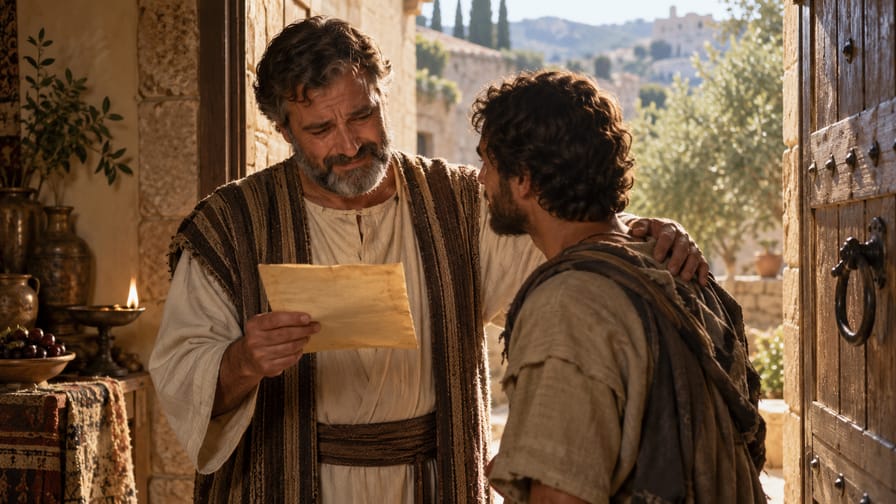
The figure of Philemon, although not a protagonist in grand biblical narratives, is central to one of the New Testament's most concise and theologically rich Pauline epistles. His story and character are revealed through the letter that bears his name, offering profound insights into Christian ethics, grace, and social transformation in the early church.
This study aims to explore the life and legacy of Philemon from an evangelical Protestant perspective, emphasizing the authority of Scripture, historical accuracy, and the theological relevance of his story for understanding the Christian faith. The Epistle to Philemon is a microcosm of the Gospel's application in situations of interpersonal conflict and complex social structures.
1. Etymology and meaning of the name
1.1 Origin and literal meaning
The name Philemon derives from the ancient Greek Φιλήμων (Philemon), which has its roots in the verb phileō (φιλέω), meaning "to love," "to like," "to have affection for." Consequently, the name Philemon can be translated as "amiable," "one who loves," "friendly," or "affectionate."
This etymology is particularly significant in the context of the epistle, as Philemon is described by Paul as someone of great love and faith, attributes he is challenged to demonstrate prominently in relation to Onesimus. The very nature of the name foreshadows the expected character of the letter's recipient.
1.2 Variations and biblical use
There are no other occurrences of the name Philemon in the biblical canon, making him a unique character in onomastic terms within the Scriptures. This confers a singularity to his identification, indissociably associating him with the Pauline epistle.
The transliteration from Greek to Portuguese maintains the phonetic essence, reinforcing the connection to the original meaning. The name Philemon, therefore, is not merely a label but an indicator of an intrinsic quality that Paul recognized and appealed to in his friend and fellow worker.
1.3 Theological significance of the name
The meaning of the name Philemon ("amiable," "one who loves") deeply resonates with the central theme of the letter: Christian love (agapē) put into practice through forgiveness and reconciliation. Paul not only praises Philemon for his love and faith (*Philemon 1:5*) but also exhorts him to extend that love radically to Onesimus.
The choice or divine providence that the recipient of this emblematic letter of reconciliation bore a name so suggestive of love and friendship does not go unnoticed. It is a subtle but powerful reminder of the essence of the Gospel in action, transforming hearts and relationships.
2. Historical context and biblical narrative
2.1 Period and setting
The Epistle to Philemon was written around 60-62 A.D., during Paul's first imprisonment in Rome (cf. *Acts 28:16-31*). It is one of the "Prison Epistles," along with Ephesians, Philippians, and Colossians, all sent during the same period.
The most probable geographical context for Philemon and his church is Colossae, a city in the Roman province of Asia Minor (present-day Turkey). This is inferred by the mention of Onesimus, who was from Colossae (*Colossians 4:9*), and Archippus, who is also cited in the epistle to the Colossians (*Colossians 4:17*) and in *Philemon 1:2*.
Colossae was a city of lesser importance at the time, overshadowed by its neighbors Laodicea and Hierapolis. However, it had a vibrant Christian community, likely founded indirectly through the ministry of Epaphras, who worked under Paul's supervision (*Colossians 1:7 4:12-13*).
2.2 Relationships with other biblical characters
Philemon is primarily presented as a "beloved and fellow worker" of Paul (*Philemon 1:1*), indicating a relationship of deep friendship and partnership in the Gospel. Paul greets him with affection, suggesting a significant personal and spiritual bond.
He was the master of Onesimus, a slave who had run away from his household and somehow found Paul in Rome. There, Onesimus converted to Christ and became a spiritual "son" and "fellow worker" of Paul (*Philemon 1:10-13*). The epistle is Paul's request for Philemon to receive Onesimus back.
Other important characters in the narrative are Apphia, referred to as "our beloved sister" (*Philemon 1:2*) and likely Philemon's wife, and Archippus, "our fellow soldier" (*Philemon 1:2*), possibly Philemon's son and a leader in the church at Colossae (cf. *Colossians 4:17*). The church that met in Philemon's house is also mentioned (*Philemon 1:2*).
2.3 The narrative of the letter to Philemon
The Epistle to Philemon is a personal plea from Paul. Onesimus, Philemon's slave, had run away and likely stolen from his master, a serious offense that could result in severe punishment, even death. However, Onesimus found Paul in prison and was evangelized, becoming a Christian.
Paul, acting as an intercessor, writes to Philemon not with an apostolic command, but with an appeal based on Christian love and the new reality in Christ. He asks Philemon to receive Onesimus back, no longer as a slave, but as a "beloved brother" (*Philemon 1:16*).
The letter reveals Paul's sensitivity and wisdom. He offers to pay any debt Onesimus might owe Philemon (*Philemon 1:18-19*), highlighting the principle of substitution and grace. The appeal is for Philemon to demonstrate the love of Christ in practice, by forgiving and restoring Onesimus.
3. Character and role in the biblical narrative
3.1 Virtues and spiritual qualities
Philemon's character is praised by Paul at the very beginning of the letter. He is described as a "beloved and fellow worker" (*Philemon 1:1*), which indicates not only a personal relationship with Paul but also an active commitment to the Gospel ministry.
Paul testifies to "your faith in the Lord Jesus and your love toward all the saints" and Philemon's "love" (*Philemon 1:5*). These are the two cardinal virtues of Christian life, demonstrating that Philemon was a mature and exemplary believer, known for his piety and his service to the community.
Philemon's generosity and hospitality are also evident. His house was a meeting place for the church (*Philemon 1:2*), and Paul mentions that his love had "refreshed the hearts of the saints" (*Philemon 1:7*), indicating that he was a source of encouragement and provision for other believers.
3.2 The challenge of reconciliation
Philemon's role in the narrative is that of a Christian master confronted with the opportunity to live out the principles of the Gospel in a socially complex situation. He is challenged to transcend the cultural norms of Roman slavery and embrace Onesimus as a brother in Christ.
Philemon's decision to forgive and restore Onesimus was not merely a personal matter but would have significant implications for the Christian community in Colossae, serving as a powerful testimony to the transformative power of the Gospel.
Although Philemon's response is not recorded in Scripture, Paul's confidence that Philemon would "do even more than I ask" (*Philemon 1:21*) suggests that he was a man of integrity and obedience, inclined to act according to God's will.
3.3 Role in the early church
Philemon represents the influential lay believer who, though not an apostle or prophet, played a crucial role in sustaining and advancing the early church. His home served as a center for worship and fellowship, a model for the house churches of the time.
His testimony of faith, love, and service was vital to the Christian community. He was a pillar of support for Paul's apostolic ministry, demonstrating that God's work is accomplished through a network of faithful collaborators in various spheres of life.
4. Theological significance and typology
4.1 The Gospel in action: grace and forgiveness
The letter to Philemon is a powerful illustration of the Gospel of Christ applied to daily life. It demonstrates how God's grace transforms sinners and empowers them to live in love and forgiveness. Paul's request for Philemon to forgive Onesimus reflects the forgiveness that God offers to all who believe.
Paul's attitude toward Onesimus, receiving him as a son and interceding for him, typifies the work of Christ as Mediator and Advocate. Christ receives us in our condition as "slaves" to sin and intercedes for us with the Father, paying our debt.
This epistle teaches that Christian forgiveness is not merely forgetting an offense, but restoring the relationship, transforming an enemy or a runaway servant into a beloved brother. It is a forgiveness that seeks reconciliation and full restoration, reflecting the nature of God.
4.2 Reconciliation and the new creation in Christ
The narrative of Philemon and Onesimus is a practical example of the doctrine of reconciliation, a central theme in Pauline theology (cf. *2 Corinthians 5:18-20*). Through Christ, enmities are undone and relationships are restored, both with God and with one another.
Onesimus' transformation, from a slave useless to Philemon into a "beloved brother" and "useful" (*Philemon 1:11*), illustrates the reality of the new creation in Christ (cf. *2 Corinthians 5:17*). In Christ, old social distinctions and divisions are overcome, and all become one.
Paul challenges Philemon to see Onesimus not through the lenses of Roman law or social hierarchy, but through the lens of the Gospel, where both are brothers in Christ, equally redeemed and loved by God. This is the core of Kingdom ethics.
4.3 Theological implications for slavery
Although the letter to Philemon does not explicitly command the abolition of slavery, it fundamentally undermines the theological and ethical foundations of that institution. By demanding that a master receive his runaway slave as a "beloved brother" in Christ, Paul elevates the slave's status and redefines the master-servant relationship.
The epistle teaches that in Christ "there is neither slave nor free" (*Galatians 3:28*), a radical declaration that, over time, contributed to the eventual eradication of slavery in societies influenced by Christianity. Human dignity and spiritual equality are emphasized.
Paul's attitude, offering to pay Onesimus' debt, is a powerful type of Christ's work, who paid the debt of our sin. This substitution and the grace demonstrated are the foundation for all Christian relationships, including those that transcend social structures.
5. Biblical-theological legacy and canonical references
5.1 Contribution to the canon and biblical theology
The Epistle to Philemon, despite its brevity, is an essential part of the New Testament canon. It offers a unique window into the practical application of Pauline theology in a personal and social context, demonstrating the Gospel's relevance to all areas of life.
Its inclusion in the canon attests to its divine inspiration and the importance of its truths for the church of all ages. It complements the doctrinal epistles, showing how the great themes of grace, forgiveness, and reconciliation are manifested in the lives of ordinary believers.
It is a testament to Paul's apostolic authority and his pastoral concern not only with major doctrinal issues but also with the interpersonal and ethical challenges faced by believers. The letter establishes a model for conflict resolution within the community of faith.
5.2 Influence on Reformed and Evangelical Theology
In Reformed and evangelical theology, the Epistle to Philemon is often cited as a prime example of the application of Christian faith to social and ethical issues. It is seen as a powerful argument for individual and social transformation through the Gospel.
Commentators such as John Calvin highlighted Paul's wisdom and sensitivity, as well as the profound Christian ethics that the letter instills. For Martin Luther, the Epistle to Philemon illustrates "the goodness of Christ" and how Christians should "serve one another."
The emphasis on substitution (Paul paying Onesimus' debt) is seen as a clear typology of Christ's work on the cross, where He paid the debt of our sins. This resonates with the doctrine of justification by faith and propitiation.
5.3 Contemporary relevance
The legacy of Philemon and the epistle that bears his name continues to be profoundly relevant for the contemporary church. It challenges us to live the Gospel authentically in all our relationships, overcoming prejudices and divisions.
The letter is a call to reconciliation in a fragmented world, teaching the importance of forgiveness, grace, and restoration. It reminds us that Christian faith is not merely theoretical, but must be lived out in practice, transforming the way we interact with others, especially those who have offended us.
Philemon, as an ordinary believer who opened his home to the church and was challenged to a great demonstration of love and forgiveness, serves as a model for every Christian who seeks to live a godly life and impact their social context with the values of the Kingdom of God. His story is an eternal testimony to the transformative power of Christ's love.