


What does the Bible say about fasting?
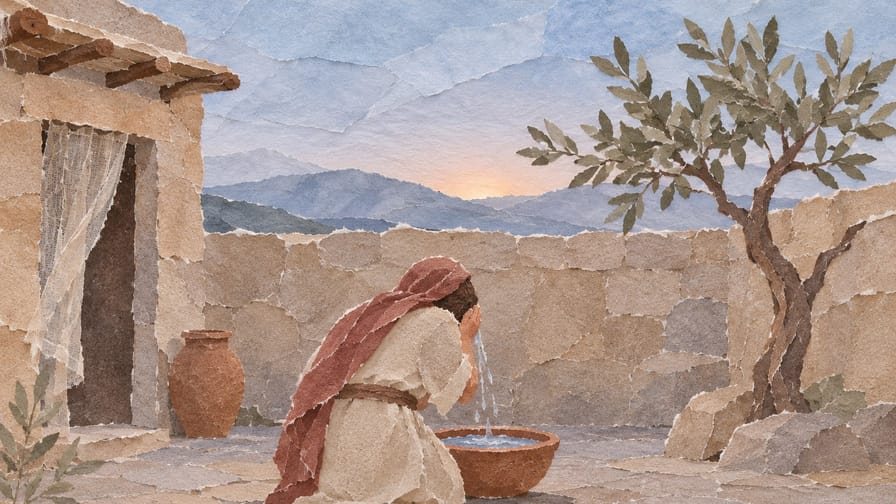
The Bible presents fasting as a practice, voluntary in the New Testament, of going without food for a time in order to seek God with humility and dependence. It is not a calendar law for Christians, it does not earn God’s favor, and it cannot force him to answer. Still, Jesus spoke of fasting as something his disciples would do: he says “when” you fast, not “if” (Matthew 6:16-18).
What is fasting in the Bible, and when does it appear?
Hebrew uses tsom (צוֹם) for the act of fasting, and the Greek of the New Testament uses nēsteia (νηστεία), which means going without food. The Law of Moses commands the people to “afflict” their souls on the Day of Atonement, once a year (Leviticus 16:29-31). Tradition, and texts such as Psalm 35:13 and Acts 27:9, understand that expression as fasting; Leviticus itself does not spell out what it involved. During the exile and after it, the people kept fasts in fixed months (Zechariah 7:5; 8:19), which tradition links to the fall of Jerusalem, but the Law never commanded them.
Beyond that, fasting shows up as a response to concrete situations:
- repentance and returning to God (Joel 2:12-13; Jonah 3:5-10);
- mourning (1 Samuel 31:13);
- asking for protection and direction (Ezra 8:21-23; Esther 4:16);
- pleading for someone in danger, as David did for his sick son (2 Samuel 12:16);
- setting people apart for a mission (Acts 13:2-3; 14:23).
Moses (Exodus 34:28) and Jesus (Matthew 4:1-2) went forty days without food. These are singular accounts of people sustained by God for a unique mission, not goals for the ordinary believer.
Does fasting make God act? What Isaiah 58 corrects
In Isaiah 58:3 the people complain that they fast and God does not seem to notice. The answer is stark: on the day of their fast they pursued their own pleasure, exploited their workers, and quarreled (Isaiah 58:3-4). The fast God wants includes loosing the chains of injustice, freeing the oppressed, sharing bread with the hungry, and taking in the homeless poor (Isaiah 58:6-7). Zechariah 7:5-6 points the same way: God asks whether, when they fasted, they were really fasting for him.
This overturns the idea that fasting is a currency: I pay with hunger, and God owes me healing, money, a job, or an answer. Fasting is not a bargaining chip. David fasted and prayed for his sick child, and the child died; then he got up, worshiped the Lord, and ate again (2 Samuel 12:15-23). Before that, his hope came in the form of a question: “who knows” whether the Lord would be gracious (2 Samuel 12:22). The same language appears with the Ninevites (Jonah 3:9) and with Joel (Joel 2:14). It is the vocabulary of petition, not of guarantee.
The promises that follow in Isaiah 58:8-9, of light, healing, and an answer, describe how God relates to a people who practice justice and mercy. The text does not present them as the automatic result of a ritual. Nor is fasting a measure of spirituality: no one is saved, accepted, or made a better Christian by fasting, because salvation is by grace, through faith in Christ, not by works (Ephesians 2:8-9). The kingdom of God, Paul writes, is not a matter of eating and drinking but of righteousness, peace, and joy in the Holy Spirit (Romans 14:17).
How Jesus taught his disciples to fast
In Matthew 6:16-18 Jesus corrects fasting done to be seen. The hypocrites put on gloomy faces so everyone would notice, and so they had already received the reward they wanted. The disciple, by contrast, anoints his head and washes his face so that no one can tell, and the Father, who sees in secret, rewards. The text does not say what that reward is, nor does it turn it into a contract of results. What matters is before whom you fast: the Father, not an audience. Luke 18:9-14 reinforces the point. The Pharisee lists that he fasts twice a week, and the man who goes home justified is the tax collector who simply asks for mercy.
In Matthew 9:14-15 John’s disciples ask why Jesus’ disciples do not fast. He answers with the image of the bridegroom: wedding guests do not mourn while the bridegroom is with them, but days will come when the bridegroom is taken away, and then they will fast. The most common reading is that, after the ascension, Christian fasting expresses longing for the Lord and expectation of his return. His answer also shows that fasting is not a routine for its own sake: it grows out of a relationship with Christ and the moment you are living in.
What the early church did, and what the Bible does not command
Acts 13:1-3 shows the prophets and teachers of the church at Antioch worshiping and fasting when the Holy Spirit asked them to set apart Barnabas and Saul. After fasting and praying, they laid hands on them and sent them off. Note the order: the prophets and teachers were already worshiping and fasting, and it was the Spirit who spoke. The text does not teach fasting as a technique for extracting a word from God. In Acts 14:23, Paul and Barnabas appoint elders in each church with prayer and fasting.
On the other hand, the New Testament does not impose fixed fasting days or a set length on the church. Practices such as Lent are traditions that many faithful believers observe with benefit and others do not adopt, and Romans 14 asks that no one despise or judge the other in these matters of freedom. Be careful, too, with Matthew 17:21 and Mark 9:29: the mention of fasting in those verses is missing from early manuscripts, and many Bibles place it in a footnote. Do not build on that phrase the idea that certain problems can only be solved by fasting.
How to fast wisely without harming your health
The purpose of fasting is to turn the heart toward God, not to punish the body. The body is God’s creation and the temple of the Holy Spirit (1 Corinthians 6:19-20), a text that is not about fasting but that we apply here: the body belongs to the Lord and deserves care. So Christian fasting calls for prudence. Seek medical advice before fasting from food if you:
- have diabetes, high blood pressure, heart or kidney problems, or another chronic illness;
- take daily medication (never stop any on your own);
- are pregnant or breastfeeding;
- are a child, a teenager, or a frail older adult;
- have or have ever had anorexia, bulimia, binge eating, or another eating disorder.
None of these conditions keeps you from seeking God. For anyone in these groups, the alternative is fasting from things other than food: screens, social media, entertainment, or shopping, using that time to pray, read the Word, and serve. Even a partial fast from food, like Daniel’s, who for three weeks went without choice food, meat, and wine (Daniel 10:2-3), also calls for medical advice first, because it is still a food restriction. Anyone with a history of an eating disorder should avoid any fast from food, partial ones included, and talk with a doctor or therapist and with their pastor: the Lord does not ask anyone to reopen a wound in order to be heard. Long fasts without water, like Esther’s in Esther 4:16, are accounts of emergency, not models.
The goal of fasting is the same as in Isaiah 58: a gentler heart, a more honest prayer, and hands more open to others.
Key Bible references
Isa 58:3-7 · Matt 6:16-18 · Matt 9:14-15 · Acts 13:2-3 · Joel 2:12-13 · Zech 7:5-6 · 2 Sam 12:15-23 · Lev 16:29-31