


What does the Bible say about debt?
The Bible does not teach that debt is a sin in itself, but it treats it as a serious weight: the borrower becomes subject to the lender (Proverbs 22:7). What Scripture condemns is failing to repay what you owe (Psalm 37:21) and profiting from someone in distress. Rather than banning lending, it governs it with honesty, prudence, and mercy.
Paying what you owe is the line Scripture draws
The most direct text is Psalm 37:21: the wicked “borrows but does not pay back,” while the righteous is generous and gives. Notice where the fault lies: not in borrowing, but in not repaying. Proverbs 3:27-28 points the same way, asking us not to put off what is due to someone when we are able to pay it now, and Psalm 15:4 describes the righteous as someone who keeps his word even when it costs him.
Scripture also speaks well of those who lend. Psalm 112:5 praises the man who deals generously and lends, Deuteronomy 15:7-8 tells Israel to open the hand to a needy brother and lend him what he lacks, and Jesus says in Luke 6:34-35 to lend without expecting anything in return. The inference is simple: if lending can be a kindness, receiving a loan is not sinful in itself.
Does Proverbs 22:7 forbid debt, or only warn about its weight?
“The rich rules over the poor, and the borrower is the slave of the lender.” This proverb observes how life works; it does not give the command “do not borrow.” The Hebrew word ʿebed (עֶבֶד), “servant” or “slave,” describes dependence: while the debt lasts, part of your freedom to decide sits in the creditor’s hands. The book also warns against putting up security for others. Proverbs 6:1-5 and Proverbs 22:26-27 treat pledging yourself for another person’s debt as a trap: Proverbs 22:27 shows the concrete risk, losing even your bed when there is nothing to pay with. The counsel to someone already caught as a guarantor (Proverbs 6:3-5) is to act quickly and humbly to get free.
Two forced readings show up here. The first turns the proverb into law and concludes that all debt is sin. The second swings the other way and promises that the faithful will never need to borrow. Deuteronomy 15:6 and Deuteronomy 28:12 speak of Israel lending to many nations without borrowing, but these are covenant blessings given to the nation, not a formula for believers today. Read further: Deuteronomy 15:11 admits that there will never cease to be poor in the land, and Deuteronomy 28:44 reverses the picture, with the people as the borrowers, as a warning. The widow in 2 Kings 4:1-7 shows the same thing: her husband feared the Lord, and still she was left with a debt that threatened to take her sons as slaves. The Bible tells us God rescued her there, but it does not promise that it will go that way with every debt.
Does Romans 13:8 say to owe nothing to anyone?
“Owe no one anything, except to love each other” is the verse most often cited for a total ban. Faithful Christians read it in two ways: some see an ideal of living without loans, others see a command to leave no obligation overdue. The context favors the second. One verse earlier Paul says, “Pay to all what is owed to them” (Romans 13:7), naming taxes, revenue, respect, and honor, with words from the same Greek family: opheilē (ὀφειλή), “what is due,” and opheilō (ὀφείλω), “to owe.” The subject is paying what is owed without leaving anything outstanding, and the sentence ends on the one debt that is never finished: loving your neighbor (Romans 13:8-10).
Anyone who prefers to read the verse as an ideal has Proverbs 22:7 on their side, and avoiding the weight of debt is a sensible choice. What cannot be sustained is turning that reading into an accusation against someone whose debt is honest and current.
The same family of words appears when the Bible calls sin a debt, and there it is an image, not a financial rule: in Matthew 6:12 Jesus teaches us to pray “forgive us our debts” (opheilēmata, ὀφειλήματα), and Luke 11:4 says “sins” in the same petition. In Colossians 2:13-14 Paul says God canceled the record of debt that stood against us, nailing it to the cross. That theme has its own place in the answer on what the Bible says about forgiveness, and here it is enough to note that the image is not a rule for collecting or paying a money debt.
What the Law and Nehemiah demand of the lender
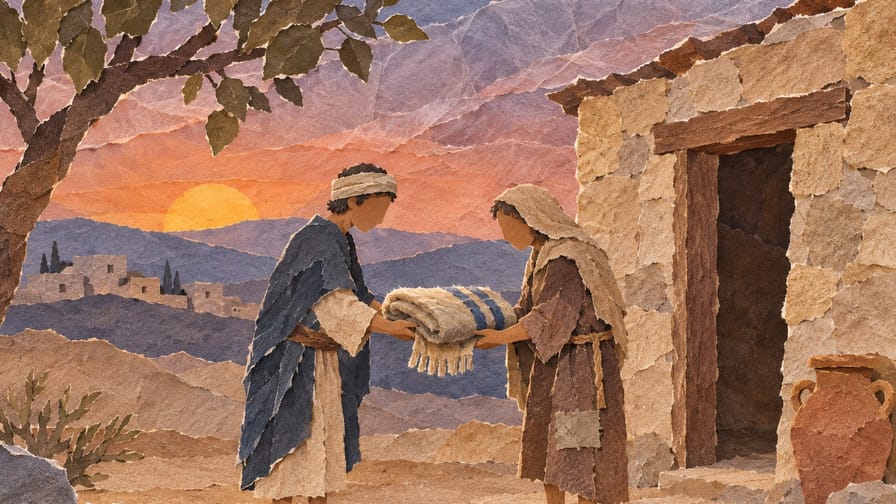
The Law of Moses does not forbid lending, but it protects the poor debtor. Exodus 22:25 and Leviticus 25:35-37 forbid charging interest to a brother who has fallen into poverty, and Deuteronomy 24:6 and Deuteronomy 24:10-13 limit the pledge: you may not take as security the millstone that is the household’s livelihood, the creditor may not enter the debtor’s house, and a cloak taken in pledge must be returned before nightfall. Deuteronomy 15:1-2 commands that every seven years the creditor release the debtor from what he had lent (the exact form of that release is debated). The picture in the Law is, above all, of lending as relief for someone in trouble.
Nehemiah 5 shows what happens when this is ignored. In the middle of famine and the king’s tax, families mortgaged fields and houses and gave up sons and daughters as slaves for debt, while the nobles charged interest to their own brothers. Nehemiah said that what they were doing was not good, called a great assembly, and demanded that they return the fields, vineyards, and houses, and the hundredth part they had charged, usually understood as the interest (Nehemiah 5:1-13). The sin there was not the debt, it was the exploitation of someone else’s distress.
How to apply this to interest today is a matter on which faithful Christians differ, and there is no way to draw from it a rule about modern rates or banking products. The principle, however, is clear: no one should profit from another person’s desperation.
What this changes for the borrower, the lender, and the person who is drowning
Scripture does not provide a financial plan. It does not say whether financing a home, studying on credit, or starting a business with a loan is right or wrong, or which debt to pay off first. It gives principles for the character of everyone involved:
- The borrower: pay what you promised (Psalm 37:21; Romans 13:7-8) and, if you cannot, do not hide: act quickly and humbly, go to the creditor and tell the truth (by analogy with the counsel of Proverbs 6:3-5 to a guarantor).
- The lender: do not exploit anyone’s hardship (Exodus 22:25) and be willing to lend generously (Luke 6:34-35).
- Anyone thinking of taking on a debt: weigh the price of your freedom (Proverbs 22:7) and do not take on another person’s debt without the means to cover it (Proverbs 22:26-27). Each case calls for wisdom and the counsel of mature believers, and no verse decides it for you.
- Anyone sinking in debt: debt is not proof of weak faith or a sure sign of punishment (2 Kings 4:1), and the Bible tells believers to carry one another’s burdens (Galatians 6:2). No prayer, fast, or offering replaces an honest conversation and a request for help. God can act, but Scripture does not promise that the debt will disappear.
In short, debt is not a sin in itself, but it calls for honesty, prudence, and mercy. The heart’s relationship with money is another subject, covered in the answer on money and the love of money.
Key Bible references
Prov 22:7 · Ps 37:21 · Rom 13:8 · Deut 15:6 · Neh 5:1-13 · Exod 22:25 · Luke 6:35