


What Are the Signs of the End Times?
The signs of the end times Jesus gave are false messiahs, wars and rumors of wars, famines, earthquakes, persecution of his disciples, multiplying lawlessness, and the gospel preached to all nations (Matthew 24:4-14), leading up to the coming of the Son of Man on the clouds (Matthew 24:30). He called the wars, famines, and earthquakes the beginning of birth pains (Matthew 24:6-8) and said no one knows the day or the hour (Matthew 24:36). The signs are given so that we stay watchful, not so that we can calculate dates.
Which signs did Jesus give in Matthew 24, Mark 13, and Luke 21?
All three Gospels preserve the same discourse, and Matthew and Mark place it on the Mount of Olives. The disciples had just heard that the temple would be torn down, and they asked when that would happen and what would signal Jesus’ coming and the end of the age (Matthew 24:1-3). His answer gathers signs of different kinds:
- Deceivers: many would come in his name, claiming to be the Christ and saying the time is near, and would mislead many (Matthew 24:4-5; Luke 21:8).
- Wars and rumors of wars, nation rising against nation (Matthew 24:6-7).
- Famines and earthquakes in various places; Luke adds pestilences and great signs from heaven (Matthew 24:7; Luke 21:11).
- Persecution, betrayal by those closest to them, and hatred because of Jesus’ name (Matthew 24:9-10; Mark 13:9-13).
- False prophets, lawlessness that multiplies, and the love of many growing cold (Matthew 24:11-12).
- The gospel of the kingdom proclaimed throughout the whole world as a testimony to all nations (Matthew 24:14).
- The abomination of desolation and the flight of those in Judea; in Luke, Jerusalem surrounded by armies (Matthew 24:15-21; Mark 13:14-20; Luke 21:20-24).
- Signs in the sun, moon, and stars and distress among the nations (Luke 21:25-26), and then the coming of the Son of Man (Matthew 24:29-30).
Notice what Jesus does with this list. About wars and rumors of wars, he tells the disciples not to be alarmed: these things must happen, but the end is not yet (Matthew 24:6; Mark 13:7). Then he calls this first group the beginning of birth pains (Matthew 24:8; Mark 13:8), in Greek ōdin. The picture describes a process that intensifies, and the first contractions do not reveal the hour of birth.
Why can’t the signs be used to set a date?
Because Jesus himself shut that door. Of that day and hour no one knows, not even the angels in heaven, nor the Son, but only the Father (Mark 13:32; Matthew 24:36). After the resurrection, when the disciples asked whether it was time to restore the kingdom to Israel, he answered that it was not for them to know the times or seasons the Father has fixed by his own authority, and he sent them to the mission instead (Acts 1:6-8). Jesus compares his return to the arrival of a thief, who gives no notice of the hour (Matthew 24:43-44; 1 Thessalonians 5:1-2).
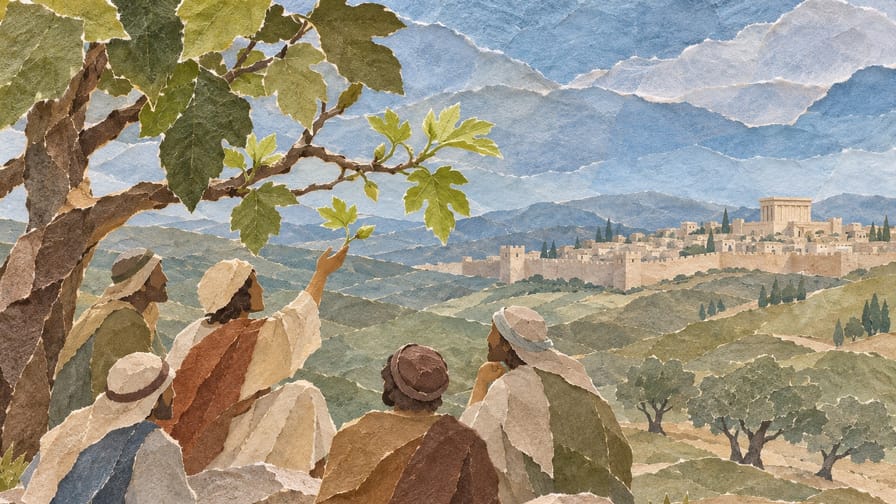
That does not make the signs useless. Jesus tells us to learn from the fig tree: when its branches sprout, you know summer is near, and in the same way, when you see these things, you should know that he is near, at the very gates (Matthew 24:32-33). But the fig tree announces the season, not the day. Anyone who sets a date, or presents a particular war, earthquake, or this week’s headline as proof that little time remains, goes beyond the text. Generation after generation has seen wars, famines, and earthquakes, and none of the dates announced so far has proved true.
What do 2 Timothy 3 and 2 Thessalonians 2 add?
Paul writes to Timothy that in the last days there will come times of difficulty (2 Timothy 3:1). But “last days” does not point only to a distant future. Peter said Pentecost fulfilled what Joel announced for the last days (Acts 2:16-17), Hebrews says God has spoken to us in these last days by his Son (Hebrews 1:2), and John wrote that it was the last hour (1 John 2:18). The New Testament already calls the time opened by Christ the last days. For that reason many see the signs of the end times recurring throughout history, while others expect them to intensify near his return.
The portrait in 2 Timothy 3:2-5 shows people who love themselves and money, who are proud, ungrateful, disobedient to parents, without self-control, and lovers of pleasure rather than lovers of God. The heaviest detail comes last: they hold the appearance of godliness but deny its power. That sign can live inside a hollow religion, so it is worth looking first at our own hearts. Paul’s instruction to Timothy, though, is to turn away from such people (2 Timothy 3:5).
In 2 Thessalonians 2 the problem is a false alarm. Some believers were shaken by messages that the day of the Lord had already come (2 Thessalonians 2:1-2). Paul answers that this day would not come unless the rebellion came first, in Greek apostasía, and the man of lawlessness was revealed (2 Thessalonians 2:3), and that the Lord Jesus will destroy him with the breath of his mouth and the appearance of his coming (2 Thessalonians 2:8). Who this man is, and what restrains him (2 Thessalonians 2:6-7), is a debated question that deserves its own answer. The text guarantees the essential: rebellion and deception will come, and Christ will have the last word.
What has already been fulfilled, and what is still ahead?
Faithful Christians differ here. In AD 70 the Romans destroyed Jerusalem and the temple, as Jesus had said (Matthew 24:1-2; Luke 21:20-24). Some interpreters see much of the discourse fulfilled in that event; others read nearly all of it as future; many see a layered fulfillment, with a first fulfillment in AD 70 that foreshadows the climax at Christ’s return.
The phrase “this generation” (Matthew 24:34; Mark 13:30; Luke 21:32) fuels the debate. Jesus said it would not pass away until all these things take place. Some take him to mean his own contemporaries, tying the text to AD 70; others, the generation that sees the signs begin; others understand the Greek word genea as “race” or “people,” something that endures until the end. Two verses later Jesus says that no one knows the day or the hour (Matthew 24:36).
The debates over the great tribulation, the rapture, and Armageddon have their own answers, and no particular scheme is needed to hold what Scripture states clearly:
- Jesus will return personally, visibly, and gloriously (Matthew 24:30; Acts 1:11).
- There will be a resurrection of the dead and a judgment (John 5:28-29; Matthew 25:31-32).
- No one knows the day or the hour (Matthew 24:36; Acts 1:7).
What lies between these points can be debated with humility; the certainty of Christ’s return does not depend on who wins the debate.
How should we live until the Lord returns?
Jesus closes the discourse with practical commands, not calculations:
- Stay watchful: the Lord comes on a day and hour we do not know (Matthew 24:42; 25:13), and Mark keeps the word spoken to everyone: watch (Mark 13:37).
- Be faithful in ordinary things: blessed is the servant whom the master finds doing his work when he arrives (Matthew 24:45-46).
- Do not be deceived or frightened: Jesus warned against those who claim to be the Christ and those who announce that the time is near (Matthew 24:4-5; Luke 21:8), and Paul asks the same in the face of messages that the day of the Lord has already come (2 Thessalonians 2:2).
- Persevere and bear witness: Jesus calls for endurance to the end (Matthew 24:13), and the gospel must be proclaimed (Matthew 24:14; Acts 1:8).
- Guard the heart: Luke 21:34 warns against hearts weighed down by dissipation, drunkenness, and the cares of life.
The Lord’s delay has a purpose too: he is patient, not wishing that any should perish but that all should reach repentance (2 Peter 3:9). For those who trust in Christ, the end times are not a reason for panic but for hope: when these things begin to take place, Jesus tells us to lift up our heads, because our redemption is drawing near (Luke 21:28). The Bible ends with the Lord promising to come soon and the church answering: “Come, Lord Jesus” (Revelation 22:20).
Key Bible references
Matt 24:3-14 · Mark 13:32-37 · Luke 21:25-28 · 2 Tim 3:1-5 · 2 Thess 2:1-12 · Acts 1:6-8 · 2 Pet 3:8-11 · 1 Thess 5:1-6