


帖撒罗尼迦前书
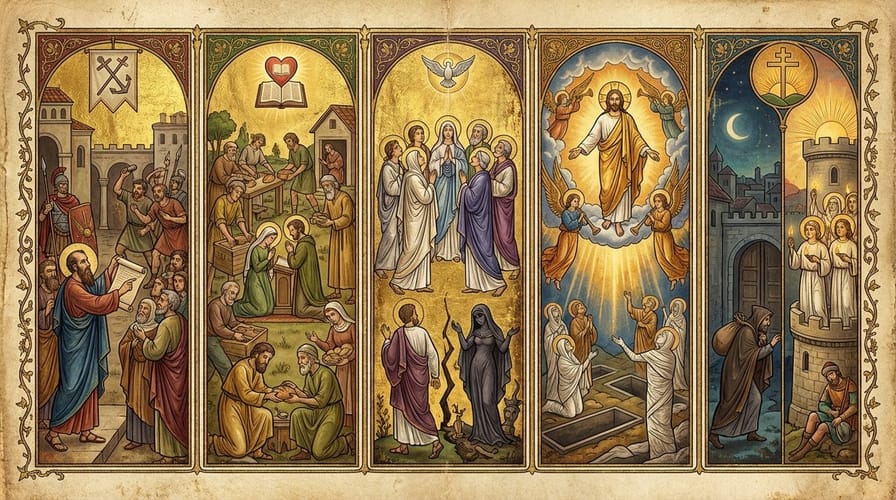
Illustration of the Book of 1 Thessalonians, one of the 27 books of the New Testament (Nano Banana Pro).
This introduction aims to unveil the depths and theological richness of the First Epistle to the Thessalonians, one of the oldest and most pastorally relevant jewels of the New Testament. Written by the Apostle Paul, this letter is not merely a historical document; it is a living proclamation of God's truth, a discipleship manual for a young and persecuted church, and a beacon of eschatological hope for believers of all ages. Our approach will be guided by a conservative evangelical Protestant perspective, which embraces the inerrancy, authority, and sufficiency of the Holy Scriptures.
Throughout this analysis, we will seek to balance academic rigor with pastoral sensitivity, defending the traditional positions of evangelical biblical scholarship against the assaults of modern higher criticism. We believe that 1 Thessalonians, like the entire Bible, is the inspired Word of God (2 Timothy 3:16), and therefore, its message transcends time and culture, offering eternal principles for Christian faith and practice. This introduction will serve as a structural model for the analysis of any biblical book, systematically addressing its context, structure, themes, canonical relevance, and hermeneutical challenges.
Our study of 1 Thessalonians will reveal the dynamics of Paul's apostolic ministry, the resilience of Christian faith amidst adversity, and the centrality of hope in the second coming of Christ. We will see how Paul, with the heart of a spiritual father, nurtures and corrects his children in the faith, offering an imperishable example of servant leadership and selfless love. May this journey through the epistle enrich our understanding of God's Word and strengthen our own walk of faith.
The Epistle to the Thessalonians stands out for its emphasis on eschatology, offering one of the earliest and clearest expositions on the coming of the Lord and the destiny of believers. Furthermore, it highlights the importance of sanctification and brotherly love as distinctive marks of authentic Christian life. These themes are not mere abstract concepts but practical imperatives for a community living under the expectation of their Savior's return and amidst a hostile world.
As we unfold the five sections of this introduction, we will seek to demonstrate the coherence and theological depth of 1 Thessalonians, connecting it to the grand narrative of redemption that culminates in Jesus Christ. A Christocentric perspective will be a guiding thread, showing how every aspect of the epistle points to the person and work of Christ, whom the Thessalonians were called to serve and await. May the study of this letter inspire a deeper faith and a firmer hope in the Lord who is coming.
The relevance of 1 Thessalonians extends far beyond its original context. Its messages about perseverance in faith, moral purity, mutual love, and the blessed hope of Christ's return are as vital for the church today as they were for first-century believers. In an increasingly secularized world that challenges Christian faith, Paul's epistle to the Thessalonians offers encouragement, exhortation, and the unwavering promise of God's faithfulness. This introduction is an invitation to explore the richness of this inspired letter and to apply its transformative truths in our lives.
1. Historical Context, Dating, and Authorship
First Thessalonians emerges from a vibrant and challenging setting of early Christianity, being one of the Apostle Paul's earliest letters and, consequently, one of the oldest documents in the New Testament. Its understanding requires a careful immersion in its historical background, authorship, and dating, elements that are fundamental for a robust hermeneutics faithful to the inspired author's intention.
1.1 Pauline Authorship and Irrefutable Evidence
The Pauline authorship of 1 Thessalonians is one of the best attested and least contested among the New Testament epistles. From the earliest days of the church, the consensus has been unanimous in attributing it to the Apostle Paul. The letter itself begins with the explicit identification of Paul, Silvanus (Silas), and Timothy as its senders (1 Thessalonians 1:1). Although Silvanus and Timothy are mentioned as co-signatories, the style, vocabulary, and theological content unequivocally point to Paul as the primary author and dictator of the letter.
The internal evidence is robust. Paul refers to himself in the first person singular at several crucial points in the letter (e.g., 1 Thessalonians 2:18, 3:5), defending his ministry and expressing his deep affection for the Thessalonians. The language is warm, personal, and pastoral, striking characteristics of Paul's style. Furthermore, the theology presented — with an emphasis on justification by faith, sanctification, eschatology, and Christian ethics — is consistently Pauline, aligning perfectly with the body of his other epistles.
External evidence amply corroborates Pauline authorship. The epistle is cited and alluded to by early Church Fathers like Irenaeus, Clement of Alexandria, and Tertullian. It is also present in Marcion's Canon (c. 140 A.D.) and the Muratorian Fragment (c. 170 A.D.), which represent some of the oldest lists of canonical New Testament books. The universal acceptance of 1 Thessalonians as genuinely Pauline in early Christianity is a powerful testimony to its authenticity.
Despite the strong consensus, some voices in modern higher criticism have historically raised objections to Pauline authorship, based on alleged differences in vocabulary or style compared to other epistles. However, such arguments are generally considered weak and insufficient to shake the traditional position. Variations in style can be easily explained by different contexts, purposes, and the urgent nature of the letter. The vast majority of New Testament scholars, including many with a critical inclination, continue to accept the authenticity of 1 Thessalonians as one of Paul's most genuine writings. For the evangelical interpreter, Pauline authorship is an unshakable foundation for understanding and applying the letter, reaffirming the divine inspiration and inerrancy of the text.
1.2 Dating and the Missionary Context
First Thessalonians is widely considered the earliest of Paul's epistles to have reached us, written around 50-51 A.D. This dating is crucial for situating the letter in the development of Pauline thought and the history of the early church. It was composed during Paul's second missionary journey, a period of intense evangelistic activity and church planting in the Aegean Sea region.
The background for the dating is found in the book of Acts of the Apostles. After founding the church in Philippi, Paul, Silas, and Timothy traveled to Thessalonica (Acts 17:1-9). There, Paul preached in the synagogue for three Sabbaths, and many Gentiles and some prominent women converted, forming the basis of the new church. However, Jewish opposition led to a riot, forcing Paul and Silas to flee to Berea, and then Paul left for Athens, leaving Silas and Timothy behind (Acts 17:10-15).
From Athens, Paul sent Timothy back to Thessalonica to strengthen and encourage the newly converted believers who were facing severe persecution (1 Thessalonians 3:1-5). Paul then moved to Corinth, where Timothy and Silas joined him, bringing encouraging news about the Thessalonians' faith and love, but also reporting some concerns, especially about their understanding of eschatology and moral conduct (Acts 18:5; 1 Thessalonians 3:6-10). It was in Corinth, after receiving Timothy's report, that Paul wrote 1 Thessalonians, likely during the first part of his eighteen-month stay in the city. The mention of proconsul Gallio in Corinth (Acts 18:12-17), whose term of office can be fixed between 51-52 A.D. by epigraphic evidence, helps to anchor Paul's dating in Corinth and, consequently, that of the epistle.
The urgency of the letter reflects Paul's concern for the young church, which was under intense pressure and suffering from theological misunderstandings. The epistle is, therefore, an immediate pastoral response to the needs and challenges of a newly formed Christian community in a hostile environment. Its early dating makes it an invaluable document for understanding Pauline theology in its initial stage and the life of the apostolic church.
1.3 The Setting of Thessalonica: Persecution and Resilient Faith
Thessalonica, known today as Thessaloniki, was a prominent port city and the capital of the Roman province of Macedonia. Founded in 315 B.C. by Cassander, one of Alexander the Great's generals, and named after his wife, Thessalonica, Alexander's half-sister, the city enjoyed a privileged status as a "free city" (*civitas libera*), with its own council and popular assembly. Its strategic location on the Via Egnatia, an important trade route connecting Rome to the East, ensured its economic prosperity and cultural diversity, with a population composed of Greeks, Romans, and Jews.
It was in this cosmopolitan environment that Paul, Silas, and Timothy arrived, establishing a small but vibrant Christian community. The account in Acts 17:1-9 describes a relatively short ministry, lasting only a few weeks, but extremely fruitful. Paul preached in the synagogue, resulting in the conversion of some Jews, many God-fearing Greeks, and a considerable number of prominent women. The church in Thessalonica, therefore, was predominantly Gentile, which is confirmed by the letter describing their conversion "from idols to serve the living and true God" (1 Thessalonians 1:9).
However, the success of the gospel generated envy among non-believing Jews, who incited the population, accusing Paul and his companions of subverting the Roman empire by proclaiming "another king, namely, Jesus" (Acts 17:7). This opposition resulted in intense persecution, forcing Paul to leave the city. The persecution, however, did not cease with Paul's departure; it continued to be a constant reality for the Thessalonian believers, as the letter itself attests (1 Thessalonians 1:6, 2:14, 3:3-4). Paul praises their faith and perseverance amidst this tribulation, which served as a testimony to the surrounding regions (1 Thessalonians 1:7-8).
The persecution was multifaceted: social, economic, and potentially physical. Adherence to Christianity meant breaking with pagan social and religious norms, including emperor worship and participation in idolatrous festivals, which could lead to ostracization and economic hardships. This context of resilient faith under the fire of persecution is vital for understanding Paul's exhortations to perseverance, holiness, and eschatological hope. The letter is not just a theological guide but a pastoral balm for a church suffering for its faithfulness to Christ.
2. Structure, Division, and Main Content
First Thessalonians, though brief, is rich in theological and pastoral content. Its structure reflects the conventions of first-century Greco-Roman letters, but Paul adapts and infuses them with a unique Christian depth. Analyzing its literary organization and argumentative flow is essential for grasping the Apostle's intention and the message he wished to convey to the young church in Thessalonica.
2.1 Literary Genre and Epistolary Organization
1 Thessalonians belongs to the epistolary literary genre, being a genuine letter written by Paul to a specific community at a specific time. Although it follows the basic format of Hellenistic letters of the time, which included a salutation, thanksgiving, body of the letter, exhortations, and farewell, Paul infuses these elements with a distinctly Christian and apostolic character. His epistolography is not merely formal but deeply relational and theologically laden.
The typical structure of a Pauline letter, clearly visible in 1 Thessalonians, is as follows:
- Salutation (1:1): Identification of the senders (Paul, Silvanus, and Timothy) and the recipients (the church of the Thessalonians), followed by a greeting of grace and peace, which is a fusion of Greek and Hebrew greetings, expressing divine blessings.
- Thanksgiving (1:2-10): An extended section of thanks to God for the Thessalonians' faith, love, and hope, and for their example to the churches in Macedonia and Achaia. This section often establishes themes that will be developed later.
- Body of the Letter (2:1-5:11): This is the substantial part of the epistle, where Paul addresses the main themes and concerns. It can be divided into narrative, apologetic, doctrinal, and hortatory sections.
- Final Exhortations and Practical Instructions (5:12-22): A series of ethical and practical commands for communal and individual life.
- Final Blessing and Farewell (5:23-28): Prayers, personal greetings, and an apostolic blessing, culminating in the grace of the Lord Jesus Christ.
Paul uses this flexible structure to fulfill multiple purposes: strengthening believers' faith, defending the integrity of his ministry, correcting theological misunderstandings, and providing practical guidance for Christian living. The epistolary genre allows for direct and personal communication, essential for Paul's pastoral relationship with the churches he founded.
2.2 Synthetic Outline of Content
To facilitate understanding of the letter, we can present a synthetic outline that highlights the main divisions and the flow of Paul's argument:
- I. Salutation and Thanksgiving (1:1-10)
- 1.1. Apostolic Salutation (1:1)
- 1.2. Thanksgiving for the Thessalonians' Faith, Love, and Hope (1:2-3)
- 1.3. The Election and Power of the Gospel in Thessalonica (1:4-5)
- 1.4. The Thessalonians' Example and Conversion (1:6-10)
- II. Defense of Paul's Ministry in Thessalonica (2:1-3:13)
- 2.1. The Blameless Conduct of Paul and His Companions (2:1-12)
- 2.2. The Thessalonians' Response to God's Word and Their Persecution (2:13-16)
- 2.3. Paul's Longing to Visit the Thessalonians (2:17-20)
- 2.4. The Sending of Timothy and His Report (3:1-8)
- 2.5. Paul's Prayer for Growth and Sanctification (3:9-13)
- III. Exhortations to Holiness and Eschatological Hope (4:1-5:11)
- 3.1. Exhortation to Sanctification and Sexual Purity (4:1-8)
- 3.2. Exhortation to Brotherly Love and Honest Work (4:9-12)
- 3.3. The Hope of Believers Who Died in Christ (The Coming of the Lord) (4:13-18)
- 3.4. The Coming of the Lord and Christian Vigilance (5:1-11)
- IV. Final Instructions and Blessing (5:12-28)
- 4.1. Duties to the Community (5:12-15)
- 4.2. General Exhortations for Christian Life (5:16-22)
- 4.3. Prayer for Complete Sanctification (5:23-24)
- 4.4. Request for Prayer, Greeting, and Final Blessing (5:25-28)
This outline reveals a logical progression, moving from gratitude and affirmation to a defense of the ministry, through doctrinal and ethical instructions, and culminating in practical exhortations and a final blessing. The letter is a testament to Paul's pastoral care and his concern to build up the church in sound doctrine and holy living.
2.3 Argumentative and Pastoral Flow
The argumentative flow of 1 Thessalonians is predominantly pastoral, with Paul weaving together praises, defenses, and exhortations in an interconnected manner. The letter is not a systematic dissertation, but a personal and urgent communication, shaped by the specific needs of the church in Thessalonica. Paul begins with a note of deep gratitude and joy for the Thessalonians' exemplary faith (chapter 1). He praises them for their genuine conversion and for how they became a model for other believers, demonstrating that the gospel had come to them "not only in word, but also in power, in the Holy Spirit and with full conviction" (1 Thessalonians 1:5).
Next, Paul dedicates a considerable section to defending the integrity of his ministry among them (chapter 2). This defense is not an exercise in self-justification, but a response to possible slanders or misunderstandings about his motives. He emphasizes his selfless conduct, his hard work, and his genuine love, comparing himself to a nursing mother and a father who exhorts and encourages (1 Thessalonians 2:7, 11). This section is crucial for reaffirming the authenticity of his message and the sincerity of his apostolic heart, strengthening believers' confidence in his leadership and in the truth of the gospel he had preached.
Chapter 3 describes Paul's anxiety concerning the Thessalonians and his relief upon receiving Timothy's positive report. This section serves as a bridge to the practical and doctrinal exhortations that follow. The news that their faith remained firm amidst persecution brought great comfort to Paul, who then prays that God would help them grow in love and holiness, preparing them for the coming of Jesus.
Chapters 4 and 5 form the climax of the letter, where Paul addresses the practical and theological concerns that Timothy had reported. He exhorts believers to sanctification in all areas of life, with a particular focus on sexual purity (4:3-8), brotherly love, and honest work (4:9-12). The majority of this section is dedicated to eschatology, correcting misunderstandings about the destiny of deceased believers and the nature of the Lord's coming (4:13-5:11). Paul offers comfort and hope, assuring them that those who died in Christ will rise first and, together with living believers, will be "caught up" (*harpazō*) in the clouds to meet the Lord in the air. He also exhorts them to vigilance, for the "Day of the Lord" will come like a thief in the night, and believers must be prepared.
The letter concludes with a series of concise and practical exhortations about life in the community (5:12-22), including respect for leaders, support for the weak, continuous prayer, and spiritual discernment. The final blessing (5:23-28) is a prayer for the complete sanctification of the Thessalonians and a reaffirmation of God's faithfulness. The flow of the letter is, therefore, a testament to Paul's pastoral heart, which seeks to build up, correct, and encourage the church of Christ on its earthly journey.
3. Central Theological Themes and Purpose
First Thessalonians, despite its brevity, is a compendium of fundamental theological and ethical truths for Christian life. Paul addresses crucial issues for a newly formed and persecuted church, establishing doctrinal foundations that resonate through the centuries. The central themes of the letter are not just abstract concepts but imperatives for faith and practice, all rooted in the person and work of Jesus Christ.
3.1 Holiness as a Response to Divine Vocation
One of the most prominent themes in 1 Thessalonians is the exhortation to holiness. Paul emphasizes that God's will for believers is their sanctification (1 Thessalonians 4:3). This holiness is not a passive state or a mere external conformity, but an active process of living in a way that pleases God in all areas of life. The call to holiness is a direct response to divine vocation, for God called them "not for impurity, but for holiness" (1 Thessalonians 4:7).
Holiness is presented as a distinctive mark of God's people, sharply contrasting with the pagan morality of the Greco-Roman world. Paul places particular emphasis on sexual purity, exhorting the Thessalonians to abstain from sexual immorality (*porneia*), to control their own bodies in holiness and honor, and not to exploit their brothers in this matter (1 Thessalonians 4:3-6). He reminds them that to disregard these instructions is not rejecting a man, but God, who gives them His Holy Spirit (1 Thessalonians 4:8). Sanctification, therefore, is a work of the Holy Spirit in the believer's life, enabling them to live in a manner pleasing to God.
This theme of holiness is intrinsically linked to the idea that the Christian life is a journey of transformation, where believers are called to conform to the image of Christ. Holiness is both a gift from God (positional) and an imperative for daily life (progressive). Reformed theology emphasizes that, while justification is a singular act of God declaring us righteous in Christ, sanctification is a continuous process of growth in godliness, driven by God's grace and obedience to His Word.
3.2 Eschatological Hope and the Coming of the Lord
Eschatology, or the doctrine of the last things, is the most distinctive and comprehensive theme of 1 Thessalonians. The letter is notable for its strong emphasis on the second coming of Christ (the *Parousia*) and its implications for Christian life. Each chapter of the letter makes direct or indirect reference to the coming of the Lord (1:10, 2:19, 3:13, 4:13-18, 5:1-11, 23).
Paul addresses the issue of believers' deaths and the Thessalonians' concern about the destiny of those who had already "fallen asleep" in Christ before His return (1 Thessalonians 4:13-18). He comforts them with the truth that those who died in Christ will rise first and, together with living believers, will be "caught up" (*harpazō*) in the clouds to meet the Lord in the air. This passage is one of the biblical bases for the doctrine of the Rapture of the Church, viewed from a conservative evangelical perspective as a future, literal, and personal event that precedes or coincides with the second coming of Christ to establish His kingdom.
Furthermore, Paul discusses the "Day of the Lord" (1 Thessalonians 5:1-11), a concept rooted in the Old Testament that refers to the time of God's judgment and the vindication of His people. He exhorts believers to live in vigilance and sobriety, for the Day of the Lord will come unexpectedly for unbelievers, but will not catch the children of light by surprise. The hope of Christ's coming is not an invitation to passivity, but an incentive for holy living, brotherly love, and perseverance amidst difficulties. Pauline eschatology in 1 Thessalonians is eminently practical and pastoral, aiming to comfort, encourage, and motivate the church.
3.3 Brotherly Love and Community Life
Brotherly love (*philadelphia*) is another theological and ethical pillar of 1 Thessalonians. Paul praises the Thessalonians for their love for one another, acknowledging that they were already taught by God to love (1 Thessalonians 4:9-10). However, he exhorts them to "abound still more" in this love, showing that growth in love is a continuous and vital process for the health of the Christian community.
This brotherly love manifests itself in concrete actions, such as the exhortation to "live quietly, mind your own affairs, and work with your own hands" (1 Thessalonians 4:11), so that you may not be dependent on anyone and have a good testimony to outsiders. It is also reflected in the instructions on how to relate within the church: respect those who labor among them, admonish the idle, encourage the fainthearted, help the weak, and be patient with everyone (1 Thessalonians 5:12-15). Brotherly love is the cement that unites the community of faith, allowing it to function as a cohesive body and effectively bear witness to the world.
Community life, characterized by love and interdependence, is essential for perseverance in faith. In a context of persecution, mutual support, prayer for one another, and reciprocal edification are more than mere suggestions; they are imperatives for the survival and flourishing of the church. The theology of the body of Christ, though more developed in other Pauline letters, has its roots here, emphasizing that each member has a vital role in the life and witness of the local church.
3.4 The Primary Purpose of the Epistle
Considering the central themes and historical context, the primary purpose of 1 Thessalonians can be articulated on several interconnected fronts:
- To Encourage and Strengthen the Church in Persecution: Paul desires to comfort and encourage the Thessalonians who were suffering intense persecution because of their faith (1 Thessalonians 3:2-3). He assures them that their tribulation is part of God's plan and that their faith is being purified by it.
- To Defend the Integrity of Paul's Ministry: It is likely that there were accusations against Paul, questioning his motives or his conduct. Paul defends his ministry, reaffirming his sincerity, his love, and his purity of intentions in preaching the gospel (1 Thessalonians 2:1-12).
- To Correct Doctrinal Misunderstandings, Especially Regarding Eschatology: The letter directly addresses the confusion about the second coming of Christ and the destiny of believers who had already passed away (1 Thessalonians 4:13-18). Paul clarifies that those who died in Christ will rise and will not be left behind.
- To Exhort to Holiness and Moral Growth: Paul encourages believers to live a life that honors God, with an emphasis on sexual purity, brotherly love, and diligence in work (1 Thessalonians 4:1-12). He invites them to "abound still more" in all these virtues.
- To Prepare the Church for the Coming of the Lord: The letter aims to instill a holy and vigilant expectation of Christ's coming, motivating believers to live in a way that prepares them for the "Day of the Lord" (1 Thessalonians 5:1-11).
In essence, 1 Thessalonians is a letter of pastoral encouragement, doctrinal instruction, and ethical exhortation, all under the light of eschatological hope. Paul desires to see a mature, holy, and persevering church, faithfully awaiting the return of its Lord.
4. Relevance and Canonical Connections
First Thessalonians, as an integral part of the biblical canon, cannot be understood in isolation. Its importance is amplified when viewed in its connections with the rest of Scripture, revealing the unity of divine revelation and the progression of God's redemptive plan. Its relevance extends from the earliest days of the church to the challenges of contemporary faith, always pointing to the centrality of Jesus Christ.
4.1 The Importance of 1 Thessalonians in the New Testament Canon
As one of Paul's earliest epistles, 1 Thessalonians holds a unique place in the New Testament canon. It offers us a window into early Christianity, revealing the concerns and challenges of a newly formed church in a hostile environment. It is a primary source for understanding Pauline theology in its initial stage of development, especially regarding eschatology.
The letter demonstrates the nature of Paul's apostolic ministry—his evangelistic zeal, his deep pastoral love, and his dedication to building up believers in the faith. It serves as a model for how theological truth should be applied to concrete pastoral situations, offering comfort, correction, and encouragement. Furthermore, 1 Thessalonians establishes ethical foundations for Christian life, such as the call to holiness, sexual purity, and brotherly love, which are recurrent themes throughout the New Testament and are essential for the formation of Christian character.
Its presence in the canon attests to the universality and timelessness of its messages. The early church recognized its value as the inspired Word of God, capable of instructing, correcting, and equipping believers. For us today, it continues to be an authoritative voice on perseverance in faith, ethical conduct, and the hope of Christ's coming, confirming the principle of the sufficiency of Scripture for all matters of faith and practice.
4.2 Christocentric and Typological Connections
Although 1 Thessalonians does not contain many direct Old Testament quotations or explicit typological allusions, its message is profoundly Christocentric. The figure of Jesus Christ is the center of the faith, hope, and life of the Thessalonians, and of all Pauline theology. Their conversion is described as turning from idols to "serve the living and true God and to wait for His Son from heaven, whom He raised from the dead, Jesus, who delivers us from the coming wrath" (1 Thessalonians 1:9-10).
The hope of the entire letter is the *Parousia*, the coming of Jesus Christ. It is Christ's coming that motivates holiness (1 Thessalonians 3:13), that comforts the grieving (1 Thessalonians 4:14), and that serves as the basis for vigilance (1 Thessalonians 5:2-6). The resurrection of Jesus is the prototype and guarantee of the resurrection of believers (1 Thessalonians 4:14). The promise of being "always with the Lord" (1 Thessalonians 4:17) is the consummation of believers' union with Christ.
Sanctification, a central theme, is seen as the process by which believers are perfected "so that you may be blameless in holiness before our God and Father at the coming of our Lord Jesus with all His saints" (1 Thessalonians 3:13). The very grace and peace that open the letter flow from God the Father and the Lord Jesus Christ (1 Thessalonians 1:1). In short, Christ is the Alpha and the Omega of Thessalonian faith, the object of their faith, the model of their conduct, and the hope of their future. The reading of 1 Thessalonians is, therefore, inevitably Christocentric, for everything in the letter points to Him.
4.3 Citations and Allusions in Other Biblical Books
Although 1 Thessalonians is not extensively cited by other biblical books, its themes and concepts resonate throughout the New Testament, especially in later Pauline epistles and the general epistles. The very existence of 2 Thessalonians demonstrates the continuity of Paul's concerns and the need to deepen and correct misunderstandings about the same eschatological themes.
The discussion about the coming of the Lord and the "Day of the Lord" (1 Thessalonians 4:13-5:11) finds parallels and developments in 1 Corinthians 15 (the resurrection of the dead), 2 Thessalonians 2 (the man of lawlessness and the Day of the Lord), and even in Peter's epistles (2 Peter 3:10-13) and the book of Revelation (the coming of Christ and the final events). The idea of living in vigilance and sobriety in anticipation of Christ's coming is a common theme (e.g., Romans 13:11-14, Philippians 4:5, James 5:7-8, 1 Peter 4:7).
The exhortations to holiness and sexual purity (1 Thessalonians 4:3-8) are echoed in various Pauline letters (e.g., Romans 12:1-2, 1 Corinthians 6:18-20, Ephesians 5:3-5, Colossians 3:5-8) and also in the general epistles (e.g., Hebrews 12:14, 1 Peter 1:15-16). Brotherly love and mutual care in the community (1 Thessalonians 4:9-12; 5:12-15) are central themes throughout the New Testament, from the teachings of Jesus (John 13:34-35) to the exhortations of Paul (e.g., Romans 12:9-10, Galatians 5:13, Ephesians 4:2-3) and John (1 John 4:7-12). Thus, 1 Thessalonians, while a text in itself, contributes to a harmonious chorus of canonical truths.
4.4 Relevance for the Contemporary Church
The message of 1 Thessalonians transcends its original context and remains profoundly relevant for the contemporary church on various fronts. In a world that often opposes Christian values, the Thessalonians' experience with persecution (1 Thessalonians 1:6, 2:14, 3:3-4) offers a model of resilience and encouragement for believers today who face ostracism, discrimination, or even martyrdom for their faith. The letter reminds us that tribulation is not a sign of divine abandonment, but an opportunity for faith to be tested and strengthened, and that perseverance amidst suffering is a powerful testimony to the gospel.
The emphasis on holiness and sexual purity (1 Thessalonians 4:3-8) is more crucial than ever in a society that relativizes morality and promotes licentiousness. Paul invites us to a counter-culture of holiness, reminding us that our body is a temple of the Holy Spirit and that purity is God's will for us. The exhortation to brotherly love (1 Thessalonians 4:9-10) and healthy community life (1 Thessalonians 5:12-15) is an antidote to individualism and social fragmentation, calling the church to be a refuge of love, support, and mutual edification.
Finally, the eschatological hope of Christ's coming (1 Thessalonians 1:10, 4:13-18, 5:1-11) offers comfort and purpose in an increasingly uncertain and hopeless world. The expectation of Jesus' return is not an invitation to passivity or escapism, but a catalyst for holy living, evangelism, and service. It reminds us that our true citizenship is in heaven and that our ultimate hope does not reside in the promises of this world, but in the faithfulness of Christ who is coming. The contemporary church is challenged to live with this living hope, transforming the expectation of the *Parousia* into motivation for a life of faithfulness and witness.
5. Hermeneutical Challenges and Critical Issues
The interpretation of 1 Thessalonians, like that of any biblical book, presents its own hermeneutical challenges and has been the subject of various critical issues throughout history. A conservative evangelical approach seeks to address these challenges with intellectual honesty, defending the inerrancy and authority of the Scriptures, and applying sound hermeneutical principles for a faithful understanding of the text.
5.1 The Interpretation of Pauline Eschatology
The greatest hermeneutical challenge in 1 Thessalonians lies in the interpretation of its eschatology, particularly the passages about the coming of the Lord (1 Thessalonians 4:13-18) and the "Day of the Lord" (1 Thessalonians 5:1-11). These sections have been the basis for a myriad of eschatological systems and debates within Christianity.
The passage in 1 Thessalonians 4:13-18, which describes the "rapture" of the Church, is central to discussions about the sequence of final events. Within evangelicalism, there are different views on when this event will occur in relation to the Tribulation (pre-tribulationism, mid-tribulationism, post-tribulationism) and the millennium (premillennialism, postmillennialism, amillennialism). Pre-tribulationism, which advocates for a rapture of the church before the Great Tribulation, finds strong support in this passage, interpreting the promise that believers will be "caught up" to meet the Lord in the air as a distinct and imminent event.
The main difficulty is not the clarity of the promise that Christ will come and take His people, but rather the attempt to fit this promise into a detailed timeline of future events that Paul does not explicitly intend to provide in this letter. Paul's purpose was primarily pastoral: to comfort believers about the destiny of their departed loved ones and to encourage them to vigilance, not to offer a complete eschatological diagram. The conservative evangelical interpretation defends the literalness of the described events (resurrection, rapture, meeting with Christ), but recognizes the diversity of opinions on the exact chronology, emphasizing the living hope and motivation for holiness that eschatology should generate.
5.2 Issues of Literary Genre and Cultural Context
Understanding the epistolary literary genre and the cultural context of Thessalonica is fundamental for a correct interpretation. The letter is not a work of systematic theology, but a personal and pastoral communication, which means that Paul's statements must be read in the context of his immediate concerns and his relationship with the church.
The Greco-Roman cultural context is vital for understanding the ethical exhortations. Sexual immorality (*porneia*) was widespread in the pagan society of Thessalonica, and Paul's exhortation to sexual purity (1 Thessalonians 4:3-8) represents a radical break with the cultural norms of the time. Understanding these cultural differences helps us to appreciate the transformative nature of the gospel and the continuing relevance of the call to holiness in any culture. Similarly, the exhortation to honest work (1 Thessalonians 4:11-12) may have been a response to some believers who, perhaps due to a misunderstanding of the imminence of Christ's coming, had abandoned their secular responsibilities, becoming idle and dependent on the community.
The issue of Paul's apostolic authority and the way he exercises it in the letter is also informed by the cultural context. Paul does not impose himself as a tyrant, but as a loving father who guides his children in the faith, defending his reputation against accusations and exhorting with gentleness and firmness. Recognizing the pastoral and relational character of the letter helps to interpret its exhortations and instructions in a more nuanced way.
5.3 Critiques of Authenticity and the Evangelical Response
Although, as mentioned, 1 Thessalonians is one of the Pauline epistles with the least contested authorship, some critics, particularly in the 19th and early 20th centuries, raised questions about its authenticity. The main objections are usually based on supposed differences in vocabulary, style, or theology compared to other "undisputed" Pauline letters (such as Romans, 1 and 2 Corinthians, Galatians, Philippians, and Philemon). For example, some argue that the eschatology of 1 Thessalonians is less developed than in 2 Thessalonians, or that the tone is softer than in other letters.
The evangelical response to these critiques is multifaceted and robust. Firstly, the overwhelming external and internal evidence in favor of Pauline authorship (discussed in section 1.1) is considered decisive. Secondly, the supposed differences in vocabulary and style are often exaggerated and can be easily explained by factors such as the target audience, the specific purpose of the letter, the unique pastoral situation of the church in Thessalonica (a very young church), or the use of co-signatories like Silvanus and Timothy who may have slightly influenced the phrasing. It is unrealistic to expect Paul to write with an identical style and vocabulary in all his letters, given the diverse circumstances.
As for theological differences, especially in eschatology, the evangelical view argues that there is no contradiction, but rather a development or a different emphasis. 1 Thessalonians is one of Paul's earliest letters, and his theology was still in the process of articulation and response to specific needs. Biblical inerrancy does not demand stylistic uniformity, but faithfulness to truth. The evangelical position reaffirms the authenticity of 1 Thessalonians as the inspired Word of God, written by the Apostle Paul, and that such critiques are unfounded.
5.4 The Relationship with 2 Thessalonians
The relationship between 1 and 2 Thessalonians is a hermeneutical and critical issue in itself, often referred to as the "Thessalonian problem." Both letters address similar themes, such as the coming of the Lord and persecution, and have a similar structure and vocabulary. This has led some critics to question the authenticity of 2 Thessalonians or suggest that it was written before 1 Thessalonians.
The traditional evangelical view holds that 1 Thessalonians was written first, and 2 Thessalonians was written soon after to correct additional misunderstandings that arose following the first letter, especially concerning the "Day of the Lord" and the issue of idleness. In 1 Thessalonians, Paul comforts believers and exhorts them to vigilance. In 2 Thessalonians, he needs to clarify that the Day of the Lord had not yet arrived and that certain events (such as the apostasy and the revelation of the "man of lawlessness") needed to occur first. Additionally, he more directly addresses the issue of believers who had stopped working, expecting the imminent coming of Christ.
This sequence explains the similarity and differences between the two letters. They are complementary, each responding to a slightly different stage of the church's concerns in Thessalonica. The continuity of Pauline authorship for both letters is the most coherent position with the evidence and church tradition, and it is the view accepted by conservative evangelical scholarship. Both letters are considered inspired and authoritative, offering a more complete view of Pauline eschatology and ethics.
5.5 Hermeneutical Principles for Correct Interpretation
For a correct interpretation of 1 Thessalonians from an evangelical perspective, some hermeneutical principles are essential:
- Grammatical-Historical-Theological Principle: This method involves interpreting the text in its literal sense, considering its grammar and vocabulary (grammatical), the historical and cultural context of the author and recipients (historical), and the text's place in the progressive revelation of God and broader biblical theology (theological). For 1 Thessalonians, this means understanding Paul's language, the setting of the church in Thessalonica, and how its doctrines fit into Pauline theology and biblical revelation as a whole.
- Christocentric Reading: All Scripture should be read through the lens of Jesus Christ. In 1 Thessalonians, the hope of Christ's coming, sanctification in Christ, and life in Christ are dominant themes, reiterating that Jesus is the center of the gospel message and Christian life.
- Interpretation within the Canonical Context: Although 1 Thessalonians is a complete letter in itself, it should be interpreted in harmony with the rest of Scripture. One should not build an entire doctrine on a single passage without considering how other biblical books address the same theme. This is particularly important for eschatology, where 1 Thessalonians offers one piece of the puzzle, but not the complete picture.
- Pastoral Application: Recognizing the pastoral purpose of the letter is crucial. Paul's exhortations aimed at the edification and well-being of believers. Interpretation should not be merely academic, but should seek the practical and transformative application of God's truth in the life of the church and individuals today. The truths about holiness, love, and the hope of Christ's coming are timeless and should shape contemporary faith and practice.
- Reaffirmation of Biblical Inerrancy and Authority: Ultimately, the evangelical approach relies on the conviction that 1 Thessalonians is the inspired Word of God, without error in its original autographs, and fully authoritative for faith and life. This fundamental presupposition guides the entire interpretive process and resists critiques that undermine the text's reliability.
By applying these principles, we can approach 1 Thessalonians with confidence, extracting its eternal truths and allowing the Holy Spirit to enlighten our understanding and guide us in applying its transformative message.