


Sopater
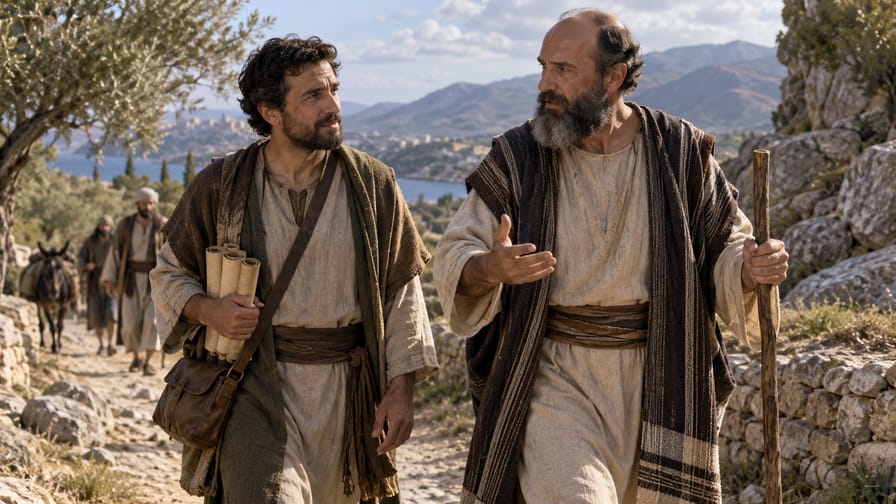
The figure of Sopater, though briefly mentioned in Scripture, offers a rich opportunity for biblical and theological analysis, especially from an evangelical Protestant perspective. His inclusion in the sacred canon, even if concise, underscores the belief in the inspiration and usefulness of all Scripture (2 Timothy 3:16-17).
This study aims to explore the depth of his onomastic meaning, his historical context, the inferences about his character, and his theological relevance, contributing to a more complete understanding of the body of Christ in the early church and of God's divine purpose in using seemingly minor individuals for great designs.
We will examine Sopater's connection with the apostle Paul and the early missionary movement, highlighting how even supporting characters in the biblical narrative play crucial roles in the history of redemption.
1. Etymology and meaning of the name
The name Sopater (in Greek: Σώπατρος) is of Greek origin and has a quite revealing etymological meaning. It is composed of two Greek roots: σώζω (sōzō), which means "to save," "to preserve," or "to deliver," and πατήρ (patēr), which means "father."
Thus, the name Sopater can be literally interpreted as "savior of his father" or "one whose father is saved/preserved." This combination of terms reflects a theme of paternal care and redemption, concepts deeply rooted in biblical theology.
There are no significant variations of the name Sopater in the original biblical languages, such as Hebrew or Aramaic, as it is a Greek name. Its occurrence is singular in Acts 20:4, although there is an academic discussion about its possible identification with Sosipater, mentioned in Romans 16:21.
This connection will be explored in later sections, but it is important to note that both names share the root sōzō, indicating a possible connotation of salvation or preservation.
The theological significance of the name Sopater, though not directly attributed to a prophetic or messianic role, resonates with the central themes of evangelical Christianity. The concept of "salvation" is fundamental to the faith, highlighting the work of God the Father in providing redemption through Jesus Christ (John 3:16).
Even if the name refers to the salvation of an earthly father, it symbolically points to the spiritual salvation that is granted by God, the heavenly Father, through Christ. Perhaps Sopater's own life, as a convert and companion of Paul, was a testament to the salvation he experienced.
In a broader sense, the idea of "saving the father" can evoke the responsibility of children, in a spiritual context, to honor and, metaphorically, "save" (in the sense of preserving the legacy or faith) of their ancestors through their own faithfulness and witness.
For the evangelical believer, the etymology of Sopater serves as a subtle reminder of the omnipresence of the theme of salvation throughout Scripture and of the centrality of God as the Father who saves.
2. Historical context and biblical narrative
Sopater appears in the biblical narrative during a crucial period in the history of the early church, which corresponds approximately to the middle of the first century A.D. He is specifically mentioned in Acts 20:4, in the context of the apostle Paul's third missionary journey.
This was a time of intense missionary activity, characterized by the expansion of the Gospel throughout the Roman Empire, the establishment of new Christian communities, and the consolidation of apostolic doctrine.
The political context was that of Roman rule, which, despite its oppressions, provided the roads and relative peace (Pax Romana) necessary for the propagation of Christianity. Socially, the early church was a mixture of Jews and Gentiles, challenging the cultural and religious barriers of the time.
Religiously, Christianity was differentiating itself from Judaism, and Christian communities were learning to live their faith in predominantly pagan environments, facing both Roman persecution and Jewish opposition.
Although the Bible does not provide details about Sopater's genealogy or family origin, it informs us that he was from Berea (Acts 20:4). Berea (modern Veria) was a city in Macedonia, known for the noble spirit of its inhabitants, who "received the word with all eagerness, examining the Scriptures daily to see if these things were so" (Acts 17:11).
Sopater's association with Berea suggests that he may have been one of the converts resulting from the ministry of Paul and Silas in that city, and that he personified the receptivity and zeal for biblical truth characteristic of the Bereans.
The main event in Sopater's life, as recorded, is his journey with Paul and other companions. He is listed among the delegates who accompanied Paul back to Asia Minor, on the way to Jerusalem.
The key passage is Acts 20:4, which states: "Sopater the son of Pyrrhus from Berea, and Aristarchus and Secundus from Thessalonica, and Gaius from Derbe, and Timothy, and Tychicus and Trophimus from Asia accompanied him." This list is crucial for understanding Paul's support network.
The geography related to Sopater includes his hometown, Berea, in Macedonia. The journey described in Acts 20 begins in Philippi, passes through Troas, where Paul raises Eutychus (Acts 20:7-12), and continues to Assos, Mitylene, Chios, Samos, Miletus, and from there to Jerusalem.
Sopater and his companions are mentioned as those who "went on ahead and waited for us at Troas" (Acts 20:5), indicating a division of the group to meet at a specific point.
His most important relationships are with the apostle Paul, whom he accompanied, and with the other traveling companions: Aristarchus, Secundus, Gaius (from Derbe), Timothy, Tychicus, and Trophimus. This diverse group represented various Gentile churches, probably entrusted with carrying the offering for the poor saints in Jerusalem (1 Corinthians 16:1-4 2 Corinthians 8-9).
Sopater's presence among them underlines the unity and inter-ecclesiastical cooperation in the early church, a testament to the fellowship among believers of different geographical and ethnic backgrounds.
3. Character and role in the biblical narrative
Although Scripture offers only a concise mention of Sopater, we can infer aspects of his character and his role from the context of his association with the apostle Paul and the group of companions. His inclusion in this trusted entourage is a strong indication of his faith and commitment to the Gospel.
The fact that Sopater was "the son of Pyrrhus, from Berea" (Acts 20:4) and was traveling with Paul suggests that he was a mature and respectable believer in his community. The city of Berea was known for its believers who diligently examined the Scriptures (Acts 17:11), implying an environment of spiritual depth and seriousness.
His willingness to undertake a long and dangerous journey with Paul points to virtues such as loyalty, courage, and dedication. The journey to Jerusalem, especially with an offering for the poor, was not only an act of service but also an act of inter-ecclesiastical solidarity that required personal sacrifice and considerable time.
There are no documented records of sins, weaknesses, or moral failures for Sopater, which is common for biblical characters of such brief mention. His appearance is solely in the context of faithful service and support for the apostolic ministry.
His specific vocation or function was that of a delegate from the church in Berea. He was likely one of the chosen representatives to accompany Paul and ensure that the collection for the saints in Jerusalem was delivered transparently and securely.
This role was of utmost importance, as the offering symbolized the unity between Gentile and Jewish believers and the gratitude of the Gentile churches for the Gospel they had received from Jerusalem (Romans 15:26-27). Sopater, therefore, played the role of an ambassador for his church.
Sopater's significant actions include his decision to travel with Paul and his companions, demonstrating a practical commitment to the cause of the Gospel. He was not merely a listener but an active participant in the mission of the church.
His presence in the group that "went on ahead and waited for us at Troas" (Acts 20:5) indicates his readiness to follow instructions and coordinate with the apostle, showing discipline and team spirit.
The development of Sopater's character throughout the biblical narrative is limited due to his single mention. Nevertheless, his inclusion in the book of Acts, written by Luke, who was a meticulous historian and a companion of Paul, grants Sopater a permanent place in the history of the early church.
He represents the many anonymous believers who, with their faithfulness and service, were essential pillars for the advancement of the Kingdom of God. His life, though little documented, is a testament to the importance of each member in the body of Christ.
4. Theological significance and typology
The theological significance of Sopater, though not revealed in great acts or direct teachings, lies in his representation of crucial themes for evangelical theology, especially in the context of redemptive history and progressive revelation. He is an example of inter-ecclesiastical cooperation and faithfulness in service.
His presence in the group carrying the collection for Jerusalem is highly significant. This act of generosity from the Gentile churches toward the Jewish believers in Jerusalem was a tangible testament to the unity of the body of Christ, overcoming ethnic and cultural barriers (Galatians 3:28).
Sopater, as a Gentile from Berea, participating in this offering, demonstrates the realization of the new covenant, where Jews and Gentiles are united in Christ Jesus (Ephesians 2:14-16).
There is no direct Christocentric prefiguration or typology associated with Sopater. However, his life and service point to Christ indirectly, insofar as he embodies the spirit of service and sacrifice that Christ exemplified and taught (Philippians 2:5-8). He demonstrates the type of discipleship that submits to apostolic leadership and dedicates itself to the well-being of the community of faith.
Sopater's participation in the collection for the saints in Jerusalem is an echo of the generosity of Christ, who "though he was rich, yet for your sake he became poor, so that you through his poverty might become rich" (2 Corinthians 8:9).
A relevant theological question that arises is the possible identification of Sopater with Sosipater, mentioned in Romans 16:21. Paul writes: "Timothy, my co-worker, greets you, as do Lucius, Jason, and Sosipater, my relatives."
Scholars such as F.F. Bruce and C.K. Barrett discuss this possibility, noting the similarity of the names (both derived from sōzō) and the plausibility of Paul having relatives or Jewish compatriots who were also Christians and collaborators. If they are the same person, this would add to Sopater the designation of "relative" of Paul, suggesting a Jewish ethnic connection or, more likely, a deep spiritual brotherhood.
The conservative evangelical perspective tends to view this identification as possible, but not definitive, given the lack of conclusive evidence. Even if different, both names represent faithful individuals in service to Christ.
The figure of Sopater connects with central theological themes:
- Unity and Fellowship of the Church: He is a living symbol of koinonia (fellowship) among the diverse churches, demonstrating that Christian love transcends geographical and ethnic boundaries.
- Missions and Evangelism: His participation in Paul's entourage underlines the importance of logistical and personal support for missionary work.
- Christian Generosity: By participating in the collection, he exemplifies the doctrine of stewardship and the sharing of resources among believers (2 Corinthians 9:7).
- Faithful Service: Sopater represents the many believers who, without great prominence, faithfully serve behind the scenes, contributing essentially to the advancement of the Kingdom of God.
His life, therefore, reinforces the doctrine that every member of the body of Christ is vital, and that faith is manifested in practical acts of love and service.
5. Biblical-theological legacy and canonical references
Sopater's legacy in biblical theology is subtle yet significant, especially when viewed through the lens of the evangelical Protestant perspective that values every word of Scripture. His sole direct mention in Acts 20:4 is the focal point of his canonical existence, though the possible connection with Sosipater from Romans 16:21 is a point of discussion that broadens his scope.
There are no literary contributions attributed to Sopater he is not an author of books, psalms, or epistles. His importance lies not in his authorship but in his historical participation in the founding and expansion of the early church.
His inclusion in the book of Acts, an essential book for understanding church history and pneumatological theology, grants him a place of honor. The presence of Sopater and other collaborators of Paul validates the authenticity and communal character of the apostolic movement.
Sopater's influence on biblical theology lies primarily in his representation of ecclesiastical and ethical principles. He personifies the ordinary, yet dedicated, believer who contributes to God's mission in practical and essential ways.
He reminds us that God's work is not accomplished only by prominent figures like Paul or Peter, but also by the many who faithfully serve in less visible roles. This resonates with the Protestant doctrine of the priesthood of all believers (1 Peter 2:9), where every believer is called to serve God with their gifts and talents.
In Christian interpretive tradition, Sopater is generally seen as an example of faithful discipleship and support for the apostolic ministry. Evangelical commentators often mention him to illustrate the diversity of Paul's collaborators and the collaborative nature of Christian ministry.
He is a testament to the universality of the Gospel, for, coming from Berea (a Gentile city), he joins Paul in a mission that embraces both Jews and Gentiles.
There are no references to Sopater in intertestamental literature, as he is a New Testament figure. However, his mention in the biblical canon is sufficient to guarantee his relevance.
In Reformed and evangelical theology, the figure of Sopater, like other secondary characters, is valued as part of the divinely inspired narrative that reveals God's sovereignty in using all types of people for His purposes.
His story, though brief, serves to reinforce the doctrine of divine providence and the importance of personal faithfulness in God's great plan of redemption. He is a model of selfless service and Christian fellowship.
The importance of Sopater for understanding the canon lies in the fact that his inclusion, even if minimal, attests to the historical accuracy of the book of Acts and the richness of detail that Luke, the author, took care to record.
Every name and every locality mentioned by Luke contributes to the credibility of the biblical account, affirming the authority of Scripture as the inspired Word of God, useful for teaching, rebuking, correcting, and training in righteousness (2 Timothy 3:16).
Thus, Sopater, the man from Berea, remains a silent yet powerful reminder of the vastness of the body of Christ and the value of each one who faithfully contributes to the advancement of the Kingdom of God.