


Priscilla
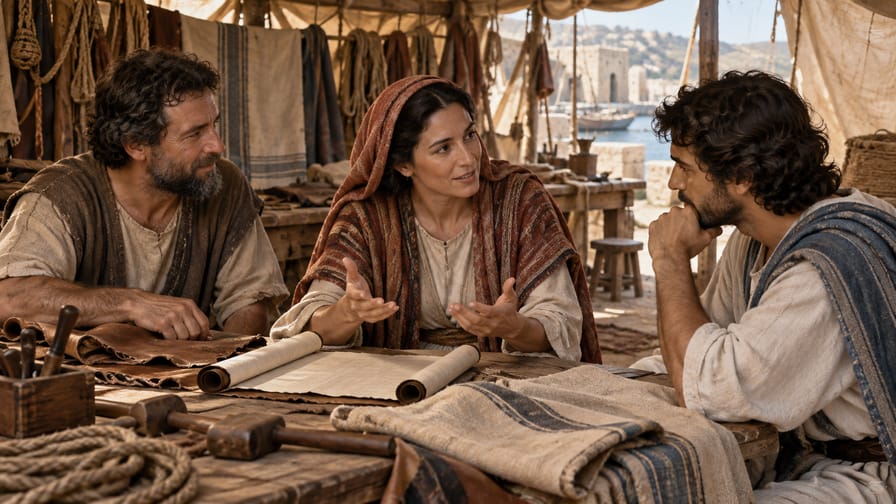
The figure of Priscilla, also known as Prisca, emerges from the pages of the New Testament as one of the most prominent women in the early church, distinguished by her faith, intelligence, and dedication to ministry. Her story, intrinsically linked to that of her husband Aquila and the apostle Paul, offers a valuable glimpse into the dynamics of the first-century Christian community, the role of women in the advancement of the Gospel, and the collaborative nature of missionary work. Her life is a testament to God's ability to use ordinary individuals for extraordinary purposes, shaping the course of church history.
The analysis of Priscilla transcends mere biography, delving into etymological, historical, exegetical, and theological aspects that underscore her lasting relevance. Her work as Paul's co-worker, Apollos' instructor, and host of house churches demonstrates a model of active discipleship and selfless service. From an evangelical Protestant perspective, Priscilla's life is an inspiring example of how spiritual gifts are employed for the edification of the body of Christ and the proclamation of the redemptive message.
1. Etymology and Meaning of the Name
The name Priscilla derives from the Latin Prisca, a Roman cognomen meaning "ancient," "venerable," or "primitive." In the Bible, she is mentioned both as Priscilla (Priskilla, Πρίσκιλλα) and as Prisca (Priska, Πρίσκα). The form Priskilla is an affectionate diminutive of Priska, suggesting "little Prisca" or "my dear Prisca," and appears in Acts 18:2, Acts 18:18, and Romans 16:3.
The shorter form, Prisca, is found in 1 Corinthians 16:19 and 2 Timothy 4:19. This alternation between the formal name and the diminutive may indicate the level of familiarity and affection of the biblical authors towards her, or simply reflect the linguistic conventions of the time. There are no other biblical characters with this name, making her unique in the Scriptures.
Although the etymological meaning of "ancient" does not have a direct theological implication for her character or ministry, the name, common in Roman society, signals her cultural integration. The fact that she was a Jew (or proselyte) with a Roman name illustrates the cultural diversity present in the early church and the reach of the Gospel beyond ethnic and social boundaries.
The association of the name with "venerable" or "primitive" can metaphorically resonate with her fundamental and pioneering role in the formation of Christian communities. The name, therefore, although of secular origin, contextualizes Priscilla within the Greco-Roman environment where Christianity flourished, highlighting the universality of Christ's message.
2. Historical Context and Biblical Narrative
The life of Priscilla and her husband Aquila unfolds in the vibrant and challenging setting of the Roman Empire in the mid-1st century A.D., during the apostolic era. They are introduced in the biblical narrative at a time of great expansion of Christianity, facing both Roman persecution and Jewish opposition. The period is marked by the Pax Romana, which facilitated communication and travel, but also by political and religious tensions.
The first mention of Priscilla occurs in Acts 18:1-3, where it is reported that Paul met her along with Aquila in Corinth. They had recently been expelled from Rome due to the edict of Emperor Claudius (around 49 A.D.), which ordered all Jews to leave the city. This event is historically corroborated by extrabiblical sources, such as the Roman historian Suetonius, who mentions the expulsion of Jews due to disturbances caused by "Chrestus" (likely a reference to Christ and the disputes between Jews and Christians in Rome).
2.1 Origin and Movements
Although the Scriptures do not provide details about Priscilla's genealogy or family origin, she is consistently presented as the wife of Aquila, a Jew native to Pontus. It is probable that Priscilla was also Jewish or a converted proselyte, living in Rome before the expulsion. Her presence in Rome and her Latin name suggest a familiarity with Roman culture, which was common among diaspora Jews.
The chronology of her life and ministry can be structured through her geographical movements:
- Rome: Original place of residence before Claudius's edict, where they were likely already believers or converted.
- Corinth: Where they met Paul after being expelled from Rome (Acts 18:1-3). They shared the same profession of tentmakers, which strengthened their bond with the apostle.
- Ephesus: They accompanied Paul to Ephesus (Acts 18:18-19), where they remained while Paul continued his journey. It was in Ephesus that they played a crucial role in teaching Apollos (Acts 18:24-28) and hosted a house church (1 Corinthians 16:19).
- Return to Rome: After the lifting of Claudius's edict, Priscilla and Aquila returned to Rome, where they again hosted a church in their home (Romans 16:3-5).
- Ephesus again: The last mention of them places them again in Ephesus, according to Paul's greeting to Timothy (2 Timothy 4:19).
2.2 Relationships with Other Biblical Characters
Priscilla's relationship with other biblical characters is central to her narrative. Her partnership with Aquila is inseparable, as they are almost always mentioned together. The order of their names, with Priscilla frequently preceding Aquila (Acts 18:18, 26 Romans 16:3 2 Timothy 4:19), has been noted by commentators, suggesting that she may have had a more prominent role or perhaps was socially more recognized or more spiritually influential. However, this order does not imply hierarchy, but rather an egalitarian partnership in ministry.
Her connection with Paul was deep and lasting. They were co-workers and friends, sharing not only faith but also their profession. Paul describes them as his "fellow workers in Christ Jesus" who "risked their own lives" for him (Romans 16:3-4), indicating an extraordinary level of dedication and sacrifice. This friendship and partnership are a testament to the model of collaborative ministry that Paul practiced.
The relationship with Apollos is another highlight of her story. Apollos, an eloquent Jew powerful in the Scriptures, knew only the baptism of John. Priscilla and Aquila "took him aside and explained to him the way of God more accurately" (Acts 18:26). This event underscores the depth of their theological knowledge and their ability to instruct, even a talented preacher like Apollos.
3. Character and Role in the Biblical Narrative
Priscilla's character is consistently portrayed in the Scriptures with admirable qualities that make her a model of faith and service. She stands out for her intelligence, courage, hospitality, and deep knowledge of the Scriptures, elements that enabled her for significant ministry in the early church. Her life is a clear example of active discipleship.
One of her most evident virtues is hospitality. In various cities – Ephesus and Rome – her home served as a center for the Christian community, hosting house churches (1 Corinthians 16:19 Romans 16:5). Hospitality was not merely a social act, but a vital practice for the survival and growth of nascent Christianity, offering a safe place for worship, teaching, and fellowship in times of persecution.
Priscilla also demonstrates remarkable courage and dedication to the Gospel. Paul testifies that she and Aquila "risked their own lives" for him (Romans 16:4), though we do not have specific details about this event. This statement suggests that they faced significant dangers, possibly related to persecution, to protect or support the apostle, demonstrating unwavering faith and radical commitment to Christ.
Her capacity for teaching and theological discernment is unquestionable, especially evidenced in the episode with Apollos (Acts 18:26). Apollos was an "eloquent" man and "powerful in the Scriptures," but his knowledge of the way of God was incomplete. Priscilla and Aquila, together, "explained to him the way of God more accurately," indicating a deep doctrinal understanding and the ability to communicate complex truths clearly.
There are no documented sins, weaknesses, or moral failings about Priscilla in the Scriptures. She is presented as a figure of integrity and devotion, a testament to God's transforming grace. Her vocation can be described as an apostolic co-worker and a theological instructor, acting in partnership with her husband and with Paul.
Priscilla's role in the biblical narrative is multifaceted: she is an itinerant missionary, a host of churches, a tentmaker, and, crucially, a teacher. Her active participation in ministry, often side by side with men like Paul and Aquila, challenges anachronistic notions about the role of women in the early church and highlights the equality of value and opportunity for service in the Kingdom of God, within biblical parameters.
The development of her character throughout the narrative, although not explicitly detailed, can be inferred from her progressive visibility and impact. Beginning as a refugee in Corinth, she becomes a central figure in Ephesus and Rome, demonstrating continuous growth in her faith, knowledge, and ministerial influence. She is an example of how life in the Spirit empowers believers for effective and fruitful service.
4. Theological Significance and Typology
The theological significance of Priscilla in redemptive history is multifaceted, serving as a powerful example of the active and integral participation of believers, including women, in God's mission. Although she is not a prophetic or typological figure in the direct sense of prefiguring Christ, her life and ministry illustrate fundamental New Testament theological principles, especially concerning discipleship, evangelism, and the use of spiritual gifts.
Priscilla's life demonstrates the reality of the priesthood of all believers, a central concept in Reformed Protestant theology. She was not an apostle or a formally ordained leader, but a layperson who exercised a vital and impactful ministry. Her ability to instruct Apollos "more accurately the way of God" (Acts 18:26) is a testament to the empowerment of the Holy Spirit that transcends formal and hierarchical structures, emphasizing that all believers are called to share and teach the Word of God according to their gifts.
Although not a typological figure who directly prefigures Christ, Priscilla points to Christ indirectly by embodying the values of the Kingdom and the mission of the Church. Her dedication, sacrifice, and service reflect Christ's call for His followers to be light and salt in the world, engaging in the propagation of the Gospel. Her willingness to "risk her own life" (Romans 16:4) for Paul echoes Christ's self-sacrifice and the selfless love that should characterize believers.
Priscilla's story connects with central theological themes such as salvation by grace through faith, which empowered her for service obedience to the Great Commission to make disciples and God's grace that equipped her with wisdom and courage. She is a practical example of how faith manifests itself in works of service and love, not as a means of salvation, but as its fruit.
Priscilla's role as Apollos' instructor is an important point of discussion in conservative evangelical theology regarding the role of women in ministry. While some interpret passages such as 1 Timothy 2:11-14 as absolute restrictions on women teaching men in public assembly, Priscilla's example is often cited to illustrate that women can, and should, use their teaching gifts in appropriate contexts. The instruction to Apollos occurred in a private or discipleship setting, complementing his knowledge, and not in a public congregational sermon. This demonstrates a model of female ministry that is powerful and effective, but which operates in conformity with apostolic guidelines for order in the church.
Her life also underscores the importance of Christian hospitality as an extension of ministry. The house churches that she and Aquila hosted were crucial for the survival and growth of early Christianity, serving as centers of evangelism, discipleship, and fellowship. This highlights the doctrine of the Church as the body of Christ, where each member contributes to the common good and the expansion of the Kingdom.
5. Biblical-Theological Legacy and Canonical References
Priscilla's legacy for biblical theology and ecclesiastical practice is significant, even though she did not contribute to the authorship of canonical books. Her mentions in four New Testament books – Acts, Romans, 1 Corinthians, and 2 Timothy – attest to her prominence and the high esteem in which she was held by the apostles and the early church. The consistency in the narrative of her partnership with Aquila and her active involvement in ministry reinforces the authenticity of her role.
Priscilla's influence on biblical theology lies primarily in her example of lay and female ministry. She demystifies the idea that significant service in the Kingdom is exclusive to formal leaders or a specific gender. Her life is a testament to the truth that God empowers and uses all His sons and daughters for the edification of the Church and the propagation of the Gospel.
In the Christian interpretive tradition, Priscilla is often celebrated as a model of faith, service, and discipleship. From the Church Fathers to the Reformers and contemporary evangelical theologians, her name is invoked to illustrate the importance of collaboration in ministry and the ability of women to contribute intellectually and spiritually to the life of the church. She is a living argument against any view that marginalizes the role of women in Christian service.
In Reformed and evangelical theology, Priscilla is a crucial reference point in discussions about spiritual gifts and the role of women in the church. Complementarian theologians, who affirm the distinction of roles between men and women in church leadership, frequently cite Priscilla as an example of how women can exercise a powerful and instructive ministry (as in the case of Apollos) in contexts that do not violate the prohibitions of teaching and authority over men in public assembly (cf. 1 Timothy 2:12). Her instruction to Apollos is seen as personal and supplementary discipleship, not as authoritative preaching in the congregation.
On the other hand, egalitarians also view her as an example of a woman who taught and led, arguing that the context in which she taught Apollos should not be used to limit all forms of female teaching. However, the conservative evangelical perspective tends to emphasize the distinction between formal/authoritative teaching in the church and informal instruction/discipleship, placing Priscilla firmly in the latter context, without diminishing the value or impact of her ministry.
Priscilla's importance for understanding the canon lies in her ability to illustrate the practical application of apostolic principles. Her story helps us understand how the Gospel spread through networks of committed believers, how house churches functioned, and how spiritual gifts were exercised in the daily life of the Christian community. She offers a window into the life and ministry of the early church, complementing Paul's epistles and the narrative of Acts.
In summary, Priscilla remains an inspiring and theologically rich figure. Her example of faith, courage, hospitality, biblical knowledge, and dedication to ministry continues to challenge and encourage believers of all ages to use their gifts for the glory of God and the advancement of His Kingdom, demonstrating that Christian service is a universal calling, accessible to all who are transformed by the grace of Christ.