


Melchizedek
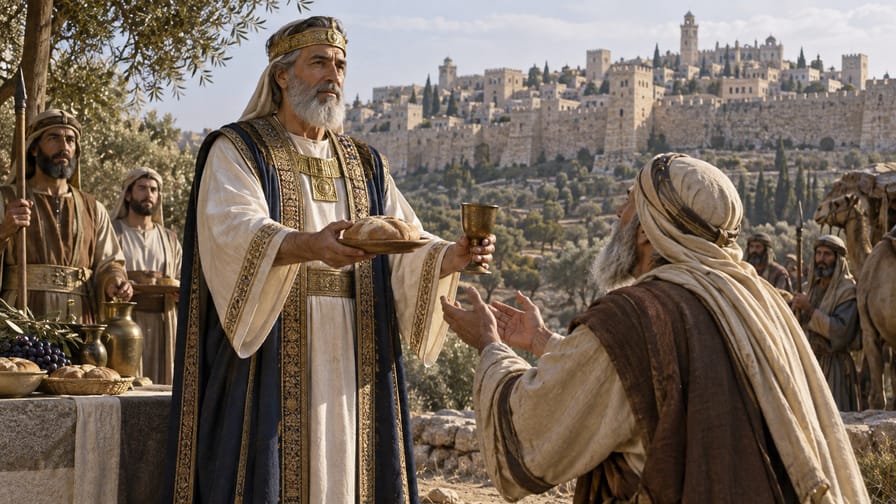
The figure of Melchizedek is one of the most enigmatic and theologically rich in the Scriptures. Although he appears briefly in the Old Testament, his mention is profoundly significant for understanding the work and office of Jesus Christ. He is presented as a priest-king who transcends usual covenantal and genealogical structures, serving as a powerful type of Christ.
This analysis will explore the etymology of his name, his historical and narrative context, his character and role, his profound theological and typological significance, and his legacy within the biblical canon, from a conservative evangelical Protestant perspective.
1. Etymology and meaning of the name
The name Melchizedek (in Hebrew: מַלְכִּי־צֶדֶק, Malki-Tzedeq) is composed of two Hebrew roots. The first is melek (מֶלֶךְ), which means "king," and the second is tzedeq (צֶדֶק), which means "justice" or "righteousness." Thus, the literal and most accepted meaning of the name is "My king is justice" or "King of righteousness."
This etymology is not merely descriptive, but profoundly theological. In Hebrews 7:2, the author explicitly explores this meaning, stating that Melchizedek "first, means ‘king of righteousness’." This title prefigures the inherent righteousness and the imputed righteousness that Christ, the true King, offers to humanity.
Besides being "King of righteousness," Melchizedek is also identified as "King of Salem" (Genesis 14:18). The name Salem (שָׁלֵם, Shalem) is derived from the Hebrew root meaning "peace" or "completeness." Thus, he is also "King of peace," as highlighted in Hebrews 7:2.
The combination of these two titles – King of Righteousness and King of Peace – is crucial for Christocentric typology. Jesus Christ is the King who establishes God's righteousness and, through it, brings true peace to human hearts and to the world (Isaiah 9:6-7 Romans 5:1 Ephesians 2:14-17). There are no other biblical characters with this exact name, which underscores his uniqueness.
The theological significance of the name lies in its ability to encapsulate divine and messianic attributes. Righteousness and peace are fundamental characteristics of the kingdom of God and the person of Christ. The absence of a recorded genealogy for Melchizedek, combined with the profundity of his name, elevates him to a unique position as a prophetic type.
2. Historical and biblical narrative context
The appearance of Melchizedek occurs in a crucial period of biblical history, during the patriarchal era, around the second millennium B.C. (approximately 2000-1800 B.C.). This is the time of Abram, before the establishment of the nation of Israel and the Mosaic Law. The political and social landscape consisted of Canaanite city-states, frequently in conflict, as evidenced by the war between the kings of Sodom and Gomorrah and the Mesopotamian kings led by Kedorlaomer.
The main and unique Old Testament narrative about Melchizedek is found in Genesis 14:18-20. After Abram's (not yet Abraham) victory over Kedorlaomer and his allies, rescuing Lot and the plundered goods, he returns from battle. It is at this moment that Melchizedek appears.
The key passages describe that Melchizedek, "king of Salem," came out to meet Abram, bringing "bread and wine." He is explicitly identified as "priest of God Most High" (El Elyon). He blessed Abram with the words: "Blessed be Abram by God Most High, Creator of heaven and earth. And blessed be God Most High, who delivered your enemies into your hand" (Genesis 14:19-20a).
In response to this blessing and his position, Abram gave Melchizedek "a tenth of everything" (Genesis 14:20b). This act is of utmost theological importance, as it establishes Melchizedek's superiority over Abram, and by extension, over the Levitical lineage that would come from Abram, as the book of Hebrews argues.
The geography related to the character is Salem, which is widely identified as the future Jerusalem (Psalm 76:2). The absence of any mention of his genealogy, family origin, birth, or death is a distinctive characteristic, purposefully emphasized in Scripture, as we will see in the theological section. He appears "without father or mother, without genealogy" (Hebrews 7:3), not literally, but in the biblical record, to serve as a type.
The relationship with Abram is the only documented interaction. Melchizedek emerges as a figure of spiritual and royal authority, recognized and honored by the patriarch Abraham himself, the father of faith. This interaction establishes a precedent for a priesthood and a kingship that operate outside of future Israelite structures.
3. Character and role in the biblical narrative
The character of Melchizedek, as revealed in the Scriptures, is marked by righteousness, peace, and divinely instituted authority. He is presented without any moral flaw or weakness, a singular and immaculate figure in the biblical narrative. His spiritual qualities are evident in his role as priest of God Most High and in his blessing of Abram.
His calling is dual and unique: he is simultaneously king and priest. This is an unusual arrangement in the Old Testament, where kingship and priesthood were generally separated and attributed to different tribes (Judah for kings, Levi for priests). The fusion of these two functions in Melchizedek is a foreshadowing of the Messiah, who would be both King and Priest (Zechariah 6:12-13).
As king of Salem, he represents civil order and governmental authority, maintaining peace and righteousness in his city. As priest of God Most High, he serves as a mediator between God and men, offering blessing and, presumably, worship and intercession. The offering of bread and wine to Abram can be seen as an act of royal hospitality and a priestly provision.
Melchizedek's significant actions are the blessing of Abram and the reception of tithes. The priestly blessing he pronounced upon Abram was not a mere formality, but a declaration of divine favor and a confirmation of God's promise to Abram (Genesis 12:2-3). Abram's act of giving tithes to Melchizedek is a confession of Melchizedek's priestly superiority.
The absence of information about his origin or end of life is a crucial aspect of his typological character. The author of Hebrews emphasizes that he is "without father or mother, without genealogy, having neither beginning of days nor end of life" (Hebrews 7:3). This does not suggest a literal and eternal existence, but rather that Scripture presents him in this way so that he might serve as a perfect type of the Son of God, whose priesthood is eternal and does not depend on earthly lineage.
Melchizedek does not develop as a character throughout an extensive narrative he appears as a fully formed figure, whose brief appearance has a specific theological purpose. His uniqueness and mystery contribute to the depth of his prophetic role in God's progressive revelation.
4. Theological significance and typology
The theological significance of Melchizedek is deeply rooted in biblical theology, especially in his function as a type of Christ. His appearance in Genesis 14, before the Mosaic Law and the Levitical priesthood, demonstrates that God always had a greater plan for the priesthood and kingship, a plan that transcends the temporal structures of Israel.
The main passage that develops the typology of Melchizedek is Hebrews 7:1-28, which is based on the messianic prophecy of Psalm 110:4: "The Lord has sworn and will not change his mind: 'You are a priest forever, in the order of Melchizedek.'" This Psalm, widely recognized as messianic in Judaism and Christianity, points to a coming priest-king who would not be of the Levitical order.
The Christocentric typology is multifaceted:
- King of Righteousness and Peace: As "King of righteousness" and "King of peace," Melchizedek prefigures Jesus Christ, who is the righteous King who establishes God's righteousness and brings true peace (Isaiah 9:6-7 Romans 5:1 Ephesians 2:14-17). Christ is the incarnation of divine righteousness and the Prince of Peace.
- Eternal Priest: The absence of genealogy and of a record of birth/death for Melchizedek (Hebrews 7:3) symbolizes the eternity of Christ's priesthood. Unlike the Levitical priests who died and needed successors, Christ possesses an "unchangeable priesthood" (Hebrews 7:24), based on the power of an indestructible life (Hebrews 7:16).
- Priestly Superiority: The act of Abram, the father of the Levites, giving tithes to Melchizedek and being blessed by him, demonstrates the superiority of Melchizedek's priesthood over the Levitical priesthood (Hebrews 7:4-10). If Abram, and in his loins Levi, paid tithes, then Melchizedek's priesthood is greater. This superiority points to the supremacy of Christ's priesthood over the priesthood of the Old Covenant.
- Priest by Divine Oath: While the Levitical priests were made without an oath, Christ was constituted priest by an oath from God (Hebrews 7:20-22), according to Psalm 110:4. This oath confers unquestionable permanence and authority to Christ's priesthood, which is the guarantee of a superior covenant.
- Perfect Mediation: Christ's priesthood, "according to the order of Melchizedek," is perfect and able to save completely those who draw near to God through him (Hebrews 7:25). He does not need to offer sacrifices repeatedly like the Levites, for he offered himself once for all (Hebrews 7:27).
The connection of Melchizedek with central theological themes is profound. He points to justification by faith, demonstrated in Abraham's faith before the Law. He reveals a universal priesthood, not limited to a tribe or nation, which finds its fulfillment in Christ. His figure is central to understanding the superiority of the New Covenant over the Old and to Christ's mediating role as eternal High Priest and King.
The bread and wine that Melchizedek offers can be seen as a foreshadowing of the Lord's Supper, where Christ offers his body and blood as the perfect sacrifice (Matthew 26:26-28 1 Corinthians 11:23-26). Thus, Melchizedek is a richly symbolic figure who prefigures the Messiah in his fullness.
5. Biblical-theological legacy and canonical references
The legacy of Melchizedek in biblical theology is immense, despite his scarce direct mention in the canon. He appears only in three books: Genesis 14 (the original narrative), Psalm 110 (the messianic prophecy), and the book of Hebrews (the theological interpretation). This brevity, however, does not diminish his importance on the contrary, it highlights the intentional and divinely orchestrated nature of his appearance and his prophetic role.
His influence on biblical theology is primarily Christological. He serves as the primary Old Testament type for the priesthood of Jesus Christ, legitimizing the non-Levitical and eternal nature of Christ's priestly office. Reformed and evangelical theology strongly emphasizes this typology, seeing in Melchizedek proof of the continuity of God's redemptive plan and the superiority of the New Covenant.
Theologians like John Calvin, in his commentaries on Genesis and Hebrews, highlighted the importance of Melchizedek as a "mirror" or "figure" of Christ. Calvin explained that the absence of genealogy for Melchizedek does not mean that he had no parents or that he was an angelic figure, but that the Holy Spirit, by being silent about his origin and end, did so that he might be a more perfect type of Christ's eternal priesthood.
In the Jewish interpretive tradition, some intertestamental and rabbinic sources, such as the Targums and the Dead Sea Scrolls (e.g., 11QMelchizedek), speculated about Melchizedek's identity, sometimes identifying him with Shem, son of Noah, or with a celestial figure. However, the Protestant evangelical perspective adheres strictly to canonical revelation, which presents him as a real man, king of Salem and priest of God Most High, whose uniqueness is divinely orchestrated to point to Christ.
The importance of Melchizedek for understanding the canon lies in his ability to unite the Old and New Testaments. He demonstrates that God's plan for a perfect High Priest and an eternal King was not an afterthought, but was present from the earliest stages of redemptive history, manifesting itself even before the institution of the Law and the Levitical priesthood. He is a theological "bridge" that validates the superiority and finality of Christ's work.
In summary, Melchizedek is a biblical figure of profound relevance, whose name, character, and actions in the Old Testament are intentionally designed by God to prefigure the person and work of Jesus Christ. His legacy is essential for understanding Christ's eternal priesthood, the superiority of the New Covenant, and the universal nature of salvation, a testament to God's wisdom and redemptive plan.