


Cainan
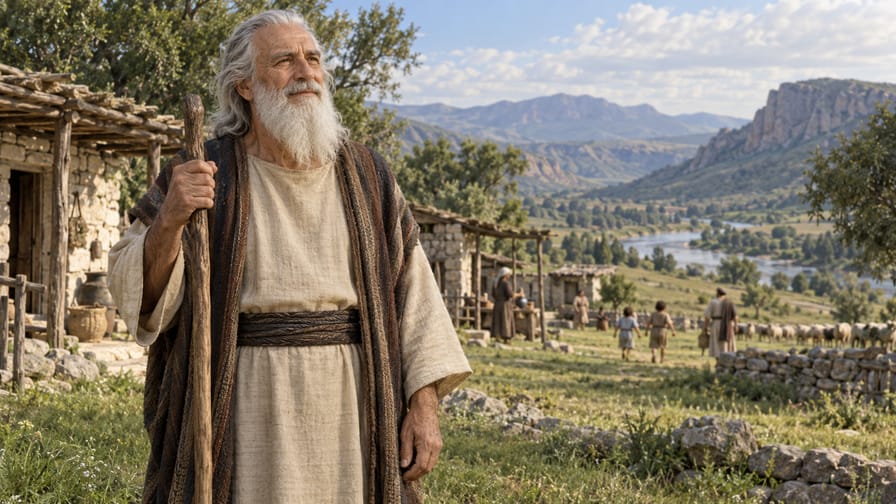
The biblical figure of Cainan, also known as Kenan, emerges from the pages of Scripture as an antediluvian patriarch, a vital link in the genealogy that connects fallen humanity to Adam and, ultimately, to the messianic promise. Although the biblical narrative offers few details about his personal life or specific actions, his inclusion in the genealogical lists of the Old and New Testaments underscores his theological importance. An analysis of Cainan requires a close look at the meaning of his name, the context in which he lived, and the role he played in the history of redemption, according to the Protestant evangelical perspective.
His existence, attested in Genesis and Luke, serves as a reminder of God's faithfulness in preserving a lineage through which the Savior would come. Far from being a secondary figure, Cainan represents the continuity of hope and the unfolding of the divine plan. This article will seek to explore the depth of his onomastic meaning, his position in the biblical narrative, his implicit character, and his theological relevance, underscoring divine sovereignty in the guidance of human history.
1. Etymology and meaning of the name
The name Cainan derives from the Hebrew Qenan (קֵינָן), which appears in the Old Testament. The etymological root of this name is subject to some discussion among scholars, but it is generally associated with terms that evoke "possession," "lamentation," or "smith/craftsman." One of the most accepted derivations connects Qenan to the root qana' (קָנָא), which means "to acquire" or "to possess," giving the name the sense of "possession" or "one who is possessed."
Alternatively, some lexicographers suggest a connection to qayin (קַיִן), which can mean "smith" or "spear," a root that also gives rise to the name Cain. This connection, although etymologically plausible, can be theologically charged, given the distinction between the lineage of Cain and that of Seth, to which Cainan belongs. The idea of "lamentation" (qinah) is also considered, perhaps echoing the name of his father, Enosh ('Enosh), which means "mortal" or "frail man," and the human condition after the Fall.
Variations of the name include Kenan in the Hebrew Masoretic Text and Cainan (Καινάν) in the Septuagint (LXX) and the Greek New Testament. There are no other biblical characters with this specific name, which helps maintain the clarity of his identity. However, the phonetic and etymological proximity to Cain (Qayin) is notable. While Cain represents the lineage of disobedience and fratricide, Cainan is a descendant of Seth, the lineage of hope.
The theological significance of the name Cainan, if interpreted as "possessioan," may point to divine possession over the messianic lineage. Even in a world turning away from God, the Lord preserved a holy "possession," a chosen people through whom His promise would be fulfilled. If related to "lamentation," it reflects the sorrow and mortality inherent in the post-Fall human condition, even within the line of faith.
The choice of names in Hebrew culture often carried a prophetic or descriptive meaning. Although the text does not explain the specific reason for Cainan's name, his position in the lineage of Seth, who was given as "another descendant" (Genesis 4:25) in place of Abel, suggests a divine purpose. Thus, "possession" can be seen as God's possession over this elect lineage, or "lamentation" as an echo of the fallen condition of humanity that this lineage was meant to redeem.
2. Historical context and biblical narrative
Cainan is a figure from the antediluvian period, an era that precedes the Great Flood, as described in the book of Genesis. He is the son of Enosh, grandson of Seth, and great-grandson of Adam, placing him as the fourth generation after the first man. Scripture records that Cainan was born when Enosh was ninety years old (Genesis 5:9) and that he lived 910 years, dying after he had begotten sons and daughters (Genesis 5:14).
The historical context of that era is marked by extraordinary human longevity and a rapid moral deterioration of humanity, which would culminate in the judgment of the Flood (Genesis 6:5-7). Politically and socially, the land was likely inhabited by tribal communities or clans, with the incipient development of cities and technologies, as seen in the lineage of Cain (Genesis 4:17-22). The world was filling with violence and corruption.
Cainan's genealogy is explicitly traced in three main biblical passages: Genesis 5:9-14 in the Old Testament, which details the lineage from Adam to Noah 1 Chronicles 1:2, which lists the patriarchs from Adam and Luke 3:37 in the New Testament, which presents the genealogy of Jesus Christ, connecting Him to Adam. These references underscore Cainan's importance as an uninterrupted link in salvation history.
According to Genesis 5:12, Cainan was seventy years old when he begot his son Mahalalel. After the birth of Mahalalel, Cainan lived another eight hundred and forty years, begetting other sons and daughters. The longevity of the antediluvian patriarchs, including Cainan, is a distinctive trait of this era, perhaps reflecting different environmental conditions or a more robust human constitution before the genetic and environmental degradation post-Flood.
The geography associated with Cainan and his contemporaries is the region of Mesopotamia, generally considered the cradle of post-Edenic civilization. Although the Bible does not specify exact cities or locations directly related to Cainan, it is reasonable to assume that he lived in the vicinity of the first human communities. His family relationships are crucial: he is the son of Enosh, who is notable for having seen the "calling upon the name of the Lord" begin (Genesis 4:26), and the father of Mahalalel, who would continue the lineage.
3. Character and role in the biblical narrative
The Bible is remarkably concise regarding Cainan's character and actions. Unlike figures such as Enoch, who "walked with God" (Genesis 5:24), or Noah, who was a "righteous and blameless man" (Genesis 6:9), the Scriptures do not record specific virtues, moral failings, vocations, or notable events in Cainan's life. His description is limited to his birth, age when begetting a son, subsequent years of life, and his death, a common pattern for most patriarchs in Genesis 5.
This absence of narrative details does not diminish his importance, but rather redefines it. Cainan's primary role in the biblical narrative is purely genealogical: he is an indispensable link in the chain of Seth's lineage, which God chose to preserve the seed of the woman promised in Genesis 3:15. His existence, therefore, is a testament to God's faithfulness in keeping the messianic line intact, despite the increasing corruption of the antediluvian world.
Although there is no explicit mention of his character, Cainan's inclusion in the lineage of Seth, which is contrasted with the lineage of Cain, implicitly suggests a continuity of faith. The lineage of Seth is the one through which the "name of the Lord began to be invoked" (Genesis 4:26), indicating a tradition of worship and seeking God. Being part of this line implies, at minimum, an adherence to this faith and the preservation of the knowledge of the true God.
His longevity, characteristic of the antediluvian patriarchs, is not an indicator of character, but rather an aspect of human physiology of the time, which allowed for a long life and, consequently, a prolonged cultural and religious transmission between generations. This may have facilitated the preservation of traditions and faith in a period when writing may not have been widespread or where oral memory played a crucial role.
Cainan's role, therefore, is that of a silent guardian of the history of redemption, a bearer of life who ensured the continuity of the lineage of promise. His life, though not narrated in detail, is a testament to divine providence, which operates through individuals to fulfill His sovereign purposes. He is a reminder that, even amid the silence of Scripture about personal life, the existence of each link in the genealogy is vital for understanding God's redemptive plan.
4. Theological significance and typology
The theological significance of Cainan lies fundamentally in his position as a link in redemptive history and in God's progressive revelation. He is part of the lineage of the "seed of the woman" (Genesis 3:15), through which redemption for humanity would come. His inclusion in the genealogies is not merely a historical record, but an affirmation of divine sovereignty in guiding human history toward the fulfillment of His promises.
Cainan's most significant theological contribution is his participation in the messianic lineage. The Gospel of Luke, in tracing the genealogy of Jesus Christ back to Adam and, ultimately, to God (Luke 3:23-38), includes Cainan in Luke 3:37. This direct connection to Christ emphasizes the universality of Jesus' redemptive work, which is not only for Israel but for all humanity, tracing back to its earliest roots in Adam. This demonstrates that Jesus is the fulfillment of the promise made in Eden.
Although Cainan is not a prefiguration or Christocentric typology in the classic sense of pointing directly to Christ through actions or offices, his presence in the genealogy serves as a vital precursor. He is part of the historical framework that supports the reality of Christ's incarnation. God's faithfulness in preserving this line through generations of men, even in a sinful world, highlights the certainty of prophetic fulfillment.
His existence in the lineage of Seth, which is distinct from the lineage of Cain, reinforces the idea of a faithful remnant. While the lineage of Cain is characterized by material development and violence (Genesis 4:17-24), the lineage of Seth is the one that "began to call upon the name of the Lord" (Genesis 4:26). Cainan's inclusion in this line suggests his participation in this tradition of faith and worship, contrasting with the general apostasy of antediluvian humanity.
The meticulousness of biblical genealogies, including that of Cainan, underscores the historicity of the Christian faith. The Bible does not present a mythology, but a real history with real people. As theologian John Murray states, genealogies are "the backbone of redemptive history," ensuring that God's plan unfolds in concrete time and space. Cainan's life, though briefly mentioned, is a testament to God's sovereignty in preserving and directing history toward His ultimate purpose.
Cainan's presence connects with central theological themes such as God's grace and faithfulness. It is by grace that God chooses and preserves a lineage in the midst of corruption, and it is by His faithfulness that He fulfills His promises through generations. Cainan's life, in its genealogical simplicity, is an essential fragment of the vast mosaic of salvation history, culminating in the coming and work of Jesus Christ.
5. Biblical-theological legacy and canonical references
Cainan's biblical-theological legacy is, first and foremost, his mention in canonical books of the Old and New Testaments, specifically in Genesis 5:9-14, 1 Chronicles 1:2, and Luke 3:37. These references are crucial for understanding the continuity of salvation history and the genealogy of Jesus Christ. There are no literary contributions attributed to Cainan, nor is he the focus of extensive narratives or specific doctrines, but his mere existence in the canon is of profound importance.
Cainan's influence on biblical theology lies in the validation of the historicity of God's redemptive plan. By tracing the lineage from Adam to Noah and, subsequently, to Abraham and to Christ, the Scriptures establish an uninterrupted line of descent, demonstrating divine providence in each generation. Reformed and evangelical theologians, such as Herman Bavinck, emphasize the importance of these genealogies as proof of God's faithfulness to His covenant and His promise of redemption through a specific seed.
In Jewish interpretive tradition, the genealogies of Genesis 5 are seen as an accurate record of early human history and the continuity of the lineage that would survive the Flood. For the Christian tradition, especially the evangelical one, the inclusion of Cainan in Luke's genealogy is fundamental for establishing Jesus' humanity and His connection to the entire human race, confirming Him as the "second Adam" (1 Corinthians 15:45) and the universal redeemer.
It is important to note a relevant textual issue in intertestamental literature and the New Testament. The Septuagint (LXX), the Greek translation of the Old Testament, includes a second Cainan (Καινάν) between Arphaxad and Shelah in Genesis 10:24 and Genesis 11:12. The Gospel of Luke, following the LXX, also includes him in its genealogy (Luke 3:36). However, this second Cainan is not present in the Hebrew Masoretic Text nor in the Samaritan Pentateuch. This textual variant is a point of discussion among biblical scholars, but it does not affect the identity or role of Cainan, son of Enosh, who is the focus of this analysis.
The treatment of Cainan in Reformed and evangelical theology generally focuses on his function as a genealogical link, highlighting the doctrine of divine election and preservation. The existence of Cainan, without narrative details, serves to illustrate that God's sovereignty operates through seemingly ordinary lives to fulfill His extraordinary plans. He is a silent witness to God's providential hand over history.
Cainan's importance for understanding the canon lies in how he contributes to the weaving of salvation history. His presence in the genealogies is not merely a space-filler, but an affirmation of God's order and purpose from creation. He ensures that the biblical narrative is cohesive and that the divine plan of redemption is executed with historical precision, culminating in the incarnation, life, death, and resurrection of Jesus Christ, the promised Messiah.