


Aeneas
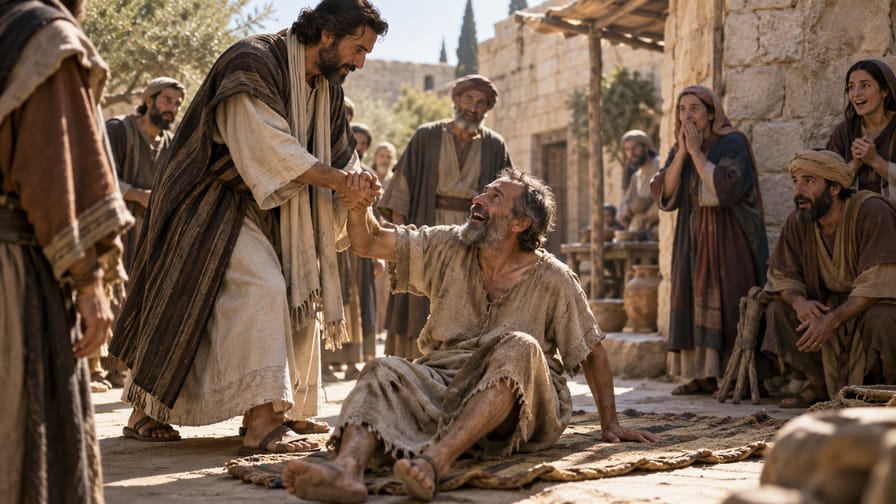
The figure of Aeneas, though briefly mentioned in the Scriptures, emerges as a powerful testimony to the authority and power of God operating through His apostles in the early Church. His story, recorded in the book of Acts of the Apostles, offers valuable insights into the nature of apostolic miracles, the expansion of the Gospel, and divine sovereignty in the lives of individuals. From a Protestant evangelical perspective, Aeneas represents not merely a man healed, but a symbol of the transformation that Christ effects, validating the message of salvation and the missionary commission.
This study proposes to analyze Aeneas through various theological and historical lenses, in accordance with the principles of a biblical-theological dictionary. We will address the etymology of his name, the historical and narrative context of his appearance, the characteristics of his role in the narrative, his theological and typological significance, and finally, his legacy within the canon and Reformed theology. The depth of the analysis aims to extract the rich spiritual and doctrinal lessons that his story, however concise, offers to the Christian faith.
The relevance of Aeneas does not lie in his prominence as a leader or prophet, but in his condition as a recipient of divine grace, which transformed him from a paralytic into an unwitting herald of Christ's power. His healing catalyzed a revival in the region of Lydda and Sharon, demonstrating that miracles were not ends in themselves, but signs pointing to the Kingdom of God and the truth of the Gospel, a fundamental principle in evangelical theology.
Throughout this analysis, we will seek to maintain an erudite and objective tone, grounded in the Scriptures and a theologically conservative perspective. Exegetical precision will be prioritized, and biblical references will be abundantly cited to support each point. The ultimate goal is to provide a comprehensive and edifying understanding of the figure of Aeneas, who, despite his brief mention, leaves an indelible mark on the history of the early Church and in Christian theology.
1. Etymology and Meaning of the Name
The name Aeneas, as recorded in the Greek New Testament, is Aineias (Αἰνείας). It is a name of Greek origin, not Hebrew or Aramaic, which is consistent with the Hellenistic context of Judea and Samaria in the first century A.D. and the original language of the book of Acts.
The etymological root of the name Aineias is linked to the Greek word ainos (αἶνος), which means "praise," "eulogy," or "story/fable." Thus, the name Aeneas can be interpreted as "praised," "worthy of praise," or "he who is extolled."
There are no other biblical characters with the same name Aeneas, making him unique in the canonical narrative. This uniqueness, combined with the meaning of "praised," acquires a remarkable theological significance in the context of his story.
The miraculous healing of Aeneas through Peter, in the name of Jesus Christ, resulted in great praise and recognition of God's power. The narrative in Acts 9:35 states that "all who lived in Lydda and Sharon saw him and turned to the Lord." The man's very name, "praised," became prophetic in his experience.
For Protestant evangelical theology, the meaning of Aeneas' name underscores the truth that the glory and praise of God are the ultimate purpose of all His works, including miracles. The healing of Aeneas was not for his own fame, but so that God might be praised and many might be converted, in accordance with the meaning of his name.
This connection between the name and the event serves as a reminder that God often uses the most subtle details to communicate profound truths. Aeneas' name, "worthy of praise," foreshadows the response his healing would provoke, directing all glory to the Lord Jesus Christ, to whom Peter attributed the miracle.
2. Historical Context and Biblical Narrative
2.1 Period and Historical Setting
The story of Aeneas is narrated in Acts 9:32-35, set in a crucial period of early Church history, approximately between 34-40 A.D. This period follows the conversion of Saul of Tarsus (later Paul) and precedes Peter's vision and the conversion of Cornelius, marking a phase of the Gospel's expansion beyond Jerusalem and the strictly Jewish community.
The political context of the time was Roman domination over Judea. Socially, the region was a melting pot of Jewish and Hellenistic cultures. Lydda, where Aeneas lived, was a prominent city on the plain of Sharon, northwest of Jerusalem, known for its mixed population and as a center of commerce and agriculture. It was a strategic location for the advancement of the Christian message.
Religiously, Judaism was still the dominant force, but nascent Christianity was gaining ground, despite initial persecution. The miracles performed by the apostles, such as the healing of Aeneas, served as powerful divine validations of the Gospel message and apostolic authority, as recorded in Acts 2:43 and Acts 5:12.
2.2 The Narrative of Aeneas' Healing
The narrative begins with Peter visiting the saints (believers) in Lydda. There, he finds Aeneas, a man who had been bedridden for eight years, paralyzed (Acts 9:33). Aeneas' condition was severe and long-lasting, indicating a situation of total dependency and prolonged suffering.
Peter, moved by the Holy Spirit and with the authority granted to him by Christ, addresses Aeneas with the words: "Aeneas, Jesus Christ heals you! Get up and make your bed!" (Acts 9:34). Peter's command was not a suggestion, but an order imbued with divine power, and the response was immediate.
The biblical text is explicit: "Immediately he got up" (Acts 9:34). Aeneas' healing was instantaneous and complete, without any period of convalescence. This miracle was not performed by Peter's inherent power, but by the authority of Jesus Christ, as Peter clearly declared.
The repercussion of the healing was remarkable: "And all who lived in Lydda and Sharon saw him and turned to the Lord" (Acts 9:35). This verse highlights the evangelistic impact of the miracle. The healing of Aeneas served as a visible and undeniable sign of God's power, leading many people to faith in Jesus Christ.
The geography of the story is central: Lydda and the plain of Sharon. Sharon, in particular, was a fertile region, and the phrase "all who lived in Lydda and Sharon" suggests a wide dissemination of the news and a significant movement of conversion, demonstrating the reach of Aeneas' testimony and the apostolic ministry.
2.3 Relationships with Other Characters
Aeneas' main relationship in the narrative is with the apostle Peter. Peter, one of Jesus' twelve disciples, was a central figure in the early Church, endowed with great authority and power to perform miracles, as promised by Jesus in Mark 16:17-18 and demonstrated in Acts 3:1-10 (healing of the lame man at the temple gate).
Peter's interaction with Aeneas reflects the ministry of Jesus Christ, who also healed paralytics and demonstrated compassion and power over illnesses (Matthew 9:1-8 John 5:1-9). Peter acted as an instrument of Christ, extending Jesus' work through the power of the Holy Spirit.
Aeneas' story also connects indirectly with the community of "saints" (believers) in Lydda, whom Peter was visiting. These believers would be the first to witness the healing and spread the news, contributing to the propagation of the Gospel in the region and solidifying the testimony of the local church.
3. Character and Role in the Biblical Narrative
3.1 Analysis of Character and Qualities
The Bible offers few explicit details about Aeneas' personal character, which is common for secondary characters in narratives focused on larger events. However, what is revealed about him allows for inferences about certain qualities. His condition as a paralytic for eight years suggests a life of great suffering and dependency.
The immediate acceptance of Peter's command to get up and make his bed (Acts 9:34) may indicate a willingness to believe and obey, or at least a receptivity to Peter's spiritual authority, who spoke in Jesus' name. Although Aeneas' faith is not explicitly mentioned as a prerequisite for healing, as in other cases (Mark 5:34), his immediate response is a testament to implicit faith.
The absence of any record of complaints or grumbling, despite his long illness, may suggest resilience and patience amidst suffering. While we cannot state this with certainty, the narrative's focus is on divine intervention rather than human failing, which is consistent with the Protestant evangelical perspective that God's grace is often bestowed regardless of human merit.
3.2 Vocation and Specific Function
Aeneas' primary role in the biblical narrative is not that of a leader or an active evangelist, but that of a recipient of divine grace. His "vocation" was to be an object of Christ's compassion, a living testimony to the power of God operating through His servants. He served as a tangible example of Jesus' ability to restore and transform lives.
His healing was not an isolated event, but had a greater purpose in God's plan. Aeneas' story is recorded to demonstrate Peter's apostolic authority and, more importantly, to validate the message of the Gospel. The miracle performed on Aeneas served as a sign to the community of Lydda and Sharon, leading many to conversion (Acts 9:35).
In this sense, Aeneas played a crucial role as a catalyst for the advancement of the Kingdom of God. His life before the healing was a testament to human fragility his life after the healing became a testimony to the supernatural power of God. He became, through his experience, living proof of the resurrection and lordship of Jesus Christ.
3.3 Significant Actions and Development
Aeneas' most significant action was his immediate obedience and his ability to get up after eight years of paralysis. The command "Get up and make your bed!" required not only physical healing, but also an active response on Aeneas' part, which he promptly offered.
The character's development, though brief, is dramatic: from a prostrate and hopeless man, he is transformed into someone who can walk and serve. This physical transformation symbolizes the spiritual transformation that the Gospel offers. While the narrative does not describe his continuous development, his healing is a definitive milestone in his life and in the life of the community.
Aeneas' story, therefore, illustrates the dynamic of divine grace: God acts sovereignly, but frequently invites the individual to a response of faith and obedience. Aeneas' healing is a classic example of how a particular event can have a widespread evangelistic impact, reinforcing the Church's mission to bear witness to the transformative power of Jesus Christ.
4. Theological Significance and Typology
4.1 Role in Redemptive History and Progressive Revelation
The story of Aeneas plays a significant role in redemptive history by illustrating the continuity of Jesus Christ's ministry through His apostles. The healing of Aeneas by Peter, in Jesus' name, demonstrates that Christ's power and authority did not cease with His ascension, but were extended to His Church through the Holy Spirit (Acts 1:8).
This event is part of God's progressive revelation, showing the expansion of the Gospel beyond the strict confines of Jerusalem and into surrounding regions, such as Lydda and Sharon. It is an important step in the fulfillment of the Great Commission (Matthew 28:18-20), as Christ's message reaches new peoples and places, validated by signs and wonders.
The healing of Aeneas reinforces the Protestant evangelical belief in God's sovereignty over sickness and death, and in the power of Jesus Christ to redeem the body as well as the soul. It is not merely a story of physical healing, but a testament to the arrival of the Kingdom of God, where sickness and suffering will finally be eradicated.
4.2 Prefiguration or Christocentric Typology
While Aeneas is not a typological figure in the classical sense of prefiguring Christ in his person or office, his healing is profoundly Christocentric. The miracle is explicitly attributed to "Jesus Christ" by Peter (Acts 9:34), emphasizing that the power resided not in the apostle, but in the risen Lord.
The healing of Aeneas serves as a type of miracle that points to Christ in several ways:
- Continuity of Jesus' healing ministry: Jesus healed many paralytics during His earthly ministry (Matthew 9:1-8 Mark 2:1-12). The healing of Aeneas demonstrates that Jesus continues to heal through His representatives.
- Power over sin and its consequences: Paralysis, in biblical theology, is often used as a metaphor for spiritual incapacity caused by sin. The physical healing of Aeneas points to the spiritual healing and deliverance from sin that only Jesus can offer (John 8:36).
- New life in Christ: Aeneas' ability to get up and walk symbolizes the new life and ability to serve God that believers receive in Christ, passing from spiritual death to life (Ephesians 2:1, 5).
This typology reinforces the evangelical doctrine that Christ is the center of all Scripture and that miracles in the New Testament serve to authenticate His message and His person. The healing of Aeneas is a direct link to Jesus' earthly ministry, validating the claim of His divinity and authority.
4.3 Connection with Central Theological Themes
Aeneas' story connects to several central theological themes:
- Apostolicity and Authority of the Church: The miracle validates Peter's ministry and the authority the apostles possessed to act in Christ's name (Acts 2:43 Acts 5:12), laying the foundation for the doctrine of apostolic authority as the basis for the early Church.
- Power of the Holy Spirit: Peter's empowerment to perform such a miracle is a manifestation of the Holy Spirit's power, which was poured out on believers at Pentecost (Acts 2:1-4) and continues to operate in the Church.
- Faith and Salvation: The response of many in Lydda and Sharon who "turned to the Lord" (Acts 9:35) demonstrates that miracles were signs intended to lead people to saving faith in Jesus Christ. Physical healing served as a means to a greater end: spiritual salvation.
- Evangelism and Mission: Aeneas' story is a classic example of the evangelistic power of miracles. The healing served as a powerful tool for the propagation of the Gospel in a new region, reinforcing the importance of the Church's mission to reach the lost.
Evangelical doctrine emphasizes that apostolic miracles were, in large part, "signs and wonders" intended to authenticate the message of the apostles during the foundational period of the Church. The healing of Aeneas fits perfectly into this purpose, confirming the truth of the Gospel and the divinity of Jesus Christ to those who witnessed it.
5. Biblical-Theological Legacy and Canonical References
5.1 Mentions in Other Biblical Books and Influence
The figure of Aeneas is mentioned exclusively in the book of Acts of the Apostles, in Acts 9:32-35. There are no other direct references to him in any other book of the biblical canon, whether in the Old or New Testament. This singularity, however, does not diminish his impact or his theological importance.
Although he made no direct literary contributions, Aeneas' story is an integral part of Luke's narrative in Acts, which aims to document the expansion of Christianity and the work of the Holy Spirit through the apostles. The inclusion of his story demonstrates the importance of miracles as tools for the dissemination of the Gospel and the confirmation of apostolic truth.
His influence in biblical theology resides in his function as an exemplary case of divine intervention. The healing of Aeneas is proof of the authority and power of Jesus Christ, which continue to operate through His servants. It serves as a precedent for understanding the role of miracles in the ministry of the early Church and their evangelistic purpose.
5.2 Presence in Interpretive Tradition
In Christian interpretive tradition, the story of Aeneas is frequently cited in sermons and studies on the power of God, apostolic authority, and the nature of miracles. Church fathers and commentators throughout history have used his narrative to illustrate Christ's compassion and the efficacy of faith.
Within Reformed and evangelical theology, the story of Aeneas is viewed as evidence of the manifestation of the Kingdom of God in action. Theologians like John Calvin and Matthew Henry, in their commentaries on Acts, highlight the clarity with which Peter attributes the healing to Jesus Christ, emphasizing divine sovereignty and the apostle's instrumental role.
Conservative evangelical interpretation often emphasizes that miracles like Aeneas' were not merely spectacles, but "signs" that pointed to a greater spiritual reality: the coming of the Messiah and the validation of His message. They were an essential part of the Church's foundation, establishing the authenticity of the apostles as messengers of God (Hebrews 2:3-4).
5.3 Importance for Understanding the Canon
The story of Aeneas is crucial for understanding the biblical canon, especially the book of Acts, which details the transition from Judaism to Christianity and the expansion of the Gospel to the Gentile world. The healing of Aeneas in Lydda, a city with a strong Jewish and Hellenistic presence, precedes the conversion of Cornelius, a Gentile, and serves as a preparatory step for this broader inclusion.
Aeneas' narrative demonstrates the continuity of God's redemptive work, beginning with Israel and extending to "all peoples" (Acts 1:8). His healing and the conversions that followed in Lydda and Sharon are a microcosm of what was to come on a global scale, according to God's plan for the Church.
In summary, Aeneas, the paralytic healed in Lydda, remains a figure of great theological relevance. His story, though brief, offers a powerful illustration of the power of Jesus Christ, the authority of the apostles, the importance of miracles as evangelistic signs, and the glory that must be attributed to God in all things. He is an enduring testimony to God's ability to transform lives and to use even the most vulnerable to advance His Kingdom.