


Abagtha
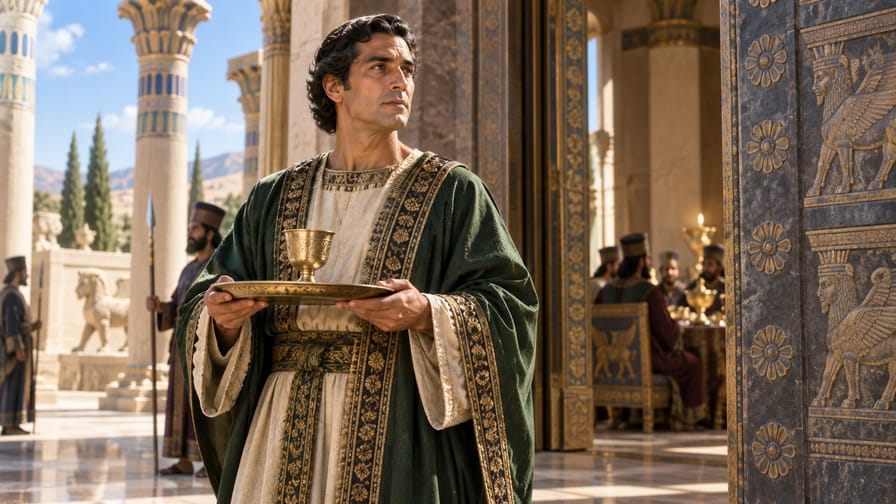
Abagtha is a minor figure in the biblical narrative, appearing briefly in the book of Esther. He is identified as one of the seven eunuchs who served King Xerxes I of Persia, holding a position of trust and proximity to the royal court. His role, though small, offers a glimpse into the vast and intricate administration of the ancient Persian Empire.
His story is intertwined with the dramatic events surrounding Queen Vashti's defiance and the subsequent search for a new queen, ultimately leading to Esther's rise to power. Though not a central character, Abagtha's presence underscores the historical context and the array of individuals who played a part in God's overarching plan for His people.
1. Name and origin
1.1 Etymology and meaning
The name Abagtha (אֲבַגְתָא) is Persian in origin, like many names found in the book of Esther. While its precise etymology is debated among scholars, it is generally understood to mean something akin to “father of the winepress” or “given by fortune.” Such names were common in the Persian court, reflecting the cultural and linguistic influences of the empire.
The significance of the name itself is not directly explored in Scripture, as Abagtha's role is purely functional. However, its Persian roots firmly place him within the historical and geographical context of the Achaemenid Empire during the reign of Xerxes I, providing an authentic detail to the biblical account.
1.2 Family, era, and geography
Abagtha lived during the reign of King Xerxes I (also known as Ahasuerus in the Bible), which is generally dated to the 5th century BC (486–465 BC). This places him firmly within the post-exilic period for the Jewish people, a time when many Jews remained in the Persian diaspora.
As a eunuch serving in the royal court, Abagtha's life would have been centered in Susa (Shushan), the capital city of the Persian Empire, located in modern-day Iran. His family background is not mentioned, which is typical for minor characters, especially those in service roles within a vast imperial bureaucracy. His identity is defined by his position within the king's household.
2. Biblical narrative
2.1 Calling and key episodes
Abagtha's primary appearance in the Bible is in Esther 1:10. He is listed among the seven eunuchs—Mehuman, Biztha, Harbona, Bigtha, Abagtha, Zethar, and Carkas—who served King Xerxes. These men held significant positions, often acting as chamberlains or personal attendants to the monarch, indicating a high degree of trust and access to the king.
His specific task, along with the other eunuchs, was to bring Queen Vashti before King Xerxes, who wished to display her beauty to his guests during a grand banquet. This command, however, was famously refused by Vashti, setting in motion the chain of events that would lead to her dethronement and Esther's eventual ascent to the throne (Esther 1:11-12).
2.2 Relationships and turning points
Abagtha's relationships are not detailed in the text beyond his association with the other six eunuchs and his service to King Xerxes. He is part of a collective, executing the king's orders. His role in the narrative is a single, pivotal moment: the attempt to summon Queen Vashti.
While this moment was a turning point for Vashti and the kingdom, it was not a turning point for Abagtha himself, as his personal story is not developed. He remains a background figure, a cog in the vast machinery of the Persian court, whose actions, though minor, contributed to the unfolding of God's plan for His people, even if he was unaware of the larger divine purpose.
3. Character and faith
3.1 Virtues and devotion
Given the limited information about Abagtha, it is difficult to ascribe specific virtues or devotion to him. As a royal eunuch, his primary virtue would have been loyalty and obedience to the king. In a court where political intrigue was rampant, maintaining the king's favor and executing his commands without question would have been paramount for survival and advancement.
His inclusion in the list of trusted attendants suggests he was reliable and competent in his duties. While the text does not speak to his personal faith, his life, like that of all individuals in the biblical narrative, ultimately serves a purpose within God's sovereign plan, even if he was not a conscious participant in that divine work.
3.2 Failures and lessons
The Bible does not record any failures on Abagtha's part. He simply carried out the king's command, which, in this instance, was met with Queen Vashti's refusal. His role was to deliver a message and escort the queen, not to enforce her compliance. Therefore, no moral or spiritual lessons are drawn directly from his actions or character in the text.
Instead, his brief appearance serves as a reminder that even seemingly insignificant individuals in powerful settings play a part in larger historical and divine narratives. The lesson here is less about Abagtha's personal character and more about the intricate ways God uses various people and circumstances, both great and small, to achieve His purposes.
4. Theological significance and legacy
4.1 Christological foreshadowing or typology
As a minor figure with a very limited role, Abagtha does not offer direct Christological foreshadowing or typology. His life and actions are not presented as symbolic representations of Christ or aspects of His redemptive work. He is a historical figure whose presence helps to establish the authenticity and detail of the biblical account.
However, the broader narrative in which Abagtha appears—the story of Esther—is rich with theological significance. It demonstrates God's providential care for His people, even when His name is not explicitly mentioned. In this sense, Abagtha is a part of the tapestry of human history that God weaves to bring about His purposes, ultimately pointing to the coming of the Messiah who would perfectly fulfill God's redemptive plan.
4.2 Witness in later Scripture and church memory
Abagtha is not mentioned in any other biblical texts beyond Esther 1:10, nor does he feature prominently in later Jewish or Christian tradition. His memory is preserved solely within the context of the Esther narrative, where he serves as one of the king's attendants.
His legacy, therefore, is not one of individual prominence but rather as a testament to the meticulous detail of the biblical record. He is a reminder that God's story encompasses not only the heroes of faith but also the countless individuals whose lives, however brief their mention, contribute to the unfolding of His sovereign will throughout history.
5. Conclusion
Abagtha, though a fleeting presence in the book of Esther, represents the countless individuals who operate within the grand sweep of biblical history, often unaware of their role in God's larger plan. As one of King Xerxes' trusted eunuchs, his brief appearance in the attempt to summon Queen Vashti highlights the intricate workings of the Persian court and the dramatic events that paved the way for Esther's rise. His life, though not a focus of theological reflection, quietly testifies to the meticulous providence of God, who orchestrates every detail, even through seemingly minor characters, to bring about His purposes and ultimately point to the coming of Christ, the true King and Deliverer.