


Thomas
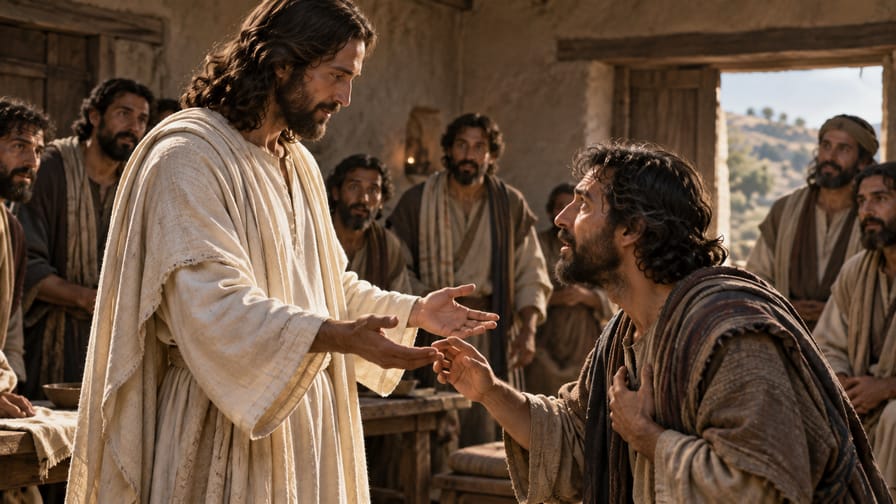
The figure of Thomas, one of the twelve apostles of Jesus Christ, emerges in the New Testament narratives with a singular depth, offering enduring lessons on faith, doubt, and the nature of belief. Although his presence is most prominent in the Gospel of John, the few glimpses we have of him reveal a complex character and, ultimately, a powerful testimony to the resurrection of Christ. His story, often summarized by the epithet "Doubting Thomas," is, upon deeper analysis, the journey of a loyal and courageous man who, confronted with the greatest of supernatural realities, demanded tangible evidence before uttering one of the most sublime confessions of faith in the biblical canon.
The conservative evangelical Protestant perspective sees in Thomas not a figure to be stigmatized, but a real apostle whose experience validates the historicity of the resurrection and the need for a robust faith, even if at times challenged. His narrative serves as a point of contact for all who, at some point, struggle with understanding divine truths. This article will explore the etymology of his name, the historical context of his life, the complexity of his character, his profound theological significance, and the enduring legacy of his faith for the church.
1. Etymology and meaning of the name
The name Thomas (in Greek, Thomas, Θωμᾶς) is of Aramaic origin, deriving from T’oma’ (תאומא), which means "twin." The Gospel of John, in particular, frequently identifies him with his Greek equivalent, Didymos (Δίδυμος), which also means "twin" (John 11:16 20:24 21:2). This dual identification underscores the nature of his name as a cognomen or nickname, and not necessarily a formal proper name.
The etymological root of Thomas, therefore, is simple and descriptive. There is no mention in the Bible of a twin brother of Thomas, nor any indication as to who this "twin" referred to by the name might be. This has led to traditional speculations, such as that he might be a twin of Jesus, or of another apostle, or even of a figure without biblical relevance, but such theories lack scriptural basis.
The literal meaning of "twin" does not, in itself, possess an intrinsic theological significance evident in the biblical context. However, the fact that John consistently calls him "the Twin" may suggest a distinctive characteristic that set him apart from the other apostles. Some theologians interpret that, although not a direct theological meaning, the name singles him out among the Twelve, preparing the reader for the individuality of his character and his journey of faith.
The mention of the name Thomas is exclusive to the New Testament, specifically in the Synoptic Gospels (Matthew 10:3 Mark 3:18 Luke 6:15) and the book of Acts (Acts 1:13), where he is listed among the twelve apostles, and more detailedly in the Gospel of John. There are no other biblical characters with this name, which makes him distinctly associated with this apostle.
The theological significance of the name, though not explicit in its literal translation, lies in how the narrative of Thomas is used to reinforce fundamental truths of the Christian faith. His identity as "the Twin" can be seen as a reminder of his shared humanity with others, representing the human experience of doubt and the need for palpable evidence for faith, a central theme in his story.
2. Historical context and biblical narrative
Thomas lived in the first century of the common era, a period of intense political, social, and religious effervescence in Judea and Galilee. The region was under the oppressive rule of the Roman Empire but maintained a rich Jewish culture, with various sects and religious movements, such as the Pharisees, Sadducees, and Zealots, all with their own messianic expectations and interpretations of the Mosaic Law.
As one of the twelve apostles, Thomas was part of the inner circle of Jesus of Nazareth, accompanying him in his itinerant ministry through Galilee, Samaria, and Judea. Although the Scriptures do not provide details about his family origin or genealogy, most of the apostles, including Thomas, were of Galilean origin, likely fishermen or manual laborers, as was common among the disciples chosen by Jesus.
The biblical narrative presents Thomas at three crucial moments in the Gospel of John, which reveal distinct aspects of his character. The first occurs when Jesus decides to return to Judea to raise Lazarus, despite the danger of being stoned by the Jews (John 11:7-8). It is Thomas who, with a mixture of loyalty and pessimism, declares to the other disciples: “Let us also go, that we may die with him” (John 11:16).
The second significant moment happens during the Last Supper, when Jesus speaks about going to prepare a place for them and affirms that they know the way (John 14:1-4). Thomas, again, is the one who expresses doubt and the need for clarity, asking: “Lord, we do not know where You are going how then can we know the way?” (John 14:5). This question prompts one of Jesus' most profound declarations: “I am the way, and the truth, and the life no one comes to the Father except through Me” (John 14:6).
The third and most well-known episode of Thomas occurs after the resurrection of Jesus. When the other disciples witness the resurrected Lord and tell Thomas, he refuses to believe without physical and empirical evidence: “Unless I see in His hands the print of the nails, and put my finger into the print of the nails, and put my hand into His side, I will not believe” (John 20:25). Eight days later, Jesus appears again and invites Thomas to touch His wounds, leading him to an unprecedented confession of faith: “My Lord and my God!” (John 20:28).
After Jesus' ascension, Thomas is listed among the apostles who persevered in prayer in the Upper Room in Jerusalem (Acts 1:13). Later ecclesiastical tradition, though not canonical, attributes extensive evangelistic missions to Thomas, especially in Persia and India. The Syrian Church and the Mar Thoma Church of Kerala, India, consider Thomas their founder, a legacy that, though outside the Bible, demonstrates the enduring influence of the apostle's figure.
3. Character and role in the biblical narrative
The character of Thomas, as revealed in the Scriptures, is marked by a mixture of traits that make him deeply human and relatable. His loyalty is evident when he readily offers to die with Jesus in Judea (John 11:16), demonstrating undeniable courage and deep devotion to his Master, even in the face of imminent danger. This willingness for personal sacrifice highlights a remarkable virtue.
At the same time, Thomas is portrayed as a man of a questioning and, at times, pessimistic nature. His question about the way to the Father (John 14:5) is not a sign of insubordination, but of a mind that seeks clarity and logical understanding. He was not content with vague or metaphorical answers, but desired explicit knowledge, a characteristic that, although it might seem a weakness, also reflects intellectual honesty and a sincere desire to understand the truth.
The most prominent characteristic of Thomas is his reluctance to accept the resurrection of Jesus without empirical evidence (John 20:25). This "doubt" should not be interpreted as a lack of faith or as malicious skepticism, but as an expression of his need for concrete certainty. For Thomas, the resurrection was such an extraordinary event that it demanded proofs of equal measure, a testimony that echoes the experience of many who earnestly seek God.
Thomas's role in the biblical narrative is crucial for the validation of Christ's resurrection. His initial unbelief and his subsequent confession of faith, based on tactile and visual experience, serve as a powerful antidote against any claim that the disciples were naive or overly credulous. He represents the "investigator," the "honest skeptic" who, once convinced, becomes an irrefutable witness to the truth.
The development of Thomas's character culminates in his declaration: “My Lord and my God!” (John 20:28). This is the most explicit and direct confession of Jesus' divinity made by any of the disciples in the Gospel of John, and perhaps in the entire New Testament. It demonstrates a complete transformation, from a questioning mind to a worshipping heart, recognizing Jesus not only as Master, but as God incarnate Himself. His journey is a model of how sincere doubt can lead to a deeper and more informed faith.
4. Theological significance and typology
The theological significance of Thomas in redemptive history is multifaceted and profound, especially from a conservative evangelical Protestant perspective. His experience is a vivid testimony to the reality of the resurrection of Jesus Christ, a central pillar of the Christian faith (1 Corinthians 15:14). Thomas's demand for physical evidence—to see Jesus' hands and side (John 20:25)—serves to authenticate the bodily nature of the resurrection, refuting any idea that Jesus appeared merely as a spirit or a hallucination.
The story of Thomas is not a Christocentric prefiguration or typology in the sense of pointing directly to Christ, but his experience typifies the journey of the believer. He represents humanity in its search for certainty, and his overcoming of doubt serves as an encouragement for those who struggle with questions of faith. Jesus' patience in meeting his demand for proof demonstrates divine grace and Christ's compassion for those who sincerely doubt.
Thomas's confession, “My Lord and my God!” (John 20:28), is one of the highest points of biblical Christology. This declaration is not merely an expression of personal faith, but an unequivocal affirmation of Jesus' divinity, a fundamental concept in evangelical Christian theology. It corroborates other passages that attest to Christ's divinity (e.g., John 1:1 Philippians 2:6 Colossians 2:9), solidifying the belief in Jesus' dual nature as true God and true man.
Jesus' response to Thomas, “Because you have seen Me, have you believed? Blessed are those who have not seen and yet have believed” (John 20:29), introduces a crucial theological theme about the nature of faith. While Thomas needed sensory evidence, Jesus points to a faith that transcends the visible, a faith that is the core of the Christian experience for future generations. This does not devalue Thomas's faith, but exalts the faith of those who would come later, based on apostolic testimony.
The narrative of Thomas is intrinsically linked to central theological themes such as salvation by faith, obedience to divine revelation, and God's grace that meets man in his unbelief. His story reinforces the doctrine that genuine faith, even if initiated in doubt, is validated by a personal encounter with the risen Christ. He is an example of how God's grace can transform unbelief into worship, and how the honest search for truth is rewarded with divine revelation.
5. Biblical-theological legacy and canonical references
The biblical-theological legacy of Thomas, although it does not involve the authorship of canonical books, is immense and enduring. His few appearances in the Scriptures, particularly in the Gospel of John, contribute significantly to New Testament theology, especially regarding the doctrine of the resurrection and the nature of faith. His story is one of the most cited to illustrate the overcoming of doubt and the importance of evidence for belief.
Besides the Synoptic Gospels (Matthew 10:3 Mark 3:18 Luke 6:15) and the book of Acts (Acts 1:13), where he is merely listed, the Gospel of John offers the wealth of detail that shaped the perception of Thomas. The way John presents him, with his questions and his demand for proof, serves an apologetic purpose, strengthening the credibility of the apostolic testimony of the resurrection for subsequent readers.
In Christian interpretive tradition, Thomas is often referred to as "Doubting Thomas," a title that, although popular, often fails to capture the depth of his journey of faith. Reformed and evangelical theology, however, seeks to contextualize his "unbelief" as a search for certainty, a desire to ground faith in concrete facts, which ultimately resulted in a robust and theologically crucial confession of faith. He is seen as a representative of humanity that needs evidence, and whose experience is validated by the grace of Christ.
Thomas's influence extends beyond the canon, with the existence of various apocryphal texts bearing his name, such as the Gospel of Thomas and the Acts of Thomas. It is crucial to note that these writings, though historically interesting, are not considered inspired or canonical by conservative evangelical Protestant traditions and frequently contain Gnostic teachings that diverge from orthodox biblical doctrine. They serve more to illustrate the veneration and legend that developed around Thomas in subsequent centuries.
The importance of Thomas for understanding the canon lies in his role as an eyewitness to the resurrection. His initial doubt and his subsequent emphatic confession—“My Lord and my God!”—provide a powerful validation of Jesus’ divinity and the bodily resurrection, which are essential doctrines for the Christian faith. His story teaches that true faith is not blind credulity, but a response to compelling evidence and a personal encounter with the living Christ, even if that evidence comes after a period of sincere questioning. Thomas, the Twin, is, therefore, a mirror of the human experience in the search for divine truth.