


Publius
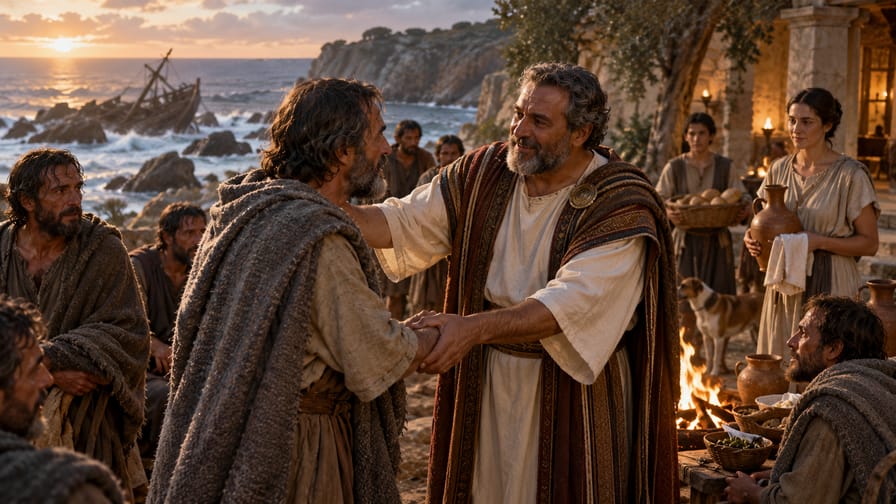
The figure of Publius, though briefly mentioned in the Scriptures, emerges as a character of notable importance in the account of Paul's missionary journey, as recorded in the book of Acts of the Apostles. His story, intrinsically linked to Paul's shipwreck on the island of Malta, offers valuable insights into divine providence, the dynamic of evangelization in the first century, and the comprehensiveness of God's grace.
This study aims to provide an in-depth biblical and theological analysis of Publius, exploring his onomastic significance, the historical context in which he lived, the characteristics of his character revealed in the narrative, and his theological relevance from an evangelical Protestant perspective. The implications of his existence for understanding the redemptive work of Christ and the expansion of the Kingdom of God will be highlighted.
The approach will be scholarly and encyclopedic, seeking historical and exegetical precision, based on the inerrant authority of the Scriptures. A conservative evangelical perspective will guide the interpretation, emphasizing Christocentric typology and the application of fundamental doctrinal principles.
1. Etymology and Meaning of the Name
The name Publius (in Greek, Pouplios, Πούπλιος) is of Latin origin, being a direct transliteration of the Roman name Publius. This was a praenomen (first name) or a nomen (family name) quite common in ancient Rome, indicating a connection with the public sphere or with the people.
The etymological root of Publius derives from the Latin word publicus, which means "of the people," "public," or "relating to the people." Thus, the literal meaning of the name Publius is "public" or "belonging to the people."
There are no significant variations of the name Publius in the original biblical languages, as it is a Roman proper name adopted directly into Koine Greek. The absence of other biblical characters with the same name makes the figure of Publius of Malta unique in the Scriptures.
The theological significance of the name, though not directly explored in the biblical text, can be seen indirectly. Being the "first" or "foremost" man of the island, his name, meaning "of the people," reflects his position of prominence and service to the local community, evidencing recognized and respected leadership.
The hospitality demonstrated by Publius, a man "of the people" and for the people, in receiving the apostle Paul and his shipwrecked companions, highlights the importance of community interaction and selfless service, values that echo in various biblical passages about caring for one's neighbor (*Romans 12:13* *Hebrews 13:2*).
2. Historical Context and Biblical Narrative
2.1 Historical Period and Geographical Context
The story of Publius is situated in the historical period of the Early Church, specifically around 60-61 A.D., during Paul's journey as a prisoner to Rome, as narrated in *Acts 27* and *28*. After a spectacular shipwreck, Paul and his companions were cast onto the island of Malta, an event that divine providence orchestrated for the expansion of the Gospel.
Malta, known in antiquity as Melita (Μελίτη), was a strategic island in the Mediterranean, located south of Sicily. At the time, the island was under Roman rule, being governed by an official who held the chief authority, which aligns with the description of Publius as the "first" or "foremost" man of the island (prōtos tēs nēsou).
The political and social context was that of an expanding Roman Empire, with its laws and administration present in all provinces. The predominant religion in Malta would have been Roman and local paganism, with worship of various deities, as observed in the reaction of the Maltese to the viper's bite on Paul (*Acts 28:4-6*).
2.2 Key Life Events and Biblical Passages
The biblical narrative presents Publius in a very specific and brief, yet impactful, period. He is introduced in *Acts 28:7*, where he is described as the "chief man of the island" (ho prōtos tēs nēsou) who welcomed Paul and his 275 traveling companions after the shipwreck.
His hospitality is immediately noted: "This man received us and entertained us hospitably for three days" (*Acts 28:7*). This act of welcome is the first and most striking trait of his revealed character.
The central event involving Publius is the miraculous healing of his father, who was sick in bed with fever and dysentery. Paul, upon being informed of the illness, "entered, prayed, laid his hands on him and healed him" (*Acts 28:8*). This miracle had a domino effect, for "when this happened, the rest of the people on the island who had diseases also came and were cured" (*Acts 28:9*).
The response of the Maltese to the miracles, which began in Publius's house, was one of great honor and gratitude: "They honored us with many honors, and when we were about to depart, they provided us with whatever we needed" (*Acts 28:10*). Publius's appearance in the narrative ceases after these verses, but his house became the epicenter of the manifestation of God's power on the island.
2.3 Relationships with Other Biblical Characters
Publius's primary relationship is with the apostle Paul. He is the host who offers refuge and sustenance to the apostle and his companions, becoming Paul's first official contact on the island. The healing of his father by Paul establishes a deep connection, based on gratitude and the testimony of divine power.
Indirectly, Publius also relates to Luke, the author of Acts, who was one of Paul's companions and an eyewitness to the events. It is probable that Luke recorded the details of the stay in Malta from his own experience and observation in Publius's house.
His interaction with the other inhabitants of the island is demonstrated by the fact that the healing of his father paved the way for the healing of many other Maltese people. Publius, in his position of leadership, likely facilitated Paul's access to the community, becoming a crucial link between the apostle and the people of Malta.
3. Character and Role in the Biblical Narrative
3.1 Analysis of Character and Virtues
Publius's character is revealed through his actions and the way Luke describes him. The most prominent and undeniable virtue is his hospitality. At a moment of great vulnerability for Paul and his companions, after a shipwreck, Publius welcomed them into his own house for three days (*Acts 28:7*).
This hospitality was not merely a formal gesture, but demonstrated genuine "kindness" (philanthrōpia, φιλανθρώπως), as the text suggests. He opened his home to a large number of strangers, evidencing generosity and compassion, qualities highly valued in both Roman culture and Christian ethics (*Romans 12:13*).
In addition to hospitality, Publius demonstrates respect and perhaps an openness to divine influence. By allowing Paul to enter his house to pray and lay hands on his father, he revealed an attitude of trust or, at minimum, of receptivity to a foreign religious practice. His position as "first man of the island" suggests that he was a man of status and responsibility, which makes his humility in seeking help for his father even more notable.
There is no record of documented sins, weaknesses, or moral failures for Publius in the biblical narrative, which is common for characters who appear briefly and in positive contexts. The Bible focuses on his virtuous actions that contributed to the narrative of divine providence.
3.2 Vocation and Specific Role
Publius's vocation is clearly identified as being the "first man of the island" (prōtos tēs nēsou, πρῶτος τῆς νήσου). This title, which some scholars consider a technical term for the governor or a chief magistrate in Malta, indicates that he held the highest civil authority on the island.
His role in the biblical narrative is multifaceted. Firstly, he serves as an instrument of God's providence, offering crucial refuge to Paul and his companions after the shipwreck. Without his welcome, the situation of the shipwrecked individuals would have been much more precarious.
Secondly, Publius's house becomes the stage for the manifestation of God's power through the healing of his father. This miracle not only alleviates the suffering of his family, but also serves as a catalyst for the healing of many other inhabitants of the island, establishing Paul's credibility and opening doors for the preaching of the Gospel.
Publius acts as a link between the messenger of the Gospel and the local community. His position and his favorable reaction to Paul's ministry facilitated the apostle's interaction with the Maltese, becoming an example of how individuals in positions of influence can positively impact the propagation of the faith.
3.3 Significant Actions and Key Decisions
Publius's actions, though few, are significant. The decision to host 276 people for three days, without doubt, represented a considerable logistical and financial effort, demonstrating his generosity and sense of responsibility towards those in need.
His decision to allow Paul to pray and lay hands on his sick father was crucial. This openness allowed the power of God to manifest, bringing healing and, subsequently, a great testimony to the entire island. It is an example of how faith and trust, even if incipient, can open doors for divine intervention.
The development of Publius's character is limited by the brevity of his appearance. However, his trajectory in the narrative shows a transition from a hospitable leader to someone who experiences God's power in his own family and, indirectly, for his community. He becomes a recipient of divine grace and a facilitator for others to also receive it.
4. Theological Significance and Typology
4.1 Role in Redemptive History and Progressive Revelation
The story of Publius, though secondary, plays a significant role in redemptive history by illustrating divine providence and the universal expansion of the Gospel. Paul's shipwreck in Malta, which could have been a disaster, is transformed by God into a missionary opportunity (*Romans 8:28*).
The interaction with Publius demonstrates that salvation and the manifestation of God's power are not restricted to Jews or to large urban centers, but reach the "ends of the earth" (*Acts 1:8*), even on a remote island in the Mediterranean. This reinforces the progressive revelation of God's plan to include the Gentiles in His covenant.
The event in Publius's house is a microcosm of Paul's mission to the Gentiles, showing how the Gospel manifests with signs and wonders, validating the apostolic message and opening hearts to faith (*Romans 15:18-19*).
4.2 Prefiguration or Christocentric Typology
Directly, Publius is not a typological figure of Christ in the classic sense of prefiguration. However, the healing event in his house and the subsequent evangelization in Malta can be seen as a prefiguration of the work of Christ and the mission of the Church in several ways.
The healing of Publius's father by Paul, through the power of the Holy Spirit, reflects the healing ministry of Jesus Christ, the Great Physician, who came to bring physical and spiritual restoration (*Matthew 4:23-24*). Paul, as an apostle of Christ, manifests the power that emanates from the Savior Himself.
Publius's hospitality can be interpreted as a symbol of the welcome that Gentiles receive into the family of God through Christ. Just as Publius opened his house to the apostle, Christ opens His arms to all who come to Him by faith, regardless of their origin (*Galatians 3:28*).
The manifestation of God's power in Malta, through Paul, is a testament to Christ's sovereignty over all circumstances, including the chaos of a shipwreck. It demonstrates that the Word of God cannot be imprisoned but advances irresistibly to fulfill divine purposes (*Philippians 1:12-14*).
4.3 Connection to Central Theological Themes
The story of Publius is intrinsically linked to several central theological themes of the evangelical faith. Divine providence is a striking theme, evidenced by the fact that a shipwreck, which could be a disaster, becomes a means for the propagation of the Gospel and the manifestation of God's power in Malta (*Proverbs 16:9*).
Divine healing is another prominent theme. The healing of Publius's father and the other inhabitants of the island demonstrates God's power to intervene in physical ailments, often associated with the preaching of the Gospel as a sign of its veracity (*Mark 16:17-18*).
Publius's hospitality is a practical example of Christian ethics, which values welcoming the stranger and the needy. This act of kindness not only reflects a virtuous character but also creates an environment conducive to missionary work (*Hebrews 13:2*).
Finally, Publius's story highlights the mission to the Gentiles. Malta, an island inhabited by non-Jews, receives the Gospel and experiences God's power through Paul, reinforcing the universal nature of salvation in Christ, which breaks down ethnic and cultural barriers (*Ephesians 2:11-22*).
God's sovereignty is manifest, for He uses a man of position, Publius, to facilitate the advancement of the Gospel. This event in Malta is a vivid testimony that God acts in all spheres of society to fulfill His redemptive purposes.
5. Biblical-Theological Legacy and Canonical References
5.1 Mentions of the Character and Influence on Biblical Theology
Publius is mentioned exclusively in *Acts 28:7-10*. There are no other direct references to him in any other biblical book, neither in the Old Testament, nor in other epistles or Revelation. He is not the author of any canonical book, nor are there records of his participation in significant ecclesiastical councils or decisions.
Despite his brief appearance, the figure of Publius and the event in his house have a subtle, yet important, influence on biblical theology, especially in the theology of the book of Acts. He exemplifies how divine providence operates through ordinary individuals in extraordinary circumstances to advance God's plan.
His story reinforces the doctrine of God's sovereignty, who uses apparently fortuitous events, like a shipwreck, to fulfill His missionary purposes. The healing of Publius's father serves as a powerful sign of apostolic authority and the truth of the Gospel, validating Paul's message before the Gentiles.
The narrative also underscores the importance of hospitality and generosity as Christian virtues that open doors for ministry. Publius's welcome was not merely an act of kindness, but a catalyst for the manifestation of God's power on the island of Malta.
5.2 Presence in Interpretive Tradition and Reformed Theology
In Christian interpretive tradition, Publius is often remembered as an example of hospitality and how God can use people in positions of influence for the advancement of the Gospel. Patristic and medieval commentators highlight his generosity and positive response to Paul's preaching.
Roman Catholic tradition, in particular, reveres Publius as the first bishop of Malta, although this has no direct biblical basis, being an inference from later ecclesiastical tradition. He is considered a saint and martyr in some traditions.
In Reformed and evangelical theology, the focus on Publius lies on the clarity of the narrative in Acts. He is seen as an example of God's providence, which prepares hearts and circumstances for the reception of the Gospel. The emphasis is on God's sovereignty in using means and people for His redemptive ends.
Theologians like John Calvin, when commenting on Acts, highlight God's goodness in caring for His servants even amidst adversities, and the manifestation of divine power through apostolic miracles. Publius fits perfectly into this framework as both a beneficiary and a facilitator of God's work.
5.3 Importance for Understanding the Canon
The story of Publius is vital for understanding the biblical canon, especially for the book of Acts, which narrates the expansion of the Gospel "to the ends of the earth" (*Acts 1:8*). His inclusion demonstrates the universality of the Christian message and God's ability to operate in any cultural or geographical context.
He serves as a testimony to the historical veracity of the book of Acts, providing specific details about Paul's journey, life on a Roman island, and interactions with local leaders. Luke's precision in describing the "first man of the island" is a point of validation for the historicity of the text.
The story of Publius, therefore, is not merely an interesting interlude, but an integral piece of the great mosaic of redemptive history. It reinforces the doctrine that God is active in human history, using both great figures and minor characters to fulfill His eternal purposes, culminating in the glory of Christ and the expansion of His Kingdom.
Thus, the figure of Publius, the hospitable "first man of the island" of Malta, remains a vivid reminder of divine providence, the efficacy of apostolic ministry, and the transformative power of the Gospel to reach and impact lives everywhere.