


Thaddeus
1. Etymology and Meaning of the Name
The figure of Thaddaeus in the Scriptures is marked by a notable onomastic ambiguity, which has generated considerable discussion and research among biblical scholars. The name Thaddaeus, in Greek Thaddaios (Θαδδαῖος), appears in the lists of apostles in Matthew and Mark (Matthew 10:3 Mark 3:18). The most accepted etymology for Thaddaios suggests an Aramaic origin, possibly from the term taddai (תַּדַּי), which means "breast" or "heart."
This derivation may imply qualities such as "courageous," "heartfelt," or "loving," suggesting a person of great sensitivity or bravery. Alternatively, some suggest a connection with the Greek name Theudas, although this is less probable and does not have the same etymological backing. The onomastic variation is a distinctive trait of this apostle.
In Luke 6:16 and Acts 1:13, the same apostle is identified as "Judas, son of James" (in Greek, Ioudas Iakōbou, Ἰούδας Ἰακώβου). The name Judas, Ioudas (Ἰούδας), derives from the Hebrew Yehudah (יְהוּדָה), which means "praise" or "he shall be praised." This identification is crucial to distinguish this Judas from the infamous Judas Iscariot, the betrayer of Jesus.
The confusion is even greater in some manuscripts of Matthew 10:3, where the name "Lebbaeus" (in Greek, Lebbaios, Λεββαῖος) is added, sometimes accompanied by Thaddaeus ("Lebbaeus, who was surnamed Thaddaeus"). The etymology of Lebbaios is uncertain, but it may come from the Hebrew levav (לֵבָב) or lev (לֵב), also meaning "heart," reinforcing the idea of a person of great heart or courage.
The theological significance of this multiplicity of names lies in divine providence. Regardless of the name by which he was known, the individual was chosen by Christ to be one of His twelve apostles, a foundation of the Church (Ephesians 2:20). The variation in names may reflect different regional contexts or nicknames, but his identity as an apostle remains unquestionable in the canon.
The association of names with meanings like "heart" and "praise" can, metaphorically, point to an apostle whose service was marked by sincere devotion and worship of God, even if his prominence in the biblical narrative is limited. This obscurity, paradoxically, highlights God's sovereignty in choosing the "humble" for His purposes, as per 1 Corinthians 1:27-29.
2. Historical Context and Biblical Narrative
2.1 Period and Socio-Religious Context
Thaddaeus lived in the first century AD, a period of great political and religious ferment in Judea and Galilee, under the dominion of the Roman Empire. Jewish society was divided into various factions, such as Pharisees, Sadducees, Essenes, and Zealots, each with its own interpretation of the Law and messianic expectations.
The ministry of Jesus of Nazareth (c. 27-30 AD) erupted in this scenario, challenging established structures and proclaiming the arrival of the Kingdom of God. Jesus' choice of the twelve apostles, including Thaddaeus, symbolized the restoration of the twelve tribes of Israel and the founding of a new community, the people of the Messiah (Matthew 19:28).
2.2 Family Origin and Geography
The Bible offers very few details about Thaddaeus's family origin. The designation "Judas, son of James" in Luke and Acts is the most concrete information. Although not explicitly stated, most of the apostles were from Galilee, suggesting that Thaddaeus might also have had his roots in this region, known for its working population and less orthodox views compared to Judea.
The geography of his life is intrinsically linked to the locations of Jesus' ministry: the villages and cities of Galilee, the region of Judea, and, centrally, Jerusalem, where the apostles gathered after Christ's ascension (Acts 1:4, 12). His life before being called by Jesus is a blank in the Scriptures, a common characteristic for many of the twelve.
2.3 Main Events and Biblical Passages
Thaddaeus's presence in the biblical narrative is discreet, but fundamental. He is mentioned in the four lists of apostles:
- Matthew 10:3: "Philip and Bartholomew Thomas and Matthew the tax collector James the son of Alphaeus, and Thaddaeus"
- Mark 3:18: "Andrew, and Philip, and Bartholomew, and Matthew, and Thomas, and James the son of Alphaeus, and Thaddaeus, and Simon the Cananaean"
- Luke 6:16: "Judas the brother of James, and Simon called the Zealot"
- Acts 1:13: "And when they had entered, they went up into the upper room, where abode Peter, and James, and John, and Andrew, Philip, and Thomas, Bartholomew, and Matthew, James the son of Alphaeus, and Simon the Zealot, and Judas the brother of James."
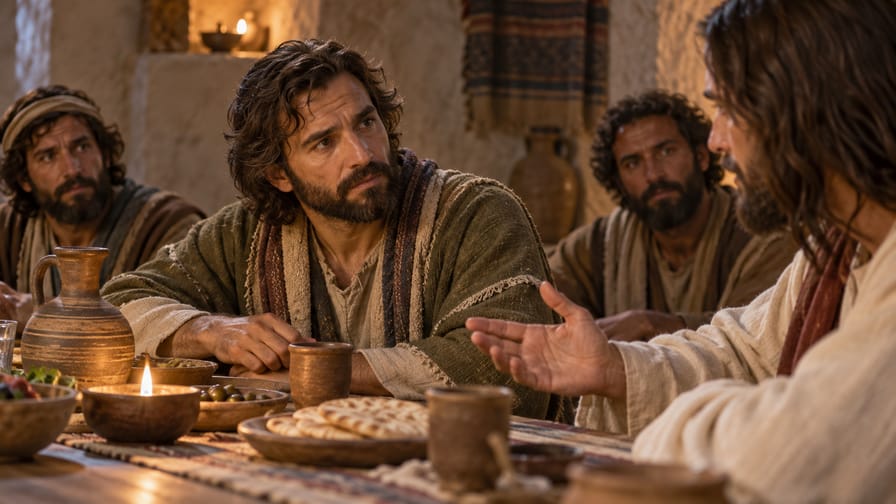
The only direct interaction of Thaddaeus with Jesus recorded in the Gospels occurs in John 14:22. After Jesus spoke about manifesting Himself to those who love Him and keep His commandments, Judas (not Iscariot) asked: "Lord, how is it that You will manifest Yourself to us, and not to the world?" This is the only time his voice is heard directly in the Scriptures.
This question from Thaddaeus is crucial, as it provokes one of Jesus' most profound revelations about the nature of divine communion and the dwelling of the Father and the Son in the believer. After Jesus' ascension, Thaddaeus is again mentioned as one of the apostles gathered in the upper room in Jerusalem, awaiting the fulfillment of the promise of the Holy Spirit (Acts 1:13). His participation in Pentecost and in the founding of the Church is inferred from his inclusion in this group.
3. Character and Role in the Biblical Narrative
3.1 Analysis of Character and Spiritual Qualities
The scarcity of direct information about Thaddaeus in the New Testament does not prevent us from inferring significant aspects of his character. His inclusion among the Twelve apostles by Jesus Christ (Matthew 10:1) already attests to his initial dedication and faith. The divine choice was not arbitrary, but based on God's foreknowledge and purpose for each individual.
Thaddaeus's question in John 14:22 reveals an inquisitive mind and a heart that sought to understand the depth of Jesus' teachings. He questioned the particularity of Christ's manifestation to the disciples, in contrast to the world. This curiosity is not one of skepticism, but of a sincere desire to comprehend the divine plan and the distinction between Jesus' followers and the unbelieving world.
This attitude suggests that Thaddaeus was someone who pondered Jesus' words, seeking practical and theological implications. He demonstrates a concern for justice and divine revelation, wanting to know why such a privilege would be exclusive to the disciples. This points to a quality of discernment and a yearning for spiritual clarity.
Thaddaeus's obscurity in the biblical narrative, in contrast to the prominence of figures like Peter, James, and John, may indicate a virtue of humility. He seems to have been content to serve without seeking prominence, a characteristic valued by Jesus (Matthew 23:12). His faithfulness, even in the absence of highlight, is a silent testimony.
3.2 Vocation and Specific Role
The primary role of Thaddaeus, like that of all the Twelve, was to be an apostle, one who is "sent" (from the Greek apostolos, ἀπόστολος). Jesus commissioned them to preach the Kingdom of God, heal the sick, and cast out demons (Matthew 10:7-8). They were eyewitnesses of Jesus' life, ministry, death, and resurrection, essential elements for their apostolic authority (Acts 1:21-22).
As part of the apostolic college, Thaddaeus contributed to the founding of the Christian Church. The apostles are described as the foundation upon which the Church is built, with Jesus Christ as the cornerstone (Ephesians 2:20). Even with few recorded actions, his presence and testimony were vital for the continuity of the gospel.
After Jesus' ascension, Thaddaeus was among the believers in the upper room, awaiting the outpouring of the Holy Spirit at Pentecost (Acts 1:13-14). This participation places him at the heart of the Church's birth and the reception of power to fulfill the Great Commission (Acts 1:8). His life, therefore, is an example of the call to discipleship and faithful service, even if in the background.
There are no specific sins or failures of Thaddaeus documented in the Scriptures. His life is presented as that of a loyal disciple and a dedicated apostle, whose main contribution was his presence and the question that generated a profound theological response from Jesus. He represents the faithful follower who, without great fanfare, fulfills his divine calling.
4. Theological Significance and Typology
4.1 Role in Redemptive History and Progressive Revelation
The inclusion of Thaddaeus among the Twelve apostles is, in itself, a theological affirmation of God's sovereignty in choosing His instruments. He is part of the select group that witnessed the fullness of God's revelation in Jesus Christ (Hebrews 1:1-2). His life and ministry, though little detailed, contribute to redemptive history by validating the continuity of the apostolic work initiated by Jesus.
As one of the Twelve, Thaddaeus symbolizes the foundation of the new covenant, established in the blood of Christ (Luke 22:20). The choice of twelve men echoes the twelve tribes of Israel, signaling the restoration and expansion of the people of God, now no longer limited by ethnicity, but by faith in Christ (Galatians 3:28).
4.2 Thaddaeus's Question and Christocentric Revelation
The most theologically significant moment of Thaddaeus is his question in John 14:22: "Lord, how is it that You will manifest Yourself to us, and not to the world?" This question, naive in its formulation, provokes one of Jesus' most profound declarations about the nature of divine revelation and intimate communion with His followers.
Jesus' response (John 14:23-24) is central to evangelical theology: "If anyone loves Me, he will keep My word and My Father will love him, and We will come to him and make Our home with him. He who does not love Me does not keep My words and the word which you hear is not Mine but the Father's who sent Me." Here, Jesus reveals that His manifestation is not an indiscriminate public spectacle, but a personal and spiritual experience reserved for those who love and obey Him.
This passage emphasizes the doctrine of divine indwelling, where the Father and the Son, through the Holy Spirit, dwell in the believer (John 14:16-17 Romans 8:9-11). Thaddaeus's question, therefore, serves as a catalyst for the revelation of the particular and relational nature of salvation and communion with God, a crucial theme in Christian theology.
4.3 Connection to Central Theological Themes
The figure of Thaddaeus, though discreet, connects to several central theological themes:
- Divine election: His choice as an apostle demonstrates God's sovereignty in calling whom He desires for His purposes (John 15:16).
- Faith and obedience: Jesus' answer to Thaddaeus intrinsically links love for Christ with keeping His words, emphasizing the importance of obedience as evidence of genuine faith (James 2:17).
- The nature of revelation: Christ's manifestation is selective, based on the relationship of love and obedience, not on a spectacle for the world, highlighting the distinction between believers and unbelievers.
- Intimacy with God: The promise that the Father and the Son will make their home in the believer is a doctrine of profound consolation and power for the Christian life.
From a typological perspective, Thaddaeus can be seen as a type of the faithful believer, who, although not prominent, contributes fundamentally to the Kingdom of God through his loyalty, sincere questioning, and obedience. His life points to the truth that faithfulness in obscure places is as valuable to God as service in prominence.
5. Biblical-Theological Legacy and Canonical References
5.1 Canonical Mentions and the Epistle of Jude
The canonical references to Thaddaeus are limited to the apostolic lists (Matthew 10:3 Mark 3:18 Luke 6:16 Acts 1:13) and his single recorded question (John 14:22). However, one of the most significant and debated aspects of his legacy lies in his possible authorship of the Epistle of Jude.
The Epistle of Jude presents itself as written by "Jude, a servant of Jesus Christ and brother of James" (Jude 1). Given Thaddaeus's identification as "Judas, son of James" in Luke and Acts, and the lack of any other prominent "Judas, brother of James" in the early days of the Church who was not Iscariot, most conservative evangelical theologians and biblical commentators consider it highly probable that the author of the epistle is the apostle Thaddaeus.
This identification would substantially transform Thaddaeus's legacy from an obscure apostle to an inspired author of a New Testament book. The Epistle of Jude is a concise and powerful work, which exhorts believers to "contend earnestly for the faith which was once for all delivered to the saints" (Jude 3), warning against false teachers and apostasy.
5.2 Literary Contributions and Influence on Biblical Theology
If the authorship of Jude is attributed to Thaddaeus, his literary contribution to the canon is immense. The Epistle of Jude is valued for its vigorous defense of the orthodox faith, its condemnation of the immoral and heretical, and its emphasis on perseverance and holiness. It serves as a perennial reminder of the need for discernment and vigilance within the Christian community.
The epistle addresses themes such as the authority of the Scriptures, the divine condemnation of the ungodly, the importance of prayer in the Holy Spirit, the preservation of the faith, and the glory of Christ. It reflects a profound pastoral concern for the doctrinal and moral purity of the Church, elements that would be consistent with an apostle who sought to understand the manifestation of Jesus and the distinction between believers and the world.
5.3 Presence in Tradition and Reformed and Evangelical Theology
In Church tradition, Thaddaeus is often associated with evangelistic missions in distant places, such as Mesopotamia, Persia, and Armenia, where he is said to have suffered martyrdom. Although these extra-biblical traditions do not possess canonical authority, they reflect the understanding that the apostles, including the less mentioned ones, were active instruments in the propagation of the Gospel.
In Reformed and evangelical theology, the emphasis is on the exclusive authority of Scripture. Thus, the main focus on Thaddaeus is on his identity as an apostle and, crucially, on the probability of him being the author of the Epistle of Jude. This identification elevates his theological importance, making him a defender of the faith and a fighter against heresy.
His figure, even if discreet, serves to reinforce the doctrine of divine election, the importance of each member in the body of Christ, and the faithfulness required of Jesus' followers. Thaddaeus's question in John 14:22 continues to be a key text for understanding the personal and intimate nature of Christ's revelation to His own and the promise of divine indwelling, themes that resonate deeply in evangelical piety.
In summary, Thaddaeus, the apostle with multiple names, represents the truth that God uses both the prominent and the obscure to fulfill His redemptive purposes. His contribution, whether through his presence in the apostolic lists, his single insightful question, or the authorship of a canonical epistle, is an enduring testament to God's faithfulness and the apostolic foundation of the Church.