


Nicolas
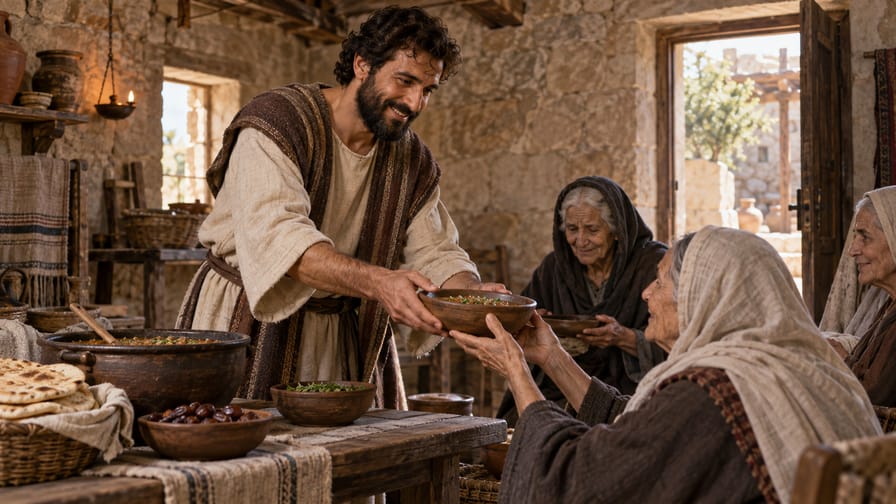
The figure of Nicolas, though briefly mentioned in the Scriptures, occupies a significant place in the narrative of the Early Church. He is one of the seven men chosen to serve tables, in one of the first manifestations of ecclesiastical organization. His identity and the potential of his connection with the Nicolaitans of Revelation generate important theological discussions.
This analysis will seek to explore the etymology of his name, the historical context of his appearance, the qualities attributed to him, his role in the founding of the church, and the theological implications of his mention, from a conservative evangelical Protestant perspective, grounded in the authority of Scripture.
1. Etymology and Meaning of the Name
1.1 Original Name and Linguistic Derivation
The name Nicolas derives from the Greek Nikolaos (Νικόλαος). It is a compound name formed by two Greek words: nikē (νίκη), which means "victory" or "triumph," and laos (λαός), which means "people" or "multitude."
Thus, the literal meaning of Nicolas is "victory of the people" or "conqueror of the people." This etymology is simple and straightforward, common for Greek names that combine concepts of success and community.
1.2 Literal and Symbolic Meaning of the Name
The literal meaning "victory of the people" can be interpreted in various ways. In a positive sense, it can evoke the idea of someone who leads the people to victory, or who is victorious on behalf of the people, perhaps as a defender or benefactor.
However, the term "conqueror of the people" can also have an ambiguous or negative connotation, especially if interpreted in the context of domination or manipulation. This duality becomes particularly relevant when considering the possible, though debated, association of Nicolas with the heresy of the Nicolaitans.
1.3 Variations of the Name and Other Characters
There are no significant variations of the name Nicolas in biblical languages that alter its fundamental meaning. He is consistently recognized as Nikolaos in the Greek New Testament.
Furthermore, there are no other biblical characters explicitly named Nicolas in the canonical Scriptures. This makes the figure in Acts 6:5 singular in his direct biblical mention.
1.4 Theological Significance of the Name in the Biblical Context
The theological significance of the name Nicolas in its immediate context in Acts 6 is limited. The text makes no allusion or wordplay with the meaning of his name in relation to his function or character. He is simply identified by his name.
However, the possible later connection, though not directly biblical, with the Nicolaitans (mentioned in Revelation 2:6, 15) confers upon the name a retrospective theological charge. If this connection were true, the name "conqueror of the people" would become ironically prophetic, indicating someone who, in some way, led God's people to apostasy or to submission to erroneous doctrines.
2. Historical Context and Biblical Narrative
2.1 Historical Period and Context of the Early Church
The mention of Nicolas occurs in the book of Acts of the Apostles, chapter 6, verse 5. This period corresponds to the early years of the Christian Church, shortly after the ascension of Jesus Christ and the outpouring of the Holy Spirit at Pentecost, around the 30s and 40s A.D.
The church in Jerusalem was experiencing exponential growth, as recorded in Acts 2:41, 47 and Acts 4:4. This rapid growth brought with it organizational and social challenges that required new structures of leadership and service.
2.2 Political, Social, and Religious Context
The social context was complex, marked by the coexistence of Hebrew-speaking Jews (Hebrews) and Greek-speaking Jews (Hellenists) within the Christian community. The Hellenist widows were being neglected in the daily distribution of food, a problem that threatened the unity of the church, according to Acts 6:1.
Spiritually, the church operated under the shadow of Judaism, from which many converts had come. The distinction between "serving tables" and "ministering the word" (Acts 6:2, 4) illustrates the need to balance spiritual and practical responsibilities within the nascent community.
2.3 Family Origin and Genealogy
The Scriptures do not provide details about the genealogy or family origin of Nicolas. However, a crucial detail is provided: he is described as a "proselyte from Antioch" (Acts 6:5). A proselyte was a Gentile who had converted to Judaism, accepting the Law and circumcision.
Antioch of Syria was one of the largest and most important cities in the Roman world, with a significant Jewish and Hellenistic population. The identification of Nicolas as a proselyte from Antioch suggests that he was a Jew converted from paganism, from a cosmopolitan city, which made him a valuable link between the different cultures within the early church.
2.4 Key Life Events and Biblical Passages
The only direct mention of Nicolas in the Bible occurs in Acts 6:5, where he is listed as one of the seven men chosen by the community to oversee the distribution of food to the widows. The text says: "And the saying pleased the whole multitude, and they chose Stephen, a man full of faith and of the Holy Spirit, and Philip, and Prochorus, and Nicanor, and Timon, and Parmenas, and Nicolas, a proselyte from Antioch."
This choice was a response to the murmuring of the Hellenists (Acts 6:1) and aimed to allow the apostles to devote themselves to prayer and the ministry of the word (Acts 6:4). The appointment of the Seven is a seminal event in church history, establishing a model for the practical administration of the community.
2.5 Geography Related to the Character and Relationships
The primary geography associated with Nicolas is Antioch, his city of origin, and Jerusalem, where he was chosen to serve. Antioch later became a crucial center for the Gentile mission and a starting point for Paul's missionary journeys (Acts 13:1-3).
In Jerusalem, Nicolas related with the apostles and with the other six elected men, among whom Stephen and Philip would later stand out for their evangelistic ministries and miracles (Acts 6:8-15 Acts 8:4-40).
3. Character and Role in the Biblical Narrative
3.1 Analysis of Character as Revealed in the Scriptures
Although the Bible does not provide an extensive narrative about the character of Nicolas, it offers a succinct and powerful description at the time of his election. He was chosen because he was "a man full of the Spirit and of wisdom" (Acts 6:3, literal translation from the Greek plērēs pneumatos kai sophías).
This qualification is notable, as it was the same required for all seven, indicating that service leadership in the early church was not merely administrative, but deeply spiritual. The fullness of the Holy Spirit implied a life of holiness and divine power, while wisdom denoted discernment and ability to deal with practical and interpersonal matters.
3.2 Virtues and Spiritual Qualities Evidenced
The mention of Nicolas as "full of the Spirit and of wisdom" reveals essential virtues. The fullness of the Holy Spirit is an indicator of his faith and communion with God, a testimony to his life transformed by Christ. Wisdom, in turn, suggested his capacity to make prudent and just decisions, especially in a sensitive context of resource distribution.
His origin as a proselyte from Antioch can also indicate an open mind and cultural adaptability, valuable qualities for bridging the gap between the Hebrew and Hellenist factions of the church. He represented the diversity and inclusion that characterized the nascent church.
3.3 Documented Sins, Weaknesses, and Moral Failings
The Scriptures do not document any sin, weakness, or moral failing of Nicolas. The narrative of Acts 6 presents him in an entirely positive light, as an individual qualified and approved by the community and the apostles for an important ministry of service.
The absence of any direct biblical criticism is a crucial point for the conservative evangelical perspective, which adheres strictly to what the Word of God explicitly reveals about the individual.
3.4 Vocation, Calling, or Specific Function
The vocation of Nicolas was to serve tables (διακονεῖν τραπέζαις), a function that involved the practical administration of church resources and ensuring that the needs of the widows, especially the Hellenists, were met fairly.
Although the term "deacon" is not used explicitly for the Seven in Acts 6, many theologians and commentators view this institution as the prototype of the diaconal office in the Christian church. Their role was to relieve the apostles of administrative tasks so that they could focus on the ministry of the Word and prayer (Acts 6:2, 4).
3.5 Significant Actions and Key Decisions
The most significant action of Nicolas recorded in the Bible is his election to service. His acceptance of this calling was a key decision that impacted the organization of the church and the resolution of an internal conflict. He participated in the creation of a ministry model that combined the spiritual with the practical and social dimensions.
His inclusion in the group of the Seven, alongside such prominent figures as Stephen and Philip, underscores the importance of his contribution, even if his individual deeds are not detailed like those of his colleagues.
4. Theological Significance and Typology
4.1 Role in Redemptive History and Progressive Revelation
The inclusion of Nicolas in the list of the Seven in Acts 6 plays a role in the progressive revelation of the Church's organization. It demonstrates divine wisdom in structuring a rapidly growing community, necessitating different gifts and ministries (Romans 12:4-8 1 Corinthians 12:4-31).
The church was not merely a spiritual assembly, but a community with practical needs, and the provision for these needs was an integral part of its redemptive mission, reflecting God's care for His people, manifested in the practice of charity and social justice (James 1:27).
4.2 Christocentric Prefiguration or Typology
There is no direct Christocentric prefiguration or typology associated with Nicolas. He is not presented as a type of Christ in a prophetic or symbolic sense. However, his service and the service of the Seven, in general, can be seen as a reflection of the ministry of servitude of Jesus Christ, who came not to be served but to serve, and to give his life as a ransom for many (Mark 10:45).
In this broader sense, Nicolas's willingness to serve the practical needs of the community echoes the example of the Messiah himself, who demonstrated compassion and care for the multitudes (Matthew 14:14).
4.3 Connection with Central Theological Themes
The story of Nicolas and the Seven connects with central theological themes such as the unity of the Church, Christian service (diaconia), the importance of prudent administration, and the primacy of the ministry of the Word and prayer. His election underscores that practical service is a spiritual ministry, requiring spiritual qualities such as the fullness of the Spirit and wisdom (Acts 6:3).
The situation that led to his appointment also highlights the importance of social justice within the community of faith, ensuring that no one was neglected, echoing Old Testament principles regarding the care for orphans and widows (Deuteronomy 10:18 Isaiah 1:17).
4.4 Doctrine and Teachings Associated with the Character: The Nicolaitans
The most debated and theologically charged aspect regarding Nicolas is his possible connection with the heretical sect of the Nicolaitans, mentioned in the letters to the churches of Ephesus and Pergamum in Revelation 2:6, 15. The church in Ephesus is praised for hating the works of the Nicolaitans, while the church in Pergamum is rebuked for having among them those who followed their doctrine.
The Nicolaitans seem to have promoted a form of antinomianism, allowing the consumption of food sacrificed to idols and sexual immorality, practices that were a significant temptation for Gentile Christians of the time (cf. Acts 15:20, 29). The tradition of the early church, notably Church Fathers such as Irenaeus (in Adversus Haereses), Tertullian, and Clement of Alexandria, associated the Nicolaitans with Nicolas from Acts 6, suggesting that he had apostatized or that his followers distorted his teachings.
However, the conservative evangelical Protestant perspective generally rejects this direct connection due to a lack of explicit biblical evidence. The text of Acts 6 presents Nicolas as a man of good reputation, "full of the Spirit and of wisdom." It would be a drastic and undocumented fall for someone with such qualifications to become the founder of such a serious heresy.
Many evangelical scholars argue that "Nicolaitans" could be a symbolic name, meaning "conquerors of the people," or refer to another individual named Nicolas. The absence of any biblical indication in Acts regarding an apostasy by Nicolas leads to caution in accepting patristic tradition. Primary biblical authority requires us to limit ourselves to what the Scriptures directly state.
5. Biblical-Theological Legacy and Canonical References
5.1 Mentions of the Character in Other Biblical Books
The only direct canonical mention of Nicolas is found in Acts 6:5. The references to the Nicolaitans in Revelation 2:6, 15 are distinct and do not explicitly identify him with the Nicolas of Acts. From the perspective of strict biblical exegesis, there are no other occurrences of the character in the Scriptures.
This means that his biblical legacy, according to the Protestant canon, must be constructed primarily from his brief, yet significant, appearance in the book of Acts.
5.2 Literary Contributions and Influence on Biblical Theology
Nicolas is not the author of any biblical book or epistle. His literary contribution is indirect, through his inclusion in the narrative of Acts, which serves as a historical and theological record of the formation of the Early Church.
His influence on biblical theology resides primarily in his role in the institution of the diaconal ministry. The choice of the Seven, including Nicolas, established a precedent for the division of labor and the importance of practical service in the church, complementing the ministry of the Word (Acts 6:2-4). This model is fundamental for Protestant ecclesiology.
5.3 Presence in Jewish and Christian Interpretive Tradition
In Jewish interpretive tradition, Nicolas holds no direct relevance, as his figure belongs to the Christian period. In Christian tradition, however, his figure is subject to debate due to the aforementioned connection with the Nicolaitans.
The Church Fathers, such as Irenaeus, Tertullian, and Hippolytus, frequently associated Nicolas of Acts 6 with the founder of the Nicolaitans, based on extrabiblical accounts and the similarity of names. This tradition influenced many interpretations throughout church history.
5.4 Treatment of the Character in Reformed and Evangelical Theology
In Reformed and evangelical theology, there is a strong emphasis on Sola Scriptura (Scripture alone). Therefore, the connection between Nicolas of Acts and the Nicolaitans of Revelation is treated with great skepticism or explicit rejection. Commentators such as John Calvin, Matthew Henry, and many contemporary evangelical theologians, such as F.F. Bruce and John Stott, prefer not to link the two, given the absence of biblical evidence.
The dominant view is that Nicolas of Acts 6 was a man of faith and wisdom, who faithfully fulfilled his calling. Attributing to him the founding of a heresy without direct biblical support would be speculative and unfair to the description that the Word of God offers us of him. The legacy of Nicolas, therefore, is that of one of the earliest and exemplary ministers of service in the Church.
5.5 Importance of the Character for Understanding the Canon
The inclusion of Nicolas and the Seven in Acts is vital for understanding the canon, as it illustrates how the church, under the guidance of the Holy Spirit and the apostles, began to develop structures to deal with its internal and external challenges. This demonstrates the organic and functional nature of the church, which seeks order for the glory of God and the well-being of its members.
His story, however brief, highlights the importance that every ministry, whether of the Word or of service, must be exercised by individuals full of the Spirit and of wisdom, ensuring that the church remains faithful to its divine calling (1 Peter 4:10-11).