


Bartimaeus
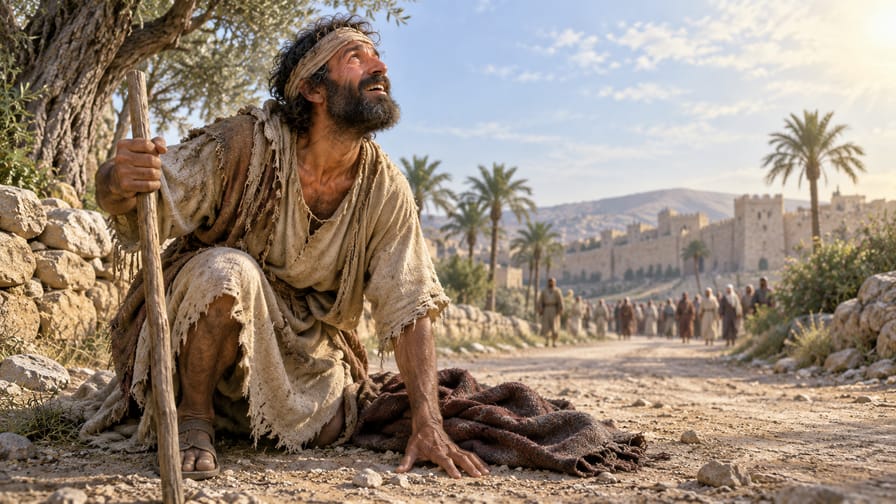
The figure of Bartimaeus, the blind beggar from Jericho, is one of the most vivid and theologically rich narratives in the Synoptic Gospels. His story, though relatively brief, offers profound lessons on faith, grace, discipleship, and the messianic identity of Jesus Christ. From an evangelical Protestant perspective, Bartimaeus is not merely a recipient of a miracle, but a model of how humanity, in its spiritual blindness and marginalization, can find salvation and a new purpose by crying out for and following the Lord Jesus.
His narrative is a testament to Christ's compassion and the effectiveness of persistent faith, resonating with central themes of evangelical soteriology and Christology. The analysis of Bartimaeus transcends mere historical account, becoming a paradigm for the experience of conversion and the call to radical discipleship. This study aims to explore his onomastic meaning, the context of his story, his character, and his theological relevance, as outlined in the Scriptures.
1. Etymology and meaning of the name
The name Bartimaeus appears specifically in the Gospel of Mark 10:46, being the only one of the blind beggars healed by Jesus to be named in the Synoptic Gospels. The name in Greek is Bartimaios (Βαρτιμαῖος). Its structure is of Semitic origin, combining the Aramaic term Bar (בַּר), meaning "son of", with the name Timaios (Τιμαῖος), which is a Greek transliteration of an Aramaic or Hebrew name. Thus, the name literally means "son of Timaeus" or "son of Timaeus".
The etymology of Timaios is debated. Some suggest a Hebrew root ṭāmēʾ (טָמֵא), meaning "unclean" or "blind", which would be poetically ironic for a blind man. However, most scholars agree that Timaios is a transliteration of an Aramaic personal name no longer commonly known or, more likely, a common Greek name meaning "honorable" or "esteemed". Mark himself explains Bartimaeus's name as ho huios Timaiou (ὁ υἱὸς Τιμαίου), "the son of Timaeus", reinforcing the interpretation that Timaios is the father's name.
The inclusion of the father's name is significant because, in Jewish culture, identity was often linked to paternal lineage. Although **Bartimaeus's** father is not known from other sources, the mention of his name, even if through his son, confers upon **Bartimaeus** an individuality and an identity that the other healed blind men do not receive in the synoptic narrative. This may indicate a specific source of information for Mark or the intention to highlight the person of **Bartimaeus**.
The theological significance of the name is subtle but profound. If Timaios carries the meaning of "honorable", Bartimaeus's situation as a blind beggar contrasts dramatically with the potential meaning of his name. He was "son of an honorable man", but lived in social and physical disgrace. His healing, therefore, not only restores his sight but also his dignity and "honor", aligning him more fully with the potential of his name and, more importantly, with his identity in Christ.
There are no other prominent biblical characters with the name Bartimaeus. The uniqueness of his mention by Mark, in contrast to Matthew and Luke who leave him anonymous or mention two blind men, suggests that his story was particularly well-known or important in the tradition Mark was recording. The name, therefore, not only identifies him but also underscores the specificity of Jesus' compassion for a marginalized individual.
2. Historical context and biblical narrative
Bartimaeus's narrative is situated at a crucial moment in Jesus' ministry, shortly before His triumphal entry into Jerusalem and His Passion. This event occurs as Jesus and His disciples, accompanied by a large crowd, were departing from Jericho (Ierichō, Ἱεριχώ) on their way to Jerusalem (Ierousalem, Ἱερουσαλήμ) (Mark 10:46 Matthew 20:29). Luke, in turn, narrates a similar event of healing a blind man as Jesus approached Jericho (Luke 18:35), which has been a subject of harmonization discussion.
Conservative evangelical perspective often harmonizes the narratives by suggesting that Luke may be referring to the region of Jericho, while Mark and Matthew refer to the city of Jericho. Alternatively, some propose that there were two events of healing blind men in Jericho, one at the entrance and one at the exit, or that Matthew mentions two blind men where Mark and Luke focus on one. The consensus, however, is that the story of Bartimaeus named by Mark is the most detailed and central for analysis.
The historical period is the early 1st century A.D., under Roman rule in Judea. The city of Jericho, located in the Jordan Valley, was a prosperous city, known for its palm trees and balsam, and an important commercial and pilgrimage center, serving as a stop for those traveling from Galilee to Jerusalem. The presence of a large number of people in transit made it a favorable location for beggars, like Bartimaeus.
The social context of the time was one of profound marginalization for people with disabilities, especially blindness. Blind people were often considered cursed by God or punished for sins (cf. John 9:2). They depended on charity to survive, lacking access to work opportunities or social inclusion. Bartimaeus's blindness, therefore, was not merely a physical disability but a symbol of his social and religious exclusion.
The key narrative is found in Mark 10:46-52. Bartimaeus was sitting by the roadside, begging, when he heard that Jesus of Nazareth was passing by. He began to cry out loudly, "Jesus, Son of David, have mercy on me!" (Mark 10:47). The crowd tried to silence him, but he cried out all the more. Jesus, hearing him, stopped and commanded him to be called. Bartimaeus, throwing aside his cloak, stood up and came to Jesus. Jesus asked him what he wanted, and Bartimaeus replied, "Teacher, that I may see!" (Mark 10:51). Jesus then said, "Go, your faith has saved you!" And immediately he recovered his sight and followed Jesus on the way (Mark 10:52).
There is no information about Bartimaeus's genealogy or family origin beyond his father's name, Timaeus. His identity is defined by his condition and, subsequently, by his faith and Christ's action. He relates directly to Jesus Christ and, indirectly, to the disciples and the crowd that accompanied the Lord. The crowd represents both the social barrier and the witness of Christ's work.
3. Character and role in the biblical narrative
Bartimaeus's character, as revealed in the brief but impactful Gospel narrative, is marked by extraordinary faith, persistence, and an immediate response to Jesus' call. He is not a passive character on the contrary, his actions demonstrate a deep spiritual understanding and an ardent desire for divine intervention.
Bartimaeus's most prominent virtue is his faith. He recognizes Jesus not only as a healer but as the promised Messiah, the "Son of David" (Mark 10:47). This title is a significant messianic confession, indicating that, despite his physical blindness, Bartimaeus possessed a keen spiritual insight into Jesus' identity. His faith was not merely intellectual assent, but an active and desperate trust in Jesus' ability to grant him mercy.
His persistence is another notable quality. When the crowd tried to silence him, rebuking him for bothering the Teacher, Bartimaeus did not keep silent. On the contrary, "he cried out all the more" (Mark 10:48). This refusal to be silenced, overcoming social pressure and ostracism, demonstrates an unwavering determination to reach Jesus. He understood the urgency of the moment and the uniqueness of the opportunity.
Bartimaeus's **symbolic action** of throwing his cloak aside (Mark 10:50) is profoundly significant. A beggar's cloak was his most valuable possession, his blanket, his means of collecting alms, and perhaps even his bed. By throwing it, **Bartimaeus** demonstrates his conviction that he would no longer need it, expressing total abandonment of his old life of dependence and misery. It is a gesture of total surrender and unwavering hope, an act of faith that precedes and anticipates his healing.
Bartimaeus's role in the narrative is multifaceted. He serves as an **example of Jesus' compassion** for the marginalized and suffering. His story illustrates Jesus' power to perform miracles, confirming His divine authority and His messianic identity. More importantly, **Bartimaeus** is a **model of saving faith**. Jesus explicitly attributes **Bartimaeus's** healing to his faith: "Your faith has saved you" (Mark 10:52). This declaration underscores the evangelical doctrine of salvation by grace through faith.
Furthermore, **Bartimaeus** plays the role of a **true disciple**. After being healed, he did not merely go home, but immediately "followed Jesus on the way" (Mark 10:52). This act of following Jesus is the hallmark of radical discipleship. He abandons his old life and joins Jesus' entourage, becoming an active follower. His character development is instant and complete: from a blind and marginalized beggar to a follower of Christ with full vision, both physical and spiritual.
4. Theological significance and typology
The story of Bartimaeus is rich in theological significance and Christocentric typology, serving as a powerful illustration of several central themes of evangelical Protestant faith. His narrative is not merely a record of a miracle, but a living parable of the human experience of redemption and discipleship.
Firstly, **Bartimaeus's** healing is a fulfillment of **messianic prophecies**. The Old Testament frequently associates the coming of the Messiah with the opening of the eyes of the blind (Isaiah 35:5 Isaiah 42:7). Jesus' ability to restore sight was not merely an act of compassion but an unequivocal demonstration that He was God's Anointed One, bringing the Kingdom of God to earth. His redemptive work is manifested in the complete restoration of the individual.
Bartimaeus's cry, "Jesus, Son of David, have mercy on me!" (Mark 10:47), is crucial. The title "Son of David" is a messianic confession that recognizes Jesus as the rightful heir to David's throne and the promised **King** of Israel (cf. 2 Samuel 7:12-16). By using this title, **Bartimaeus** demonstrates a spiritual understanding that many religious leaders of the time did not possess. His faith was not blind, but discerned the true identity of Christ.
Bartimaeus's physical blindness serves as a powerful **metaphor for the spiritual blindness** of humanity. All human beings, in their fallen state, are spiritually blind, unable to see the truth of God and the glory of Christ (cf. 2 Corinthians 4:4). **Bartimaeus's** restoration of sight typifies the spiritual illumination that occurs in conversion, when the Holy Spirit opens the eyes of the heart to the light of the gospel (Ephesians 1:18).
Bartimaeus's act of throwing his cloak aside symbolizes the **abandonment of the old life** of sin and dependence on self or the world, and total surrender to Christ. It is a gesture of detachment that represents the renunciation of everything that hinders the encounter with the **Savior**. This is a central theme in evangelical conversion theology, where saving faith implies a radical change in direction and priorities.
Jesus' response, "Your faith has saved you" (Mark 10:52), is a fundamental affirmation of the doctrine of **salvation by faith** (sola fide). It was not **Bartimaeus's** works, his begging, or his suffering that saved him, but his faith in Jesus. This declaration resonates with Pauline passages that emphasize salvation as a gift of God's grace, received by faith (Ephesians 2:8-9 Romans 3:28). **Bartimaeus's** faith was not passive, but active, manifested in his persistent crying out and his readiness to go to Jesus.
Finally, **Bartimaeus's** act of "following Jesus on the way" after his healing (Mark 10:52) establishes a crucial link with the theme of **discipleship**. True saving faith is not barren it results in a life of obedience and following Christ. **Bartimaeus's** healing was not an end in itself, but the beginning of a new journey of discipleship. He becomes an example of how God's grace transforms not only the individual's condition but also their life's purpose.
5. Biblical-theological legacy and canonical references
The story of Bartimaeus, although primarily concentrated in Mark 10:46-52, with parallels in Matthew 20:29-34 and Luke 18:35-43, has a significant biblical-theological legacy that transcends its brief mention. His narrative contributes to the understanding of crucial New Testament themes and has been a perennial source of reflection in Christian interpretative tradition.
The variations in the Synoptic accounts – Mark naming Bartimaeus, Matthew mentioning two blind men, and Luke an unnamed blind man and the slightly different location – are important points of study for evangelical hermeneutics. The conservative approach generally advocates for the inerrancy and infallibility of the Scriptures, seeking harmonizations that respect the integrity of each Gospel. It is argued that Mark may have focused on Bartimaeus because he was the most prominent or well-known, while Matthew included the other blind man. The difference in location in Luke is often explained by the reference to the region of Jericho, rather than the exact city, or by the possibility of multiple similar events.
Bartimaeus's influence in biblical theology lies primarily in his personification of saving faith and true discipleship. He is frequently cited in discussions about the nature of faith (sola fide), the compassion of Christ, and the radical transformation that occurs in conversion. His story serves as a powerful illustrated sermon on the need to cry out to Christ, Christ's readiness to respond, and the believer's appropriate response (following Jesus).
In Christian interpretive tradition, from the Church Fathers to the reformers and contemporary evangelical theologians, Bartimaeus is an emblematic figure. Augustine of Hippo, for example, saw in **Bartimaeus's** blindness the blindness of humanity due to sin, and in the healing, the illumination of grace. John Calvin, in his commentaries, highlighted the persistence and sincerity of **Bartimaeus's** faith as a model for all who seek God, emphasizing that faith is not sluggish, but active and crying out.
In Reformed and evangelical theology, the story of Bartimaeus is frequently used to illustrate:
- The **total depravity** of man, symbolized by blindness and inability to help oneself.
- The **irresistible grace** of God, manifested in Jesus' initiative to stop and call **Bartimaeus**, even when the crowd rebuked him.
- The **efficacy of faith** as the only means of receiving salvation and healing from Christ.
- The call to **radical discipleship**, evidenced by **Bartimaeus's** willingness to abandon everything and follow Jesus.
His legacy is that of a man who, despite his marginalization and disability, demonstrated superior spiritual insight, cried out in faith, and upon receiving Christ's mercy, dedicated his life to following Him. Bartimaeus, the son of Timaeus, became a son of God and an exemplary disciple, whose testimony continues to inspire and challenge believers of all generations to seek Jesus with the same urgency and faith.
Bartimaeus's relevance for understanding the canon lies in how his story fits into the larger panorama of Jesus' messianic revelation. It immediately precedes the triumphal entry into Jerusalem, serving as a final and powerful public testimony to Jesus' identity as **Messiah** and **Lord** before His Passion. The story of **Bartimaeus** confirms that faith in the "Son of David" is the path to salvation and true vision, setting the stage for the culminating events of Christ's redemptive work.