


Colossesi
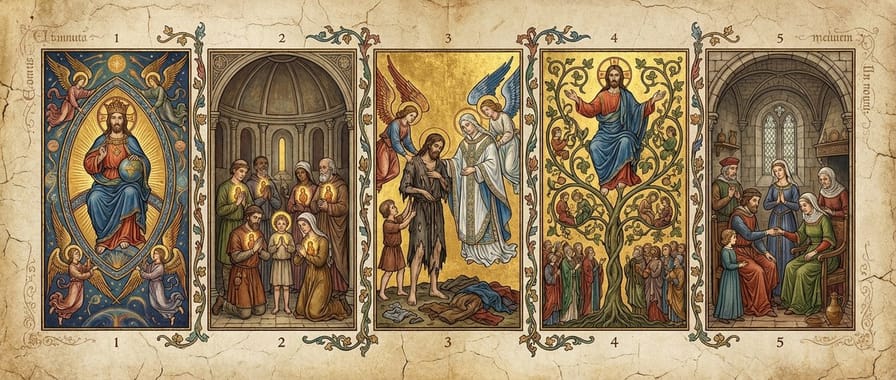
Illustration of the Book of Colossians, one of the 27 books of the New Testament (Nano Banana Pro).
The introduction to any book of the Bible transcends the mere presentation of historical facts; it is a hermeneutical portal that invites the reader to delve into the depths of divine revelation, comprehending the text in its original context and discerning its perennial relevance for contemporary faith and life. From a Protestant evangelical perspective, each book of the Holy Scriptures is a word inspired by God, inerrant in its autographs and authoritative for all generations. The approach, therefore, must be reverent, academically rigorous, and theologically committed to revealed truth.
As we approach Paul's Epistle to the Colossians, we are confronted with a theological gem that exalts the person and work of Jesus Christ in a unique and powerful way. This book, though concise, is one of the pillars of New Testament Christology, offering a robust defense against the infiltration of false doctrines and a vibrant call to a life of holiness, centered on the sufficiency of Christ. Our journey through this introduction will seek to establish a comprehensive model of biblical analysis, exploring the historical setting, literary structure, theological themes, canonical connections, and interpretive challenges.
The objective is not merely to inform, but also to equip the reader with tools for faithful exegesis and transformative application, always guided by the conviction that the Bible is the living and effective Word of God. The Epistle to the Colossians, in particular, resonates with urgency in a pluralistic and syncretistic world where the uniqueness and supremacy of Christ are constantly challenged. It calls us to return to the simplicity and depth of faith in the Lord Jesus Christ, the head of all things and the reconciler of all creation.
This introduction will be built upon the pillars of Reformed theology, which emphasizes the sovereignty of God, the authority of the Scriptures, the total depravity of man, salvation by grace through faith alone in Christ, and the glory of God as the ultimate end of all things. In doing so, we hope not only to uncover Colossians but also to demonstrate a path for understanding any book of the biblical canon, always with our eyes fixed on Christ, who is the Alpha and the Omega of all revelation.
1. Historical context, dating, and authorship
Understanding the Epistle to the Colossians requires a careful immersion in its historical context, which encompasses the Greco-Roman world of the first century, the peculiarities of the city of Colossae, and, crucially, the identity of its author. The conservative evangelical Protestant perspective firmly defends traditional Pauline authorship, situating the book within the period of the so-called "prison epistles."
1.1 Pauline authorship and its traditional defense
The Epistle to the Colossians, from the oldest manuscripts and patristic citations, is attributed to the apostle Paul. The text itself begins with the declaration: "Paul, an apostle of Christ Jesus by the will of God, and Timothy our brother" (Colossians 1:1). This is a distinctive mark of the Pauline epistles, reflecting his apostolic authority and his identity as a servant of Christ. The epistle concludes with a greeting written in his own hand: "I, Paul, write this greeting with my own hand. Remember my chains. Grace be with you" (Colossians 4:18), reinforcing his literary paternity.
Historically, the acceptance of Pauline authorship has been almost universal in the early church. Church Fathers such as Irenaeus, Clement of Alexandria, Tertullian, and Origen consistently cited Colossians as Paul's work. The Muratorian Canon, one of the oldest catalogs of New Testament books, also includes Colossians among the Pauline epistles. This external evidence is robust and consistent, pointing to a unanimous conviction in the ancient church.
However, modern higher criticism, beginning in the 19th century, raised questions about the Pauline authorship of Colossians, along with Ephesians and 2 Thessalonians. The main objections are based on alleged differences in vocabulary and style compared to "undisputed" Pauline epistles (Romans, 1 and 2 Corinthians, Galatians) and on an alleged more developed theology, particularly the Christology, which some critics consider anachronistic for the historical Paul. It is argued that the language about Christ as "head of every rule and authority" (Colossians 2:10) and the "fullness of God" (Colossians 1:19) represents a later stage of Christian theology.
In response to these criticisms, evangelical scholars contend that stylistic and vocabulary variations are perfectly explicable. Paul was a versatile author, adapting his style and vocabulary to the audience and purpose of each letter. The presence of an amanuensis, such as Tychicus (Colossians 4:7), who might have had some freedom in drafting under Paul's supervision, can also justify certain nuances. Furthermore, the theology of Colossians does not represent a rupture but an organic development and specific application of themes already present in Paul's earlier letters, especially in his defense of Christ's supremacy against emerging heresies. The need to combat a particular heresy in Colossae demanded a deeper and more explicit exploration of the supremacy of Christ, which would naturally lead to a denser and more specific formulation of Christology.
1.2 Dating and context of writing
The Epistle to the Colossians is widely considered one of the "prison epistles," along with Ephesians, Philippians, and Philemon. This is evident from Paul's references to his chains and captivity (Colossians 4:3, 4:18). The most widely accepted dating by conservative scholars places the writing during Paul's first imprisonment in Rome, around 60-62 A.D. This dating harmonizes well with the account in Acts 28, where Paul is held under house arrest in Rome, with permission to receive visitors and preach the gospel.
The reason for writing was the news of a serious heresy that was infiltrating the church in Colossae, a city in the Roman province of Asia Minor (modern-day Turkey). This news was brought to Paul by Epaphras, the founder of the Colossian church (Colossians 1:7, 4:12-13). The church in Colossae was not founded by Paul personally, but by Epaphras, probably during Paul's ministry in Ephesus (Acts 19:10), when "all who dwelt in Asia heard the word of the Lord, both Jews and Greeks."
Colossae, though not a prominent metropolis like Ephesus, was a city located on an important trade route in the Lycus River valley, near Laodicea and Hierapolis. The region was a cultural melting pot, where Greco-Roman, Jewish, and Eastern influences intermingled. This cultural mix fostered a fertile environment for religious and philosophical syncretism, which paved the way for the emergence of the heresy Paul addresses.
1.3 The Colossian heresy: a syncretistic challenge
Although Paul does not describe the Colossian heresy in explicit detail, he vehemently combats it, allowing us to infer its characteristics. It appears to have been a complex mixture of Jewish, philosophical, and mystical-ascetic elements. It included:
- Jewish legalism: Observance of festivals, new moons, Sabbaths, and dietary restrictions (Colossians 2:16-17).
- Asceticism: Emphasis on "Do not handle, Do not taste, Do not touch" (Colossians 2:21), with a false humility and mortification of the body (Colossians 2:23).
- Worship of angels: An undue veneration of angelic beings, perhaps as mediators between God and men (Colossians 2:18).
- Mysticism and "visions": A search for spiritual experiences and secret knowledge (gnosis), based on human speculations and not on the revelation of Christ (Colossians 2:18).
- Philosophy and deception: Dependence on "philosophy and empty deceit, according to human tradition, according to the elemental spirits of the world, and not according to Christ" (Colossians 2:8).
This heresy undermined the sufficiency and supremacy of Christ, proposing that salvation or spiritual fullness required something "additional" to Christ – rituals, rules, mystical experiences, or the intercession of angels. Paul, in his response, not only dismantles these teachings but also reaffirms the absolute centrality of Christ as the only and sufficient Savior and Lord, in whom "all the fullness of deity dwells bodily" (Colossians 2:9).
2. Structure, division, and main content
The Epistle to the Colossians, as a Pauline letter, follows a standard epistolary structure, but its theological argumentation is dense and logically progressive. The book can be divided into two main sections: the doctrinal (chapters 1-2) and the hortatory/practical (chapters 3-4), with characteristic introduction and conclusion.
2.1 Literary organization and argumentative flow
The literary genre of Colossians is that of an epistle, a formal letter written by an apostle to a specific Christian community, but with universal implications. Paul's argumentative flow is masterful: he first establishes the unquestionable supremacy of Christ (doctrinal section), then uses this fundamental truth to refute the false doctrines threatening the church, and finally, derives the ethical and practical implications of this elevated Christology for the daily lives of believers.
This logical progression is a model for evangelical theology: correct doctrine (orthodoxy) must always precede and inform correct practice (orthopraxy). The basis for Christian conduct is not a list of arbitrary rules, but a profound understanding of Christ's identity and the believer's identity in Him.
2.2 Synthetic outline of the content
The Epistle to the Colossians can be outlined as follows:
2.2.1 Greeting and thanksgiving (Colossians 1:1-14)
- 1:1-2: Formal greeting from Paul and Timothy to the church in Colossae.
- 1:3-8: Thanksgiving for the Colossians' faith, love, and hope, and for the fruit of the gospel that reached them, brought by Epaphras.
- 1:9-14: Paul's prayer that the Colossians may grow in knowledge, wisdom, and spiritual understanding, living in a manner worthy of the Lord and being strengthened for all perseverance and patience, with gratitude to God who rescued them from the domain of darkness and transferred them to the kingdom of his beloved Son. This prayer already introduces crucial themes such as knowledge and liberation.
2.2.2 The supremacy and sufficiency of Christ (Colossians 1:15-2:5)
- 1:15-20: The great Christological hymn, exalting Christ as the image of the invisible God, the firstborn of all creation, creator and sustainer of all things, head of the church, the firstborn from the dead, and reconciler of all things through his blood on the cross. This is the theological heart of the letter.
- 1:21-23: The application of Christ's reconciling work to believers, who were reconciled and presented holy and blameless before God, conditionally on their continuance in the faith.
- 1:24-2:5: Paul's ministry as a servant and steward of the mystery of Christ, which is "Christ in you, the hope of glory" (Colossians 1:27). He expresses his struggle and concern for the Colossians and others who had not known him personally, so that their hearts may be encouraged and united in love, reaching all the riches of full assurance of understanding, for the perfect knowledge of God's mystery, which is Christ.
2.2.3 Warning against false doctrine (Colossians 2:6-23)
- 2:6-7: Exhortation to remain firm in Christ, as they were taught, rooted and built up in Him.
- 2:8-15: The core of the polemic. Paul warns against philosophies and empty deceptions that do not come from Christ, emphasizing that in Christ all the fullness of deity dwells and that believers are complete in Him. He describes spiritual circumcision in Christ, burial and resurrection with Him, and the cancellation of the debt of our sins on the cross. Christ disarmed evil powers and authorities.
- 2:16-19: Admonition against legalism (food restrictions, Jewish festivals, Sabbaths) and the worship of angels, which are shadows of what was to come, with the reality being Christ. He criticizes those who engage in false visions and cling to a false humility.
- 2:20-23: Critique of asceticism and human rules ("Do not handle, Do not taste, Do not touch"), which have an appearance of wisdom, but are ineffective against sensuality.
2.2.4 Exhortations for Christian living (Colossians 3:1-4:6)
- 3:1-4: The foundation of Christian ethics: union with Christ in his death and resurrection. Believers should seek the things that are above, where Christ is, seated at the right hand of God, and not things on earth, for they have died to the world and their life is hidden with Christ in God.
- 3:5-11: Exhortation to mortify earthly members (sexual sins, anger, malice, lying) and put off the old self with its practices, putting on the new self, which is being renewed in knowledge after the image of its Creator, where there is no distinction of ethnicity, social status, or gender, but Christ is all and in all.
- 3:12-17: Exhortation to put on Christian virtues: compassion, kindness, humility, meekness, patience, forgiveness, and above all, love, which is the bond of perfection. The peace of Christ should rule in the heart, and the word of Christ dwell richly, teaching and admonishing one another with psalms, hymns, and spiritual songs, doing everything in the name of the Lord Jesus.
- 3:18-4:1: Instructions for social and household relationships (wives, husbands, children, fathers, servants, masters), based on submission to the Lord and love.
- 4:2-6: Exhortation to persistent and watchful prayer, with thanksgiving, praying also for Paul and his ministry. Wise behavior toward outsiders, making the most of every opportunity and speaking with grace and wisdom.
2.2.5 Final greetings and benediction (Colossians 4:7-18)
- 4:7-9: Tychicus and Onesimus are introduced as bearers of the letter and informants about Paul's situation.
- 4:10-14: Greetings from Paul's companions (Aristarchus, Mark, Justus, Epaphras, Luke, Demas).
- 4:15-17: Greetings to the church in Laodicea and to Nympha and the church in her house, with instructions for the mutual reading of letters and an exhortation to Archippus.
- 4:18: Final greeting in Paul's own hand, with remembrance of his chains and the blessing of grace.
3. Central theological themes and purpose
Colossians is an epistle dense in theological content, whose primary purpose is to combat the Colossian heresy through an unparalleled exaltation of the person and work of Jesus Christ. The central themes intertwine to form a comprehensive defense of the supremacy of Christ and the sufficiency of salvation in Him.
3.1 The supremacy and deity of Christ: the heart of Christology
The most prominent and central theme of Colossians is the universal supremacy of Christ. Paul presents Jesus not only as the Savior but as the Creator, Sustainer, and Reconciler of the entire universe. The famous Christological hymn in Colossians 1:15-20 is one of the most sublime and theologically rich passages in the entire New Testament, affirming that Christ is:
- The image of the invisible God: He fully reveals God (Colossians 1:15).
- The firstborn of all creation: Not "created," but preexistent and sovereign over creation, the one by whom and for whom all things were created (Colossians 1:15-16).
- The creator and sustainer of all things: "For by him all things were created, in heaven and on earth, visible and invisible, whether thrones or dominions or rulers or authorities—all things were created through him and for him. And he is before all things, and in him all things hold together" (Colossians 1:16-17). This statement is a clear affirmation of the deity of Christ and his cosmic sovereignty.
- The head of the church: He is the source of life and authority for his body (Colossians 1:18).
- The firstborn from the dead: He has primacy over death and resurrection, being the beginning of the new creation (Colossians 1:18).
- The one in whom all the fullness of God dwells: "For in him all the fullness of God was pleased to dwell" (Colossians 1:19) and "in him the whole fullness of deity dwells bodily" (Colossians 2:9). This is a direct refutation of any heresy that sought mediators or "fullnesses" outside of Christ.
- The reconciler of all things: Through his blood on the cross, he reconciled to himself all things, whether on earth or in heaven (Colossians 1:20).
This elevated Christology is the basis for the refutation of the Colossian heresy. If Christ is all this, then there is no need for additional rituals, human philosophies, angel worship, or asceticism. He is sufficient and supreme in all spheres.
3.2 The sufficiency of Christ and the fullness of the believer in Him
Intimately linked to the supremacy of Christ is the theme of the sufficiency of Christ for salvation and for the Christian life. Paul argues that believers are "complete" in Christ (Colossians 2:10). This fullness in Christ is the antidote to the search for "something more" that the heresy promoted. The heresy insinuated a deficiency in Christ, or that He was not the only way to true spirituality or to the knowledge of God.
Paul, however, declares that in Christ believers received true circumcision (spiritual, not physical, Colossians 2:11), were buried with Him in baptism and raised with Him through faith (Colossians 2:12). God "made us alive together with him, having forgiven us all our trespasses" (Colossians 2:13). The "record of debt that stood against us with its legal demands" was nailed to the cross (Colossians 2:14). There is no more condemnation, and the evil powers were disarmed and triumphed over by Christ (Colossians 2:15).
Therefore, the believer does not need to seek perfection in empty rituals, deceptive philosophies, or mystical experiences. Everything necessary for life and godliness has already been provided in Christ. This doctrine of the sufficiency of Christ is fundamental to Reformed theology, which emphasizes solus Christus (Christ alone) as the only mediator and the only means of salvation and access to God.
3.3 The transformed life in Christ: ethics and sanctification
The doctrine of Christ's supremacy and sufficiency is not merely theoretical; it has profound practical implications for the believer's life. Paul dedicates the second part of the letter (chapters 3-4) to ethical exhortations, which flow directly from the believer's identity in Christ. "If then you have been raised with Christ, seek the things that are above, where Christ is, seated at the right hand of God" (Colossians 3:1).
Believers are called to "put to death" the sinful desires and practices of the "old man" (Colossians 3:5-9), which include sexual immorality, impurity, passion, evil desire, covetousness, anger, wrath, malice, slander, and obscene talk. At the same time, they are called to "put on the new man" (Colossians 3:10), who is being renewed in knowledge after the image of its Creator. This new man is manifested in compassion, kindness, humility, meekness, patience, forgiveness, and, above all, love (Colossians 3:12-14).
Christian ethics in Colossians is radically Christocentric and founded on union with Christ. The transformed life is not the result of legalistic or ascetic human effort, but of the new identity the believer possesses in Christ. Morality is not a means to salvation, but an evidence and expression of salvation already received. This perspective is in full conformity with Reformed theology, which sees sanctification as a continuous process of conformity to the image of Christ, driven by the grace of God and the indwelling of the Holy Spirit.
3.4 The primary purpose of the epistle
Paul's primary purpose in writing Colossians is twofold:
- Theological-polemical: To refute the false doctrines that were undermining the faith of the Colossians, reaffirming the absolute supremacy and exclusive sufficiency of Jesus Christ in all spheres – creation, redemption, and Christian life. He wanted to protect the church from being "taken captive" by human philosophies and empty traditions (Colossians 2:8).
- Practical-pastoral: To exhort believers to live in a manner consistent with their new identity in Christ. Correct doctrine leads to correct practice. The Christian life must be marked by seeking the things that are above, by mortifying sin, and by putting on the virtues of Christ, in all relationships and areas of life.
In essence, Paul wanted the Colossians to understand who Christ is, what He did for them, and who they are in Him, so that they could live a life that glorified Him and resisted the external and internal pressures that tried to lead them astray from the true faith.
4. Relevance and canonical connections
The Epistle to the Colossians is not an isolated letter, but an integral and vital part of the biblical canon, resonating with other books and offering a unique and perennial contribution to the theology and life of the church. Its relevance extends from its connections with the Old Testament to its application in the contemporary church.
4.1 Importance in the canon and connections with the Old Testament
Colossians holds a strategic place in the New Testament canon, serving as one of the strongest bulwarks of Pauline Christology. Its explicit formulation of Christ's divinity and cosmic sovereignty is fundamental to understanding the person of Jesus throughout the canon. Without Colossians, our understanding of Christ's preexistence, his role in creation, and his universal reconciliation would be less complete.
Although Colossians is a New Testament epistle and does not directly quote the Old Testament as frequently as Romans or Galatians, it is deeply rooted in OT theology. The Colossian heresy, with its legalistic and ritual elements (Colossians 2:16-17), reflects a distortion of the Mosaic laws and festivals. Paul does not reject them in themselves, but positions them as "a shadow of the things to come," with "the substance belonging to Christ." This establishes a clear Christocentric typology: Old Testament institutions pointed to Christ, and in Him they find their fulfillment and reality.
The idea of Christ as "the image of the invisible God" (Colossians 1:15) echoes the creation of man in God's image in Genesis (Genesis 1:26-27), but elevates this image to a divine level. Christ is the perfect and final image, the prototype of redeemed humanity. The theme of reconciliation (Colossians 1:20-22) fulfills the promises of covenant restoration and the overcoming of the curse of sin, which permeate the entire Old Testament, from the fall in Genesis to the Messianic prophecies of Isaiah and other prophets.
4.2 Parallels and contrasts with other Pauline epistles
Colossians is often studied in conjunction with Ephesians due to their remarkable similarities, sometimes being called "twin epistles." Both share vocabulary, sentence structures, and theological themes, especially Christology (Christ as head of the church, his work of reconciliation) and ecclesiology (the church as the body of Christ). However, there is a difference in emphasis: while Ephesians focuses on the church as the body of Christ and the unity of Jews and Gentiles in Him, Colossians emphasizes the supremacy of Christ over all things and the sufficiency of salvation in Him, as an antidote to heresy.
Other important connections include:
- Philippians: Also a prison epistle, it shares themes of joy amidst suffering and the exaltation of Christ (the Christological hymn in Philippians 2:5-11 is comparable to that in Colossians 1:15-20).
- Philemon: A personal letter, sent along with Colossians (Colossians 4:9), which deals with the practical application of the gospel to social relationships, specifically the reconciliation between a master and his slave.
- Romans and Galatians: Colossians reaffirms justification by faith and freedom from the law, central themes in these epistles, but it does so in a context of refuting legalism and mysticism, rather than a frontal defense against Judaizers.
4.3 Relevance for the contemporary church
The message of Colossians is incredibly pertinent for the church and the world today. We live in an age of religious pluralism, spiritual syncretism, and moral relativism, where the exclusivity and supremacy of Christ are constantly questioned. Colossians offers a powerful antidote to these tendencies:
- Combatting syncretism: Just like the Colossian heresy, many today seek "something more" beyond Christ – Eastern philosophies, New Age, esotericism, spiritual self-help. Colossians reminds us that in Christ "all the fullness of deity dwells bodily" and that "you have been filled in him" (Colossians 2:9-10). He is sufficient.
- Defense of Christ's deity: In a time when the divinity of Jesus is frequently diminished or denied, Colossians is an undeniable testimony that He is God, the Creator and Sustainer of the universe.
- Authentic Christian life: The epistle calls believers to live radically differently from the world, seeking the things that are above and mortifying sin, not out of legalism, but as an expression of their new identity in Christ. This challenges both legalism and antinomianism.
- Unity in diversity: The declaration that in Christ "there is no Greek and Jew, circumcised and uncircumcised, barbarian, Scythian, slave, free; but Christ is all, and in all" (Colossians 3:11) is a powerful affirmation of the unity and equality of all believers before God, with profound implications for overcoming racial, social, and cultural divisions in the church.
Colossians, therefore, is not merely a historical document, but a "living and active word" (Hebrews 4:12) that continues to shape the faith, doctrine, and practice of believers in all generations, reaffirming the centrality and glory of Jesus Christ.
5. Hermeneutical challenges and critical questions
The interpretation of the Epistle to the Colossians, although fundamental to Christian theology, presents its own hermeneutical challenges and has been the target of various critical questions throughout the history of biblical exegesis. A faithful evangelical approach must acknowledge these difficulties and offer answers consistent with the inerrancy and authority of the Scriptures.
5.1 The exact nature of the Colossian heresy
One of the greatest interpretive challenges of Colossians is the difficulty in precisely identifying the nature of the heresy Paul combats. As seen, Paul does not describe it systematically, but refutes it indirectly. This has led to various theories over the centuries:
- Incipient Gnosticism: Many scholars, including Lightfoot, saw in the Colossian heresy the first signs of Gnosticism, which would flourish in the 2nd and 3rd centuries. Elements such as the search for secret knowledge (gnosis), the veneration of intermediary beings (angels), and an asceticism that despises matter are seen as Gnostic precursors.
- Jewish-Hellenistic mysticism: Others argue that it was a form of mystical Judaism with Hellenistic influences, perhaps related to the Essene movement or other forms of syncretistic Judaism. References to Jewish rituals (festivals, Sabbaths) and the worship of angels (which had roots in some Jewish traditions) support this view.
- Local syncretism: A more recent view suggests that the heresy was a unique mixture of Jewish, pagan, and philosophical elements, peculiar to the Lycus Valley region, without being a formally developed theological system like later Gnosticism.
The conservative evangelical response tends to agree with the idea of a Jewish-Hellenistic syncretism that Paul was confronting. It is not necessary for the heresy to have been a fully developed system to be dangerous. The important thing is that, regardless of its exact label, it was undermining the supremacy and sufficiency of Christ, and Paul's response is timeless in its defense of the centrality of Jesus.
5.2 Interpretation of specific passages and ethical questions
Some passages in Colossians require careful hermeneutics to avoid misunderstandings and anachronistic applications:
- The "firstborn of all creation" (Colossians 1:15): This verse has been used by non-Trinitarian groups (such as Jehovah's Witnesses) to argue that Christ was God's first creature. However, careful exegesis, considering the immediate context (Colossians 1:16-17, where Christ is the Creator of all things) and the use of the term "firstborn" in the OT (which often denotes primacy and sovereignty, not necessarily the first to be born), reveals that Paul is affirming the supremacy of Christ over creation, and not his creation. He is the heir of all and the sovereign over all.
- "Do not handle, Do not taste, Do Do not touch" (Colossians 2:21): The interpretation of these ascetic prohibitions is clear in the sense that Paul rejects them as means of holiness. The challenge is to apply this truth without falling into libertinism. Freedom in Christ is not license for sin, but freedom from slavery to sin and the elemental spirits of the world, to live in holiness by the power of the Spirit.
- The household codes (Colossians 3:18-4:1): The instructions for wives, husbands, children, fathers, servants, and masters are often criticized for seemingly endorsing hierarchical social structures, such as slavery, which are morally problematic today. Evangelical hermeneutics recognizes that Paul is operating within the social structures of his time, but imbuing them with revolutionary Christian principles. He did not abolish slavery directly, but planted the seeds for its eventual abolition by instructing masters to treat servants with justice and fairness, and servants to serve "as to the Lord." For family relationships, he establishes principles of mutual submission in love (cf. Ephesians 5), respect, and servant authority, which transcend culture and remain relevant.
5.3 Criticisms of authorship and evangelical responses
As discussed in Section 1, criticisms of the Pauline authorship of Colossians are an ongoing challenge. Arguments based on vocabulary, style, and theology are frequently reiterated. The evangelical response:
- Variation in style and vocabulary: It is natural for an author to adapt his style and vocabulary to the theme and audience. The need to combat a specific heresy required denser and more precise terms and concepts. Moreover, the use of amanuenses was common.
- Theological development: The theology of Colossians, especially its Christology, is not a rupture with previous Pauline thought, but an organic development and specific application of themes already present (e.g., Christ as head of the church in 1 Corinthians, the fullness in Christ in Galatians). The depth of Colossians' Christology is a direct response to the gravity of the heresy, which diminished the person of Christ.
- External evidence: The unanimous acceptance of Pauline authorship by the early church is powerful external evidence that cannot be easily dismissed by arguments of style or vocabulary, which are inherently subjective. Biblical inerrancy and the plenary verbal inspiration of the Scriptures presuppose traditional authorship, unless there is overwhelming internal and external evidence to the contrary, which is not the case for Colossians.
5.4 Hermeneutical principles for correct interpretation
To navigate the challenges of Colossians and any biblical book, the evangelical perspective emphasizes the following hermeneutical principles:
- Grammatical-historical interpretation: To understand the text in its linguistic (grammar, vocabulary) and historical-cultural context. What was the original author's intention for the original audience?
- Canonical reading: To interpret Colossians in light of the entire canon of Scripture, allowing the Bible to interpret the Bible itself. This helps to harmonize apparently difficult passages and to see the progression of revelation.
- Christocentric reading: To recognize Christ as the center of all Scripture. Colossians is a vivid testimony to this centrality, and its message should always be read through the lens of the supremacy of Christ.
- Theological and practical application: After careful exegesis, to seek timeless theological truths and apply them to contemporary life, discerning what is culturally conditioned from what is universally normative.
By applying these principles, the Epistle to the Colossians reveals itself not only as an ancient letter, but as a prophetic and pastoral voice that continues to guide the church in the worship of the Lord Jesus Christ, the head of all, in whom all fullness dwells and in whom we are complete.