


Gioele
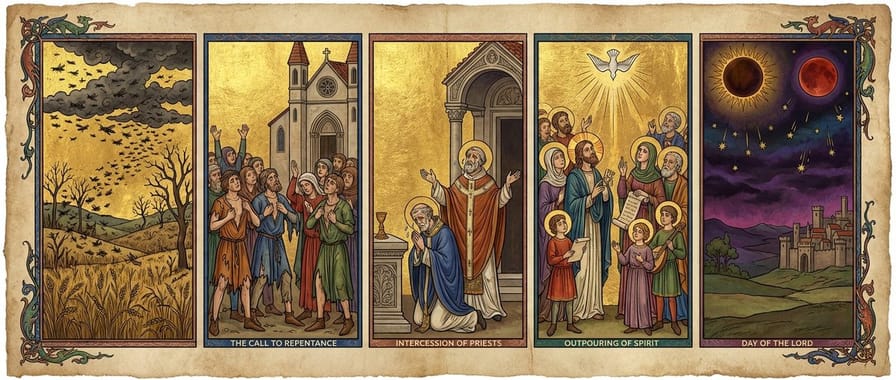
Illustration of the Book of Joel, one of the 39 books of the Old Testament (Nano Banana Pro).
This introduction aims to offer a comprehensive and theologically rich overview of the prophetic book of Joel, one of the twelve minor prophets of the Old Testament. Although relatively brief in length, Joel's message resonates with eschatological depth and pastoral urgency that make it indispensable for understanding God's redemptive plan. Adopting a conservative evangelical Protestant perspective, this analysis underscores the inerrancy and authority of Scripture, defending traditional positions of authorship and dating, and exploring the rich Christocentric connections that permeate the text. Our objective is to provide an analytical framework that can serve as a model for the study of any biblical book, balancing academic rigor with relevance for the life of the contemporary church.
Joel's message is particularly potent in its ability to transition between imminent calamity and future hope, between divine judgment and redemptive mercy. The prophet confronts his people with the reality of the Day of the Lord, a central theme that takes on multiple facets throughout the book: from a devastating locust plague to a final cosmic judgment. However, amidst the somber warnings, Joel presents a passionate call to genuine repentance and a glorious promise of the outpouring of the Holy Spirit, which finds its culminating fulfillment in the New Testament.
Throughout this introduction, we will delve into the complexities of Joel's historical context, his ingenious literary structure, the theological themes that define him, his canonical ramifications, and the hermeneutical challenges he presents. We believe that a diligent study of Joel not only illuminates crucial truths about the character of God and the history of salvation, but also equips the believer to live with hope and faithfulness in a world awaiting the consummation of Christ's kingdom. May this journey through the pages of Joel be fruitful for all those who seek to understand more deeply the inspired Word of God.
1. Historical Context, Dating, and Authorship
The book of Joel, one of the minor prophets, presents considerable challenges for dating and determining its precise historical context, which in turn impacts the understanding of its authorship and purpose. Modern higher criticism often attributes a late post-exilic date to Joel (5th or 4th century BC), based on arguments such as the absence of references to specific kings or world powers, the emphasis on the temple and worship, and the apparent allusion to diaspora events. However, a conservative evangelical perspective tends to advocate for an earlier dating, generally pre-exilic (9th century BC), or an early post-exilic date (6th century BC), arguing that this chronology aligns better with the internal evidence of the text and with the Jewish-Christian tradition.
1.1 Traditional Authorship and the Problem of Dating
The authorship of the book is attributed to Joel, son of Pethuel, as indicated in Joel 1:1. Although we know little about him beyond his name and his father's, tradition recognizes him as the author. The main difficulty lies in dating, which is crucial for situating Joel within the prophetic panorama of Israel. The lack of references to specific kings or clear historical events is one of the reasons for the uncertainty. However, this absence can be interpreted in several ways. For some, it suggests a period of relative stability or a deliberate focus on theology rather than politics. For others, such as proponents of the post-exilic date, it indicates a time when the monarchy was no longer a central institution and the focus was on the temple community.
The defense of a pre-exilic date, often placed in the 9th century BC, during the period of the Kingdom of Judah, perhaps during the reign of the young King Joash (835-796 BC), finds support in some internal arguments. Joel's language and style show similarities to prophets such as Amos and Hosea, who are unquestionably pre-exilic. Furthermore, the reference to the Phoenicians and Philistines in Joel 3:4-8 as enemies of Judah is more consistent with the pre-exilic period, when these nations were significant regional powers. The absence of mention of Assyria or Babylon, the great empires that would dominate the political scene in the 8th and 7th centuries BC, may also suggest a date prior to their rise.
1.2 The Historical Context of a Pre-Exilic Date
If Joel prophesied in the 9th century BC, during the reign of Joash, the context would have been a period of relative independence for Judah, but also of internal and external challenges. Joash ascended to the throne as a child, after a coup that deposed Queen Athaliah. Under the guardianship of the priest Jehoiada, there was a period of religious reform and temple restoration. However, after Jehoiada's death, Joash turned away, allowing idolatry and facing invasion from the Arameans (2 Kings 12; 2 Chronicles 24). In this scenario, the locust plague described by Joel could be interpreted as a call to repentance amidst a moment of moral and spiritual fragility, but before the great catastrophe of the exile.
In this context, Joel's emphasis on the temple and worship would not be indicative of a post-exilic period, but rather a reflection of the centrality of worship in Jerusalem at any time in Judah's history. The locust plague, which devastated the land and halted grain offerings and drink offerings, would have had a direct impact on temple worship and economy. The call to fasting and lamentation in the temple would be a natural response to such a severe calamity, seeking God's mercy through established rituals. The absence of mention of kings could be because Joel's prophetic focus was more on the people and their relationship with God, and less on court politics, or because King Joash was too young to play a prominent role in the prophetic message.
1.3 Responses to Higher Criticism
Higher critical arguments for a late post-exilic date are based primarily on language and supposed allusions to later events. It is argued that the mention of "nations" (Joel 3:2, 9) and the dispersion of God's people indicate a period after the Babylonian exile. However, these references can be interpreted as future prophecies, characteristic of prophetic literature, and not necessarily as descriptions of events that had already occurred. Furthermore, the "dispersion" can refer to small diasporas or migrations prior to the great exile.
The absence of "classical prophets" (such as Isaiah, Jeremiah, Ezekiel) in the book of Joel, as well as the absence of explicit mention of the Mosaic Law or covenants, are also cited. However, Joel's style is unique and does not need to conform to all patterns of other prophets. The emphasis on liturgy and worship is not exclusive to the post-exilic period; the temple and its practices were central to Judah's religious life since Solomon. The conservative evangelical view maintains that biblical inerrancy allows the book to be authentic and historically accurate, even if the exact details of its dating remain an object of academic debate. A pre-exilic date allows Joel to be one of the earliest prophets, with his prophecy of the Spirit being a remarkable foreshadowing of what would be fulfilled at Pentecost.
2. Structure, Division, and Main Content
The book of Joel, though relatively short, is a masterpiece of Hebrew prophetic literature, characterized by its powerful poetic language, vivid imagery, and carefully crafted structure. Its literary organization is predominantly poetic, employing parallelisms, metaphors, and hyperbole to convey its message of judgment and hope. The book's structure is generally divided into two main sections, each culminating in the manifestation of the Day of the Lord, a central theme that runs throughout the entire prophecy.
2.1 Literary Organization and Argumentative Flow
Joel employs an incipient prophetic-apocalyptic style, combining the description of a present calamity with the vision of an eschatological future. The book begins with a vivid and frightening description of a locust plague, which serves as a premonition or a type of the coming Day of the Lord. This plague is not merely a natural disaster, but a divine judgment that demands an immediate response of repentance. The argumentative flow moves from present devastation to an urgent call to penitence, and then to the promise of restoration and a final judgment of the nations. The language is rich in agricultural and military imagery, creating a sense of urgency and grandeur.
The book's structure can be seen as a chiasm or a symmetrical movement, where the present calamity (locusts) mirrors the future calamity (the Day of the Lord), and the call to repentance leads to the promise of salvation. The prophet not only describes, but also exhorts, laments, and proclaims. Joel's rhetoric is designed to awaken the people from their spiritual lethargy, confronting them with God's sovereignty over nature and history.
2.2 Main Divisions and a Synthetic Outline
The book of Joel can be divided into two main sections, each with its own subthemes:
- I. The Day of the Lord as Present Judgment and Call to Repentance (Joel 1:1-2:17)
- 1.1 The Locust Calamity (Joel 1:1-20):
Joel begins with a dramatic and hyperbolic description of an unprecedented locust plague that devastates the land of Judah. He calls upon the elders, the drunkards, and the priests to lament, for the land is desolate, the harvests destroyed, and offerings to the Lord have ceased. The plague is so severe that it is compared to an invading army and serves as a sign of the Day of the Lord.
- 1.2 An Army of Locusts and the Urgent Call to Repentance (Joel 2:1-17):
The description of the locusts continues, now with language that compares them to a powerful and invincible army, marching across the land. The prophet exhorts the people to blow the trumpet in Zion, to fast, weep, and lament, for the Day of the Lord is near and is terrible. The call to repentance is deep and genuine, not merely external, but from the heart: "Rend your heart and not your garments" (Joel 2:13). There is a hope that God, who is "gracious and merciful, slow to anger and abounding in steadfast love, and relents from disaster" (Joel 2:13), might turn away the judgment.
- 1.1 The Locust Calamity (Joel 1:1-20):
- II. The Day of the Lord as Future Restoration and Judgment of the Nations (Joel 2:18-3:21)
- 2.1 The Promise of Physical and Spiritual Restoration (Joel 2:18-27):
In response to the people's repentance (or the promise of repentance), God demonstrates His zeal for His land. He promises to remove the "army from the north" (the locusts or a symbolic military force), restore the lost harvests, and bless the land with abundance. More significantly, He promises to restore the relationship with His people, declaring: "Then you shall know that I am in the midst of Israel, and that I am the Lord your God and there is no other; and My people shall never again be put to shame" (Joel 2:27).
- 2.2 The Promise of the Outpouring of the Holy Spirit (Joel 2:28-32):
This is perhaps Joel's most famous section, where he prophesies the universal outpouring of the Holy Spirit upon "all flesh," including sons and daughters, old and young, male and female servants. This event will be accompanied by cosmic signs in heaven and on earth, culminating in the promise of salvation for "everyone who calls on the name of the Lord" (Joel 2:32). This prophecy clearly points to the messianic era and the outpouring of the Spirit at Pentecost.
- 2.3 The Judgment of the Nations and the Salvation of Zion (Joel 3:1-21):
The final section of the book describes the Day of the Lord as a day of eschatological judgment for the nations that oppressed Israel. God will gather the nations in the Valley of Jehoshaphat to judge them for their conduct against His people and His heritage. In contrast, Zion and Jerusalem will be holy and inhabited forever, blessed with rivers and springs. The book concludes with the affirmation of God's permanent presence in Zion: "The Lord dwells in Zion" (Joel 3:21).
- 2.1 The Promise of Physical and Spiritual Restoration (Joel 2:18-27):
The progression from imminent judgment to the promise of restoration and final judgment is a testament to God's sovereignty over history and His unwavering commitment to His people, both in discipline and in redemption. Joel, therefore, is not merely a prophet of doom, but a herald of eschatological hope.
3. Central Theological Themes and Purpose
The book of Joel, in its conciseness, condenses a rich tapestry of theological themes that are fundamental to biblical and systematic theology. From a Reformed perspective, these themes reveal God's unquestionable sovereignty, human depravity and its need for redemption, and the progressive nature of the divine plan of salvation. The primary purpose of the book is to call the people of Judah to genuine repentance in the face of imminent judgment (the locust plague) and a future eschatological judgment (the Day of the Lord), offering the hope of restoration and blessing through divine intervention.
3.1 The Day of the Lord: Judgment and Salvation
The concept of the Day of the Lord is Joel's central and unifying theme, appearing in Joel 1:15, 2:1, 2:11, 2:31, and 3:14. This is an eschatological day of divine intervention in history, which can signify both judgment and salvation. In Joel, it is multifaceted. Firstly, it is a day of present judgment, manifested in the devastating locust plague that afflicts Judah. This natural calamity is interpreted as a direct act of God, a premonition of a greater judgment to come. The plague is not merely a biological event, but a theological one, a call to divine attention. It is a vivid reminder of God's sovereignty over creation and His ability to use natural elements as instruments of His justice.
Secondly, the Day of the Lord is a day of future eschatological judgment upon the enemy nations of Israel (Joel 3). It is a day of divine retribution against those who oppressed God's people. Thirdly, and paradoxically, it is also a day of salvation and restoration for God's repentant people. Those who call on the name of the Lord will be saved (Joel 2:32). Thus, the Day of the Lord in Joel is a complex reality that encompasses both the manifestation of divine wrath against sin and the expression of His mercy and faithfulness toward those who turn to Him.
3.2 Repentance and Restoration: God's Sovereign Grace
The call to repentance is a prominent theme in Joel. In the face of calamity, the prophet not only describes the devastation but also exhorts the people to a deep and genuine response. The repentance Joel seeks is not a mere external ritual, but an inner transformation: "Rend your heart and not your garments, and turn to the Lord your God, for He is gracious and merciful, slow to anger and abounding in steadfast love, and relents from disaster" (Joel 2:13). This verse encapsulates the essence of Reformed theology on repentance: it is not a human merit, but a response to the grace of a God who is inherently merciful and ready to forgive.
The promise of restoration follows the call to repentance. God promises to reverse the desolation caused by the locusts, restoring the land's productivity and abundance of food (Joel 2:18-27). This physical restoration is a symbol and a guarantee of a deeper, spiritual restoration. God's faithfulness to His covenant is evident in His willingness to forgive and bless His people when they humble themselves and turn to Him. This theme underscores God's sovereign grace, which not only demands repentance but also enables it and rewards it with His goodness.
3.3 The Outpouring of the Holy Spirit: The Messianic Promise
One of Joel's most significant and prophetically rich themes is the promise of the outpouring of the Holy Spirit upon "all flesh" (Joel 2:28-32). This prophecy transcends the immediate calamity and points to a new era, the messianic era. The Spirit will be poured out on all types of people – sons and daughters, old and young, male and female servants – breaking down social and gender barriers. This indicates a democratization of access to God's presence and power, something unprecedented in the old covenant, where the Spirit was often granted to specific individuals for specific tasks.
Reformed theology views this promise as a pillar of pneumatology and eschatology. It anticipates the new covenant, where the Spirit would permanently indwell believers, enabling them to prophesy, have visions and dreams, and, fundamentally, to know God intimately. This prophecy finds its explicit fulfillment in Acts 2, on the day of Pentecost, when Peter quotes Joel to explain the miraculous events that were occurring. The outpouring of the Spirit is the guarantee of God's presence among His people and the seal of salvation for those who call on the name of the Lord.
3.4 God's Sovereignty Over Nature and History
In Joel, God's sovereignty is undeniable. He is the Lord who orchestrates the locust plague, a natural event, as an instrument of His judgment. He is the one who sends His "army" (Joel 2:11, 25), whether literal or metaphorical, to accomplish His purposes. He is the Lord who promises to remove judgment and restore the land. He is the one who controls the cosmic events that will precede the great and awesome Day of the Lord (Joel 2:30-31). And He is the one who will judge the nations and establish His kingdom in Zion (Joel 3).
This theme resonates deeply with Reformed theology, which emphasizes God's providence and sovereignty over all things, including evil and suffering. Nothing happens outside His control or purpose. Even calamities serve to draw the attention of His people and to manifest His justice. Joel's message, therefore, is a powerful reminder that God is not a passive observer of history, but the main actor who sovereignly governs the destinies of nations and His people.
4. Relevance and Canonical Connections
The book of Joel, despite its modest length, possesses immense canonical relevance, functioning as a bridge between immediate judgment and eschatological hope, and connecting the Old Testament promises with their fulfillments in the New. Its message, deeply rooted in the theology of the Day of the Lord, radiates to other prophetic books and finds its culmination in the person and work of Jesus Christ and the coming of the Holy Spirit. The conservative evangelical perspective values the coherence of the biblical canon, seeing Joel not as an isolated piece, but as an integral part of God's great redemptive plan.
4.1 Importance of the Book in the Canon and Prophetic Connections
Joel is part of "The Book of the Twelve" (the Minor Prophets), which, together, form a theological unit in the Hebrew canon. Its position in this group is strategic, often seen as one of the earliest prophets, or at least the one who sets a tone for the expectation of the Day of the Lord. His emphasis on imminent and future judgment, and on the call to repentance, is an echo and a preparation for the messages of later prophets such as Amos, Zephaniah, Isaiah, and Malachi, who also address the theme of the Day of the Lord with their own nuances.
Joel's language about the devastation of the land and the invasion of an "army" (whether of locusts or literal) finds parallels in other prophetic books that describe divine wrath and judgment. The description of cosmic signs (sun darkening, moon turning to blood) in Joel 2:30-31 is repeated in Isaiah, Ezekiel, and Zechariah, and will be taken up again by Jesus in the New Testament to describe the events preceding His second coming. This demonstrates the interconnection of prophecies and the consistency of the eschatological theme throughout Scripture. Joel, therefore, not only prepares the way for later prophets but also connects to a broader prophetic tradition that culminates in the full revelation of Christ.
4.2 Christocentric Typology and Fulfillment in Christ
A Christocentric reading of Joel is essential for an evangelical understanding of the book. Although Joel does not explicitly mention the Messiah, its themes and prophecies typologically point to Christ and the new covenant. The Day of the Lord, in its fullness, finds its ultimate fulfillment in the second coming of Christ, when He will come to judge the living and the dead and to establish His eternal kingdom. The judgment of the nations in the Valley of Jehoshaphat (Joel 3) prefigures Christ's final judgment over all nations.
Joel's call to repentance, which demands a transformation of the heart, is a direct precursor to the gospel of Christ. Jesus began His ministry by preaching: "Repent, for the kingdom of heaven is at hand" (Matthew 4:17). The promise of restoration of the land and abundance, though initially physical, points to the spiritual restoration and new creation that are achieved through Christ. Salvation for "everyone who calls on the name of the Lord" (Joel 2:32) is a universal truth that the New Testament directly applies to faith in Jesus Christ as Lord and Savior (Romans 10:9-13).
4.3 The Fulfillment of the Outpouring of the Spirit in Acts 2
Joel's most explicit and undeniable connection with the New Testament is found in Acts 2:16-21, where the apostle Peter directly quotes Joel 2:28-32 in his sermon on the Day of Pentecost. Jesus' disciples had just been filled with the Holy Spirit, speaking in other tongues, and the crowd was perplexed. Peter explains that this extraordinary event was not the result of drunkenness, but the literal fulfillment of Joel's prophecy: "But this is what was uttered through the prophet Joel: 'And in the last days it shall be, God declares, that I will pour out My Spirit on all flesh'" (Acts 2:16-17).
This fulfillment is of utmost theological importance. It marks the beginning of the church age, the new covenant, where the Holy Spirit is poured out on all believers, regardless of their origin, age, or social status. Joel's prophecy, which seemed so distant and grand, became a tangible and transformative reality. The outpouring of the Spirit at Pentecost was not merely a historical event, but the beginning of a new dispensation, where believers are empowered to live a life of witness and service, awaiting the final consummation of the Day of the Lord.
4.4 Relevance for the Contemporary Church
For the contemporary church, Joel offers multiple lessons. Firstly, it reminds us of God's sovereignty over all circumstances, including calamities and crises. It calls us to recognize God's hand even in seemingly secular events and to respond with humility and repentance. In a world that often seeks human solutions for spiritual problems, Joel directs us back to God as the sole source of hope and restoration.
Secondly, Joel's call to genuine repentance remains a vital message. The church is reminded that true faith requires a transformation of the heart, not just external rituals. Thirdly, Joel nourishes the eschatological hope of the church. We know that the Day of the Lord will yet come in its fullness, with the return of Christ to judge and reign. This expectation should propel the church to holiness, vigilance, and evangelistic urgency, for salvation is offered to "everyone who calls on the name of the Lord." Finally, the book of Joel is a reminder of the power and continuous presence of the Holy Spirit in the life of the church, empowering it for its mission in the world.
5. Hermeneutical Challenges and Critical Issues
The interpretation of the book of Joel presents several hermeneutical challenges and has been the subject of various critical issues throughout the history of biblical exegesis. A conservative evangelical approach seeks to navigate these difficulties with faithfulness to the inerrancy and authority of Scripture, applying solid hermeneutical principles that respect the literary genre, the historical-grammatical context, and the Christocentric nature of the entire Bible. Addressing these critical questions is fundamental for a robust understanding of Joel's message.
5.1 The Nature of the Locust Plague: Literal or Metaphorical?
One of the first and most persistent hermeneutical questions in Joel concerns the nature of the locust plague described in Joel 1 and 2. Is it a literal plague of insects that devastated the land of Judah, or is it a metaphor for a military invasion, perhaps the Babylonian or Assyrian army, or even an eschatological army? The vivid and detailed description of the locusts, their voracity, and their impact on the economy and religious life (Joel 1:4-12, 16-17) suggests a literal and historical locust plague. The mention of different stages of locusts (gnawing locust, swarming locust, hopping locust, destroying locust) reinforces this literal interpretation.
However, the military language employed in Joel 2:1-11, where the locusts are described as a "numerous and mighty people," "like warriors," "running upon the wall," and "like men of war," has led some to interpret the plague as a metaphor for a human army. The conservative evangelical perspective tends to view the plague as a literal locust event, a real historical calamity, but with typological and prophetic implications. That is, the literal plague serves as a foreshadowing, a "type" of the coming Day of the Lord, which will involve even greater judgments and perhaps military invasions. The literal description of the plague amplifies the impact of divine judgment and the urgency of the call to repentance.
5.2 The Identity of the "Northern Army" and the Dating of the Book
Another interpretive difficulty is in Joel 2:20, where God promises to remove the "army from the north." If the locusts are literal, the "army from the north" could be a reference to them, since locust plagues often come from the north, or it could be a reference to a real military force that would come from the north (Assyria, Babylon, or an eschatological enemy). The ambiguity here contributes to the debate about the book's dating. If it is a reference to a human army, this could support a post-exilic date, where Babylon or other northern enemies would have been a threat.
However, if the locust plague is literal, the "army from the north" may simply be a poetic description of the plague's origin. North winds are known to bring clouds of locusts to the region. A conservative approach acknowledges the ambiguity but generally prefers the interpretation that aligns with the preferred dating (pre-exilic or early post-exilic). The flexibility of prophetic language allows this reference to have multiple levels of meaning: the literal (locusts from the north) and the typological (invading armies from the north serving as divine judgment).
5.3 Interpretation of the Day of the Lord: Premillennialism and Postmillennialism
The Day of the Lord in Joel, with its descriptions of judgment and restoration, raises significant eschatological questions, especially concerning the different views of the millennium (premillennialism, postmillennialism, amillennialism). The descriptions of cosmic signs (sun and moon darkened, Joel 2:30-31) and the judgment of the nations in the Valley of Jehoshaphat (Joel 3:2, 12) are often interpreted in distinct ways by each eschatological school. Premillennialism, for instance, tends to interpret these events more literally as occurring before Christ's millennial reign on earth. Amillennialism and postmillennialism tend to see more symbolism or fulfillment in historical events and in the church age.
The conservative evangelical perspective, while possibly having internal nuances regarding the millennium, generally agrees that Joel's Day of the Lord has a future and universal eschatological dimension. Peter's quotation in Acts 2 demonstrates that part of Joel's prophecy has already been fulfilled (the outpouring of the Spirit), but the cosmic signs and the judgment of the nations still point to a future fulfillment, associated with the second coming of Christ. Hermeneutical principles should emphasize that prophecy can have multiple fulfillments (immediate, partial, final) and that apocalyptic and poetic language must be interpreted with sensitivity to its genre.
5.4 Hermeneutical Principles for Correct Interpretation
To address the hermeneutical challenges in Joel, a faithful evangelical approach must employ the following principles:
- Grammatical-historical interpretation: Understanding the text in its original historical, cultural, and linguistic context. This includes analyzing Hebrew grammar, vocabulary, and literary genre (poetic prophecy).
- Canonical interpretation: Reading Joel in light of all Scripture, recognizing how it fits into God's redemptive plan and how it is interpreted by other biblical authors, especially in the New Testament (as in Acts 2).
- Christocentric interpretation: Seeking the typological and prophetic connections with Christ. Even if Joel does not directly mention Christ, its themes (judgment, repentance, restoration, the Spirit) are precursors to Christ's work and the gospel.
- Recognition of biblical inerrancy and authority: Approaching the text with the presupposition that it is the inspired Word of God, true and trustworthy in all that it affirms. This means defending traditional positions when there is reasonable internal and external evidence, and addressing skeptical criticisms with solid theological and exegetical arguments.
- Sensitivity to prophetic genre: Recognizing that prophetic language frequently uses hyperbole, metaphor, and symbolism to convey spiritual truths. Interpretation must discern when language is literal and when it is figurative, without, however, excessively spiritualizing the text to the point of denying its historical or future meaning.
By applying these principles, the church can faithfully extract Joel's rich message, understanding its original meaning and its continuing relevance for the life and mission of believers today. Joel is a book that reminds us of the seriousness of sin, the justice of God, the urgency of repentance, and the glorious hope we have in the outpouring of the Spirit and the final coming of our Lord Jesus Christ.